
Data Center Decommissioning: The Ultimate Stress-Free Guide
Master the data center decommissioning process with this comprehensive guide covering planning, execution, and best practices for success.

Introduction
Key Takeaways
- Data center decommissioning is a complex process requiring meticulous planning to ensure secure data destruction, responsible asset removal, and regulatory compliance
- Improper decommissioning exposes organizations to data breaches, regulatory penalties, and unnecessary costs
- A structured operational playbook transforms potential chaos into orchestrated efficiency
- Success depends on rigorous adherence to standards, comprehensive documentation, and expert execution
- Enterprise IT leaders need a clear roadmap to navigate the intricate phases of decommissioning
Data center decommissioning represents one of the most critical yet challenging undertakings in enterprise IT management. Whether you're consolidating facilities, migrating to cloud infrastructure, or retiring outdated equipment, the stakes couldn't be higher. A single misstep can expose your organization to devastating data breaches, steep regulatory penalties, and spiraling costs that far exceed the original project budget.
As the lead editorial voice at Compare ITAD, I've explored countless aspects of IT asset management, but nothing quite compares to the intricate precision required in data center decommissioning. The process feels like orchestrating the careful dismantling of a digital city—every wire, every server, every byte of data must be accounted for with absolute transparency and security.
The complexity stems from multiple converging challenges. You're not simply powering down servers and hauling away equipment. You're navigating network dependencies, managing active directory cleanup, ensuring complete data destruction that meets rigorous standards, maintaining chain-of-custody documentation, and coordinating logistics across multiple teams and vendors. Each phase demands specialized expertise and flawless execution.
For enterprise IT leaders, the question isn't whether decommissioning is difficult—it's how to approach it systematically. Without a structured operational playbook, even experienced teams can find themselves overwhelmed by the sheer scope of requirements. The good news is that with proper planning, clear protocols, and the right framework, you can transform what seems like an insurmountable challenge into a manageable, repeatable process.
This guide provides that framework. We'll walk through the essential phases of data center decommissioning, from initial planning through final closeout, equipping you with the knowledge to execute confidently and compliantly. Whether you're leading your first decommissioning project or refining your existing approach, you'll find actionable strategies to ensure nothing falls through the cracks.
Sources
Discover the data center decommissioning process with this operational playbook covering essential planning and execution phases.
Focus keyword: data center decomissioningTone: professional
Table of Contents
- Introduction — Introduce the significance of data center decommissioning and its complexities, highlighting the importance of a structured operational playbook for IT leaders.
- Table of Contents
- Understanding Data Center Decommissioning — Explain what data center decommissioning entails and why it is critical for enterprise IT leaders.
- The Nine Phases of Decommissioning — Detail the nine essential phases of data center decommissioning, emphasizing planning, execution, and closeout.
- Pre-Project Planning — Discuss the importance of thorough pre-project planning for a successful decommissioning process.
- Execution Strategies — Explore effective strategies for executing the decommissioning process, including network and Active Directory cleanup.
- Data Destruction Best Practices — Outline best practices for secure data destruction during the decommissioning process to ensure compliance and security.
- Closeout and Reporting — Describe the closeout phase and the importance of reporting and accountability in the decommissioning process.
- Conclusion — Summarize the importance of a structured approach to data center decommissioning and encourage IT leaders to follow the outlined playbook.
9 sections
Understanding Data Center Decommissioning
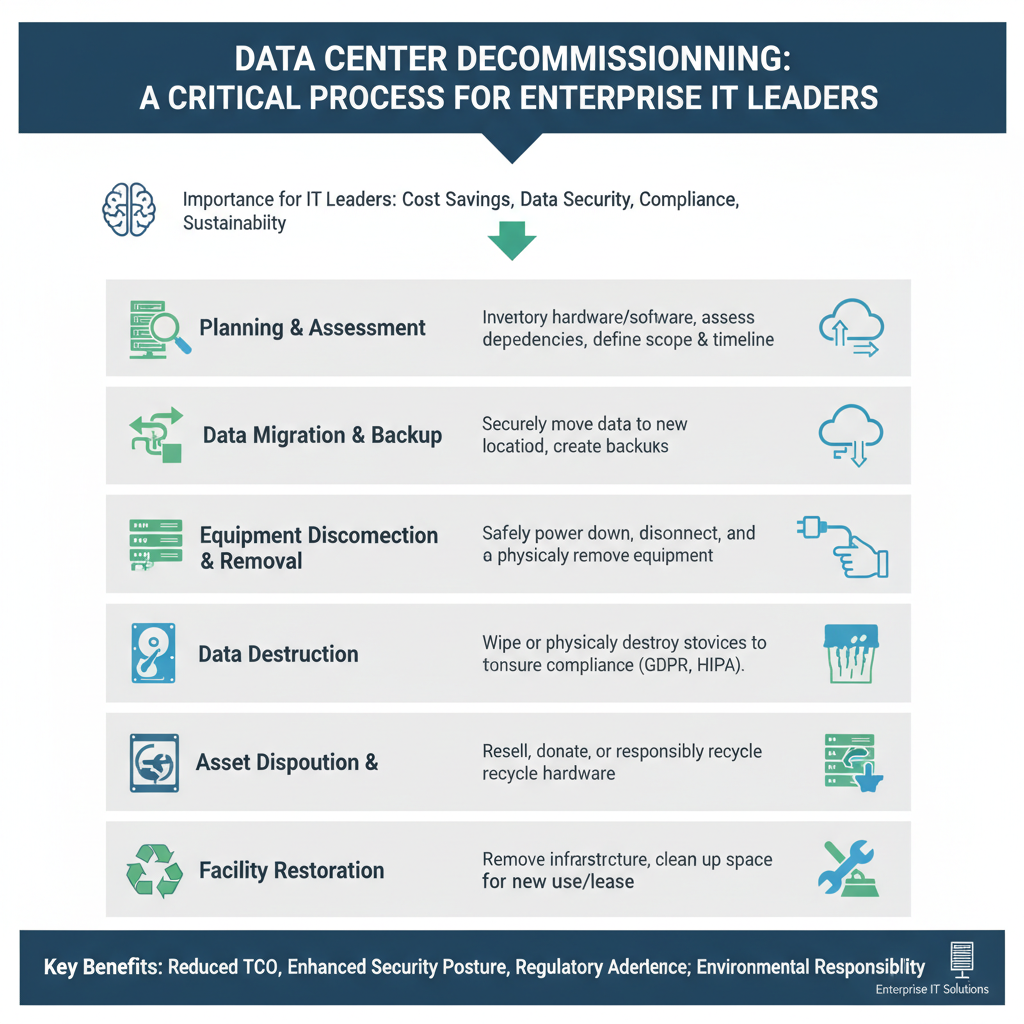
Data center decommissioning is the systematic process of retiring and removing IT infrastructure when facilities are no longer needed. This controlled shutdown involves more than simply unplugging servers—it requires meticulous planning, secure data destruction, and compliant asset removal to protect your organization from operational, financial, and legal risks.
For enterprise IT leaders, understanding this process is critical. A data center decommissioning project encompasses the complete removal of servers, storage arrays, network equipment, power distribution units, cooling systems, and cabling infrastructure. Each component must be handled with precision to maintain compliance standards and recover maximum value from retired assets.
Why Data Center Decommissioning Matters
The stakes in decommissioning are substantial. Organizations face significant exposure if sensitive data isn't properly destroyed or if assets are removed without proper documentation. Regulatory compliance requirements demand verifiable proof that information has been securely erased, making certificates and audit trails non-negotiable elements of any decommissioning strategy.
Beyond compliance, financial considerations play a crucial role. Properly executed decommissioning recovers residual value from hardware through remarketing or recycling, offsetting project costs. Conversely, rushed or poorly planned shutdowns can result in asset loss, environmental penalties, and security breaches that far exceed the cost of doing it right.
The Strategic Imperative
Data center decommissioning requires a strategic approach that balances speed with thoroughness. IT leaders must coordinate across multiple teams—network operations, security, facilities, and finance—to ensure every asset is accounted for and every data storage device is sanitized according to industry standards.
The complexity increases when dealing with interconnected systems. Network and directory cleanup must occur without disrupting ongoing operations in other facilities. This orchestration demands detailed planning phases that map dependencies, establish timelines, and define clear accountability for each workstream.
Successful decommissioning transforms what could be a chaotic shutdown into an orchestrated transition. With the right operational framework, enterprise IT leaders can execute these projects confidently, knowing that security, compliance, and financial objectives are all being met simultaneously.
Sources
The Nine Phases of Decommissioning
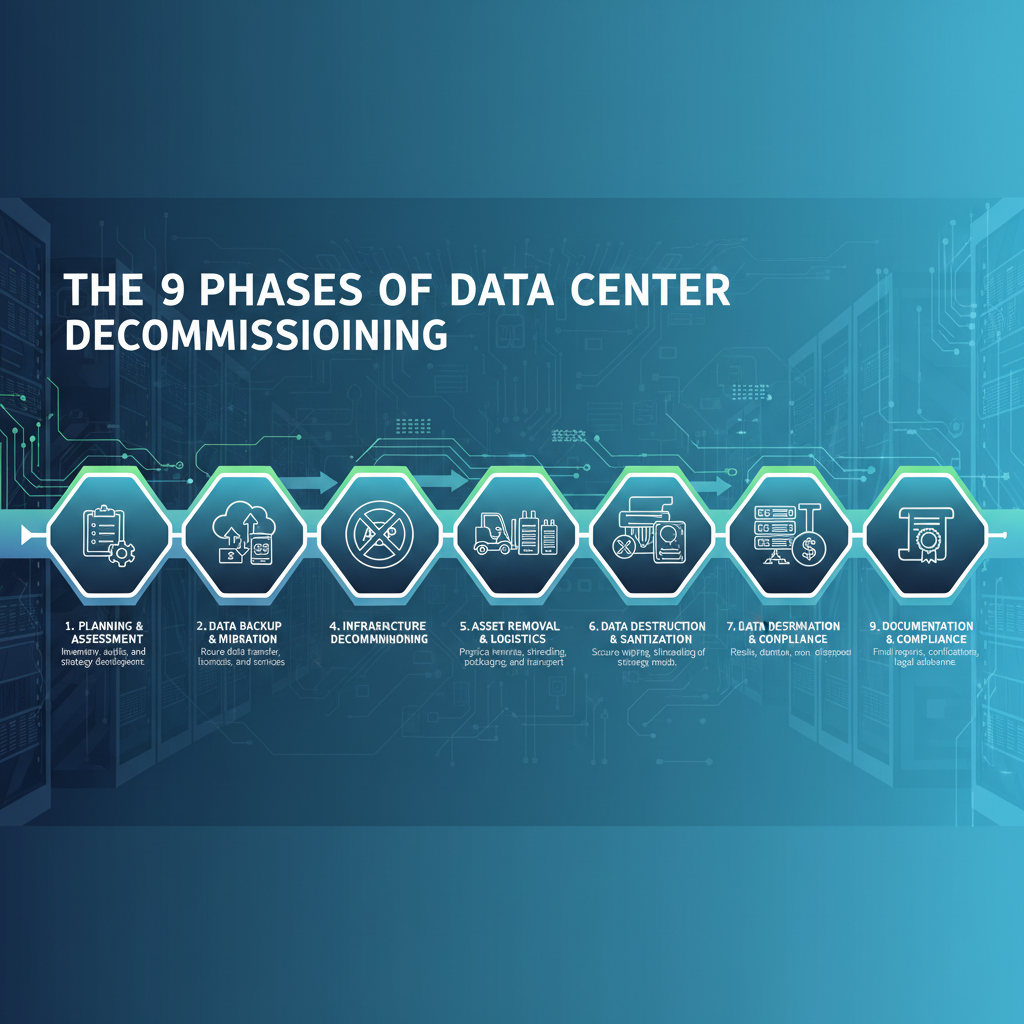
Successful data center decommissioning follows a structured approach that breaks the complex process into manageable phases. Understanding these phases helps enterprise IT leaders anticipate resource needs, allocate budgets effectively, and coordinate cross-functional teams. The typical timeline spans three to six months from initial planning to final site clearance, though this varies significantly based on facility size and complexity.
Small data centers may complete decommissioning in four to eight weeks, while large facilities often require six to twelve months for thorough execution. Each phase builds upon the previous one, creating a comprehensive framework that addresses technical, security, financial, and operational requirements.
Phase 1: Initial Assessment and Scope Definition
The decommissioning journey begins with a thorough assessment of the existing infrastructure. This phase involves cataloging all hardware assets, identifying data storage locations, and mapping network dependencies. IT leaders must document the current state of operations, including active workloads, interconnections, and critical systems that require special handling.
Stakeholder alignment is crucial during this phase. Finance teams need cost projections, security teams require data protection protocols, and operations teams must understand timeline impacts. The scope definition establishes clear boundaries for the project and identifies any assets or systems excluded from decommissioning.
Phase 2: Risk Analysis and Mitigation Planning
Once the scope is clear, teams conduct comprehensive risk assessments to identify potential disruptions. This includes evaluating data breach risks, service continuity threats, and compliance vulnerabilities. Organizations must consider both technical risks—such as accidental data exposure—and business risks like revenue impact from service interruptions.
Mitigation strategies developed during this phase become the safety net for the entire project. These may include backup systems, phased shutdown approaches, and contingency plans for unexpected complications. Documentation of risk mitigation measures also serves as evidence of due diligence for regulatory and audit purposes.
Phase 3: Detailed Project Planning
With risks identified, teams develop detailed execution plans that specify timelines, resource allocations, and task dependencies. This phase produces the master project schedule that coordinates activities across multiple teams and vendors. Detailed planning addresses logistics such as equipment removal schedules, data migration windows, and facility access requirements.
Budget finalization occurs during this phase, incorporating costs for labor, transportation, data destruction services, and potential asset recovery revenue. Organizations that invest time in thorough planning typically experience smoother execution phases with fewer costly surprises.
Phase 4: Data Migration and Backup Verification
Before any physical decommissioning begins, all critical data must be migrated to new locations or securely backed up. This phase involves transferring workloads to cloud environments, alternate data centers, or upgraded infrastructure. IT teams conduct extensive testing to verify that migrated systems function correctly and that no data loss has occurred.
Backup verification is non-negotiable. Teams must confirm that all backups are complete, accessible, and restorable before proceeding with hardware decommissioning. This phase often reveals unexpected data repositories or shadow IT systems that require special handling.
Phase 5: Network and Infrastructure Shutdown
With data safely migrated, teams begin the systematic shutdown of network infrastructure and supporting systems. This includes deactivating network connections, powering down servers in a controlled sequence, and disconnecting storage arrays. The shutdown process follows a carefully orchestrated plan that prevents cascading failures or unintended impacts on connected systems.
Cooling, power, and environmental systems remain operational during this phase to protect equipment until physical removal. Documentation of shutdown procedures ensures that teams can reference the process for future projects or troubleshooting needs.
Phase 6: Physical Asset Removal
Physical decommissioning involves the systematic removal of all IT equipment from the facility. Teams disconnect servers, storage devices, networking equipment, and supporting infrastructure following documented procedures. Each asset is tagged, inventoried, and tracked through chain-of-custody protocols that maintain accountability throughout the removal process.
Logistics coordination becomes critical during this phase. Organizations must arrange transportation, coordinate loading dock access, and ensure that removal activities don't disrupt other facility operations. Proper handling prevents equipment damage that could compromise data security or reduce potential resale value.
Phase 7: Data Destruction and Certification
Secure data destruction represents one of the most critical phases of decommissioning. All storage media undergoes sanitization following industry standards to ensure that sensitive information cannot be recovered. Organizations must choose appropriate destruction methods based on data classification levels and compliance requirements.
Certification documentation provides auditable proof that data destruction met required standards. These certificates become essential components of compliance records and demonstrate due diligence in protecting sensitive information. The thoroughness of this phase directly impacts an organization's risk exposure and regulatory standing.
Phase 8: Asset Disposition and Value Recovery
Following data destruction, organizations determine the optimal disposition path for each asset. Equipment may be remarketed for resale, recycled for raw materials, or disposed of through environmentally responsible channels. Strategic asset disposition can generate significant value recovery—some organizations have generated substantial revenue from decommissioned equipment.
The disposition phase requires careful vendor selection to ensure that partners maintain security standards, provide transparent reporting, and maximize financial returns. Environmental compliance remains paramount, with proper handling of hazardous materials and adherence to e-waste regulations.
Phase 9: Final Documentation and Closeout
The final phase involves comprehensive documentation of all decommissioning activities, financial reconciliation, and formal project closure. Teams compile certificates of data destruction, asset disposition reports, environmental compliance documentation, and financial statements that account for all costs and recovered value.
Lessons learned sessions capture insights that improve future decommissioning projects. Organizations document what worked well, what challenges emerged, and what processes need refinement. This institutional knowledge becomes invaluable for subsequent initiatives and helps build organizational competency in decommissioning operations.
Sources
Pre-Project Planning
Thorough pre-project planning is the foundation of any successful data center decommissioning initiative. Without a clear roadmap, organizations risk increased costs, extended downtime, and potential compliance failures. The planning phase sets the stage for every subsequent action, from asset inventory to final closeout.
Building a Comprehensive Decommissioning Plan
A strong decommissioning plan must address several critical components to ensure nothing falls through the cracks. Start by defining the project scope with precision—identify which systems, equipment, and infrastructure will be affected. Next, conduct a complete asset inventory that captures every piece of hardware, from servers and storage arrays to networking equipment and peripheral devices.
Your disposition strategy should outline how each asset category will be handled, whether through resale, recycling, donation, or destruction. This decision impacts both your budget and your environmental footprint, so align it with organizational sustainability goals and financial objectives.
Creating Detailed Shutdown Runbooks
One of the most valuable planning artifacts is the shutdown runbook. This document prevents surprises during execution by mapping out dependencies, establishing the proper shutdown sequence, and defining verification checkpoints. Include detailed steps for each system, noting which applications or services must be terminated first to avoid cascading failures.
Document the relationships between systems—understanding that shutting down Server A before Server B could disrupt critical processes. Your runbook should also specify who is responsible for each task and what success criteria must be met before proceeding to the next step.
Ensuring Site Readiness and Tracking
Before execution begins, verify that your facility is prepared for the physical work ahead. Assess access points, loading dock availability, elevator capacity, and any special equipment needs like lifts or dollies. Coordinate with building management to reserve necessary resources and ensure your team has appropriate clearances.
Establish a tracking system that will follow every asset from removal through final disposition. This audit trail is essential for compliance reporting, financial reconciliation, and demonstrating chain-of-custody for data-bearing devices. Your tracking methodology should capture serial numbers, asset tags, disposition methods, and certificates of destruction or recycling.
Sources
Execution Strategies

The execution phase transforms your carefully crafted decommissioning plan into reality. This is where preparation meets action, and where the complexity of data center operations becomes most apparent. Success during execution depends on coordinated effort, clear communication, and unwavering attention to security protocols.
Coordinating the Physical Removal Process
Physical asset removal requires meticulous coordination across multiple teams. Begin by establishing a clear removal sequence that minimizes disruption and maintains safety standards. Each asset should be properly labeled, tracked, and documented as it moves through the decommissioning pipeline.
Maintaining a secure chain of custody is crucial throughout this process. Track each asset from the moment of removal to final disposal, using tamper-evident seals and secure packaging to ensure nothing is compromised along the way. This level of accountability protects your organization from potential security breaches and provides the audit trail necessary for compliance.
Network and Active Directory Cleanup
Network infrastructure and Active Directory cleanup represent some of the most technically demanding aspects of execution. Before any physical hardware is removed, you must systematically decommission network connections, remove DNS entries, and clean up Active Directory objects. This prevents orphaned connections and ensures that decommissioned systems don't leave security vulnerabilities in your remaining infrastructure.
Start by documenting all network dependencies and Active Directory relationships. Work methodically through each layer, verifying that decommissioning one component won't inadvertently impact systems that remain operational. This careful approach prevents the cascading failures that can turn a controlled decommissioning into an emergency situation.
Maintaining Security Throughout Execution
Security cannot be an afterthought during the execution phase. Every step must incorporate security controls that protect sensitive data and maintain the confidentiality of your business information. The decommissioning process should include certified secure data destruction, transparent governance, and end-to-end traceability to ensure compliance and protect sensitive information.
Implement access controls that limit who can interact with decommissioned equipment. Ensure that all personnel involved in the physical removal process understand their security responsibilities. Regular security checkpoints throughout the execution phase help catch potential issues before they become serious problems.
Quality Assurance and Verification
Built-in quality assurance checkpoints ensure that execution stays on track. Verify each completed task against your project plan, and document any deviations immediately. This real-time verification prevents small oversights from compounding into major issues.
Establish clear sign-off procedures for each phase of execution. Before moving to the next stage, confirm that all requirements have been met and that documentation is complete. This structured approach creates natural pause points where teams can assess progress and adjust strategies if needed.
Sources
Data Destruction Best Practices
Secure data destruction stands as one of the most critical phases in any data center decommissioning project. Retired hardware often contains sensitive information, and without certified sanitization or destruction, organizations risk major data breaches and compliance failures. The stakes are high—customer data, intellectual property, financial records, and proprietary systems all require complete and verifiable elimination.
Certified Data Destruction Methods
Three primary methods dominate the secure data destruction landscape: data wiping, degaussing, and physical hardware shredding. Data wiping uses specialized software to overwrite storage media multiple times, rendering previous data unrecoverable. Degaussing applies powerful magnetic fields to erase data from magnetic media like hard drives and tapes. Physical shredding mechanically destroys devices into small fragments, ensuring no data can ever be reconstructed.
Each method serves different asset types and security requirements. Solid-state drives often require different approaches than traditional spinning disks. Your decommissioning partner should provide detailed documentation of which method was applied to each asset class, creating an audit trail that satisfies both internal policies and regulatory frameworks.
Chain-of-Custody and Compliance Protocols
Maintaining a documented chain of custody from the moment hardware leaves your racks until final destruction certificates are issued is non-negotiable. Every asset should be tracked through bar codes or serial numbers, with multiple verification checkpoints throughout the process. This level of accountability protects your organization from liability and demonstrates due diligence to auditors.
Engage experts early and work with experienced decommissioning partners who understand compliance, chain-of-custody protocols, and technical teardown processes. These specialists bring proven methodologies that align with industry standards and can customize approaches to meet your specific regulatory requirements, whether you're subject to HIPAA, GDPR, SOX, or other frameworks.
Verification and Certification
Once data destruction is complete, certification becomes your proof of compliance. Certificates of destruction should include detailed asset inventories, serial numbers, destruction methods used, dates of service, and the facility where destruction occurred. These documents serve as legal protection and audit evidence for years to come.
Never accept vague or generic destruction certificates. Insist on granular reporting that maps directly to your asset inventory. The best decommissioning partners provide both digital and physical certificates, often with photographic evidence of the destruction process itself. This level of transparency ensures you can confidently report to stakeholders that all data has been permanently and securely eliminated.
Sources
Closeout and Reporting
The closeout phase represents the final checkpoint in your data center decommissioning journey—where meticulous documentation transforms weeks or months of work into verifiable, auditable proof of success. This isn't simply about ticking boxes; it's about establishing a comprehensive audit trail that demonstrates compliance, accountability, and value recovery to stakeholders across finance, security, and operations.
Proper closeout documentation serves multiple critical functions. It provides legal protection by proving adherence to data destruction standards and environmental regulations. It enables financial reconciliation by tracking every asset from removal through final disposition. And it creates institutional knowledge that informs future decommissioning projects, helping your organization refine processes and avoid repeating mistakes.
Essential Closeout Documentation
A complete closeout package should include several key components. Asset inventories must detail every piece of equipment processed, including serial numbers, make, model, and final disposition status. Data destruction certificates verify that all data-bearing assets were sanitized or destroyed according to established standards, with clear chain-of-custody documentation.
Financial reports reconcile all costs against the original budget while documenting any value recovered through asset resale or recycling. Environmental compliance records demonstrate proper handling of hazardous materials and adherence to e-waste regulations. Finally, incident reports capture any deviations from the plan, security events, or operational challenges encountered during execution.
The Reporting Framework
Effective reporting requires structured information flow throughout the project lifecycle, not just at the end. Establish regular checkpoint reports during execution that track progress against milestones, flag emerging risks, and document decisions made in response to unforeseen circumstances.
Your final comprehensive report should provide both executive-level summaries and detailed technical appendices. Executives need high-level metrics: total assets processed, percentage of budget utilized, timeline adherence, and value recovered. Technical stakeholders require granular details about data destruction methods, asset-level disposition records, and compliance verification.
Certificates and Compliance Validation
Certificates serve as your proof of due diligence. Data destruction certificates should reference specific industry standards—whether NIST guidelines, DoD specifications, or other applicable frameworks—and include details about the destruction method used for each asset category. These documents become critical if your organization faces regulatory audits or legal discovery requests.
Environmental certificates demonstrate proper recycling and disposal of equipment components, particularly for items containing hazardous materials. Chain-of-custody documentation proves continuous accountability from the moment assets left your facility until final disposition, eliminating gaps that could raise compliance concerns.
Building Accountability Into the Process
Accountability begins long before closeout, but the final reporting phase makes it visible and verifiable. Implement multi-party sign-offs at critical junctures: when assets leave the facility, when data destruction is completed, and when final disposition occurs. Digital tracking systems with photographic evidence and GPS verification add additional layers of accountability that traditional paper trails cannot match.
Consider the example of organizations that have successfully completed large-scale decommissioning programs involving tens of thousands of data-bearing assets and hundreds of equipment racks. The key to their success lies in structured end-to-end programs with rigorous documentation at every phase, ensuring nothing falls through the cracks during the transition.
Lessons Learned and Continuous Improvement
The closeout phase offers a valuable opportunity to capture institutional knowledge. Conduct post-project reviews with all stakeholders to identify what worked well and what could be improved. Document unexpected challenges and the solutions that resolved them. This information becomes invaluable when planning future decommissioning projects, allowing your organization to build expertise and efficiency over time.
By the closeout phase, when each piece of hardware has been accounted for and every report double-checked, you can fully appreciate the breadth of expertise required to successfully execute a decommissioning project. Comprehensive reporting and accountability measures transform what could be a chaotic process into a well-documented, defensible operation that protects your organization while maximizing value recovery.
Sources
Conclusion
Data center decommissioning is far more than simply powering down equipment and walking away. As we've explored throughout this guide, it's a complex, multi-phase process that demands careful planning, precise execution, and unwavering attention to security and compliance. Organizations that approach decommissioning without a structured methodology expose themselves to significant risks—from data breaches and regulatory penalties to unnecessary costs and operational disruptions.
The nine-phase framework outlined in this playbook provides IT leaders with a clear roadmap for navigating the decommissioning journey. From initial planning and assessment through data destruction, asset removal, and final reporting, each phase builds upon the last to ensure nothing falls through the cracks. The key is recognizing that successful decommissioning isn't about speed—it's about thoroughness, accountability, and maintaining control at every step.
The Value of Preparation
The most successful decommissioning projects share a common trait: extensive preparation. Organizations that invest time in the planning phase—conducting thorough inventories, mapping dependencies, and establishing clear protocols—consistently experience smoother execution and fewer surprises. This preparation transforms what could be a chaotic undertaking into an orchestrated process where each team member understands their role and responsibilities.
Data security must remain paramount throughout the entire process. Whether you're implementing NIST 800-88 guidelines for data sanitization or ensuring chain-of-custody documentation for every asset, these security measures protect your organization from the potentially devastating consequences of improper handling. The certificates and reports generated during decommissioning aren't mere paperwork—they're proof of due diligence and compliance that may prove invaluable in audits or legal proceedings.
Moving Forward with Confidence
For enterprise IT leaders facing an upcoming decommissioning project, the path forward is clear: embrace a structured, methodical approach that prioritizes security, compliance, and accountability. Assemble a cross-functional team that brings together IT operations, security, facilities management, and vendor partners. Establish clear timelines and milestones, but build in flexibility for the unexpected challenges that inevitably arise.
By the closeout phase, as each piece of hardware is accounted for and every report double-checked, you'll fully appreciate the breadth of expertise required to successfully execute such a decommissioning project. Remember that while the process can be daunting, with the right operational playbook and commitment to best practices, it's entirely manageable. The investment you make in doing it right the first time will pay dividends in risk mitigation, cost control, and peace of mind.
The data center decommissioning process doesn't have to be a source of stress. With the framework and strategies presented in this guide, you have the tools to approach your next project with confidence, knowing that you're following industry best practices every step of the way.