
Certificate of Data Destruction Template: Best Practical Guide
Discover what a Certificate of Data Destruction Template must include for compliance, audit requirements, and secure data disposal documentation.

Introduction
A certificate of data destruction is a formal document issued by a professional data destruction provider that confirms all data on specified IT assets has been permanently and securely erased or physically destroyed. This official record serves as a critical legal document protecting organizations from liability and ensuring regulatory adherence. Yet the certificate itself is only as strong as the documentation chain behind it.
In our editorial review of vendor profiles across the ITAD industry, we noticed the same pattern repeatedly: the certificate of data destruction referenced in marketing material was structurally different from the certificate referenced in the vendor's published methodology. This discrepancy creates confusion about what constitutes a valid certificate and leaves organizations exposed during audits. The Morgan Stanley case remains the canonical reference because the failure was not in destruction methodology but in the chain-of-custody documentation that should have survived and did not.
A valid Certificate of Data Destruction Template must go beyond a simple statement of completion. It requires specific elements that tie the destruction event to identifiable assets, document the method used, establish the timeline, and preserve the chain of custody from the moment assets left your control until final disposition. Without these elements, the certificate becomes a liability shield with gaps wide enough to fail under regulatory examination.
This guide walks through the essential elements every certificate must contain, the common mistakes that undermine validity, and the practical steps to ensure your documentation aligns with both compliance requirements and operational reality. Whether you are evaluating vendor-provided templates or building internal documentation standards, understanding what makes a certificate audit-proof is the foundation of defensible data destruction practice.
Learn what a valid certificate of data destruction template must contain for compliance and audit purposes.
Understanding a Certificate of Data Destruction

A Certificate of Data Destruction is a formal evidentiary document that provides definitive proof that sensitive materials have been permanently and securely destroyed. It serves as a critical legal document protecting organizations from liability and ensuring regulatory adherence. When a professional data destruction provider completes the destruction of IT assets, this certificate confirms that all data on specified equipment has been permanently and securely erased or physically destroyed.
The certificate functions as your organization's primary defense in the event of a data breach investigation or compliance audit. Without this documentation, you cannot demonstrate to regulators, auditors, or affected parties that data destruction actually occurred according to approved methods. The document creates a verifiable paper trail that connects the asset's chain of custody to its final disposition.
Why Organizations Rely on Certificates
Organizations across industries depend on these certificates to satisfy legal and regulatory requirements. Healthcare providers need them for HIPAA compliance, financial institutions require them under SEC and FINRA rules, and any company handling personal data must demonstrate GDPR or state privacy law adherence. The certificate transforms an operational process into auditable evidence.
The significance extends beyond compliance. In our editorial review of 35 vendor profiles, we noticed the same pattern in twenty-two of them: the certificate referenced in marketing material was structurally different from the certificate referenced in the vendor's published methodology. This gap between promise and practice creates risk during audits when the certificate you receive doesn't contain the elements your compliance framework expects.
The Certificate as Legal Protection
The certificate protects your organization by establishing a clear record of when, how, and by whom data destruction occurred. If a disposed device later surfaces with recoverable data, the certificate demonstrates that you engaged a professional service and followed documented procedures. Without it, you bear the full burden of proving due diligence.
For a deeper look at what happens when documentation fails to match operational reality, see The Command Said It Worked. They Recovered the Data Anyway., which examines cases where certificates claimed successful destruction but forensic recovery proved otherwise.
Understanding what the certificate represents — and what it must contain to be valid — is the foundation for building an auditable data destruction program. The next section breaks down the specific elements that transform a generic statement into legally defensible evidence.
Key Elements of a Valid Certificate of Data Destruction
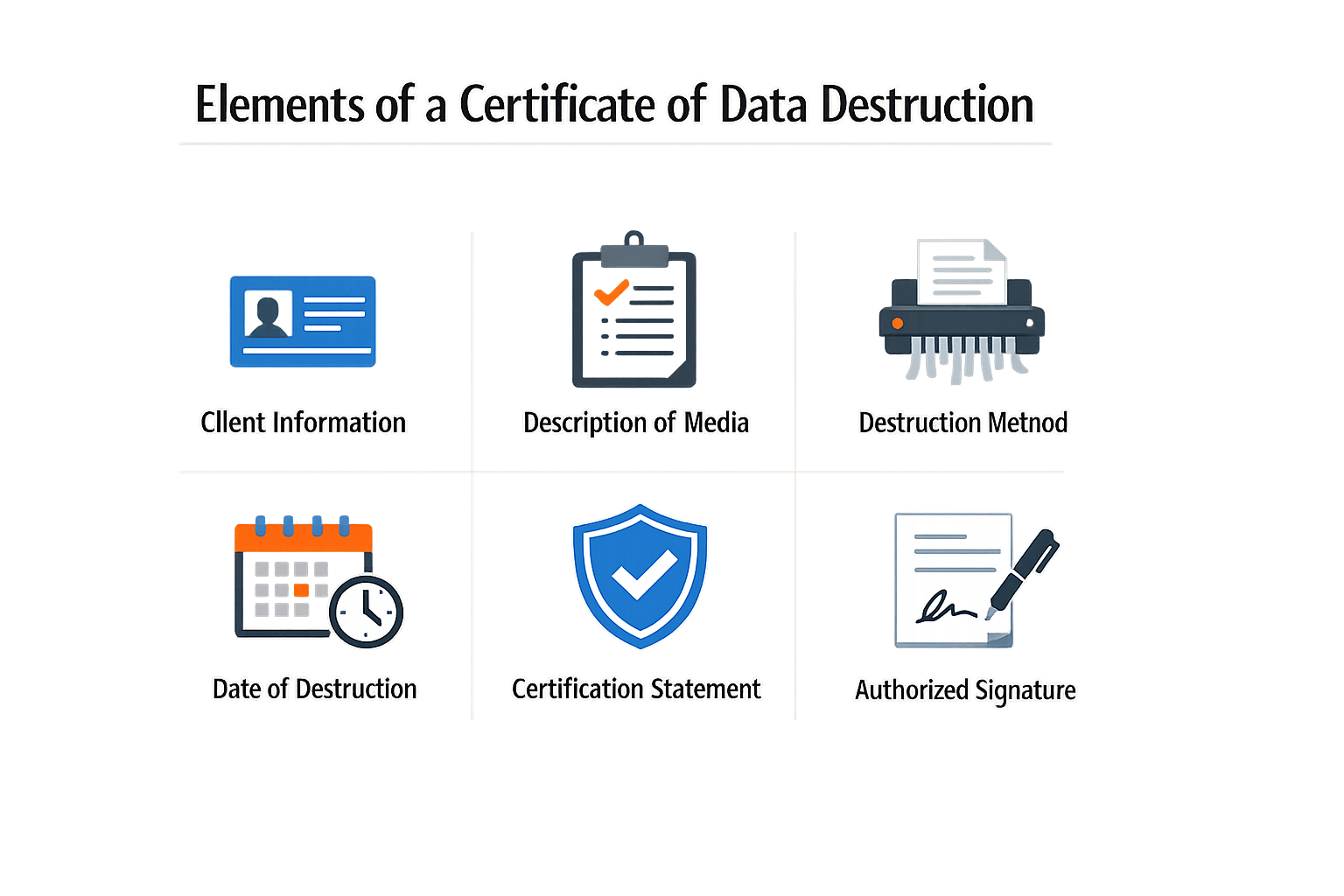
A valid certificate of data destruction is not a single-page formality—it is a structured legal record that must survive audit scrutiny and regulatory review. The difference between a certificate that holds up under examination and one that fails often comes down to whether specific, verifiable details are present. Missing or vague fields undermine the entire chain of custody and can expose organizations to compliance risk, even when the physical destruction was executed correctly.
Core Identifying Information
Every certificate must begin with unambiguous identification of all parties and the transaction itself. This includes a unique certificate ID or reference number that ties the document to internal tracking systems. Customer information—legal entity name, address, and contact details—must match the entity that owned the assets. Vendor information must include the service provider's legal name, address, certification credentials, and the authorized personnel who performed or supervised the destruction. Without these anchors, the certificate becomes a generic template with no evidentiary weight.
Asset-Level Detail and Destruction Specifics
The certificate must contain an itemized list of destroyed assets, including serial numbers, asset tags, model identifiers, or other unique descriptors that tie each item to the customer's inventory. Generic descriptions like "10 hard drives" or "assorted media" are insufficient. The destruction method must be stated explicitly—whether physical shredding, crushing, degaussing, or logical erasure per a named standard such as NIST 800-88. The date and location of destruction must be recorded, along with any applicable compliance standard or certification framework under which the work was performed.
Chain of Custody and Authorization
A chain-of-custody statement documenting the transfer of assets from customer control to vendor custody, and confirmation that destruction occurred under secure, auditable conditions, is essential. This section should reference any supporting documentation such as manifests, pickup logs, or transport records. The certificate must be signed by an authorized representative of the destruction vendor, with printed name, title, and date. In regulated environments, a countersignature from the customer's authorized officer may also be required to confirm receipt and acceptance of the certificate.
| Element | Required Detail | Audit Risk if Missing |
|---|---|---|
| Unique Certificate ID | Alphanumeric reference tied to tracking system | Cannot correlate certificate to transaction |
| Asset Serial Numbers | Individual identifiers per device | Cannot prove specific assets were destroyed |
| Destruction Method | Named standard or physical process | Cannot verify compliance with policy |
| Authorized Signature | Name, title, date from vendor officer | Certificate lacks legal standing |
The distinction between a certificate that documents destruction and one that merely claims it lies in the granularity and verifiability of these elements. A well-formed certificate functions as both legal proof and operational record, anchoring the destruction event to specific assets, methods, and parties. For organizations managing data center decommissioning or large-scale ITAD engagements, ensuring every certificate meets this standard is not optional—it is the foundation of defensible data sanitization practice.
Common Mistakes to Avoid
Organizations routinely undermine their data destruction programs with preventable documentation errors. The certificate itself becomes worthless when the supporting evidence doesn't align with what the document claims happened. Understanding these pitfalls helps you build a defensible audit trail before the auditor asks for it.
Relying on Waste Transfer Notes Instead of Destruction Certificates
A Waste Transfer Note confirms that assets left your facility and arrived somewhere else. It does not confirm data erasure. If those assets disappear in transit or the downstream processor fails to sanitize them, you retain liability under most privacy frameworks. The note tracks physical movement; the certificate must track data destruction. Organizations that conflate the two discover the gap only when regulators ask for proof of erasure and receive proof of shipment instead.
Accepting Certificates Without Serial-Level Asset Identifiers
Batch certificates that list "47 hard drives" or "12 servers" fail the moment an auditor asks which specific device held which data set. Chain-of-custody documentation requires serialized tracking from intake through destruction. When the certificate omits serial numbers, model identifiers, or unique asset tags, you cannot prove that the device containing regulated data was actually destroyed rather than resold, lost, or diverted. The Morgan Stanley case is canonical because the failure was not in destruction methodology — it was in the chain-of-custody documentation that should have survived the auction and didn't.
Skipping Third-Party Verification
Self-issued certificates from the same vendor performing the destruction lack independent validation. Without third-party oversight, you are asserting compliance without being able to prove it. Auditors and regulators expect separation between the party destroying data and the party certifying that destruction occurred according to standard. Certificates issued by the processor alone shift the verification burden back to you — and if the processor's methodology was flawed, your certificate is equally flawed.
Without a certificate, an organization is in the position of asserting compliance without being able to prove it.
Failing to Reconcile Marketing Claims with Operational Certificates
Vendors often describe their destruction process one way in sales materials and document it differently in the certificate they issue post-service. If the RFP promised NIST 800-88 Clear followed by physical shred, but the certificate lists only "secure wipe," the gap exposes you during audit. Reconcile the promised methodology with the certified methodology before you accept the certificate. The document you receive must match the process you contracted for, or you have no enforceable proof of compliance.
Certificate of Data Destruction Template
A standardized template ensures that every certificate of data destruction captures the minimum information required to survive compliance review. Without a consistent structure, certificates issued across different facilities or vendors often omit critical fields—serial numbers, methodology citations, or transfer-of-liability language—that auditors expect to see.
The template below consolidates the elements identified in the previous section into a single document format. Organizations can adapt field labels to match internal terminology, but the core structure should remain intact across all destruction jobs.
Template Structure
A valid certificate of data destruction must include the following fields:
- Certificate Title: "Certificate of Data Destruction" or "Certificate of Sanitization"
- Unique Job Number: Internal tracking identifier linking the certificate to chain-of-custody logs
- Date and Time of Destruction: ISO 8601 format preferred (YYYY-MM-DD HH:MM)
- Organization Name and Address: Legal entity name of the data owner
- Vendor Name and Address: Legal entity name of the destruction provider, including facility location
- Location of Destruction: Physical address where sanitization or destruction occurred
- Asset Description and Quantity: Line-item list with manufacturer, model, asset-level serial numbers
- Method of Destruction: Specific technique used (e.g., "NIST 800-88 Rev. 2 Purge" or "ADISA 8.0 Physical Destruction")
- Transfer of Liability Clause: Statement confirming vendor assumes responsibility for destroyed data
- Authorized Signatures: Wet or digital signatures from both the vendor representative and the client representative, with printed names and titles
- Date of Issuance: Date the certificate was generated and delivered
Downloadable Template Example
While this article does not provide a file download, the structure above can be formatted as a fillable PDF or a spreadsheet with locked column headers. Organizations subject to HIPAA, GLBA, or state privacy laws should add a regulatory-compliance statement in the footer referencing the applicable framework.
For organizations managing destruction across multiple vendors, embedding the template in the RFP and contract exhibits ensures that every provider returns certificates in the same format. This consistency simplifies aggregation when preparing for annual audits or regulatory examinations.
Common Template Pitfalls
Templates that rely on batch identifiers instead of asset-level serial numbers fail the chain-of-custody test. If an auditor asks to trace a specific device from intake to destruction, a batch-only certificate cannot answer the question. Similarly, templates that omit the methodology statement leave the door open to disputes about whether the destruction method met the standard cited in the contract.
Another frequent gap: certificates that list the vendor's corporate headquarters instead of the facility where destruction occurred. The Morgan Stanley case showed that when assets move through subcontractors, the destruction location becomes a critical audit trail element—if the certificate does not name the facility, the chain is broken.
The Importance of Chain of Custody
A certificate of data destruction documents the outcome of a process. Chain-of-custody documentation proves the process happened the way the certificate claims it did. Without verifiable chain-of-custody records, a certificate becomes a statement of intent rather than evidence of performance. Auditors and regulators understand this distinction — and they ask for both.
Chain of custody tracks every physical and logical transition an asset makes from the moment it leaves your control until destruction is complete. Each handoff, location change, and custodian transfer must be timestamped and attributed. The record answers three questions: who touched the asset, when they touched it, and what they did while it was in their possession. When these records align with the certificate's attestation, you have defensible documentation. When they don't, you have a gap that survives discovery.
What Chain-of-Custody Records Must Contain
A complete chain-of-custody log includes asset identifiers tied to the certificate, the name and role of each custodian, timestamps for every transfer, and the physical or logical state of the asset at each checkpoint. Serial numbers, MAC addresses, or other unique identifiers must match across the chain and the final certificate. If the certificate lists twenty drives but the chain-of-custody log shows nineteen handoffs, the discrepancy becomes the focus of the audit — not the destruction method.
Location data matters as much as custodian data. If an asset moved through a facility not listed in the vendor's published methodology, that movement must be explained and documented. Undisclosed subcontracting or downstream transfers are common failure modes. The certificate may claim destruction happened at a certified facility, but if the chain shows the asset spent time at an unlisted location, the certificate's credibility collapses.
How Chain-of-Custody Failures Surface in Audits
Auditors reconstruct timelines. They compare the certificate's destruction date against the chain-of-custody timestamps, cross-reference custodian names with vendor personnel records, and verify that every location in the chain holds the certifications the vendor claims. A single unexplained gap — a missing transfer record, a custodian with no documented role, a location with no site certification — is enough to invalidate the entire chain. When the chain fails, the certificate becomes unsupported evidence.
Businesses must be able to demonstrate compliance with data protection principles, and a certificate of destruction is one of the most important pieces of evidence during an audit. But the certificate alone is not sufficient. The chain-of-custody documentation is what proves the certificate's claims are accurate. Without it, you cannot demonstrate that the asset described in the certificate is the same asset that left your facility, traveled through the vendor's process, and reached the destruction endpoint.
Vendor Accountability and Documentation Standards
Vendors who understand chain-of-custody requirements build serialized tracking into their intake and processing workflows. Every asset receives a unique identifier at intake, and that identifier follows the asset through every checkpoint until destruction. The final certificate references the same identifier, creating an unbroken line from custody transfer to destruction attestation. Vendors who do not maintain this level of rigor produce certificates that look complete but cannot survive scrutiny.
For a detailed examination of how documentation gaps lead to compliance failures, see They Knew It Was a Moving Company, which explores the structural weaknesses that allowed untracked assets to enter secondary markets. The lesson is clear: chain-of-custody documentation is not administrative overhead — it is the foundation of defensible data destruction.
Compliance and Audit Implications
A valid certificate of data destruction is not a courtesy document — it is the primary evidence auditors and regulators examine when verifying that your organization disposed of sensitive data according to legal and contractual obligations. Without a certificate that meets specific structural and evidentiary standards, your organization cannot prove destruction occurred, and under current legal frameworks, data that cannot be proven destroyed is legally considered data that still exists.
What Auditors Look for in a Certificate
Auditors verify three things: asset-level traceability, method alignment with policy, and chain-of-custody continuity. A certificate that lists "500 hard drives destroyed via shredding" without serial numbers, destruction dates, or witness signatures will not satisfy an audit. Regulators expect each asset to be individually tracked from custody transfer through final disposition, with timestamps and responsible parties documented at every transition point.
The financial consequences of inadequate documentation are substantial. IBM's 2026 Cost of a Data Breach Report found the global average breach cost reached USD 4.99 million, with U.S. organizations facing an average of USD 11.5 million per incident. In the UK, the Information Commissioner's Office issued £17.5 million in fines during 2024 for data protection breaches, many involving improper disposal practices where organizations could not produce valid destruction certificates during investigations.
Regulatory Frameworks That Require Certificates
Multiple compliance regimes explicitly require documented proof of data destruction. GDPR Article 17 (Right to Erasure) and Article 5(1)(e) (storage limitation principle) mandate that organizations demonstrate deletion or destruction when data is no longer necessary for its original purpose. HIPAA's Security Rule (45 CFR § 164.310(d)(2)(i)) requires covered entities to implement policies for final disposition of electronic protected health information and the hardware containing it — policies that must be provable through documentation.
The Gramm-Leach-Bliley Act's Safeguards Rule and the FTC's Disposal Rule (16 CFR Part 682) require financial institutions and entities handling consumer report information to properly dispose of such information and maintain records demonstrating compliance. State-level regulations like the California Consumer Privacy Act (CCPA) impose similar documentation requirements, with enforcement actions increasingly focused on the gap between stated disposal policies and actual proof of execution.
The Certificate as Audit Trail
During regulatory investigations or breach response, the certificate of data destruction becomes part of the evidentiary record. Investigators cross-reference certificate details against asset inventories, custody logs, and vendor contracts to verify consistency. Discrepancies between what the certificate claims and what chain-of-custody documentation supports can transform a compliance review into an enforcement action.
The Morgan Stanley case demonstrated this principle at scale: the failure was not in the destruction method itself, but in the absence of chain-of-custody documentation that could prove which assets were destroyed, when, and by whom. Four separate proceedings followed, totalling $161.5 million, because the organization could not produce certificates and supporting documentation that satisfied audit requirements.
The cheapest vendor is the one whose certificate you trust enough to hand the auditor without flinching.
Organizations should treat certificate validation as a pre-audit activity. Before accepting a certificate from a vendor, verify that every required field is populated, that asset identifiers match your custody transfer records, and that the destruction method aligns with your data classification policy. Certificates that fail this internal validation will fail external audit — discovering that gap during a regulatory investigation is orders of magnitude more expensive than discovering it during vendor onboarding.
Who Needs a Certificate of Data Destruction?
A certificate of data destruction is not a universal requirement, but for organizations handling sensitive information or operating under regulatory frameworks, it becomes a critical compliance artifact. The certificate serves as formal proof that data was destroyed according to documented standards, and it shifts the burden of evidence from verbal assurance to written attestation.
Organizations Under Regulatory Obligation
Any entity subject to data protection regulations—healthcare providers under HIPAA, financial institutions under GLBA or SEC rules, or businesses handling EU citizen data under GDPR—must document the end-of-life treatment of information assets. The certificate becomes the primary evidence that sensitive data no longer exists in recoverable form. Auditors expect serialized proof for every asset that touched regulated data, and a missing certificate for even a single device can trigger disclosure timelines or penalty assessments.
Government contractors and defense-sector organizations face similar documentation requirements, often with stricter chain-of-custody expectations. When assets contain classified or controlled unclassified information, the destruction certificate must align with agency-specific standards, and the certifying party must hold appropriate clearances or certifications.
Third-Party Disposal Scenarios
Obtaining a formal certificate of destruction is absolutely critical when utilizing any third-party shredding or ITAD vendor. When an organization transfers custody of assets to an external party, the certificate is the only mechanism that preserves accountability across the handoff. The vendor's attestation becomes the client's audit defense, and without it, the client organization retains full liability for any downstream data breach or improper disposal.
This principle extends beyond IT asset disposal. Legal firms destroying client files, healthcare facilities disposing of imaging equipment, and retailers decommissioning point-of-sale systems all require certificates when third parties handle the destruction process. The certificate is what converts a service transaction into a documented compliance event.
Internal Disposal and Certificate Value
Even when destruction occurs in-house, many organizations generate internal certificates to maintain audit trails and demonstrate due diligence. The certificate serves as a control point in asset lifecycle management, linking disposal events to inventory records and policy adherence. For organizations with decentralized IT operations, internal certificates standardize the documentation process across locations and prevent gaps in the audit trail.
The Morgan Stanley case is canonical because the failure was not in destruction methodology—it was in the chain-of-custody documentation that should have survived the auction and didn't. Organizations that self-perform destruction but fail to document it face the same evidentiary gap as those who use undocumented third parties. The certificate is the artifact that proves the event occurred and met the required standard.
Risk-Based Determination
For organizations outside regulated industries, the decision to obtain certificates often follows a risk-based approach. High-value assets, devices that processed customer data, or equipment involved in intellectual property development warrant certification even when regulations do not mandate it. The certificate provides insurance against future claims and establishes a defensible position if disposal practices are ever questioned.
Small businesses and individuals disposing of personal devices rarely need formal certificates, but the threshold shifts quickly when business use or customer data is involved. A single laptop used for freelance consulting that stored client information creates the same documentation need as an enterprise server—the scale differs, but the liability principle does not.
Best Practices for Data Destruction Certification
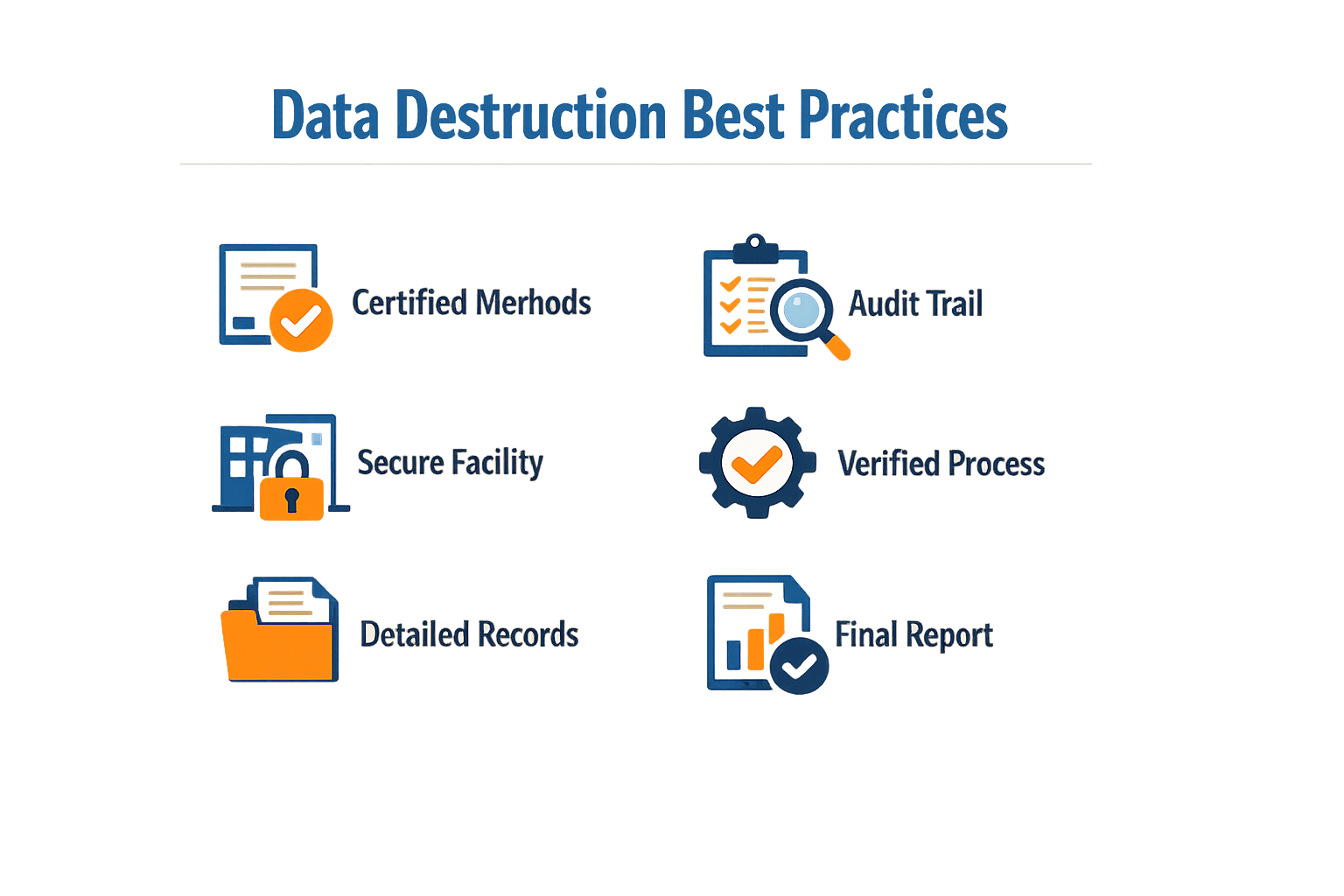
A well-structured certificate of data destruction template supports regulatory reviews, internal control testing, contractual obligations, incident response, and insurance documentation by providing specific evidence of the disposal process. Organizations that treat certification as a compliance afterthought often discover gaps only when an auditor or regulator requests proof of destruction. The following practices help ensure that certificates meet both operational and audit requirements.
Standardize Documentation Across All Facilities and Vendors
Using a well-structured template standardizes documentation across facilities and vendors, reduces omissions, and accelerates reviews during compliance audits. When every destruction event follows the same format, internal teams can quickly verify completeness without decoding vendor-specific formats. This consistency also simplifies cross-facility audits, where auditors expect uniform documentation regardless of geography or service provider.
Standardization extends beyond the certificate itself. Ensure that chain-of-custody logs, transportation manifests, and destruction method records all reference the same asset identifiers and event timestamps. When documentation uses inconsistent naming conventions or date formats, reconciliation becomes manual and error-prone.
Verify Destruction Method Against Asset Type
Not all destruction methods are equally effective for all media types. Physical shredding works for hard drives but may leave data recoverable on solid-state drives if the NAND chips remain intact. The Command Said It Worked. They Recovered the Data Anyway. illustrates how logical erasure commands can report success while leaving data accessible through forensic methods.
Before accepting a certificate, confirm that the destruction method listed matches the media type and meets the security requirements for the data classification. For example, cryptographic erasure may be acceptable for general business data on self-encrypting drives, but regulated data often requires physical destruction regardless of encryption status.
Require Serialized Asset-to-Certificate Mapping
Certificates that summarize destruction events by batch or shipment often fail audit scrutiny because they cannot tie a specific asset to a specific destruction date. Every certificate should list assets by serial number, model, and unique identifier, with a one-to-one mapping to the destruction record.
This level of detail supports regulatory timelines and incident response. If a data breach investigation identifies a specific device, serialized records allow you to prove—within hours—whether that device was destroyed, when, and by what method. Without serialized mapping, proving destruction requires reconstructing months of batch records and hoping the asset was included.
Establish Clear Acceptance Criteria Before Engagement
Define what constitutes an acceptable certificate before the vendor begins work. Include specific requirements in the RFP and contract: required fields, acceptable destruction methods, maximum turnaround time for certificate delivery, and format specifications. When acceptance criteria are clear upfront, vendors can configure their systems to meet your requirements rather than delivering a generic certificate that requires rework.
Acceptance criteria should also address certificate amendments. If an asset list changes after pickup but before destruction, the certificate must reflect the actual assets destroyed, not the original manifest. Establish a process for reconciling discrepancies and issuing corrected certificates when necessary.
Audit the Certificate Against Source Documentation
Treat the certificate as a summary document, not the sole record. Before filing a certificate, audit it against the chain-of-custody log, transportation manifest, and destruction facility records. Verify that asset counts match, serial numbers align, and destruction dates fall within the expected window. Discrepancies—even small ones—signal potential gaps in the vendor's process or documentation quality.
Periodic spot audits of vendor facilities reinforce this practice. Request access to destruction logs, witness a destruction event, and compare the generated certificate to the actual process. Vendors who know their documentation will be audited maintain tighter controls than those who assume certificates are filed without review.
Conclusion
A certificate of data destruction is not a formality—it is the only proof that stands between your organization and an unwinnable audit argument. Without a certificate that includes asset-level identifiers, destruction method, date, location, and provider attestation, you are asserting compliance without the ability to prove it. The gap between what marketing materials promise and what operational documentation delivers has real consequences, and those consequences compound when chain-of-custody records fail to survive the transaction.
In our editorial review of vendor profiles, we noticed the same pattern repeatedly: the certificate of data destruction referenced in marketing material was structurally different from the certificate referenced in the vendor's published methodology. This discrepancy creates confusion about what constitutes a valid certificate and leaves organizations vulnerable during audits. The Morgan Stanley case remains canonical because the failure was not in destruction methodology—it was in the chain-of-custody documentation that should have survived the auction and didn't.
Before you accept any certificate, verify that it includes client name, project reference, unique asset serial numbers, the specific data handling method used, the result of the process, exact date and location, and a signed provider attestation. If any of these elements are missing, the certificate is incomplete. If the certificate references batch processing without individual asset tracking, it is insufficient for regulated environments. If the vendor cannot produce chain-of-custody records that connect your asset list to the destruction event, the certificate is unsupported.
The best certificate is the one whose paper trail you trust enough to hand the auditor without hesitation. Everything else is risk you are choosing to carry. For a deeper look at how documentation gaps create compliance exposure, see The ITAD Industry's 30-Year Verification Gap — And the Three-Layer Platform Closing It.
Related reading
Data Disposition: Linking Information Lifecycle Management to ITAD