
Chain of Custody in ITAD: The Ultimate Guide Made Simple
Discover the best practices for Chain of Custody in ITAD, from loading dock to certificate, ensuring secure and compliant asset disposal.
Introduction
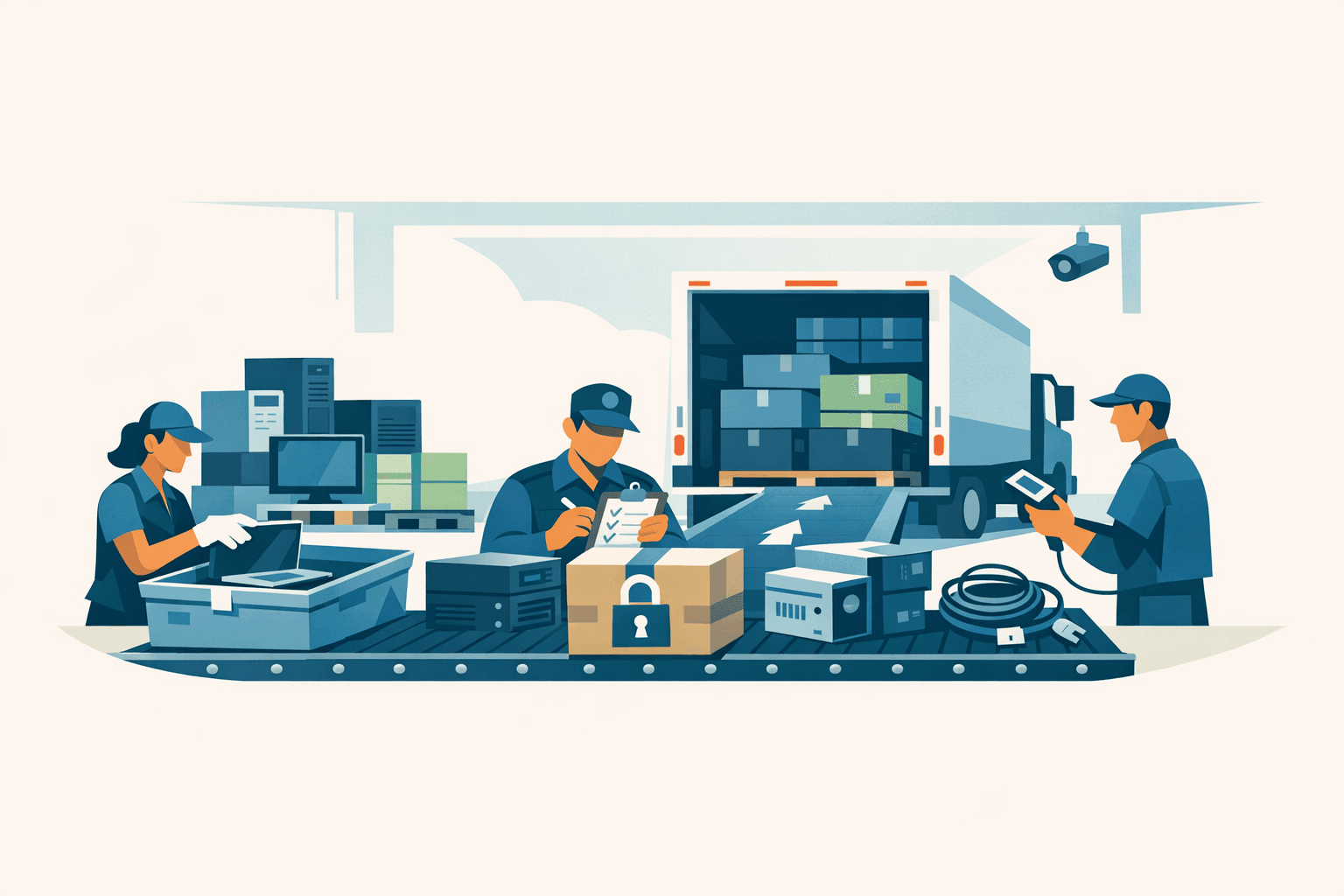
When an IT asset leaves your loading dock, it enters a chain of custody that must remain unbroken until the final certificate of destruction lands in your compliance folder. Every handoff, every transport leg, every processing step represents a potential failure point where documentation gaps can turn into data breaches, regulatory penalties, or worse. Maintaining rigorous documentation of the chain of custody is critical for ITAD professionals to avoid data breaches and ensure compliance with regulations.
In our editorial review of vendor profiles, we noticed a recurring pattern: the certificate of data destruction referenced in marketing material was structurally different from the certificate referenced in the vendor's published methodology. This discrepancy often indicates a gap in the chain of custody—the kind of gap that survives until an auditor or a breach investigation exposes it.
Weak custody procedures can lead to major operational, compliance, and financial problems. Organizations that treat chain of custody as a paperwork formality rather than a structural control discover the cost during the worst possible moment: after assets have been lost, data has been exposed, or regulators have opened an investigation. The loading dock is where accountability begins, but the certificate is where it must be proven. Everything in between requires documentation that can withstand scrutiny.
This guide walks through the mechanics of chain of custody in ITAD, from the initial inventory and pickup through transport, processing, destruction, and final certification. You'll see the common failure modes, the compliance frameworks that govern custody requirements, and the tools and practices that close the gaps. For organizations selecting ITAD vendors or auditing existing relationships, understanding what makes a custody chain defensible is the difference between a process you trust and one you hope never gets tested. For a detailed examination of how documentation failures cascade into systemic risk, see They Knew It Was a Moving Company.
Explore the chain of custody in ITAD, from loading dock to certificate, ensuring proper asset disposal.
Understanding Chain of Custody in ITAD
Chain of custody in ITAD is the documented record of every party who handled a device, from the moment it's collected from a customer to its final disposition. This trail of control, transfer, and custody creates an auditable sequence that answers a single critical question: who held each asset, when, and under what conditions? Without this documentation, you cannot prove that the asset you sent for destruction is the same asset that was destroyed—and regulators, auditors, and legal teams know it.
The significance of chain of custody extends beyond internal record-keeping. It is the mechanism that transforms a vendor's promise into evidence that survives an audit. When a breach occurs or an asset goes missing, the chain of custody determines whether you can demonstrate compliance or face penalties. A complete chain documents not just the final certificate of destruction, but every transfer point, every handler, and every custodial change along the way.
Why Chain of Custody in ITAD Matters for Compliance
Regulatory frameworks treat chain-of-custody documentation as the baseline proof of due diligence. HIPAA, SOX, GDPR, and state-level data privacy laws all require organizations to demonstrate secure handling of assets containing sensitive data. A gap in the chain—whether from undocumented transfers, missing serial numbers, or certificates that don't match the original inventory—can invalidate the entire disposal process in the eyes of an auditor.
The chain also protects against downstream risk. When vendors subcontract processing to third parties without documenting the handoff, you inherit liability for actions you never authorized. They Knew It Was a Moving Company illustrates how a breakdown in chain-of-custody documentation can escalate into a multi-million-dollar regulatory failure—even when the original vendor relationship appeared sound.
The Core Elements of a Valid Chain
A valid chain of custody in ITAD includes several non-negotiable elements. First, asset-level serialization: every device must be tracked individually, not in batches. Second, timestamped custody transfers: each handoff must be logged with the date, time, and responsible party. Third, method-of-destruction alignment: the certificate must specify the exact method used for each asset type, not a generic statement. Finally, unbroken traceability: the documentation must connect the loading dock to the final disposition without gaps or unexplained custody changes.
When these elements are present, the chain becomes defensible. When any are missing, the chain collapses—and with it, your ability to prove compliance.
The Steps of Chain of Custody in ITAD
A complete chain of custody in ITAD follows assets from the moment they leave your facility to the final certificate of destruction or resale. Each step requires documentation that proves who had physical control, when custody changed hands, and what happened to the asset. Without this serialized record, the certificate at the end means nothing — because you cannot prove the asset it describes is the same one that left your loading dock.
Secure Logistics and Initial Transfer
The chain begins when assets are prepared for pickup. A responsible logistics process includes documented custody transfers, verified transportation providers, tamper-evident seals, secure containers, and GPS-tracked vehicles. The vendor should photograph assets before loading, capture serial numbers at the point of transfer, and require dual signatures — one from your authorized representative and one from the driver. If the truck arrives without serialized inventory tracking or the driver cannot produce credentials, the transfer should not proceed.
Step 1
Receipt and Verification at the ITAD Facility
When assets arrive at the vendor's facility, they must be inventoried again — serial by serial — and reconciled against the transfer manifest. Any discrepancies (missing units, damaged seals, serial mismatches) trigger an exception process that halts further handling until resolved. This reconciliation is the first critical checkpoint: if the vendor cannot prove what arrived matches what left your site, the chain is already broken.
Step 2
Controlled Processing Environments
Once verified, assets move into a controlled environment where access is logged and physical security prevents unauthorized removal. Each asset should be photographed again, tagged with internal tracking identifiers, and assigned to a specific processing queue (data destruction, testing, parts harvesting, or resale). The facility's access logs and internal chain-of-custody records must show who handled each asset and when.
Step 3
Verified Data Destruction
For assets containing data-bearing media, destruction happens under documented conditions. The serial number of the device, the serial number of the drive, the method used (shredding, degaussing, cryptographic erasure), and the operator's identity are all captured. The destruction event generates a serialized record that ties back to the original manifest. Network switches and routers require special attention because factory-reset commands often leave configuration data recoverable — a gap that only shows up if the destruction record specifies the actual method used, not just "sanitized."
Step 4
Real-Time Reporting and Final Certificate
The final step is aggregating all custody events into a certificate that lists every serial number, every custody transfer, every destruction method, and every downstream disposition (recycled, resold, destroyed). An audit-ready chain of custody means any serial number can be traced back through every custody event: who received it, who photographed it, who transferred it, who signed for it, and where it ended up. If the certificate cannot produce this serialized history on demand, it is a summary document, not proof of custody.
Why Each Step Must Be Serialized
Batch processing — where assets are grouped and tracked as "50 laptops" instead of 50 individual serial numbers — breaks the chain. If one laptop in that batch was never destroyed, or was resold with data intact, you cannot identify which one. Regulators and auditors expect serialized tracking because liability attaches to individual assets, not aggregates. The cheapest vendor is the one whose paper trail you trust enough to hand the auditor without flinching.
Common Challenges in Maintaining Chain of Custody
Maintaining an unbroken chain of custody from the loading dock to the final certificate sounds straightforward on paper. In practice, however, organizations encounter predictable failure points that compromise the entire documentation trail. These challenges stem from operational shortcuts, unclear handoff protocols, and documentation practices that appear sufficient until an auditor asks for proof.
Mixed Boxes Without Serial Scans
One of the most common weak spots occurs when assets are packed together without individual serial number scans at the point of collection. Mixed boxes create immediate ambiguity: which specific drives left your facility, and which ones appear on the destruction certificate? If your only proof is a single email saying "pickup done," the audit conversation gets awkward.
This gap becomes critical when regulators or clients demand serialized chain-of-custody for the full retention period. Without item-level tracking from the start, reconstruction after the fact is impossible.
Subcontracted Couriers Lacking Sealed Handovers
Many ITAD vendors use third-party logistics providers for pickup and transport. When those couriers lack formal sealed-handover procedures, custody transfers happen without documented proof. The asset leaves your dock, travels through an undocumented chain, and arrives at the vendor's facility with no verifiable record of who held it in between.
This introduces a structural vulnerability: if an asset goes missing or a breach occurs during transport, you cannot establish accountability. Auditors expect to see signed manifests, tamper-evident seals, and timestamped handoffs at every custody transfer point. Anything less creates a documentation gap that weak custody procedures can quickly escalate into major operational, compliance, and financial problems, including data breaches and loss of client confidence.
Certificate-vs-Practice Gaps
Another recurring challenge is the disconnect between the certificate of data destruction referenced in marketing material and the certificate referenced in the vendor's published methodology. When these documents differ in scope, format, or detail, it signals that the chain of custody may not be as robust as advertised.
The cheapest vendor is the one whose paper trail you trust enough to hand the auditor without flinching.
Operators who fail to reconcile these discrepancies before signing a contract often discover the gap only during an audit — when it is too late to recover missing documentation. For a deeper look at how these gaps manifest in real-world incidents, see They Knew It Was a Moving Company.
Incomplete Downstream Documentation
When vendors subcontract portions of the ITAD process without disclosing it, the chain of custody fragments. Assets may pass through multiple facilities, each with its own documentation standards. If the prime vendor does not consolidate and verify downstream records, the final certificate may cover only part of the journey — leaving critical custody transfers undocumented.
This is especially problematic for organizations subject to strict regulatory frameworks, where every asset movement must be traceable. Incomplete downstream documentation creates liability that flows back to the original asset owner, regardless of contractual indemnification clauses.
Best Practices for Chain of Custody in ITAD
A robust chain of custody in IT asset disposal is not built on good intentions—it is built on formal policy, automated tracking, and regular verification. Organizations that treat documentation as an afterthought discover the gap only when an auditor or regulator asks to see the serial-level trail from loading dock to destruction certificate. By that point, reconstruction is expensive and often incomplete.
Establish a Formal Chain of Custody Policy
Every asset entering the ITAD process must be governed by a documented policy that specifies tracking requirements, custodial responsibilities, and the exact documentation required at each handoff. This policy should mandate serial number capture, timestamp recording, and custodian signatures at every transfer point. Without a written standard, asset tracking becomes discretionary, and discretionary processes fail under pressure.
The policy must also define what constitutes acceptable documentation. Generic batch receipts are insufficient; regulators and auditors expect individual asset identifiers tied to specific destruction events. Organizations that fail to specify this level of granularity in policy often discover that their vendor's "standard" documentation does not meet compliance thresholds.
Implement Digital Tracking Solutions
Manual logs and spreadsheets introduce human error at every data entry point. Digital tracking systems provide real-time visibility into asset location and status, automate timestamp capture, and reduce transcription mistakes. Barcode or RFID scanning at each custody transfer ensures that the recorded movement matches the physical movement, eliminating the drift that accumulates in paper-based systems.
Automation also enables exception alerting. When an asset moves without a corresponding scan, or when a custody gap exceeds a defined threshold, the system flags the anomaly immediately rather than months later during an audit. This real-time feedback loop allows operators to correct documentation failures before they become compliance incidents.
Step 1
Integrate tracking at intake
Capture serial numbers, asset tags, and custodian information the moment assets arrive at the loading dock. Delay in initial documentation creates gaps that are difficult to close later in the process.
Step 2
Automate handoff verification
Require digital confirmation at every custody transfer—loading, transport, facility receipt, processing, and destruction. Each scan creates a timestamped record that links the asset to the responsible party.
Step 3
Reconcile certificates to intake records
When destruction certificates are issued, verify that every serial number listed in the certificate appears in the original intake manifest. Missing assets indicate a chain-of-custody break that must be investigated and documented.
Conduct Regular Audits of the Chain of Custody Process
Policies and systems are necessary but not sufficient. Regular audits validate that the documented process matches the operational reality. Audits should sample assets across the full lifecycle—from intake through destruction—and verify that every required data point is present, accurate, and consistent across systems.
Audits also surface process drift. Over time, operators develop workarounds that bypass formal documentation steps, especially when those steps are perceived as slow or redundant. Periodic review identifies these deviations before they become entrenched practices. For organizations managing data center decommissioning, where asset volumes can overwhelm manual tracking, audit findings often drive the business case for automation investments.
Verify Data Destruction Methods and Documentation
The destruction certificate is only as credible as the process it represents. Organizations must verify that the destruction method—whether wiping, degaussing, crushing, or shredding—aligns with the sensitivity of the data and the requirements of applicable regulations. A certificate stating "data destroyed" without specifying the method, the standard followed, or the serial numbers processed is not sufficient evidence for audit or litigation defense.
Verification extends to the vendor's operational controls. Does the vendor's published methodology match the process described in the certificate? Are destruction events witnessed or logged by independent parties? Can the vendor produce chain-of-custody records for subcontracted work? These questions must be answered before assets leave your custody, not after a breach is discovered.
Case Study: The Morgan Stanley Incident
The Morgan Stanley case stands as the canonical reference point for chain of custody failure in ITAD. The failure was not in the destruction methodology itself — it was in the chain-of-custody documentation that should have survived the auction and didn't. This incident demonstrates how a gap between what is promised in certificates and what actually happens on the loading dock can cascade into regulatory penalties and reputational damage that far exceed the initial cost savings.
What Went Wrong
Morgan Stanley engaged a vendor to decommission equipment containing client data. The vendor subcontracted the work to a moving company that lacked ITAD credentials, proper data destruction capabilities, and the systems to maintain serialized asset tracking. When equipment was resold at auction without proper sanitization, the chain of custody — the documented trail from initial pickup to final certificate — simply did not exist. Regulators and auditors had no way to verify which assets had been properly handled and which had not.
Four separate proceedings followed the incident, totalling $161.5 million in penalties and settlements. The root cause was not a technical failure in data destruction — it was the absence of a verifiable chain of custody that could withstand regulatory scrutiny.
Lessons for Chain of Custody Management
The Morgan Stanley case teaches three critical lessons. First, certificates are only as strong as the documentation trail behind them. If a vendor cannot produce serialized records from pickup to destruction, the certificate is effectively meaningless in an audit. Second, subcontracting without proper disclosure and chain-of-custody handoff creates an untrackable gap. Third, the cheapest vendor is often the one whose paper trail you cannot trust enough to hand the auditor without flinching.
Organizations managing ITAD engagements must verify that their vendor maintains serialized asset tracking at every step, discloses any subcontracting relationships, and provides documentation that aligns with the methodology described in their marketing material. For a detailed examination of how the vendor selection process broke down in this case, see They Knew It Was a Moving Company.
The cheapest vendor is the one whose paper trail you trust enough to hand the auditor without flinching.
Compliance and Regulations Impacting Chain of Custody
Chain of custody in ITAD is not an administrative preference—it is a compliance mandate enforced by multiple regulatory frameworks. Organizations that fail to document asset movement, sanitization, and final disposition face financial penalties, reputational damage, and legal liability. The frameworks that govern chain of custody differ in scope and enforcement mechanism, but they share a common requirement: serialized, auditable proof that every asset was tracked from intake to final disposition.
Chain of Custody as the Backbone of R2v3, e-Stewards, and NIST 800-88
Chain of custody is the backbone of R2v3, e-Stewards, and NIST 800-88 compliance. R2v3 (Responsible Recycling) requires vendors to maintain documented custody records for all assets, including serial numbers, sanitization methods, and downstream transfer documentation. e-Stewards imposes similar requirements but extends them to environmental and social responsibility metrics. NIST 800-88 does not mandate chain of custody directly, but its sanitization verification requirements are meaningless without a documented link between the asset and the sanitization record.
A strong and fully secure chain of custody gives assurance that every device is tracked, protected, and processed according to the highest security and compliance standards. Without this documentation, an organization cannot demonstrate that a specific asset was sanitized, even if the vendor's methodology is sound. Auditors and regulators expect serialized records that tie each asset to its final disposition certificate.
HIPAA, GDPR, and State-Level Privacy Laws
For organizations handling regulated data, chain of custody becomes a legal requirement under HIPAA, GDPR, and state-level privacy laws like the California Consumer Privacy Act (CCPA). HIPAA's Security Rule requires covered entities to maintain documentation of ePHI disposal, including the identity of the disposal agent and the method used. GDPR Article 5(2) imposes accountability obligations that require organizations to demonstrate compliance with data protection principles, including secure disposal.
State-level breach notification laws often hinge on whether an organization can prove that data was destroyed before a breach occurred. If an asset containing personal information is lost or stolen, the organization must either notify affected individuals or provide evidence that the data was sanitized. Without chain-of-custody documentation linking the asset to a destruction certificate, the organization is presumed to have suffered a reportable breach.
SOX, GLBA, and Financial-Sector Obligations
The Sarbanes-Oxley Act (SOX) and the Gramm-Leach-Bliley Act (GLBA) impose record-retention and disposal obligations on financial institutions. SOX Section 802 criminalizes the destruction of records with intent to obstruct an investigation, but it also requires organizations to dispose of records securely once the retention period expires. GLBA's Safeguards Rule mandates that financial institutions develop written information security plans that include secure disposal procedures.
For financial institutions, chain of custody documentation is the only defensible proof that a retired asset was sanitized before the retention period expired. Without serialized tracking, an organization cannot demonstrate that a specific drive containing customer data was destroyed in compliance with its own policy.
Federal and Defense-Sector Requirements
Federal agencies and defense contractors face additional chain-of-custody requirements under the Federal Information Security Management Act (FISMA), the Defense Federal Acquisition Regulation Supplement (DFARS), and the Controlled Unclassified Information (CUI) framework. DFARS 252.204-7012 requires contractors to report cyber incidents within 72 hours and to preserve forensic evidence, including any IT assets involved in the incident. CUI disposal requires documented sanitization that meets NIST 800-88 standards and serialized tracking that survives audit.
For organizations operating in these sectors, chain of custody is not a vendor responsibility—it is a contractual obligation that flows down to every subcontractor in the disposal chain. If a vendor subcontracts asset transport or destruction without maintaining serialized custody records, the organization inherits the compliance risk.
Tools for Managing Chain of Custody in ITAD
Maintaining chain of custody across dozens or hundreds of assets requires more than spreadsheets and good intentions. The systems that track assets from intake through destruction must produce audit-grade documentation without becoming a second full-time job. The right tooling automates the repetitive work—serial number capture, custody handoffs, certificate generation—while preserving the evidence trail that survives regulatory scrutiny.
Purpose-Built ITAD ERP Systems
Purpose-built ITAD ERP platforms are designed to handle the unique requirements of asset disposition workflows. Unlike general inventory systems, these platforms track custody transfers, destruction methods, and compliance checkpoints in a single audit trail. They automate processes that ensure traceability, transparency, and compliance throughout the chain of custody.
These systems capture asset data at intake—serial numbers, condition codes, data-bearing status—and maintain that record through every custody transfer. When an asset moves from receiving to data destruction to physical processing, the system logs the handoff, the operator, and the timestamp. The result is a serialized chain that answers the auditor's question: who touched this asset, when, and what did they do to it?
Barcode and RFID Tracking
Barcode and RFID technologies provide the physical layer of custody tracking. Each asset receives a unique identifier at intake, and that identifier follows the asset through every process step. Barcode scanners at each workstation capture the asset's presence, while RFID tags enable bulk tracking when assets move in pallets or gaylords.
The advantage of RFID is speed: a reader can capture dozens of tags simultaneously as assets pass through a choke point. The trade-off is cost and the need for line-of-sight or proximity; barcodes remain the workhorse for serialized tracking in most ITAD facilities. Either way, the goal is the same—eliminate manual transcription errors and create a digital record of every custody event.
Certificate Generation and Audit Trails
The certificate of destruction is the final output of the chain of custody, but it is only as credible as the data behind it. Automated certificate generation pulls from the same database that logged intake, processing, and destruction events. If the system shows an asset entering the facility but never reaching the shredder, the certificate should not list that asset as destroyed.
The certificate you hand the auditor must be structurally identical to the one your system generated from the custody log—any gap is a red flag.
Audit trails must be immutable. Once a custody event is logged, it should not be editable without leaving a secondary record of the change. This immutability is what makes the trail defensible in litigation or regulatory review. For a deeper look at how documentation gaps undermine even certified processes, see The ITAD Industry's 30-Year Verification Gap — And the Three-Layer Platform Closing It.
Integration with Compliance Frameworks
Tools that manage chain of custody should integrate directly with the compliance frameworks your organization follows. If you operate under NIST 800-88 for data sanitization, the system should capture the method, pass count, and verification result for each drive. If HIPAA or GDPR applies, the system must track which assets contained regulated data and provide serialized proof of destruction for each one.
Integration means the compliance checklist is built into the workflow, not bolted on afterward. When an auditor requests proof that all ePHI-bearing assets were destroyed according to policy, the system should produce a filtered report in minutes, not days of manual reconstruction.
Who Should Choose What in Chain of Custody Management
Chain of custody requirements scale with risk exposure, not organizational size. A healthcare provider managing a single clinic faces the same regulatory burden per asset as a hospital system processing thousands of devices monthly — the difference lies in volume, not obligation. The right strategy depends on three factors: the sensitivity of data handled, the complexity of asset streams, and the capacity to maintain internal documentation that survives external audit.
Organizations Handling Regulated Data Should Prioritize Vendor Verification
Any organization subject to HIPAA, GDPR, or similar frameworks must ensure that chain-of-custody documentation is comprehensive and consistent with operational procedures. This means selecting vendors whose published methodology aligns with the certificates they issue. In our editorial review of 35 vendor profiles, we noticed a recurring pattern: the certificate of data destruction referenced in marketing material was structurally different from the certificate referenced in the vendor's published methodology. This discrepancy often indicates a gap in the chain of custody.
For these organizations, the selection process should begin with verification of the vendor's certification posture (R2v3, e3, or equivalent) and a detailed review of sample certificates against the vendor's documented procedures. The ITAD Industry's 30-Year Verification Gap — And the Three-Layer Platform Closing It explores how structural gaps in vendor verification persist despite decades of certification frameworks.
High-Volume Operators Need Asset-Tracking Automation
Organizations processing hundreds or thousands of assets per month face a different challenge: manual documentation becomes a failure point at scale. For these operators, the priority is tooling that automates asset tagging, custody handoffs, and audit trail generation. A strong chain of custody rests on six essential pillars: asset tracking and tagging, secure transport, custody documentation, data security and destruction, compliance with regulations, and certificates and audit trail.
High-volume environments should implement barcode or RFID systems that tie each asset to a unique identifier from intake through final disposition. The documentation must survive not only the immediate engagement but also the retention period required by the most stringent regulation the organization faces. This typically means seven years for financial records and six years for HIPAA-covered entities, though state laws may extend these timelines.
Small and Mid-Sized Organizations Should Standardize on Documented Handoffs
For organizations with lower asset volumes but high data sensitivity, the focus should be on ensuring that every custody transfer is documented with sufficient detail to reconstruct the chain months or years later. This does not require sophisticated software — a standardized intake form, transport manifest, and certificate template can provide adequate protection if applied consistently.
The critical discipline is ensuring that no asset leaves custody without a signed transfer record. The Morgan Stanley case is canonical because the failure was not in destruction methodology — it was in the chain-of-custody documentation that should have survived the auction and didn't. For smaller operators, this means treating the intake checklist and transport manifest as legal documents, not operational conveniences.
| Organization Type | Primary Focus | Recommended Strategy |
|---|---|---|
| Regulated data handlers | Vendor verification | Audit vendor methodology against sample certificates; require serialized tracking |
| High-volume processors | Automation | Implement RFID/barcode systems with automated audit trail generation |
| Low-volume, high-sensitivity | Handoff discipline | Standardize intake forms and transport manifests; treat as legal records |
Conclusion
Chain of custody in ITAD is not a compliance formality—it is the structural spine that connects physical asset movement to legal defensibility. From the moment equipment leaves the loading dock to the final certificate of destruction, every custody transfer, serial number verification, and documentation checkpoint builds the evidentiary record that survives audit, litigation, and regulatory scrutiny. Organizations that treat chain of custody as a checklist exercise discover the gap only when the documentation is tested, and by then the cost is measured in breach notifications, regulatory penalties, and reputational damage.
The Morgan Stanley case remains the canonical reference because the failure was not in destruction methodology—it was in the chain-of-custody documentation that should have survived the auction and didn't. In our editorial review of vendor profiles, we noticed a recurring pattern: the certificate of data destruction referenced in marketing material was structurally different from the certificate referenced in the vendor's published methodology. This discrepancy often indicates a gap in the chain of custody that becomes visible only under external review.
The cheapest vendor is the one whose paper trail you trust enough to hand the auditor without flinching.
Operators who implement serialized tracking, enforce custody handoff protocols, and maintain independent verification at each transition point build systems that scale under pressure. Those who rely on batch documentation, vendor self-certification, or post-facto reconciliation discover that the gaps compound across the chain. The difference between a robust chain of custody and a fragmented one is not visible in normal operations—it emerges when the documentation must stand alone as evidence.
For organizations evaluating their current practices, the question is not whether chain of custody matters, but whether the documentation generated today will survive the scrutiny applied three years from now. If the answer requires assumptions about vendor cooperation, memory, or goodwill, the chain is already broken. For readers seeking deeper context on how documentation gaps manifest in real-world incidents, They Knew It Was a Moving Company examines the structural failures that turn theoretical risk into realized cost.
Chain of custody in ITAD is not a feature—it is the foundation. Build it accordingly.
Related reading
How to Get R2 Certified: The Simple Ultimate Audit Path
Degaussing vs Shredding: The Ultimate Guide to Simple Selection