
Hard Drive Disposal for Business: The Ultimate Stress-Free Guide
Learn about hard drive disposal for business, including secure data destruction methods, compliance requirements, and best practices for your organization.
Introduction
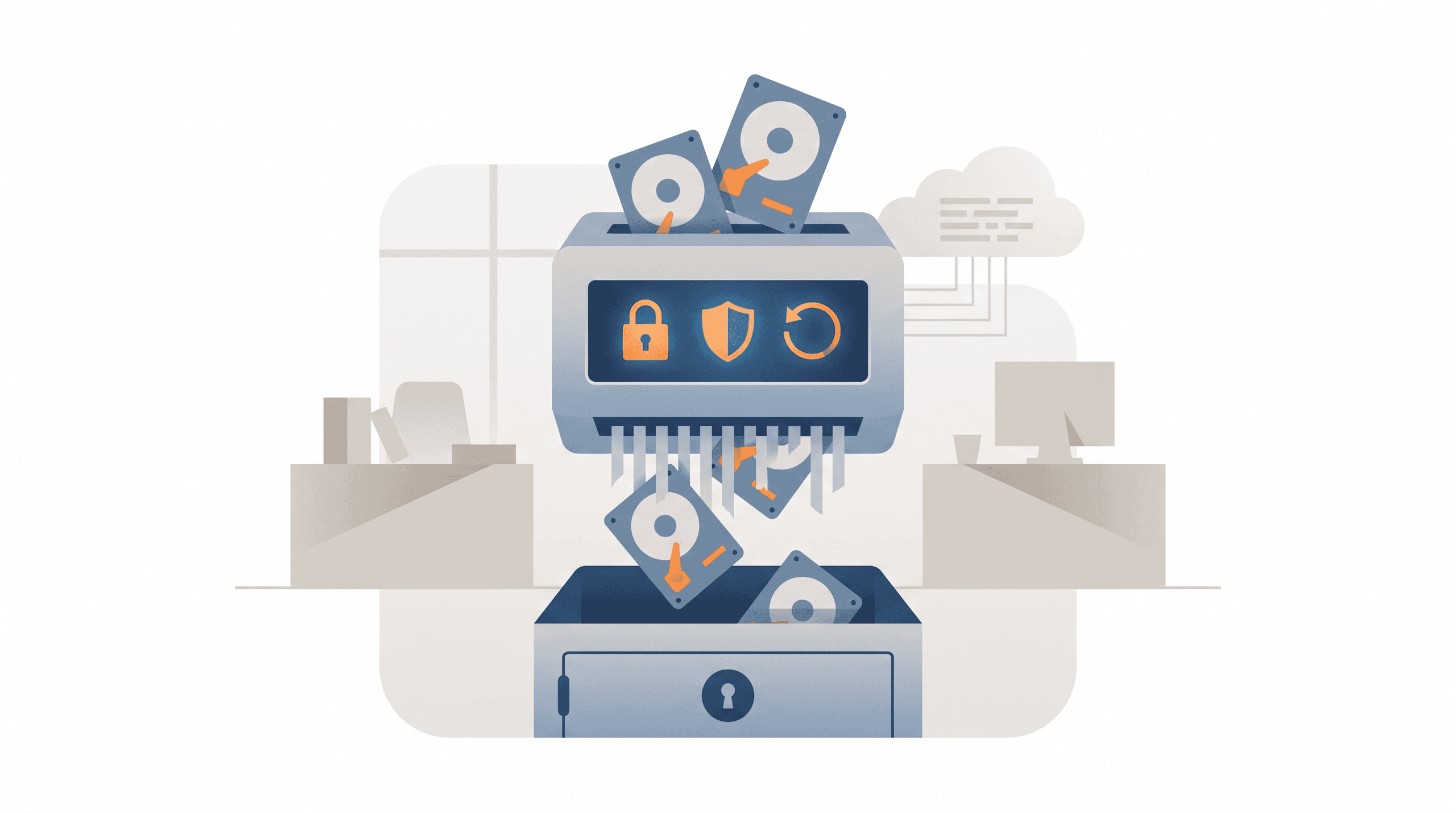
[Image: Hard drive disposal for business showing secure data destruction process in business environments]
Hard drive disposal for business is the permanent removal of sensitive data from storage media before devices leave organizational control, ensuring compliance with regulatory frameworks and preventing costly breaches. When a business replaces servers, retires workstations, or decommissions storage infrastructure, the hard drives contain more than old files. They hold customer records, financial data, employee information, and intellectual property that regulatory frameworks expect you to protect through the entire asset lifecycle — including disposal. Yet most organizations focus exclusively on the destruction method while overlooking the chain-of-custody documentation that proves the destruction actually happened as specified.
The consequences of inadequate hard drive disposal for business are not theoretical. Morgan Stanley Smith Barney LLC was charged $35 million by the SEC for inadequate disposal of customer personal information — a penalty that reflected years of accumulated risk from gaps in vendor oversight and documentation. In our editorial review of vendor profiles, we noticed the same pattern repeatedly: the certificate of data destruction referenced in marketing material was structurally different from the certificate referenced in the vendor's published methodology. This discrepancy often leads to confusion about what actually happens to your data after the truck leaves.
The challenge is not that secure disposal is impossible. The challenge is that the disposal process extends beyond the moment of physical destruction, and the documentation trail must survive audits that may occur years later. Organizations that treat hard drive disposal as a one-time transaction rather than a documented process with ongoing compliance implications discover their mistake when regulators or auditors request proof of proper disposal for assets retired months or years earlier. For a deeper look at how documentation gaps create compliance exposure, see The ITAD Industry's 30-Year Verification Gap — And the Three-Layer Platform Closing It.
This guide walks through the hard drive disposal process from initial planning through final documentation, highlighting the specific points where organizations typically encounter problems and how to structure your disposal program to survive both immediate operational needs and future audit requirements. Understanding these mechanics before the disposal truck arrives is the difference between a controlled process and an expensive regulatory problem.
Learn about hard drive disposal for business, including the data disposal process and potential pitfalls after the truck leaves.
Understanding Data Disposal
[Image: Understanding data disposal for business operations and compliance]
Data disposal is the process of permanently removing information from storage media before that media leaves your organization's control. For businesses, this means ensuring that hard drives, solid-state drives, and other storage devices are rendered unreadable before disposal, resale, or donation. The stakes are high: improperly retired technology creates data security risks and potential regulatory compliance issues that can expose your organization to breaches, fines, and reputational damage.
Many organizations assume that deleting files or formatting a drive removes the data. It does not. Deleting files or formatting an SSD does not erase the data; it only removes the pointers to the data, leaving the actual data recoverable until overwritten. This misconception creates a dangerous gap between perceived security and actual security.
The Scale of the Problem
The data recovery risk is not theoretical. Approximately 68% of used storage devices still contained recoverable data from previous owners, even after basic deletion or formatting. This means that more than two-thirds of disposed drives retain sensitive information that can be extracted with readily available tools. For businesses handling customer records, financial data, or intellectual property, this represents an unacceptable exposure.
Effective data disposal requires either cryptographic erasure, standards-compliant overwriting, or physical destruction of the media. The method you choose depends on the sensitivity of the data, the type of storage media, and your organization's compliance obligations. Understanding these distinctions is the first step in building a disposal process that actually protects your data after the hardware leaves your facility.
The Morgan Stanley case illustrates what happens when the disposal process fails: the failure was not in the destruction method itself, but in the chain-of-custody documentation that should have survived the transaction and did not. This distinction matters because it shifts the focus from what happens to the drive to what you can prove happened to the drive.
What Is the Hard Drive Disposal for Business Process?
[Image: Hard drive disposal process showing sequential steps from inventory to certification]
Hard drive destruction is the process of permanently rendering data on a hard drive unreadable and unrecoverable, ensuring that sensitive information cannot be retrieved by unauthorized parties. For businesses, this process involves several distinct phases that begin long before a vendor truck arrives and continue well after physical destruction occurs.
Understanding the Core Framework
The disposal process follows a structured framework that determines both method and documentation requirements. NIST SP 800-88 Rev. 2 provides the standard framework for sanitization methods: Clear (software overwrites), Purge (cryptographic erase), and Destroy (physical destruction). Your organization's choice among these methods depends on data classification, regulatory obligations, and asset value.
The framework itself is straightforward. The complexity emerges in the execution layer — specifically in how vendors translate methodology into documented proof that survives an audit years later.
The Sequential Steps
Step 1
Inventory and classification
Catalog every drive by serial number, location, and data classification before contacting any vendor. This inventory becomes the foundation of your chain-of-custody documentation. Without serialized tracking from the start, you cannot verify what was destroyed or prove what wasn't.
Step 2
Vendor selection and methodology agreement
Use a certified hard drive destruction service to ensure compliance with legal and environmental standards. The certification matters less than the specific methodology the vendor will apply to your assets and the documentation they will provide. Confirm in writing which destruction method applies to which asset category and what certificate format you will receive.
Step 3
Chain-of-custody initiation
When assets leave your facility, the chain-of-custody documentation must capture serial-level detail, not batch counts. This is where most failures originate — not in the destruction event itself, but in the gap between what left your building and what the certificate later describes.
Step 4
Destruction execution
The vendor applies the agreed methodology. Physical destruction methods include shredding, crushing, or degaussing. Logical methods follow NIST standards for overwrite or cryptographic erasure. The method matters, but the documentation of the method's application to your specific serialized assets matters more.
Step 5
Certificate issuance and reconciliation
You receive a certificate of destruction. This document must map back to your original inventory at the serial level. If the certificate describes batch weights or aggregate counts instead of serialized assets, you have a documentation gap that will surface during an audit or breach investigation.
What Happens After the Certificate
The process does not end when you file the certificate. Retention requirements vary by regulation, but the pattern is consistent: you must be able to produce serialized proof of destruction for assets that contained regulated data, often for periods extending beyond the asset's useful life.
For a deeper examination of how documentation gaps emerge even when methodology is sound, see The Compliance Cliff Is Real. The Date Isn't the One You Heard.
Potential Pitfalls of Data Disposal
[Image: Potential pitfalls in hard drive disposal for business including data security risks and compliance failures]
Hard drive disposal for business carries risks that extend well beyond the moment the truck leaves your loading dock. The most expensive failures in this space rarely trace to destruction methodology — they trace to gaps in what happens between asset pickup and final disposition. Improperly retired technology creates data security risks and potential regulatory compliance issues that can surface months or years later.
When Documentation Doesn't Match Reality
The certificate you receive at the end of a disposal engagement often describes a process that differs from what actually occurred. Some vendors issue destruction certificates based on contractual commitments rather than serialized proof of work. Others subcontract portions of the chain without disclosing it, creating gaps in accountability that only become visible during an audit or breach investigation.
Morgan Stanley Smith Barney LLC was charged $35 million by the SEC for inadequate disposal of customer personal information. The failure was not in the destruction method itself — it was in the documented chain of custody that should have survived the engagement and did not. This case remains the canonical reference for what happens when disposal documentation fails to match the scope of the regulatory obligation.
Common Failure Modes in the Field
Incomplete erasure on certain drive types represents another persistent risk. Factory-reset procedures on network equipment can leave configuration data intact, and some overwrite protocols fail to reach all sectors on SMR drives. These are not theoretical vulnerabilities — they are documented recovery outcomes from assets that were certified as sanitized.
Undisclosed downstream subcontracting introduces a second layer of risk. When a vendor you vetted hands assets to a subcontractor you did not vet, your chain of custody breaks. If that subcontractor resells drives instead of destroying them, you own the breach even though you never authorized the resale. For more on how configuration data persists after factory resets, see The Command Said It Worked. They Recovered the Data Anyway.
The cheapest vendor is the one whose paper trail you trust enough to hand the auditor without flinching.
Importance of Chain of Custody
Chain-of-custody documentation is the thread that connects your asset to its final disposition — and the only evidence that survives when things go wrong. When a hard drive leaves your loading dock, the physical control transfers, but your liability does not. The documentation trail is what proves you exercised reasonable care, and in the event of a breach or audit, it is the first thing regulators and forensic teams will demand.
What Chain of Custody Actually Tracks
A complete chain-of-custody record serializes every asset by make, model, and serial number, timestamps every custody transfer, and links each transfer to a named individual or entity. It is not a batch receipt. Each drive must be individually tracked from the moment it enters the disposal process until it reaches verified destruction. The record should include the transport manifest, the facility intake log, the destruction method applied, and the certificate that ties the serial number to a specific destruction event.
Without this serialized trail, you cannot prove what happened to a specific asset. Batch certificates — documents that attest to the destruction of "500 drives" without serial-level detail — offer no protection if one of those drives surfaces in a breach investigation.
Why Documentation Survives When Methodology Fails
Certified destruction services provide chain-of-custody documentation that proves reasonable care was exercised, protecting organizations legally if a breach occurs later. The methodology — whether shredding, crushing, or degaussing — is only as defensible as the documentation that connects your asset to that process. If the certificate references a destruction event but cannot tie it to your specific serial numbers, the legal protection evaporates.
The enforcement record in recent years shows a consistent pattern: most compliance actions trace to chain-of-custody documentation gaps, not to the destruction methodology itself. Vendors may use compliant methods, but if the paperwork does not survive the audit, the compliance posture collapses. For more on how documentation failures cascade into regulatory exposure, see The Compliance Cliff Is Real. The Date Isn't the One You Heard.
What Happens When the Chain Breaks
When chain-of-custody documentation is incomplete or generic, you lose the ability to demonstrate that a specific asset was destroyed. If a drive with your data appears in a secondary market or breach, you cannot prove it was never in your disposal stream, and you cannot prove it was destroyed. The burden of proof shifts to you, and the absence of serialized records becomes evidence of negligence.
Using a certified hard drive destruction service ensures compliance with legal and environmental standards, but only if the service provides documentation that is granular, serialized, and auditable. The certificate must be structurally capable of answering the question: "What happened to drive serial XYZ?" If it cannot, the certification is decorative.
Data Destruction Methods
When you hand over a hard drive, the vendor has three broad approaches: software-based erasure, cryptographic sanitization, or physical destruction. Each method answers the question "Can the data be recovered?" with a different level of certainty — and a different paper trail.
Software Overwrites and the NIST Framework
NIST SP 800-88 Rev. 2 provides the standard framework for sanitization methods: Clear (software overwrites), Purge (cryptographic erase), and Destroy (physical destruction). The "Clear" category covers multi-pass software overwrites that replace every sector with zeros or random patterns. This works reliably on traditional spinning-platter drives when the process completes and the vendor logs every serial number that passed verification.
The gap appears when the process doesn't complete. Certain drive types — particularly shingled magnetic recording (SMR) drives — have documented erasure failure modes where the software reports success but sectors remain accessible through low-level commands. If your certificate lists a drive model known for this behavior and the methodology section doesn't mention model-specific validation, you're holding a certificate that may not reflect reality.
Cryptographic Erasure for SSDs
Solid-state drives require a different approach because data is distributed across NAND cells in patterns invisible to the operating system. Manufacturer software like Samsung Magician and Crucial Storage Executive provides secure erase functions tailored to specific SSD models, ensuring effective data disposal. These tools issue controller-level commands that the drive's firmware recognizes as a full sanitization instruction.
The challenge: not every ITAD vendor runs model-specific tooling. Some rely on generic utilities that may not trigger the correct firmware pathway. When you review a certificate, check whether the listed methodology distinguishes between HDD and SSD procedures. If it doesn't, the vendor may be applying the same overwrite process to both — and SSDs don't respond to overwrites the way spinning drives do.
Physical Destruction
Shredding, crushing, and degaussing fall under the "Destroy" category. Physical destruction offers the highest confidence that data cannot be recovered, but it also eliminates any possibility of asset resale or reuse. For drives that held regulated data — healthcare records, payment card information, classified material — physical destruction is often the only method that satisfies both legal and insurance requirements.
Degaussing works only on magnetic media; it has no effect on SSDs. A certificate that lists SSDs as "degaussed" is either using the term incorrectly or the vendor doesn't understand the technology. Either way, it's a signal that the methodology may not match the marketing.
| Method | Media Type | Data Recovery Risk | Resale Possible |
|---|---|---|---|
| Software Overwrite | HDD | Low (if verified) | Yes |
| Cryptographic Erase | SSD | Very Low (if model-specific) | Yes |
| Physical Shred | HDD, SSD | None | No |
| Degaussing | HDD only | None | No |
What the Certificate Should Tell You
Every method produces a different kind of evidence. Software erasure generates logs with serial numbers, timestamps, and pass/fail results. Cryptographic erasure should include the specific command issued and the drive's response code. Physical destruction should include witness signatures, photos, and — for high-security work — a chain-of-custody log that connects the serial number on your inventory sheet to the serial number in the shredder hopper.
If your certificate lists the method but not the evidence, you're holding a summary, not documentation. Summaries don't survive audits. For more on how documentation gaps lead to compliance failures, see R2v3 Certification: The Ultimate Guide to Costs and Easy Verification
Comparing Data Disposal Options
When evaluating hard drive disposal for business, the choice between destruction methods and service providers often comes down to three variables: the sensitivity of your data, the compliance frameworks you operate under, and what documentation you can hand an auditor without hesitation. A 2024 study by data security firm Blancco found that 42% of resold hard drives purchased on eBay still contained sensitive data, including tax records and passport information — a reminder that the cheapest option is rarely the safest.
Physical Destruction vs. Logical Erasure
Physical destruction methods — shredding, crushing, degaussing — render the drive permanently unusable. Logical erasure methods — NIST 800-88 compliant overwrite, cryptographic erasure — leave the hardware intact for resale or reuse. The trade-off is straightforward: physical destruction eliminates data recovery risk entirely but also eliminates asset value. Logical erasure preserves value but introduces a documentation burden: you must prove the erasure was complete, that the method matched the media type, and that the certificate reflects what actually happened.
| Method | Data Recovery Risk | Asset Recovery | Compliance Documentation |
|---|---|---|---|
| Physical shredding | None (drive destroyed) | None | Certificate of destruction |
| NIST 800-88 overwrite | Minimal (if executed correctly) | High (drive resalable) | Erasure report + serial verification |
| Degaussing | None (magnetic media only) | None (drive unusable) | Certificate + method validation |
| Cryptographic erasure | Minimal (key destroyed) | High (SSD/SED only) | Key destruction log + drive serial |
Vendor Certification vs. Vendor Practice
Certifications — R2v3, e-Stewards, NAID AAA — signal that a vendor has committed to a documented methodology. They do not guarantee that every truck, every technician, and every downstream partner follows that methodology on your specific engagement. The gap between the certificate referenced in marketing material and the certificate you receive after the job is where most compliance failures occur. The ITAD Industry's 30-Year Verification Gap — And the Three-Layer Platform Closing It examines how this structural problem persists across the vendor landscape.
On-Site vs. Off-Site Destruction
On-site destruction — whether mobile shredding or on-premises erasure — keeps the chain of custody short and observable. Off-site destruction introduces transportation risk, facility access risk, and a longer documentation trail. For regulated industries (healthcare, finance, government), on-site destruction often simplifies the compliance narrative. For organizations with lower data sensitivity or distributed locations, off-site consolidation can reduce cost without materially increasing risk — if the vendor's chain-of-custody documentation is robust.
Choosing the right hard drive disposal method depends on the sensitivity of the data and the compliance standards that need to be met. The decision is not purely technical; it is also a question of what evidence you can produce when the auditor asks, "How do you know?"
Who Should Choose What?
Choosing the right hard drive disposal method depends on the sensitivity of the data and the compliance standards that need to be met. A small retail business with point-of-sale terminals faces different risks than a healthcare organization managing electronic health records. The method that satisfies one may be structurally inadequate for the other, and the gap usually appears during an audit, not during disposal.
Matching Disposal Methods to Business Needs
Healthcare organizations are required to dispose of electronic health information in a way that's 'unreadable, indecipherable, and cannot be reconstructed' under HIPAA. For these organizations, physical destruction methods — shredding or crushing — paired with documented chain-of-custody typically meet the regulatory standard. Logical erasure alone may not satisfy the requirement unless paired with cryptographic erasure and third-party verification.
Financial services firms managing customer account data face similar requirements under state and federal data protection laws. For them, the choice often comes down to whether the drives will be resold or destroyed. If resale is part of the business model, cryptographic erasure followed by NIST 800-88 overwrite and third-party certification may be acceptable. If resale introduces unacceptable risk, physical destruction is the safer path.
Smaller businesses with less sensitive data — such as retail operations or professional services firms — may find that certified logical erasure is sufficient, provided the vendor delivers serialized asset-level certificates and maintains chain-of-custody documentation. The key is ensuring that the certificate references the actual drive serial number and the destruction method used, not a batch identifier.
When to Choose Physical Destruction
Physical destruction is the appropriate choice when the cost of a data breach exceeds the residual value of the hardware. This typically applies to:
- Drives that stored regulated data (healthcare, financial, government)
- Drives with encryption keys or certificate stores
- Drives that failed during service and may contain partial or corrupted data
- Situations where the chain-of-custody documentation cannot be guaranteed through resale
The Morgan Stanley case is a reminder that the failure was not in the destruction methodology itself, but in the chain-of-custody documentation that should have survived the process and didn't.
When Logical Erasure Is Sufficient
Logical erasure — overwrite or cryptographic erasure — is appropriate when the drives will be resold, the data is not regulated, and the vendor provides serialized asset-level certificates with verifiable chain-of-custody. This method works well for:
- Consumer-grade laptops and desktops with non-sensitive business data
- Drives that were encrypted at rest and the encryption keys are separately destroyed
- Situations where environmental impact and cost recovery are priorities
The critical requirement is that the vendor's certificate must reference the actual methodology used and the specific drive serial number. Batch certificates or generic statements of compliance do not survive audit.
Final Thoughts on Data Disposal
Hard drive disposal for business is not a one-time checkbox exercise—it's a decision that creates a permanent record. The truck leaves, the equipment disappears, and what remains is documentation. If that documentation cannot withstand an audit, the disposal never happened in the eyes of a regulator. The difference between a compliant disposal and a costly incident often comes down to whether the chain-of-custody paperwork survived the process intact.
Documentation Outlives the Hardware
The hard drive itself may be shredded, crushed, or degaussed, but the certificate of destruction is what proves it. When that certificate references a methodology that differs from what actually occurred—or when it fails to tie each serialized asset to a documented outcome—the entire disposal becomes defensible only on trust. In our editorial review of vendor profiles, the same structural gap appeared repeatedly: marketing materials promised one form of certification while published methodologies described another. This disconnect is not academic; it becomes the weak point during regulatory review.
The Real Cost of Disposal Failure
Regulatory penalties for inadequate disposal are not theoretical. Morgan Stanley Smith Barney LLC was charged $35 million by the SEC for inadequate disposal of customer personal information—a failure rooted not in the destruction method itself, but in the inability to demonstrate proper chain-of-custody after the equipment left their control. The lesson is clear: the cheapest vendor is the one whose documentation you would hand to an auditor without hesitation.
Choosing a Path Forward
Businesses face three primary paths: physical destruction (shredding, crushing, degaussing), certified data sanitization (NIST 800-88 overwrite methods), or cryptographic erasure. Each has a place, but the choice should be driven by your ability to document the outcome, not just the method. The ITAD Industry's 30-Year Verification Gap — And the Three-Layer Platform Closing It explores how verification standards are evolving to address these documentation challenges.
Physical destruction offers finality but requires photographic or witness evidence tied to serialized inventory. Certified sanitization allows for asset reuse but demands software-generated reports that map each drive to a specific erasure session. Cryptographic erasure is fast but only works if key management was implemented before disposal became necessary. The method matters less than the paper trail it produces.
The disposal method you choose should be the one you can prove happened, not the one that sounds most secure in a brochure.
What Survives the Audit
When regulators or auditors arrive, they will ask for serialized proof: which assets were disposed of, when, by whom, and with what verifiable outcome. If your vendor cannot produce a report that answers all four questions for every device, the disposal is incomplete in the eyes of compliance. The documentation standard is not what the vendor promises—it is what the vendor delivers in a format your auditor will accept.
The enforcement record for R2v3 certification over the last 18 months shows a consistent pattern: most actions trace to chain-of-custody documentation gaps, not to data destruction methodology itself. This pattern underscores a simple truth—proof of destruction is destruction. Without it, you are left defending a process you cannot demonstrate.
Conclusion
Hard drive disposal for business is not a one-time transaction — it is an ongoing operational discipline that requires documentation, verification, and institutional memory. The process does not end when the truck leaves your loading dock; it ends when you can hand an auditor a complete chain-of-custody record that accounts for every asset by serial number, destruction method, and downstream disposition. Organizations that treat disposal as a procurement event rather than a compliance process consistently underestimate the cost of failure.
The Morgan Stanley case remains the canonical example because the failure was not in the destruction methodology itself — it was in the chain-of-custody documentation that should have survived the auction and did not. In our editorial review of vendor profiles, we noticed a recurring pattern: the certificate of data destruction referenced in marketing material was often structurally different from the certificate referenced in the vendor's published methodology. This discrepancy creates gaps that only become visible during an audit or breach investigation, long after the vendor relationship has ended.
The choice of vendor, destruction method, and documentation standard should be driven by your organization's risk profile, regulatory obligations, and internal audit requirements — not by the lowest bid or the fastest turnaround. If you cannot explain to a non-technical executive why you chose a specific vendor and what happens if their process fails, your selection criteria are incomplete. For a deeper look at how vendor selection intersects with verification standards, see R2v3 Certification: The Ultimate Guide to Costs and Easy Verification.
Hard drive disposal for business is ultimately about building a defensible record that survives turnover, mergers, and regulatory inquiries. The organizations that succeed are the ones that document their decisions, verify their vendors, and treat every disposed asset as if it will one day be part of a public enforcement action. Because sometimes, it will be.
Frequently Asked Questions About Hard Drive Disposal for Business
What is hard drive disposal for business?
Hard drive disposal for business is the permanent removal of sensitive data from storage media before devices leave organizational control, ensuring compliance with regulatory frameworks and preventing data breaches.
Why is chain-of-custody documentation important in hard drive disposal?
Chain-of-custody documentation proves that specific serialized assets were properly destroyed according to agreed methodology. Without it, organizations cannot demonstrate compliance during audits or breach investigations.
What are the main methods of hard drive disposal for business?
The three main methods are physical destruction (shredding, crushing, degaussing), software-based erasure (NIST 800-88 overwrite), and cryptographic erasure (ATA Secure Erase for SSDs). Each method suits different data sensitivity levels and compliance requirements.
How do I choose between physical destruction and data erasure?
Choose physical destruction when data sensitivity exceeds asset value, or when regulatory requirements mandate irreversible destruction. Choose certified erasure when asset reuse is valuable and documentation can prove complete sanitization.
What should a certificate of destruction include?
A proper certificate must include serial numbers of specific assets, destruction method applied, date and location of destruction, and verifiable identity of the entity performing the work—not just batch counts or aggregate weights.
What happens if hard drive disposal documentation fails an audit?
Incomplete documentation creates regulatory exposure and potential penalties. The Morgan Stanley case produced a $35 million SEC charge specifically for inadequate disposal documentation, not methodology failure — one of four proceedings totalling $161.5 million.