
IT Asset Disposition: A Complete Guide for Businesses
Introduction to IT Asset Disposition
The certificate of data destruction is the operator's primary documentary defense in a post-incident regulatory review. It is also, in our review of 35 vendor profiles, the document with the highest variance in what it actually means. When an organization retires servers, storage arrays, laptops, or networking equipment, the question is not whether data security matters—it is whether the process you run will hold up when the auditor asks to see the chain of custody.
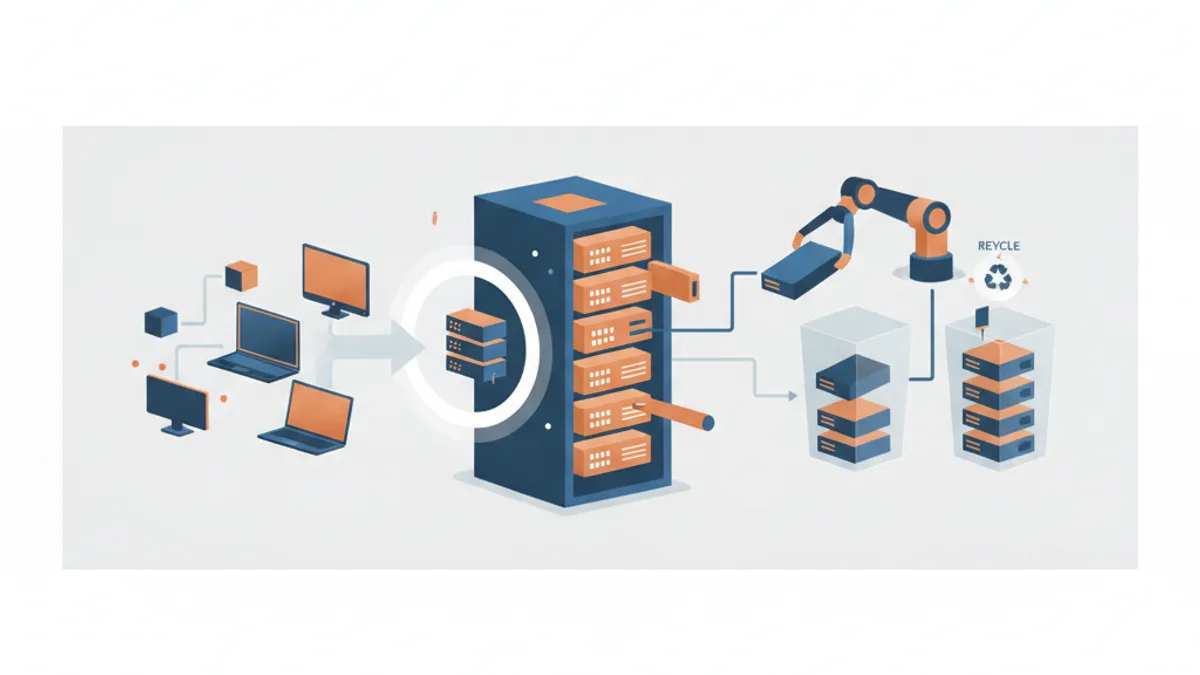
IT Asset Disposition is the structured process by which organizations manage IT equipment from the moment it is decommissioned through its final disposition—whether that means secure destruction, certified recycling, or controlled resale. The scope includes inventory tracking, data sanitization to NIST standards, physical asset handling, environmental compliance, and the generation of audit-defensible documentation at each handoff. NIST SP 800-88 Rev. 2, published in September 2024, is the current federal media sanitization standard and describes information disposition decisions as occurring "throughout the information system life cycle," not just at end-of-life. Critical factors that affect sanitization—hardware selection, interface command support, destruction feasibility—are decided at the start of a system's development, and the choices made there determine what sanitization methods will be available years later when the equipment is retired.
For a comprehensive framework on structuring these decisions from the enterprise buyer's perspective, see our IT Asset Disposition: A Framework for Enterprise Buyers guide.
Most enterprise IT teams encounter ITAD as a procurement exercise: select a vendor, ship the pallets, receive the certificate. The underlying mechanism, however, is a custody-and-verification system in which each step—pickup, transport, intake, sanitization, downstream processing—must be documented in a form that survives discovery. The operator's posture on chain of custody, the contract language governing subcontractor disclosure, and the published verification of the vendor's certifications all determine whether the program works when tested. The Morgan Stanley case remains the canonical reference: $100 million in cumulative regulatory penalties and settlements stemming from decommissioned equipment that left the data center without adequate data destruction and ended up auctioned with customer data intact. The failure was not technical—it was documentary and structural.
ITAD is not a single transaction. It is a program that begins with hardware acquisition decisions, continues through operational use, and concludes with verified final disposition. The best ITAD vendors are the ones whose documentary practices you trust enough to hand the auditor without flinching. The worst are the ones whose certificates describe an ideal process that does not match what actually happened to your equipment. The difference is not always visible in the RFP response—it emerges in the audit, and by then the exposure is already realized.
Explore our complete guide on IT asset disposition, covering best practices, common mistakes, and everything businesses need to know.
Table of Contents
- Introduction to IT Asset Disposition — Introduce the concept of IT asset disposition and its significance for businesses in managing their IT lifecycle effectively.
- Table of Contents
- What is IT Asset Disposition? — Define IT asset disposition and explain its components, including processes and methodologies involved.
- Why IT Asset Disposition Matters — Discuss the importance of effective IT asset disposition for compliance, data security, and environmental responsibility.
- How to Implement IT Asset Disposition — Provide a step-by-step guide for businesses on implementing IT asset disposition strategies.
- Best Practices for IT Asset Disposition — Highlight best practices that organizations should follow to ensure a successful IT asset disposition process.
- Common Mistakes in IT Asset Disposition — Identify and explain common pitfalls organizations face during the IT asset disposition process and how to avoid them.
- Frequently Asked Questions about IT Asset Disposition — Address common queries and concerns businesses have regarding IT asset disposition.
- Conclusion — Summarize the key points discussed in the guide and reinforce the importance of IT asset disposition for businesses.
What is IT Asset Disposition?
IT Asset Disposition is the set of processes that organizations use to retire end-of-life hardware while controlling what happens to the data that lived on it. It begins the moment an asset is flagged for removal and ends when the organization can document — to an auditor's satisfaction — that the data is irrecoverable and the hardware has reached a known final state.
The scope includes physical devices (servers, storage arrays, networking gear, endpoints), the data they contain, and the chain-of-custody documentation that proves both were handled according to policy. NIST SP 800-88 Rev. 2, the current federal media sanitization standard, frames this as a lifecycle decision: sanitization and disposition choices are made at system design, not just at end-of-life.
Core Components of IT Asset Disposition
IT Asset Disposition breaks into four operational layers, each with its own failure modes.
Inventory and chain of custody. Before any asset leaves controlled space, it must be cataloged — by serial number for anything that can be serialized, or by secure container for bulk non-serialized media. The e-Stewards Standard requires that chain of custody stipulate exactly when and where transfer of custody begins and ends, with documented controls at every handoff. The question an auditor will ask: can you prove this specific drive was in your custody until sanitization, or did it spend three weeks in an unsecured loading dock?
Data sanitization. This is the technical step — clearing, purging, or destroying the storage media to render target data unrecoverable. NIST 800-88 Rev. 2 defines three sanitization methods: clear (logical techniques via the device interface, appropriate for reuse in controlled environments), purge (physical or logical techniques that make lab recovery infeasible, required before release outside the organization), and destroy (physical destruction rendering both data recovery and media reuse infeasible). The standard is explicit: destroy is the only option when interface-based sanitization cannot be verified — obsolete interfaces, failed drives, or media types where effective sanitization procedures have not yet been determined.
Verification and documentation. Sanitization without verification is a control gap. The e-Stewards Standard requires that organizations verify successful sanitization for 100% of a device's physical memory locations when clearing or purging for reuse, and verify physical destruction processes via process validation when destroying. Failed sanitization must be logged. The verification record is what the property management officer hands the auditor when the question is asked.
Final disposition. After sanitization, the asset goes somewhere: redeployed internally, sold for reuse, sent to materials recovery, or destroyed. NIST assigns responsibility to the property management officer for tracking sanitized media through final disposition — whether redistributed within the organization, donated externally, or destroyed. The documentary record must close the loop. An asset disposition framework that ends at "we handed it to the vendor" is not audit-defensible.
When IT Asset Disposition Decisions Are Made
Disposition planning does not start when the hardware fails. NIST 800-88 Rev. 2 states that critical factors affecting information disposition and media sanitization are decided at the start of system development. Initial requirements should identify the types of storage media the system will use, because some devices support enhanced sanitization commands that make the process faster and more effective — and some emerging media types have no verified sanitization technique, meaning destruction is the only option and reuse is foreclosed.
The implication: if your procurement team buys hardware without considering how it will be sanitized at end-of-life, you are making a disposition decision by omission. That decision may be expensive later.
For a detailed breakdown of how enterprise buyers structure disposition requirements in the RFP phase, see our IT Asset Disposition: A Framework for Enterprise Buyers guide.
Why IT Asset Disposition Matters
The operator who treats IT Asset Disposition as an afterthought learns the cost structure in the wrong order. First comes the regulatory fine, then the forensic investigation, then the brand damage, and only after all three does the question arrive: what did the vendor actually do with our equipment? By then, the documentary record is the only defense that matters, and in our review of enforcement actions, that record is frequently incomplete.
NIST SP 800-88 Rev. 2, published September 2025 and now the current media sanitization standard, frames disposition and sanitization decisions as lifecycle activities, not disposal-phase tasks. The standard specifies that a media sanitization program should include policies that set expectations for asset disposal, identify sanitization decision criteria, perform the sanitization, determine its adequacy, and maintain the necessary compliance documentation. The property management officer is responsible for tracking sanitized assets through redistribution, donation, or destruction. What the standard describes is a control framework; what most organizations run is a vendor relationship with incomplete visibility.
Why Compliance Risk Concentrates at Disposition
Regulatory frameworks—HIPAA, the FTC Disposal Rule, SEC Regulation S-P, GDPR—all converge on the same failure mode: an organization remains liable for data on equipment it no longer physically controls. The Morgan Stanley Smith Barney enforcement action, which resulted in a $35 million SEC penalty and $60 million in related settlements, is the canonical reference case. MSSB contracted with a moving company approved only for logistics, not data destruction. That contractor subcontracted to an IT asset processor without MSSB's knowledge, then switched processors mid-engagement. Certificates of Destruction stopped arriving; MSSB had access to an inventory database but did not monitor it. Devices containing consumer report information were resold to downstream purchasers without sanitization, and the certificates MSSB received were Certificates of Indemnification—transfer-of-custody documents, not destruction records.
The SEC found MSSB willfully violated the Disposal Rule because it maintained devices containing consumer report information but failed to take reasonable measures to protect that information during decommissioning projects. The failure was not technical; it was structural. The contract specified one process, the vendor executed a different one, and MSSB's oversight mechanisms did not detect the substitution until devices appeared in secondary markets with data intact.
Data Security and the Chain-of-Custody Problem
IT Asset Disposition is the point in the asset lifecycle where physical custody transfers outside the organization's direct control, often multiple times, before final processing. Each transfer is a control boundary. The question regulators ask post-incident is not whether your vendor is certified; it is whether you can produce serialized records proving which specific devices went to which processor, what sanitization method was applied, and what evidence confirms completion.
NIST SP 800-88 Rev. 2 defines three sanitization methods—clear, purge, and destroy—with destroy being the only method that renders data recovery infeasible using state-of-the-art laboratory techniques. Destroy techniques include disintegrate, incinerate, melt, pulverize, and shred, but the standard warns that techniques like drilling or partial shredding may leave portions of media accessible in a lab environment. As data density increases and component materials harden, certain destructive techniques become ineffective. The standard explicitly states that pulverize and shred techniques should be avoided for anything but the lowest security categories of data.
The gap between what a certificate claims and what a process delivers is where liability concentrates. In the MSSB case, devices were represented as destroyed when they were in fact wiped (or not wiped) and resold. The downstream purchasers were not data-destruction specialists; they were resellers who assumed the devices had already been sanitized. When an organization cannot produce documentation that ties a specific serial number to a specific sanitization event with a specific verified outcome, the regulatory assumption is that sanitization did not occur.
Environmental Responsibility and Extended Producer Responsibility
Electronic waste regulation—both domestic and international—increasingly holds the original equipment owner accountable for downstream environmental harm. The EU's Waste Electrical and Electronic Equipment (WEEE) Directive and similar frameworks in California and other jurisdictions establish extended producer responsibility, meaning the organization that generated the waste retains liability even after transfer to a processor. If your ITAD vendor subcontracts to an overseas processor that dumps components in an uncontrolled landfill, your organization may face both regulatory penalties and reputational harm.
R2v3 and e-Stewards certification standards address downstream accountability by requiring certified processors to track material flows and prohibit export to non-certified facilities in certain jurisdictions. However, certification is a snapshot, not a guarantee. A vendor's certified status does not eliminate your obligation to verify that the specific engagement followed certified processes. The documentary record—manifests, weight tickets, downstream processor certifications, photographic evidence of destruction—is what survives audit.
Without an effective command or interface-based sanitization technique, the media may have to be destroyed, and in that event, the media cannot be reused by other organizations that could have benefited from receiving the repurposed equipment.
The environmental case for effective IT Asset Disposition is not only regulatory compliance; it is resource efficiency. Devices that can be securely sanitized and redeployed extend useful life and reduce demand for new manufacturing. Devices that must be destroyed should be processed in a manner that recovers materials and prevents toxic exposure. The choice between sanitization and destruction is a risk-versus-recovery trade-off, and the decision should be documented with the same rigor as the execution.
For a detailed framework on how enterprise buyers can structure vendor evaluation and contract terms around these risks, see our IT Asset Disposition: A Framework for Enterprise Buyers guide.
How to Implement IT Asset Disposition
Implementing IT Asset Disposition is not a one-time event. It is a structured process that begins when an asset enters inventory and extends through its final disposition. The mechanics of implementation determine whether your organization can produce the documentary record that survives audit—or whether you are left explaining gaps to regulators after an incident.
The following steps provide an operator-grade framework. Each step addresses a control point where documentation, verification, and chain-of-custody requirements intersect with the physical movement of assets.
Identify and Inventory All IT Assets
Step 1
Catalog assets before any vendor sees the list
Inventory every device by manufacturer serial number, asset tag, physical location, and data classification. For devices that handled regulated data (ePHI, CUI, cardholder data), flag them explicitly in the inventory. Vendors price what they can see; if your inventory is incomplete or vague, your bid will be incomplete and vague too.
NIST SP 800-88 Rev. 2 specifies that initial system requirements should include hardware specifications and data flow documents to assist in identifying the types of information storage media used in the system. This identification phase is not optional—it determines which sanitization methods are feasible and which assets require destruction rather than reuse.
For serialized devices, record the serial number. For non-serialized media (USB drives, optical discs, tapes), designate secure accumulation containers and track the container rather than individual items. Both approaches are acceptable under e-Stewards and R2v3, but the tracking mechanism must be documented and consistently applied.
Define Data Security and Sanitization Requirements
Step 2
Specify sanitization method by asset type and data classification
Map each asset category to a sanitization method: clear (for non-sensitive data and internal reuse), purge (for regulated data going to external reuse), or destroy (for failed devices, obsolete media, or highest-sensitivity data). Document the decision criteria and ensure the vendor's capabilities align with your requirements.
NIST SP 800-88 Rev. 2 defines three sanitization methods: clear, purge, and destroy. The destroy method is appropriate when other techniques cannot be effectively applied—when the device has failed, when the interface is no longer supported, or when the data sensitivity requires physical destruction regardless of device condition. Pulverize and shred techniques should be avoided for anything but the lowest security categories, as increasing data density and component hardness can render these methods ineffective.
For devices going to reuse, e-Stewards requires verification that prescribed overwrite instructions have been successfully executed for 100% of a device's physical memory locations. For devices going to destruction, the standard requires verification that physical destruction processes are completed and that verification records are retained for each serialized device or container.
Establish Chain-of-Custody Controls
Step 3
Document custody transfer points and physical security controls
Define when and where custody transfers to the vendor, how assets are transported, and what physical and electronic controls apply during transport and storage. The chain-of-custody record must account for every serialized device and every accumulation container from the point it leaves your facility until sanitization is verified.
e-Stewards Section 8.8 requires a clearly defined chain of custody that stipulates when custody begins and ends, provides secure logistics during transport, and ensures that temporary storage locations meet the same physical and electronic security controls as the vendor's primary facility. Facilities must isolate areas where data security services are performed from locations where unauthorized personnel can enter, and data must not be electronically accessible even if physically controlled.
The property management officer is responsible for identifying and tracking sanitized media that are redistributed, donated, or destroyed. This role is distinct from IT operations—it sits at the intersection of asset management, compliance, and legal defensibility.
Select and Vet ITAD Vendors
Step 4
Verify certification and downstream accountability
Require R2v3 or e-Stewards certification at a minimum. Review the vendor's most recent audit summary, confirm their downstream processor relationships, and verify that those processors hold equivalent certifications. If the vendor subcontracts any portion of data destruction or material processing, that subcontractor must be named in the contract and must meet the same standards.
The IT Asset Disposition: A Framework for Enterprise Buyers article provides detailed guidance on structuring vendor assessments and RFP language. The vendor's certification is the floor, not the ceiling—audit the documented controls, not the marketing narrative.
Background verification checks are required under e-Stewards for all workers and temporary service providers involved in data security services. This is not a formality; it is a documented control that mitigates insider risk during the custody window when your data is most vulnerable.
Execute Sanitization and Verify Completion
Step 5
Obtain serialized verification records for every device
For each device, require a certificate of data destruction or sanitization report that includes the serial number, the method applied, the date and time of completion, and the identity of the technician who performed the work. For non-serialized media, require container-level verification with a manifest of contents.
Verification is not negotiable. e-Stewards requires that failed sanitization be logged, and that customers be permitted to audit data destruction verification and logging processes. If a vendor cannot produce serialized records on demand, the sanitization did not happen in a way that will survive regulatory review.
For devices going to reuse, the verification record must confirm that 100% of physical memory locations were overwritten. For devices going to destruction, the record must confirm that the physical destruction process was completed and validated. Both records must be retained and made available to customers upon request.
Disposition and Final Documentation
Step 6
Track final disposition and close the audit trail
Document whether each asset was reused internally, sold for external reuse, recycled for materials recovery, or destroyed. Retain the full chain-of-custody record, the sanitization verification, and the final disposition record for the period required by your data retention policy and applicable regulations.
NIST SP 800-88 Rev. 2 notes that media sanitization and information disposition activities occur throughout the system life cycle, not only at disposal. Assets transferred for maintenance, upgrades, or configuration changes leave your positive control and must be tracked with the same rigor as end-of-life disposition.
The documentary record you produce during implementation is the record you will hand to auditors, regulators, and opposing counsel if an incident occurs. Build it as if it will be read under oath—because it will be.
Best Practices for IT Asset Disposition
The Morgan Stanley case documented a $100M+ cumulative cost that originated from a single failure: the operator stopped monitoring what the vendor was actually doing. The CODs that arrived on email were not certificates of destruction — they were certificates of indemnification from a downstream reseller who never performed data sanitization. No one at Morgan Stanley caught it because no one was watching the database, and the contract contemplated a process that the vendor abandoned early in the engagement.
That failure mode is structural, not exceptional. The best practices below are the controls that survive audit when the regulatory review begins.
Build a Media Sanitization Program Before You Need It
NIST SP 800-88 Rev. 2 (the current standard as of September 2024) describes a media sanitization program as an element of data governance, not a procurement task you delegate once per year. The program specifies minimum acceptable sanitization methods, identifies decision criteria for each asset class, and determines what constitutes adequate sanitization before any device leaves your control.
The program answers the question the auditor will ask: who decided that method was adequate for that data classification, and where is that decision documented?
Track Sanitized Media Through Property Management
NIST SP 800-88 Rev. 2 assigns the property management officer responsibility for identifying and tracking sanitized media that are redistributed, donated, or destroyed. That means serialized chain-of-custody, not batch-level summaries. The documentary record must show which specific device went to which downstream processor, what sanitization method was applied, and who verified it.
In the 2016 Morgan Stanley decommissioning, the vendor's inventory database was available to the client throughout the process. Morgan Stanley had direct access and could have monitored independently. They did not. When the vendor stopped using the database early in the engagement, no one at Morgan Stanley noticed — the information was available, but no one was assigned to watch it.
Verify Vendor Processes Independently
The contract is not the control. The Morgan Stanley contract contemplated that devices would be wiped by a named subcontractor, resold through auction, and documented with CODs and asset reports. The vendor abandoned that process, submitted COIs from a downstream reseller as if they were CODs, and sold devices to a single buyer who understood the devices had already been wiped — except they had not been.
Morgan Stanley never requested or received the resale proceeds the contract promised. That gap — money the client expected but never asked for — was an observable signal that the contracted process was not running. No one followed up.
The cheapest vendor is the one whose paper trail you trust enough to hand the auditor without flinching.
For a structured approach to vendor evaluation, see our framework for enterprise buyers — it walks through the verification questions that matter in an RFP.
Use Destroy Methods When Clear or Purge Methods Fail
NIST SP 800-88 Rev. 2 states that destructive techniques may be the only option when media fails, becomes obsolete, or cannot support interface-based sanitization. The destroy method — disintegrate, incinerate, melt, pulverize, or shred — renders target data recovery infeasible using state-of-the-art laboratory techniques and makes the media unusable for subsequent storage.
Bending, cutting, or drilling a hole through a device does not meet the destroy standard. Those techniques may only partly damage the media, leaving portions accessible in a lab. As data density increases and component materials harden, certain destructive techniques become ineffective. Pulverize and shred are not adequate for anything but the lowest security categories.
Step 1
Identify media type and data classification
Catalog every asset by serial, media type (HDD, SSD, tape, optical), and data classification (public, internal, confidential, regulated). The sanitization method follows from that pairing — NIST SP 800-88 Rev. 2 maps methods to media types, and your policy maps methods to data classifications.
Step 2
Select the minimum acceptable method
For each asset, apply the most restrictive requirement: if the data classification requires purge and the media type supports it, purge is the floor. If the media is obsolete or failed, destroy is the only defensible option. Document the decision before the asset leaves inventory.
Step 3
Verify execution and retain the evidence
The COD or sanitization report must identify the specific device by serial, state the method applied, and be signed by the party who performed the work. If a subcontractor performed sanitization, the COD comes from the subcontractor, not the prime vendor. Retain the evidence for the full compliance period your regulation specifies.
Approve Subcontractors Explicitly
In the Morgan Stanley case, only the prime vendor (Moving Company) was approved as a vendor of data decommissioning services without the use of a subvendor. The contract identified a subcontractor (IT Corp A) and contemplated its role, but IT Corp A was never formally approved. When Moving Company stopped working with IT Corp A and engaged IT Corp B instead, no one at Morgan Stanley was notified, and IT Corp B was never approved.
The failure was not that a subcontractor was used — it was that the subcontractor was undisclosed and unapproved, and the client had no mechanism to detect the substitution.
Sanitization Decisions Occur Throughout the System Life Cycle
NIST SP 800-88 Rev. 2 notes that critical sanitization factors are decided at the start of system development. Hardware and software specifications, interconnections, and data flow documents help the system owner identify the types of media in use. Some media support enhanced interface commands for sanitization; others do not. Without an effective interface-based technique, the media must be destroyed, and it cannot be reused.
Many types of media containing data transfer outside organizational control throughout the system life cycle — for maintenance, upgrades, or configuration updates. The sanitization decision cannot wait until disposal; it must be part of the operational process from the beginning.
Summary
The best practices that hold up in audit are the ones that answer the regulator's questions before they are asked: who decided, what did they decide, where is it documented, and how was it verified? The Morgan Stanley enforcement action documented every failure mode that results when those questions have no answer. The controls above are the documentary and operational structure that provides one.
Common Mistakes in IT Asset Disposition
The Morgan Stanley case is the canonical reference for how IT Asset Disposition failures compound. Over multiple decommissioning engagements, the operator failed to monitor subcontractor performance, accepted certificates that did not document data destruction, and allowed devices containing consumer report information to leave custody without verified erasure. The cumulative regulatory cost exceeded $100 million. The failure modes in that case are not unique — they are the industry's structural weaknesses, visible in vendor assessments and post-incident reviews across the directory.
Most enterprise IT teams run a vendor selection process that is not adequate to the risk. The RFP asks for certifications and references, the vendor provides them, and the engagement proceeds on the assumption that the paper trail matches the operational posture. In our editorial review of 35 vendor profiles, the gap between what the certificate says and what the underlying control actually does is the highest-variance element in the ITAD landscape. The mistakes below are the ones that survive discovery.
Relying on Subcontractors Without Direct Oversight
In the 2016 engagement, Morgan Stanley contracted with a moving company that subcontracted data destruction to a third party. The contract identified the subcontractor and contemplated inventory tracking, certificates of destruction, and a revenue-share arrangement for resold assets. Early in the engagement, the subcontractor ceased providing services — the inventory database went dark, certificates of destruction stopped arriving, and the revenue-share payments never materialized. Morgan Stanley had access to the tracking system and could have monitored the process independently, but no one did.
The operator's posture in this scenario is defensive only if the contract requires direct notification of any subcontractor change, and only if someone at the operator is monitoring the documentary record in real time. The question the auditor will ask is not whether the contract allowed subcontracting — it is whether you knew who had custody of the asset at every stage, and whether you verified their performance.
Accepting Certificates That Do Not Document Destruction
After the original subcontractor exited, the moving company engaged a second downstream processor to handle the devices. That processor provided Certificates of Indemnification — documents stating that the processor assumed possession and risk of loss. The moving company forwarded those certificates to Morgan Stanley via email and referred to them as Certificates of Destruction. The two document types are not equivalent. A certificate of indemnification transfers liability for physical loss or damage; it does not state that data was erased or that the device was destroyed.
Morgan Stanley's IT team accepted the mislabeled certificates without questioning the terminology. The devices were resold to downstream purchasers with customer data intact. The failure mode here is not that the vendor lied — it is that the operator did not verify what the certificate actually certified. In practice, the operator must read the certificate, confirm that it describes a destruction or erasure method consistent with NIST 800-88 or equivalent, and verify that the certificate applies to the specific serialized asset in question.
The cheapest vendor is the one whose paper trail you trust enough to hand the auditor without flinching.
Failing to Monitor Performance During the Engagement
The contract for the 2016 decommissioning contemplated that Morgan Stanley would receive asset reports, disposition reports, and certificates of destruction throughout the process. The contract also gave Morgan Stanley direct access to the subcontractor's inventory tracking database. No one at Morgan Stanley monitored the database or maintained direct contact with the subcontractor during the engagement. When the subcontractor stopped providing certificates, no alarm was raised. When the revenue-share payments stopped arriving, no one followed up.
The underlying control here is not the contract language — it is the operational discipline to treat the engagement as an ongoing audit rather than a one-time transaction. The mechanism that survives discovery is a named internal owner who reviews every certificate, reconciles it to the inventory, and escalates gaps immediately. In vendor assessments, we look for operators who can name the person responsible for that reconciliation and describe the cadence at which it happens. Most cannot.
For a detailed breakdown of what data center decommissioning services should include and what requires active client oversight, see our analysis of contract scope and the gaps that emerge when oversight is absent.
Approving Vendors Without Verifying Downstream Processors
The moving company in the Morgan Stanley case was approved as a vendor of data decommissioning services without the use of a subvendor. The contract, however, explicitly identified a subcontractor and structured the engagement around that subcontractor's capabilities. The procurement approval and the contract terms were contradictory. When the subcontractor exited and was replaced, Morgan Stanley had no formal mechanism to verify the replacement's qualifications, certifications, or data-handling posture.
In the Compare ITAD directory, vendors carry a Verified classification only when we have reviewed their certifications, confirmed their operational posture, and documented their downstream relationships. A vendor who subcontracts data destruction to an unverified processor does not qualify for Verified status, regardless of the vendor's own certifications. The trade-off is straightforward: if you cannot verify the downstream processor's posture, you cannot verify the engagement's outcome.
| Scenario | Risk | Mitigation |
|---|---|---|
| Subcontractor not in procurement system | No contractual recourse if subcontractor fails | Require formal approval of all downstream processors before engagement |
| Certificate mislabeled as destruction | Devices leave custody with data intact | Read every certificate; verify it describes a destruction or erasure method |
| No monitoring during engagement | Failures discovered only in post-incident review | Assign named owner to reconcile certificates to inventory weekly |
| Vendor approved without subvendor disclosure | Downstream processor unknown to operator | Contract must require advance written notice of any subcontractor change |
Treating IT Asset Disposition as a Facilities Problem
In many organizations, the decommissioning engagement is managed by facilities or real estate rather than IT or information security. The facilities team's expertise is in logistics — moving equipment, managing space, coordinating timelines. They are not positioned to evaluate data destruction methods, interpret certificates, or verify chain of custody. The engagement proceeds as a move, and the data risk is discovered only after the fact.
The operator's defense here is to assign the engagement to a team with the technical expertise to evaluate the vendor's data-handling posture. In practice, that means IT security or compliance owns the vendor assessment, reviews the certificates, and maintains custody of the documentary record. Facilities can coordinate the physical move, but they cannot verify that the data is gone.
Frequently Asked Questions about IT Asset Disposition
The questions below come up in every RFP review and every post-incident audit. The answers are documentary — what the standard requires, what the certificate means, and what survives discovery.
What is the difference between data sanitization and data destruction?
Data sanitization is the umbrella term. NIST SP 800-88 Rev. 2 defines three sanitization methods: clear, purge, and destroy. Clear and purge are logical techniques that leave the device intact and reusable. Destroy is physical — the device is rendered unusable and the data infeasible to recover using state-of-the-art laboratory techniques.
Most enterprise IT teams conflate "sanitization" with "wiping." That conflation is a failure mode. Wiping is one purge technique. Destruction is a different method entirely, and in some cases — failed drives, obsolete interfaces, the highest-security data categories — it is the only method that meets the standard.
How long should we retain chain-of-custody records?
The e-Stewards Standard requires that the organization "retain verification records of successful sanitization for each serialized device and/or for each container of non-serialized data storage devices." The standard does not specify a retention period, but the regulatory floor is typically the same as your organization's record-retention policy for IT assets.
In practice, the retention period is set by your auditor's question timeline. If you are subject to SEC, FINRA, or HIPAA audit, the lookback window can extend seven years or more. The chain of custody is the documentary record that proves positive control from the moment the asset left your data center to the moment it was sanitized or destroyed. If you cannot produce that record, the auditor's assumption is that you lost control.
What happens if a vendor loses an asset during transport?
The contractual answer depends on the RFP language and the liability caps in the service agreement. The regulatory answer is simpler: the organization that owned the data is responsible for the breach notification, the disclosure timeline, and the downstream cost.
The e-Stewards Standard requires "secure logistics, including the transport of data-bearing devices to the Organization's facility(s), between the Organization's facilities, and/or to the End Provider(s), and maintains effective physical and electronic controls throughout the transport and transfer processes." If the vendor's chain of custody cannot account for the asset, the vendor failed the standard. That failure does not relieve your organization of the regulatory obligation.
For a detailed breakdown of how to structure vendor accountability into the RFP, see our framework for enterprise buyers.
Can we reuse drives that have been sanitized?
Yes, if the sanitization method was purge-level and the verification record confirms that 100% of the device's physical memory locations were successfully overwritten. NIST SP 800-88 Rev. 2 describes purge as a sanitization method that "protects the confidentiality of information against a laboratory attack" and allows the media to be reused within the organization or released outside of positive control.
The failure mode is incomplete verification. The e-Stewards Standard requires that "for all data storage devices going for reuse, verify that prescribed overwrite instructions have been successfully executed for 100% of a device's physical memory locations." If the vendor's certificate does not specify 100% verification, the sanitization is not audit-defensible.
What is the role of the property management officer in IT Asset Disposition?
NIST SP 800-88 Rev. 2 assigns the property management officer responsibility for "identifying and tracking sanitized [information storage media] that are redistributed within the organization, donated to external entities, or destroyed." This is a named role in the standard, not a generic reference to the IT department.
In practice, the property management officer is the person who owns the documentary record. They track the asset from decommission to final disposition, they verify that the sanitization method matches the data classification, and they retain the chain-of-custody records that the auditor will request. If your organization does not have a named property management officer, the auditor's question is: who performed that function, and where is the documentation?
Do we need to sanitize virtual storage?
The destroy sanitization method "is appropriate for all hard copy and most [information storage media], except for logical/virtual storage," per NIST SP 800-88 Rev. 2. Virtual storage requires a different approach — typically cryptographic erasure or deletion of the encryption keys that protect the data.
The standard does not prescribe a single method for virtual storage, but the principle is the same: the sanitization technique must render target data recovery infeasible using state-of-the-art laboratory techniques. If your organization uses cloud storage or virtualized infrastructure, the sanitization decision should be documented in the system requirements phase, not deferred to the disposal phase.
Conclusion
IT Asset Disposition is not a post-project checkbox. It is the documented chain of custody that survives a regulatory review, an audit, or a post-incident discovery request. The difference between a defensible position and a $100M enforcement action is not the vendor's marketing language — it is the documentary record the operator can produce when the auditor asks where every device went and what happened to the data it held.
The Morgan Stanley case established the standard: if you cannot prove what happened to the device, you own the breach. No certificate of destruction substitutes for verified chain-of-custody documentation. No vendor's assurance substitutes for an audit trail that connects every serial number from collection through final disposition. The operator's obligation is to know, to document, and to verify — not to delegate and hope.
Three structural controls define operator-grade IT Asset Disposition: serialized inventory before any vendor touches the equipment, chain-of-custody documentation for every device at every handoff, and verified data destruction methods that match the classification of the data the device held. If the vendor cannot produce the documentary record for any device in the engagement, the engagement failed. If the RFP language does not require serialized tracking and independently verifiable destruction, the contract does not protect the operator.
The industry has spent thirty years building a vendor ecosystem where certification posture varies widely, where subcontracting is common but rarely disclosed upstream, and where the certificate of destruction means different things depending on who issued it. Enterprise IT teams and procurement leads navigating this landscape need a framework that prioritizes what survives audit over what sounds reassuring in a sales call. For a detailed evaluation structure, see our IT Asset Disposition framework for enterprise buyers.
In practice, IT Asset Disposition is the mechanism that converts end-of-life hardware from an unquantified liability into a documented, audit-defensible close. The operator who treats it as anything less is the operator who will explain the gap to a regulator.