
R2v3 Certification Guide: ITAD Standards Explained (2026)
Learn about r2v3 certification and other ITAD standards including NAID AAA, e-Stewards, and NIST 800-88 for secure IT asset disposal in 2026.

Introduction
When an organization disposes of retired IT equipment, the stakes extend far beyond simple recycling. Data breaches, environmental violations, and regulatory penalties all trace back to a single decision: which vendor handles the assets, and what certifications back their claims. In our editorial review of 35 vendor profiles, we noticed the same pattern in twenty-two of them: the certificate of data destruction referenced in marketing material was structurally different from the certificate referenced in the vendor's published methodology.
ITAD certifications exist to close that gap. R2v3 certification, managed by Sustainable Electronics Recycling International (SERI) and endorsed by the U.S. Environmental Protection Agency, sets ten core requirements that every certified facility must meet. NAID AAA certification focuses specifically on secure data destruction processes. e-Stewards certification enforces rigorous environmental standards that prevent illegal e-waste export. NIST 800-88 provides the technical framework for media sanitization methods that other certifications reference.
This guide walks through each certification's scope, requirements, and practical application. You will learn which certifications address data security versus environmental compliance, how to verify that a vendor's operational practices match their certificate claims, and what documentation standards survive regulatory audit. The goal is straightforward: match your organization's risk profile to the certifications that actually mitigate those risks, not the ones that sound impressive in a proposal.
Prerequisites
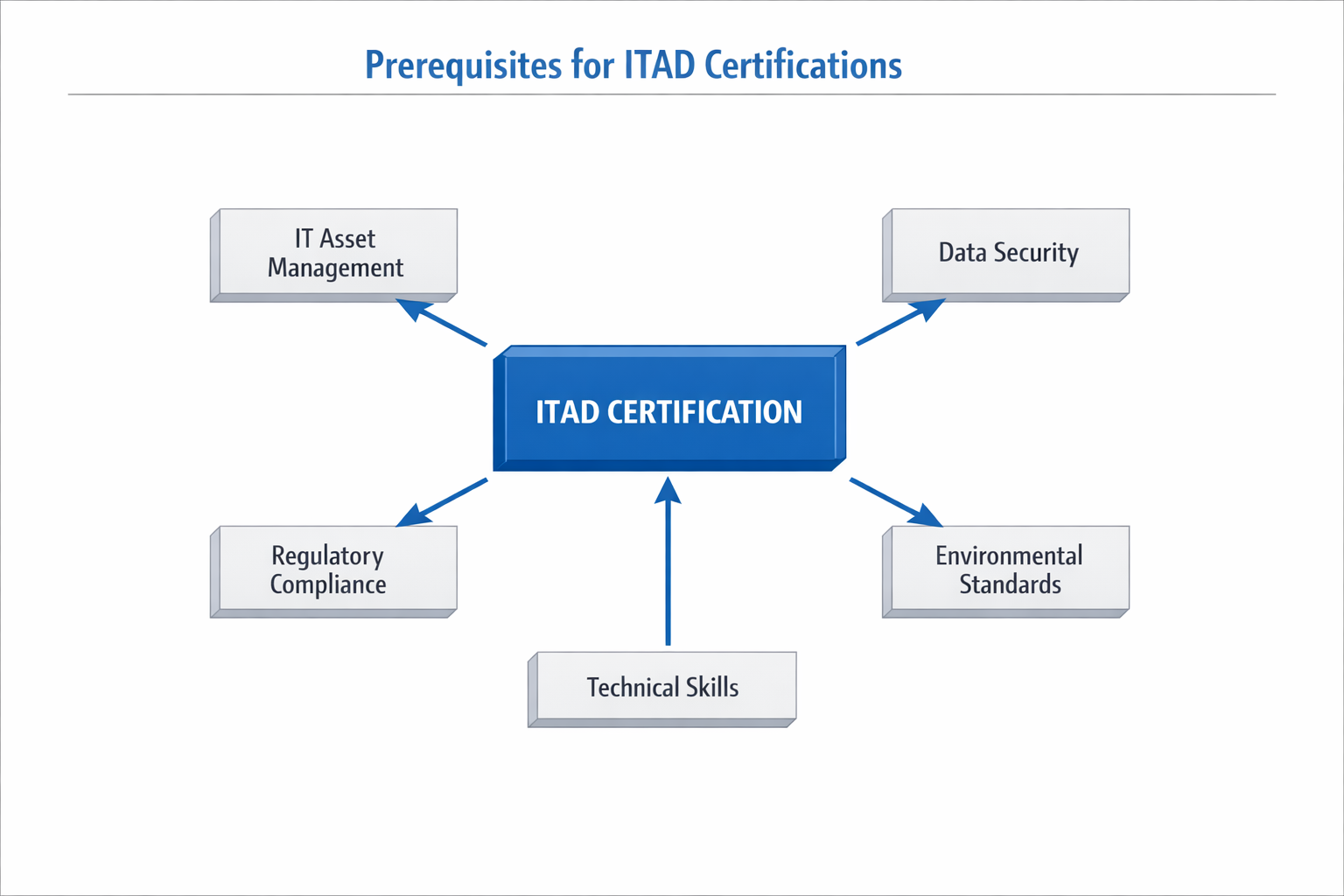
Before evaluating ITAD certifications, you need a working understanding of three foundational concepts: what your organization considers sensitive data, the regulatory frameworks that govern its disposal, and the basic lifecycle of IT assets from procurement to end-of-life. Without these anchors, certification labels become noise rather than decision criteria.
Understanding Your Data Security Requirements
Start by identifying which assets in your inventory contain or have touched regulated data. This includes not just servers and laptops, but network switches, routers, mobile devices, and storage arrays. Each device category carries different erasure requirements, and certifications address them with varying levels of specificity. If you cannot map your asset types to their data-handling risk, you cannot evaluate whether a vendor's R2v3 certification or NAID AAA accreditation actually covers your exposure.
Familiarize yourself with the difference between data destruction standards and environmental recycling standards. Media Sanitization: Understanding NIST 800-88 Standards provides the technical baseline for sanitization methods, while certifications like R2v3 and e-Stewards layer environmental and chain-of-custody controls on top of that baseline. The two domains overlap but are not interchangeable.
Regulatory and Compliance Context
Know which regulations apply to your organization. HIPAA-covered entities face serialized chain-of-custody requirements that differ from GDPR's right-to-erasure timelines or SEC recordkeeping rules. Certifications do not exempt you from regulatory obligations; they provide frameworks that make compliance easier to demonstrate. If you do not know your regulatory surface area, you cannot judge whether a certification's audit trail will satisfy your examiner.
R2v3 certification requires third-party auditors to verify compliance with data security, environmental responsibility, and worker safety. Facilities must document data destruction processes, manage materials responsibly, and ensure worker safety protocols. Understanding what third-party verification entails—and what it does not cover—prevents the assumption that a certificate alone equals regulatory compliance.
Basic ITAD Process Knowledge
You should understand the five-stage ITAD workflow: asset intake and inventory, data sanitization, functional testing and refurbishment where applicable, material recovery or destruction, and certificate issuance. Certifications apply controls at different stages. NAID AAA focuses heavily on the destruction stage, while R2v3 spans the full lifecycle. Knowing where each certification exerts its strongest influence lets you match vendor capabilities to your operational gaps.
R2v3 sets ten Core Requirements that every certified facility must meet, plus optional process appendices that apply only to specific activities such as data sanitization and materials recovery. If your disposal includes both erasure and physical destruction, ensure the vendor's certification scope covers both appendices, not just the core standard.
Step-by-Step Guide to Understanding ITAD Certifications
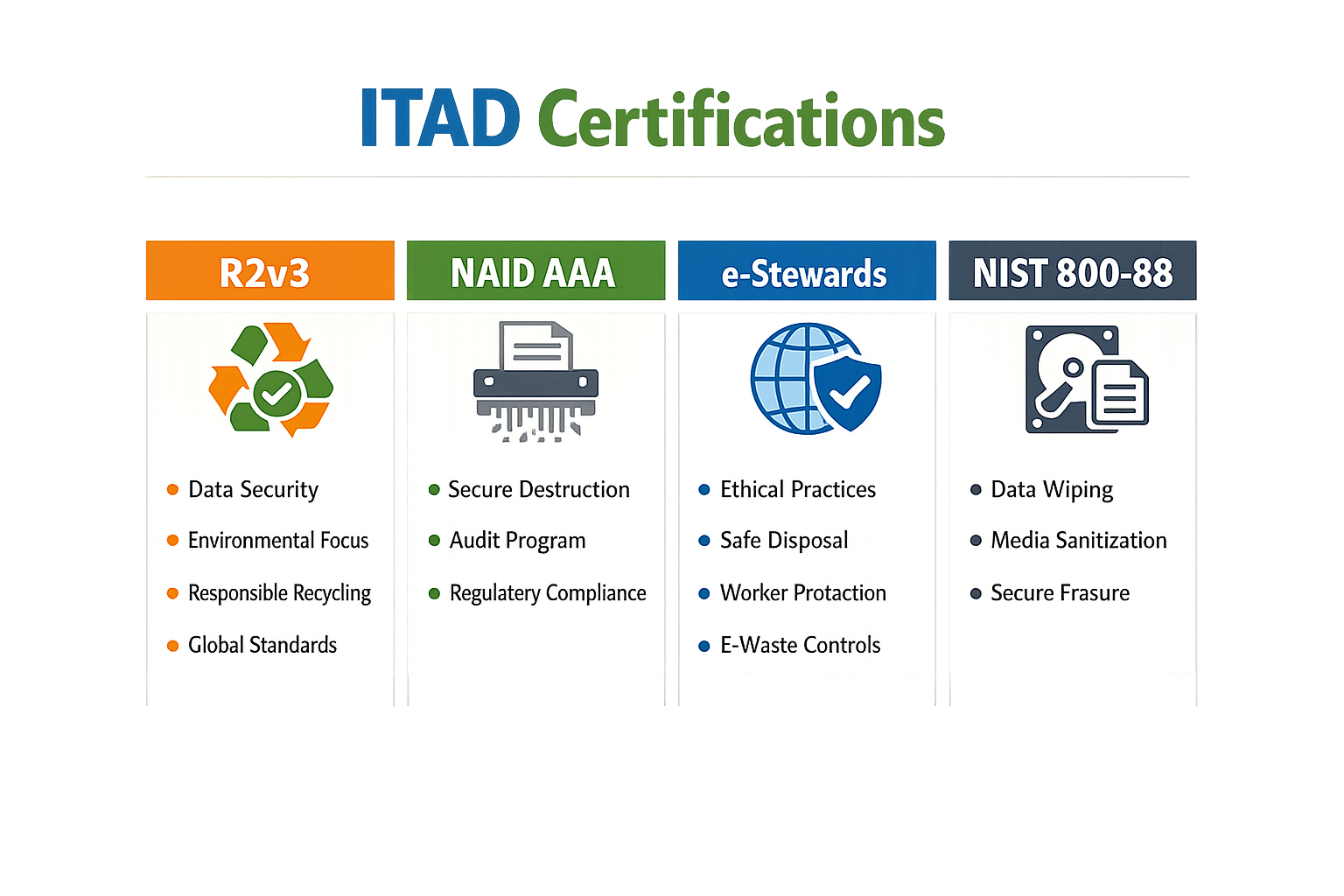
Understanding the landscape of ITAD certifications requires a methodical approach. Each certification addresses distinct operational domains—data security, environmental responsibility, and regulatory compliance—and no single credential covers all three comprehensively. The following guide breaks down the four primary certifications enterprises encounter during vendor evaluation.
R2v3 Certification: Responsible Recycling Standards
Step 1
Understand R2v3's core framework
R2v3 (Responsible Recycling) is the most widely adopted electronics recycling standard globally, managed by Sustainable Electronics Recycling International (SERI) and endorsed by the U.S. Environmental Protection Agency (EPA). The certification requires compliance across four core pillars: Data Protection, Environmental Management, Hierarchy of Responsible Practices, and Chain of Custody and Accountability. Unlike previous versions, R2v3 mandates independent certification for each facility, not at the corporate level, which means multi-site vendors must certify every location separately.
Step 2
Evaluate R2v3's data security requirements
R2v3 has evolved from earlier versions by significantly enhancing data security requirements. Certified facilities must implement documented data destruction procedures, track assets through the entire processing chain, and maintain accountability for downstream vendors. However, R2v3 does not prescribe specific sanitization methods—it requires that facilities follow a documented process and verify its effectiveness, leaving the technical implementation to the vendor's discretion.
NAID AAA Certification: Data Destruction Focus
Step 3
Assess NAID AAA's operational scope
NAID AAA certification focuses exclusively on secure data destruction processes, covering physical destruction (shredding, crushing, degaussing) and logical sanitization methods. Unlike R2v3, which addresses the full lifecycle of electronics recycling, NAID AAA certifies only the destruction phase. Vendors holding NAID AAA certification undergo unannounced audits to verify that destruction procedures match documented protocols, making it a strong indicator of process integrity for the specific destruction operation.
Step 4
Identify NAID AAA's limitations
NAID AAA does not address environmental management, downstream recycling practices, or asset remarketing. A vendor may hold NAID AAA certification for on-site shredding while subcontracting other ITAD services to uncertified partners. When evaluating vendors, verify which specific services fall under the NAID AAA scope and which do not.
e-Stewards Certification: Environmental and Ethical Standards
Step 5
Understand e-Stewards' environmental focus
e-Stewards certification, managed by the Basel Action Network, emphasizes rigorous environmental standards and prohibits the export of hazardous electronic waste to developing countries. The certification requires adherence to strict downstream vendor vetting, ensuring that all materials are processed by certified facilities. e-Stewards also incorporates data security requirements, though its primary differentiator is environmental accountability rather than destruction methodology.
Step 6
Compare e-Stewards to R2v3
Both e-Stewards and R2v3 address environmental responsibility and data security, but e-Stewards imposes stricter prohibitions on waste export and downstream vendor practices. R2v3 allows certain exports under documented conditions, while e-Stewards prohibits them entirely. For organizations with strong environmental mandates or regulatory requirements around waste export, e-Stewards provides a more restrictive framework.
NIST 800-88: Media Sanitization Guidelines
Step 7
Recognize NIST 800-88's role as a guideline
NIST Special Publication 800-88 Revision 2 (published 2025-09-26) is the current media sanitization standard, providing technical guidelines for clearing, purging, and destroying data-bearing media. Unlike R2v3, NAID AAA, and e-Stewards, NIST 800-88 is not a certification—it is a federal guideline that vendors reference when implementing sanitization procedures. Vendors do not "hold" NIST 800-88 certification; instead, they claim compliance with its methods.
Step 8
Verify NIST 800-88 compliance claims
When a vendor states they follow NIST 800-88, request documentation showing which specific methods (Clear, Purge, or Destroy) they apply to each media type. The guideline provides multiple acceptable techniques for each category, and vendors may implement different methods depending on asset type and client requirements. Understanding NIST 800-88 standards ensures you can evaluate whether a vendor's claimed compliance matches your data sensitivity requirements.
| Certification | Primary Focus | Certification Body | Audit Frequency |
|---|---|---|---|
| R2v3 | Environmental + Data Security | SERI | Annual |
| NAID AAA | Data Destruction | NAID | Unannounced |
| e-Stewards | Environmental Ethics | Basel Action Network | Annual |
| NIST 800-88 | Sanitization Guidelines (not a certification) | NIST | N/A |
Troubleshooting Common Issues with ITAD Certifications
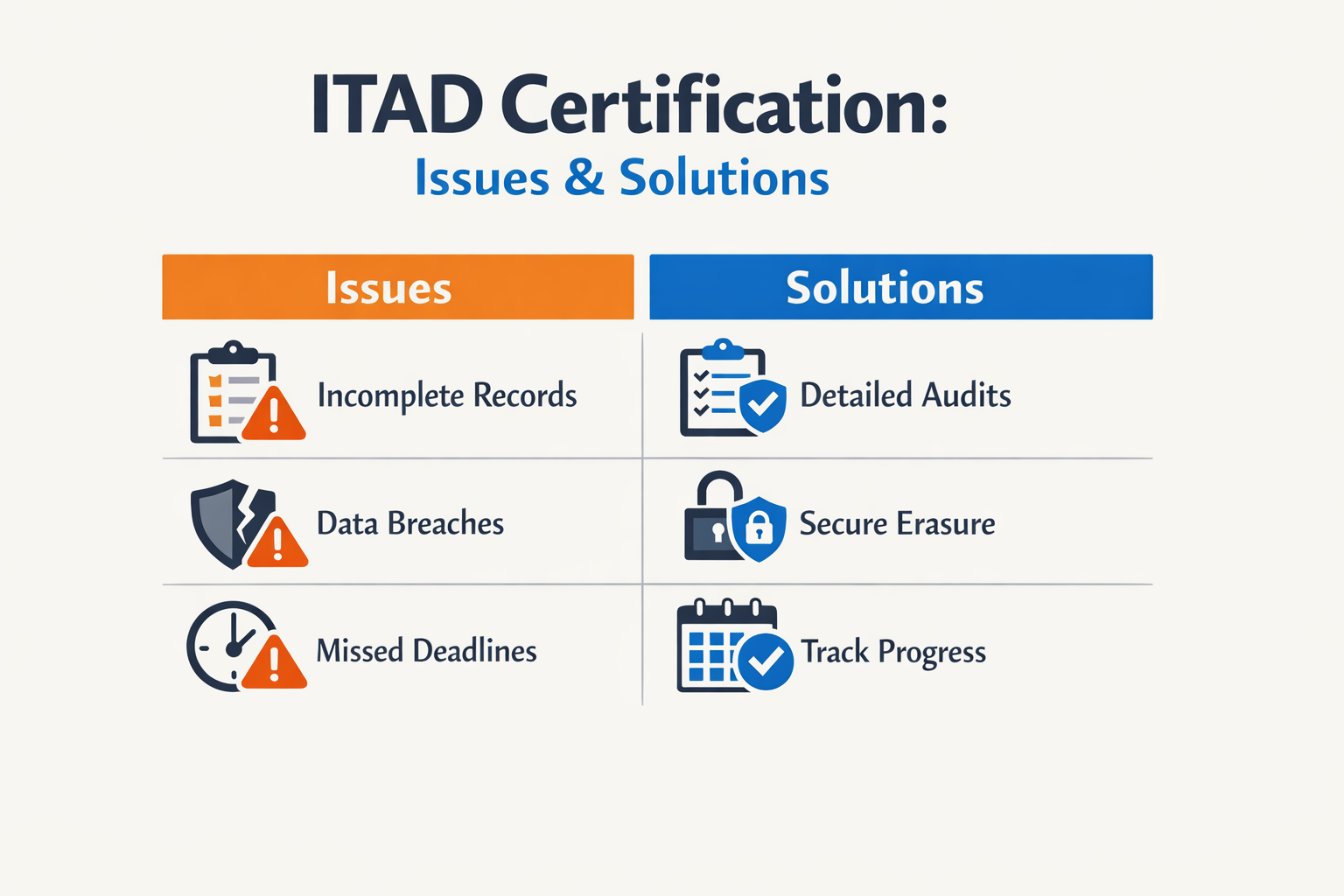
Even organizations with strong compliance intent encounter predictable friction points when implementing certified ITAD programs. The gap between a vendor's certificate and their actual operational practice creates the majority of these issues. Understanding where failures occur—and how to address them before they escalate—separates organizations that maintain compliance from those that discover problems during audits.
Downstream Vendor Accountability Gaps
The most common issue is the "certified front door, mystery back door" problem. A vendor holds R2v3 certification but subcontracts portions of the work to unqualified downstream partners. The original certificate does not transfer liability for what happens after the handoff.
To resolve this, require vendors to provide a complete chain-of-custody map during contract negotiation. Ask specifically: which processes occur on-site under the certification, and which processes are subcontracted. For subcontracted work, request proof that downstream partners hold equivalent certifications. If the vendor resists this disclosure, treat it as a disqualifying signal.
Certificate Versus Methodology Mismatches
Many vendors reference a certificate of data destruction in marketing materials that differs structurally from the certificate described in their published methodology. This creates confusion during audits when the documentation you receive does not match the documentation you were promised.
The fix is procedural: before signing a contract, request a sample certificate of destruction and compare it line-by-line against the vendor's methodology document. Verify that serial numbers, sanitization methods, and personnel signatures appear in both documents. If the sample certificate omits any element described in the methodology, the certificate may not survive regulatory scrutiny.
Export Policy Conflicts in Global Operations
Organizations with international footprints often encounter conflicts between R2v3 and e-Stewards export policies. R2v3 allows controlled exports of e-waste to audited facilities, providing operational flexibility for global supply chains. e-Stewards enforces a zero-tolerance policy on exporting hazardous e-waste to developing countries, which can restrict options for multinational deployments.
| Certification | Export Policy | Best Fit |
|---|---|---|
| R2v3 | Controlled exports to audited facilities | Global operations with vetted partners |
| e-Stewards | Zero tolerance for hazardous exports | Domestic-only or strict environmental posture |
If your organization operates across borders, map your disposal footprint against each certification's export rules before selecting a vendor. A vendor certified under one standard may not be able to service all your locations under that certification's constraints.
Financial Risk Exposure from Non-Certified Disposal
The Morgan Stanley case illustrates the financial consequences of improper IT disposal. The Office of the Comptroller of the Currency imposed a $60 million civil money penalty in October 2020 for failures in vendor due diligence and disposal controls — one of four proceedings arising from the same decommissioning, which together came to $161.5 million. Organizations often underestimate this risk until enforcement action occurs.
To mitigate exposure, treat certification as a minimum entry requirement, not a differentiator. If a vendor cannot produce current certification documentation during the RFP process, eliminate them from consideration regardless of price. The cheapest vendor is the one whose paper trail you trust enough to hand the auditor without flinching.
Incomplete Documentation During Audits
Audits frequently fail because the documentation provided by the ITAD vendor does not map cleanly to the organization's asset inventory. Serial numbers are missing, sanitization dates do not align with chain-of-custody timelines, or certificates reference batch processing when regulators expect individual asset tracking.
The solution is to establish documentation requirements in the contract before any assets move. Specify that each asset must be tracked individually by serial number, that certificates must be issued within a defined timeframe after processing, and that any gaps in the chain of custody must be escalated immediately. Test the vendor's documentation process with a small pilot batch before committing to a full deployment.
Conclusion
ITAD certifications—R2v3, NAID AAA, e-Stewards, and NIST 800-88—form the operational backbone of secure, compliant IT asset disposition. R2v3 certification ensures secure and verifiable destruction of sensitive data, compliance with environmental regulations, and prevention of illegal e-waste export, supporting the circular economy. NAID AAA focuses on physical destruction verification, e-Stewards addresses downstream environmental risk, and NIST 800-88 Rev. 2 provides the technical framework for media sanitization. Together, these standards create overlapping layers of protection that reduce both data breach exposure and regulatory liability.
The business case for certification is measurable: R2-certified facilities consistently command 20-40% higher prices on surplus IT assets compared to uncertified competitors. Beyond resale value, certification reduces audit friction, accelerates vendor onboarding, and provides defensible documentation when regulators or auditors request proof of disposal. Organizations that align their ITAD strategy with the appropriate certifications—matching R2v3's environmental focus, NAID AAA's destruction rigor, e-Stewards' export controls, or NIST 800-88's sanitization methodology to their specific risk profile—gain both operational efficiency and legal defensibility.
Applying the Framework
R2v3 sets ten Core Requirements that every certified facility must meet, plus optional process appendices that apply only to specific activities such as data sanitization and materials recovery. When evaluating vendors, verify that their certification scope matches your asset types: a vendor certified for general electronics recycling may not hold the data-destruction appendix required for storage media. Cross-reference the vendor's certificate against their published methodology to confirm alignment—this simple check surfaces the discrepancies that survive marketing copy but fail under audit.
In our editorial review of 35 vendor profiles, we noticed the same pattern in twenty-two of them: the certificate of data destruction referenced in marketing material was structurally different from the certificate referenced in the vendor's published methodology. This gap between representation and practice is where compliance failures originate. The certifications described in this guide provide the verification infrastructure to close that gap, but only when procurement teams demand certificate copies, scope statements, and chain-of-custody documentation before the first asset leaves the building. How to Choose an ITAD Vendor: 12 Simple Expert Steps walks through the due diligence sequence that turns certification claims into verifiable assurance.
ITAD certifications are not interchangeable compliance checkboxes—they are specialized tools addressing distinct failure modes. Deploy them accordingly, verify their scope before engagement, and build the documentation trail that survives the audit you hope never comes.
Explore ITAD Certifications: R2v3, NAID AAA, e-Stewards, and NIST 800-88, and understand their importance in 2026.
Related reading
ASCDI Renames to The ITAD Association, Stakes a Standards-Body Position in a Fragmented Industry