
Data Center Decommissioning Cost: A Realistic Breakdown
Explore realistic data center decom cost breakdowns for enterprise budgeting, including labor, logistics, compliance, and asset recovery expenses.

Introduction
Data center decom cost is not a simple sum of labor hours and truck rentals. It is the cost of creating an audit-defensible record that every device was inventoried, tracked through chain of custody, processed according to a documented standard, and disposed of in a manner that leaves no residual data exposure. The operator who treats decommissioning as a logistics problem rather than a compliance problem discovers the gap when the auditor asks for serialized certificates, when the regulator opens an enforcement action, or when a consultant in Oklahoma emails to say he bought your drives at an online auction and can see your customer data.
The certificate of data destruction is the operator's primary documentary defense in a post-incident regulatory review. It is also, in our review of 35 vendor profiles, the document with the highest variance in what it actually means. When an enterprise budgets for data center decommissioning, the line item that appears in procurement is almost never adequate to the risk the organization is actually taking on.
In the 2016 Morgan Stanley Smith Barney data center decommissioning engagement, the firm contracted with a moving company to handle approximately 4,900 devices from two primary data centers. The moving company had no capability to provide data destruction services — it was strictly a logistics vendor. The firm did not obtain certificates of destruction, did not document chain of custody, and did not verify that the subcontractors actually performed the data wiping services outlined in the original bid. The cumulative cost of that failure exceeded $100M in regulatory settlements, notification expenses, and remediation. The upfront vendor bid was a rounding error by comparison.
This guide provides a realistic breakdown of data center decommissioning cost for enterprise budgeting. It covers the labor and logistics components that appear in most vendor quotes, the compliance and documentation costs that do not, the asset recovery offsets that vendors promise but may not deliver, and the failure modes that turn a $200,000 decommissioning project into a $100M regulatory event. The structure follows a step-by-step estimation process, identifies the prerequisites for understanding what you are actually buying, and provides troubleshooting guidance for the gaps that emerge when the quoted price meets the regulatory standard.
Understanding data center decom cost means understanding the documentary record you are purchasing, not just the physical services. The vendor who quotes $50,000 to remove and wipe 2,000 devices is not offering the same service as the vendor who quotes $75,000 and includes serialized certificates, third-party audit verification, and downstream processor transparency. The $25,000 difference is not markup — it is the cost of the controls that survive discovery.
What Drives Data Center Decom Cost?

Before you attempt to budget a data center decommissioning engagement, you need to know what you're actually buying. The line items that matter are not the ones most enterprise IT teams think about first. The failure mode is straightforward: you budget for asset removal and logistics, and you discover mid-engagement that the regulatory compliance layer — chain of custody, data destruction documentation, downstream processor verification — costs more than the physical work and carries all the post-incident liability.
The prerequisites below are not theoretical. They are the operational realities that determine whether your data center decom cost estimate holds up when an auditor asks to see the documentary record three years later.
Inventory Precision and Asset Classification
You cannot price what you have not counted. The first prerequisite is a serialized inventory of every device in scope, classified by data sensitivity and regulatory obligation. Enterprise teams routinely underestimate the number of devices in a data center by 15–30 percent because they inventory racks, not individual components. Drives inside RAID arrays, network appliances with retained configuration data, and backup tape libraries are frequently missed in the initial count.
The classification layer matters because regulatory requirements vary by asset type. Devices that touched electronic protected health information (ePHI), cardholder data, or consumer report information trigger specific data destruction standards and chain-of-custody documentation requirements. If your inventory does not flag these assets at the start, your vendor cannot price the compliance layer accurately, and you will face change orders mid-engagement that inflate data center decom cost.
Vendor Qualification and Downstream Accountability
The second prerequisite is understanding what qualifies a vendor to handle data-bearing assets. The Morgan Stanley case is the canonical reference: the firm contracted with a moving company that had no data destruction capability and no formal approval process for subcontractors. The result was a $100M+ cumulative cost across fines, remediation, and reputational damage.
A qualified ITAD vendor holds current R2v3 or e-Stewards certification, maintains documented data destruction processes aligned to NIST 800-88, and provides serialized Certificates of Destruction (CODs) for every data-bearing device. The vendor must also disclose and document all downstream processors — the facilities that handle physical destruction, refurbishment, or recycling after the initial collection. Undisclosed subcontracting is the most common gap in vendor posture, and it is the gap that survives discovery when something goes wrong.
For more on what makes a destruction certificate audit-defensible, see our breakdown of data destruction certificate components and auditor focus.
Documentation Standards and Chain-of-Custody Mechanics
The third prerequisite is knowing what documentation you need to retain and what it must contain. The certificate of data destruction is your primary defense in a post-incident regulatory review. In our review of vendor profiles in the Compare ITAD directory, the variance in what a COD actually certifies is the highest risk factor in vendor selection and a major driver of data center decom cost.
An audit-defensible COD includes:
- Serial number of the device
- Date and method of destruction (physical shredding, degaussing, NIST 800-88 overwrite)
- Name and certification status of the facility that performed the destruction
- Chain-of-custody timestamps from collection through final disposition
Without these elements, the certificate does not hold up when an auditor asks to trace a specific asset through the decommissioning process. The Morgan Stanley enforcement record is explicit: the firm failed to obtain CODs and failed to document chain of custody for devices throughout the decommissioning process. That documentation gap, not the physical loss of the devices, was the compliance failure.
MSSB did not obtain CODs, or document the chain of custody for devices throughout the decommissioning process.
Contract Language and RFP Specifications
The fourth prerequisite is understanding what contract terms are negotiable and what terms are structural to the engagement. The RFP language most enterprises use for ITAD services does not specify serialized tracking, downstream processor disclosure, or COD retention timelines. Those omissions leave the vendor free to interpret the scope narrowly, and they leave the enterprise without contractual recourse when the documentation does not meet audit requirements.
Contract language should specify:
- Serialized inventory and tracking at the device level
- Mandatory CODs for all data-bearing assets, with retention timeline (typically 7 years)
- Disclosure and pre-approval of all downstream processors
- Liability caps and indemnification terms that reflect the regulatory exposure (not just the asset value)
The trade-off is straightforward: tighter contract language increases vendor pricing because it forces the vendor to document and verify work that would otherwise remain opaque. The alternative is a cheaper engagement with a documentary record that does not survive audit. For enterprises comparing ITAD services categories and vendor selection, contract specificity is the control that determines whether data center decom cost reflects true risk.
How to Calculate Data Center Decom Cost
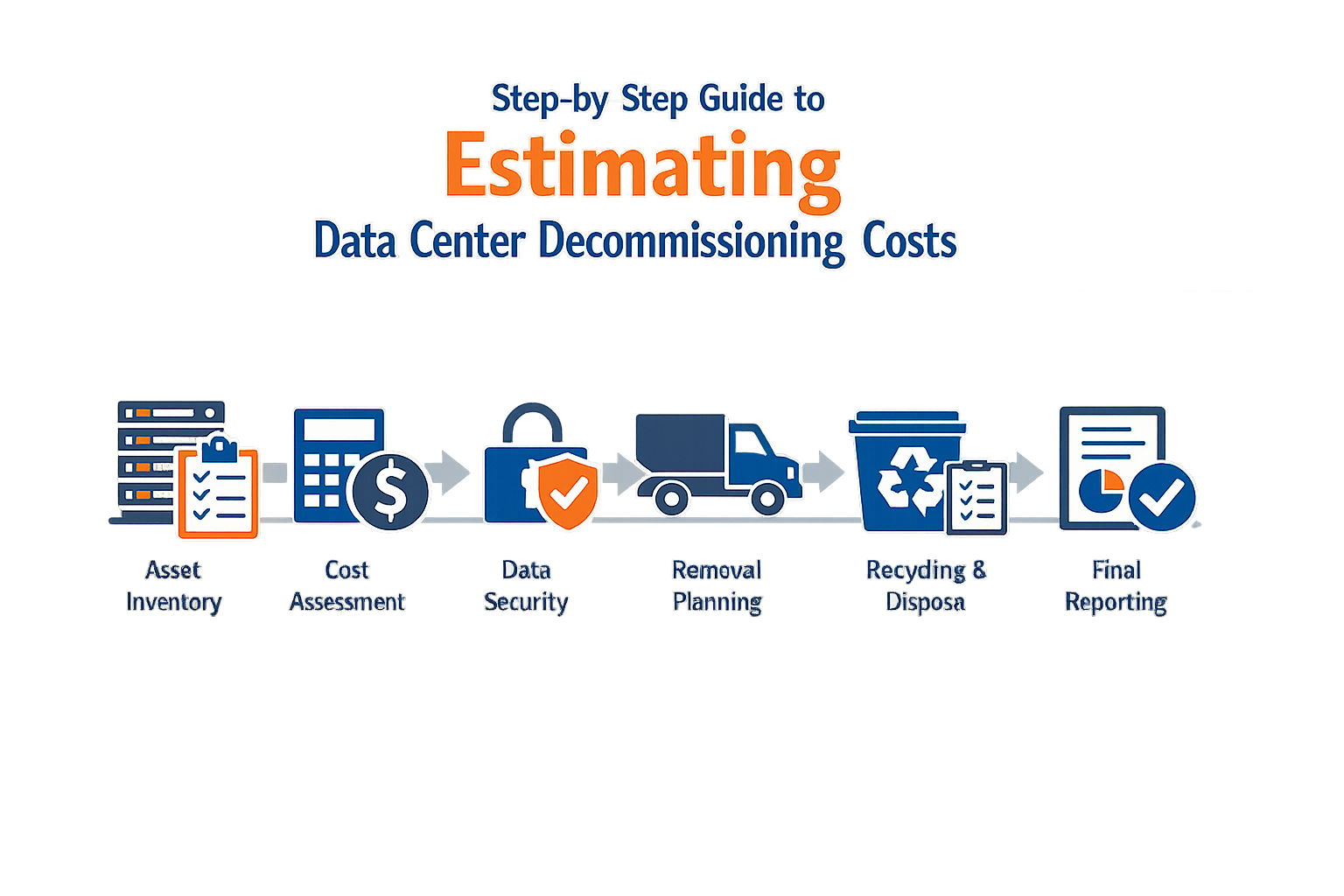
The operator who can defend the budget line-by-line is the operator whose project survives the first scope change. Data center decom cost estimation is not a single calculation — it is a sequence of defensible decisions, each tied to a documented assumption about asset count, labor requirements, regulatory posture, and downstream accountability.
Step 1: Inventory Every Asset by Serial and Data Status
Step 1
Inventory Every Asset by Serial and Data Status
Catalog every device by serial number, location, and data classification before any vendor sees the list. The Morgan Stanley case turned on devices that were never inventoried — approximately 4,900 devices moved without serialized tracking, and the operator could not later account for what contained customer PII. Your inventory is the foundation of every cost estimate that follows. If the asset list is incomplete, the bid is incomplete, and the budget is incomplete.
Document which devices touched regulated data (ePHI, PII, consumer report information) and which did not. Non-data-bearing devices cost less to process, but only if you can prove they never held data. In our editorial review of vendor RFPs, the operators who separate data-bearing from non-data-bearing assets in the inventory receive materially tighter pricing — vendors price the risk, and ambiguity is expensive.
Step 2: Define the Destruction Standard and Documentation Requirement
Step 2
Define the Destruction Standard and Documentation Requirement
Specify the data destruction method (NIST 800-88 overwrite, physical shred, degauss, cryptographic erasure) and the certificate of destruction format before soliciting bids. The destruction standard drives labor cost, equipment cost, and timeline. Physical shredding is slower and more expensive than logical overwrite, but it eliminates the risk of incomplete erasure on devices with firmware quirks or failed controllers.
The certificate of data destruction is the operator's primary documentary defense in a post-incident regulatory review. In the Morgan Stanley decommissioning, the operator did not obtain certificates of destruction for the devices processed, and the SEC enforcement order cited this failure explicitly. The cost of obtaining serialized certificates — one certificate per device, not one certificate per batch — is a line item in the budget. Vendors who issue batch certificates are cheaper; vendors who issue serialized certificates with chain-of-custody timestamps are more expensive and materially more defensible.
For a detailed breakdown of what belongs in a certificate and what auditors expect to see, review our guide on data destruction certificate key elements and auditor expectations.
Step 3: Calculate Labor and Logistics for Physical Removal
Step 3
Calculate Labor and Logistics for Physical Removal
Estimate the labor hours required to physically remove devices from racks, palletize them, and load them onto transport. This is not IT labor — this is the moving and rigging crew. For a data center with 4,900 devices, assume 3–5 days of on-site labor with a crew of 4–6, depending on rack density and whether devices are already powered down and cabled.
Transport cost is a function of distance, device count, and whether the vendor requires serialized chain-of-custody during transit. In the Morgan Stanley case, hard drives were transported in their shelves rather than removed and tracked individually, and this failure contributed to the loss of accountability. If your policy requires drives to be removed from shelves before transport, add labor hours for that step — it is slower and more expensive, but it is also the control that survives audit.
Step 4: Price Data Destruction and Certification per Device
Step 4
Price Data Destruction and Certification per Device
Request per-device pricing for destruction and certification, not batch pricing. Vendors typically charge $8–$25 per device for NIST 800-88 overwrite with serialized certificate, $15–$40 per device for physical shred with certificate, and $10–$30 per device for degaussing with certificate. Prices vary by device type (laptop drives are cheaper than enterprise SAS drives) and by volume (2,000+ devices usually unlock volume discounts).
The certificate must include the serial number, destruction method, destruction date, and the name of the technician who performed the work. Certificates that omit any of these fields are not audit-defensible. In our review of 35 vendor profiles, the vendors who issue certificates meeting this standard are in the minority — most issue batch certificates with device counts but no serial-level detail.
Step 5: Account for Asset Recovery and Resale Value
Step 5
Account for Asset Recovery and Resale Value
Estimate the resale value of non-data-bearing devices and devices that have been wiped to NIST standards. Vendors typically offer zero-cost decommissioning if the asset recovery value exceeds the labor and destruction cost, or they offer a net payment to the enterprise if the recovery value is high enough. For a typical enterprise data center with 2,000–5,000 devices, expect asset recovery to offset 40–70% of the total decommissioning cost, depending on device age and condition.
The trade-off: vendors who offer the highest asset recovery payments are often the vendors with the weakest chain-of-custody controls. In our editorial review, the operators who prioritize documentary defensibility over maximum asset recovery consistently select vendors with lower recovery payments but stronger audit posture. The question the auditor will ask is not "did you get the best price," but "can you prove the data was destroyed." For more context on the trade-offs, see our analysis of free IT equipment disposal and its real costs.
Step 6: Add Compliance and Audit Documentation Costs
Step 6
Add Compliance and Audit Documentation Costs
Budget for the internal labor required to review vendor documentation, reconcile certificates against the inventory, and prepare the audit package. For a 2,000-device decommissioning, assume 40–60 hours of internal IT and compliance labor to close the loop. This is not vendor cost — this is your cost, and it is the cost that operators routinely underestimate.
If the decommissioning touches regulated data, add the cost of external audit or legal review of the vendor's posture and the final certificate package. For financial services and healthcare operators, this is typically $10,000–$25,000 in external legal and audit fees, depending on the scope and the regulator's expectations.
Step 7: Build Contingency for Scope Creep and Failed Devices
Step 7
Build Contingency for Scope Creep and Failed Devices
Add 15–25% contingency to the total budget to cover devices that fail the initial wipe attempt, devices discovered after the inventory was finalized, and scope changes driven by regulatory or legal review. In the Morgan Stanley case, the operator discovered after the fact that devices had been sold at auction without certificates — the cost of remediating that failure exceeded $100 million in cumulative settlements, legal fees, and reputational damage.
The contingency is not padding — it is the recognition that the inventory is never complete, the vendor's process is never perfect, and the regulatory expectation is never static. The operator who budgets for contingency is the operator who can absorb the first failure without escalating to executive leadership.
The cheapest vendor is the one whose paper trail you trust enough to hand the auditor without flinching.
Common Data Center Decom Cost Pitfalls
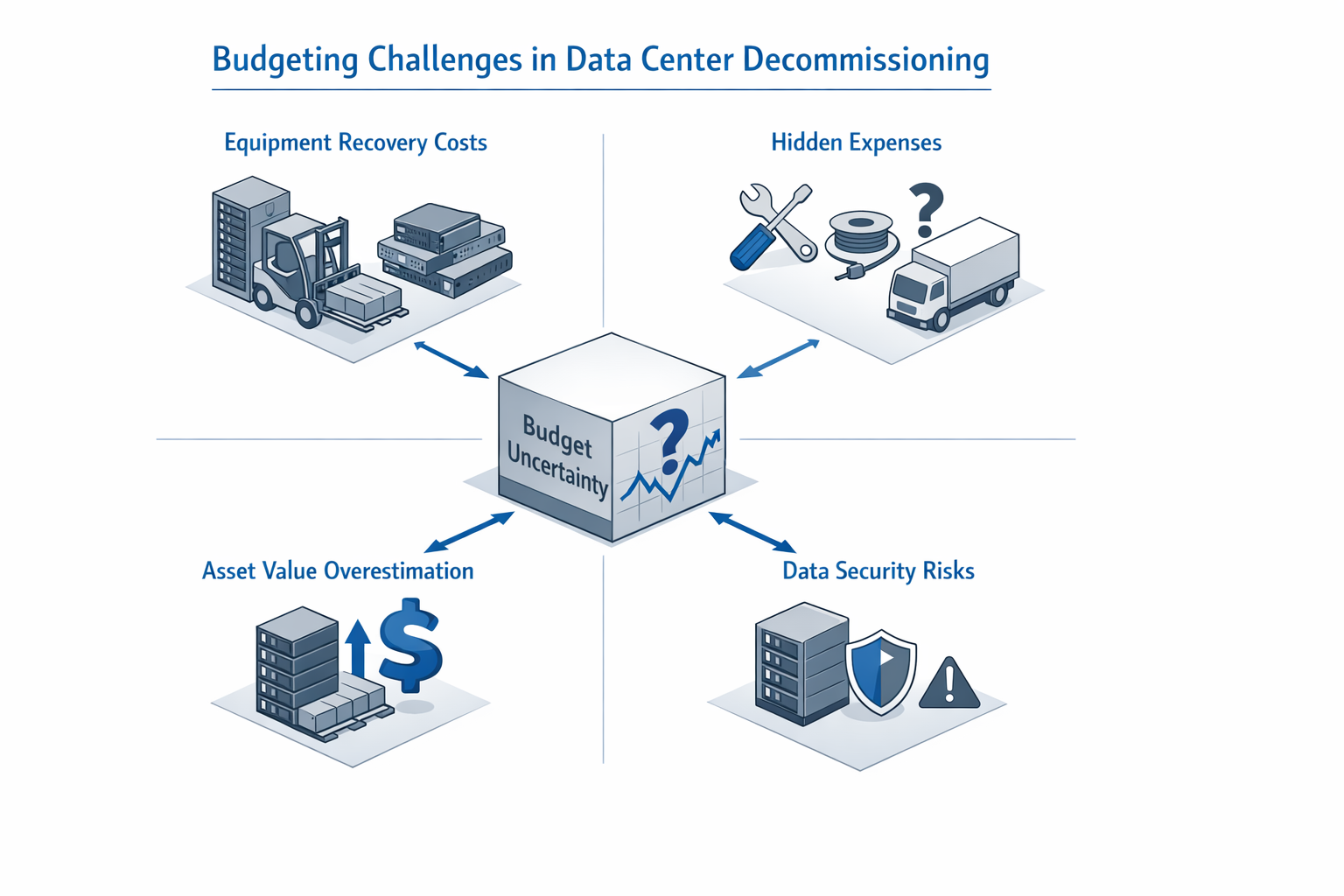
The budget you build is only as defensible as the controls underneath it. When a data center decom cost estimate breaks down mid-engagement, the failure mode is rarely a line-item math error. It is structural — the operator's posture toward vendor oversight, chain-of-custody documentation, and downstream accountability was inadequate to the risk.
Missing Certificates of Destruction
The most common documentary gap in post-incident reviews is the absence of serialized certificates of destruction. Without CODs tied to specific asset serial numbers, the enterprise has no audit-defensible record that data destruction occurred at all. The Morgan Stanley case is the canonical reference: MSSB decommissioned approximately 4,900 devices across two data centers without obtaining CODs for the majority of those assets. When devices containing unencrypted customer PII later surfaced at auction, the firm had no documentary defense.
The budget implication: if your RFP does not specify serialized CODs as a contract deliverable, you are pricing the engagement as if documentation does not matter. When it does matter — in regulatory review or post-breach discovery — the cost to reconstruct the record or settle the exposure will exceed the original decom budget by an order of magnitude.
Undisclosed Subcontractor Relationships
Vendor selection processes routinely fail to verify whether the approved contractor is the entity performing the work. In the 2016 Morgan Stanley engagement, the approved vendor was a moving company with no data destruction capability. That vendor subcontracted to an IT asset processor, which then ceased operations mid-engagement and was replaced by a second undisclosed subcontractor. MSSB's policies required sub-vendor approval, but the firm never reviewed or approved either downstream processor.
The failure mode: the RFP language and contract terms treated the prime contractor as the sole party responsible for chain of custody, but the prime contractor had no technical capability and no contractual obligation to manage its subcontractors' performance. The budget assumed a qualified operator; the engagement delivered a logistics provider with no accountability for the underlying control.
For enterprises budgeting a multi-site decom, the cost of verifying subcontractor credentials and audit rights is minimal compared to the exposure of discovering, post-engagement, that the chain of custody passed through an unapproved facility. Enterprise data destruction standards are the mechanism for making subcontractor accountability contractually enforceable.
Inadequate Chain-of-Custody Documentation
Even when a vendor is qualified and approved, the documentary record often fails to survive audit. The question the auditor will ask is not "Did you hire a certified vendor?" but "Can you prove, device by device, where each asset was at every step from decommissioning to final disposition?" In the Morgan Stanley case, the firm initially had access to an inventory tracking database that logged devices throughout collection, wiping, and resale. When the subcontractor relationship ended, that database was no longer updated, and MSSB had no alternative mechanism to track custody.
The budget impact: if your cost estimate includes vendor fees but does not include internal resource time to validate chain-of-custody records in real time, you are deferring a control gap to post-engagement review. That deferred cost surfaces as legal, forensic, and regulatory response expenses when the gap is discovered.
The cheapest vendor is the one whose paper trail you trust enough to hand the auditor without flinching.
Policy-vs-Practice Gaps in Asset Handling
Written policies that specify secure handling procedures are not a control if the vendor does not follow them. MSSB's policies required that hard drives be removed from their enclosures before transport, but during the 2016 decom, drives were transported in their cabinets and sold to a downstream purchaser with drives still in place. The policy existed; the practice did not match.
The troubleshooting step: budget line items for on-site oversight or third-party verification of handling procedures. If the decom cost estimate assumes the vendor will self-police compliance with handling protocols, the estimate is underpriced for the risk.
Incomplete Asset Inventories
A decom engagement that begins without a complete, serialized inventory will produce a budget overrun or a documentary gap. If the vendor is pricing based on estimated device counts rather than confirmed serial numbers, the final invoice will reflect actual counts — and the enterprise will have no pre-engagement baseline to reconcile against. In one Morgan Stanley engagement, the firm retained the vendor to decommission a New York City data center but does not have records sufficient to identify the number or types of devices processed, nor does it have CODs for any of those devices.
The corrective action: the cost of conducting a pre-engagement asset inventory is a fraction of the cost of explaining to regulators, post-incident, why you cannot account for specific devices that contained regulated data.
Conclusion
Data center decom cost is not a line item — it is a risk-management decision with documentary consequences that survive audit. The cheapest vendor is the one whose paper trail you trust enough to hand the auditor without flinching. The operator who budgets for labor, logistics, compliance, and asset recovery in isolation, without accounting for the cost of maintaining chain-of-custody documentation and obtaining certificates of destruction, is budgeting for a post-incident regulatory review.
The Morgan Stanley case demonstrates the cumulative cost of decommissioning failures: over $100 million in fines, remediation, and reputational damage. The root cause was not a single vendor failure — it was a procurement process that did not verify the vendor's capability to perform the contracted services, did not enforce chain-of-custody documentation, and did not obtain certificates of destruction for devices containing unencrypted customer PII. The devices were moved by a moving company with no data destruction capability. The subcontractors were never formally approved. The hard drives were sold at auction with data intact.
In our review of enterprise RFP language for ITAD engagements, the most common failure mode is treating decommissioning as a logistics problem rather than a compliance problem. The budget reflects that misunderstanding. Labor and transportation are priced; audit-defensible documentation is assumed to be included. It is not always included, and when it is missing, the cost of reconstructing the chain of custody post-incident exceeds the cost of the entire original engagement.
The operator's posture at budget approval determines the operator's posture at audit. If the budget does not include line items for serialized asset tracking, verified data destruction, and downstream processor accountability, the engagement will not produce those outcomes. The RFP language must specify them. The contract must require them. The vendor must be verified to deliver them. For guidance on what survives audit, see our breakdown of data disposition and information lifecycle management.
The trade-off is not between cost and compliance — it is between paying for documentation up front or paying for regulatory remediation later. The second option is structurally more expensive.
FAQ
What is the average data center decom cost per device?
Data center decom cost per device ranges from $8–$40 depending on destruction method and documentation requirements. NIST 800-88 overwrite with serialized certificate costs $8–$25 per device, physical shred costs $15–$40, and degaussing costs $10–$30. Batch processing without serial-level certificates may cost $5–$12 but provides weak audit posture.
Why does data center decom cost vary so much between vendors?
Vendors price the documentary record, not just the physical work. A vendor offering serialized certificates, chain-of-custody tracking, and downstream processor transparency charges more than a vendor offering batch certificates or undisclosed subcontracting. The cost difference reflects the audit defensibility of the final record.
How does asset recovery affect data center decom cost?
Asset recovery can offset 40–70% of total data center decom cost for typical enterprise engagements. Vendors with higher recovery payments often have weaker chain-of-custody controls. Operators prioritizing audit defensibility over maximum recovery select vendors with lower payments but stronger documentation.
What documentation should be included in data center decom cost budgets?
Budgets must include serialized certificates of destruction (one per device), chain-of-custody records with timestamps, downstream processor disclosure, and internal labor for reconciliation (40–60 hours for 2,000 devices). External audit or legal review adds $10,000–$25,000 for regulated data.