
Data Center Asset Disposal: From Decommissioned Hardware to Final
Learn about data center asset disposal from decommissioned hardware to final disposition, ensuring compliance and security throughout the process.

Introduction
Data center asset disposition is the structured process of retiring IT hardware from active service through final disposition, encompassing inventory, data sanitization, chain-of-custody documentation, and physical destruction or remarketing. The certificate of data destruction is the operator's primary documentary defense in a post-incident regulatory review. It is also, in our review of 35 vendor profiles, the document with the highest variance in what it actually means. When a data center retires hardware—servers, storage arrays, networking equipment—the information those assets carry does not vanish with the purchase order for replacement infrastructure. The disposal process must address the recorded data with the same rigor applied during its operational lifecycle, or the organization inherits a compliance and security liability that outlasts the asset's useful life.
The underlying control is not the age of the hardware or the efficiency of the refresh cycle. The control is whether the information on that hardware can be recovered after the asset leaves your custody. In our editorial review of vendor practices, the gap between what operators believe happens during disposal and what the documentary record supports remains the industry's most persistent failure mode.
A media sanitization program provides the framework for consistent, auditable disposal. According to NIST SP 800-88 Rev. 2, such a program ensures the appropriate handling of storage assets and helps avoid data breaches caused by mishandling during the disposal process. The standard identifies three sanitization methods—Clear, Purge, and Destroy—each mapped to specific threat models and media types. The question the auditor will ask is not whether you sanitized the media, but whether the method you selected, the documentation you retained, and the vendor you engaged can demonstrate that the data is irrecoverable under the threat model your organization's risk assessment requires.
In practice, data center operators face a three-part challenge. First, they must inventory what is being retired with sufficient granularity to support serialized chain-of-custody tracking. Second, they must select and verify a sanitization method appropriate to the data classification and media type. Third, they must document the entire process in a form that survives audit and, if necessary, regulatory discovery. The data destruction certificate is the artifact that ties these three elements together, and in most post-incident reviews, it is the first document regulators request.
The information security concern in media disposal resides in the recorded information, not the physical media itself. A decommissioned server with no data is scrap metal. The same server with an incomplete wipe of customer records, financial data, or protected health information is a regulatory incident waiting for discovery. The operator's posture must reflect this distinction: the hardware refresh is an operational decision, but the data sanitization is a compliance and security obligation that cannot be delegated without documented verification of the downstream process.
This guide walks through the prerequisites, step-by-step procedures, and troubleshooting practices for audit-defensible data center asset disposition. It is written for enterprise IT leads, procurement teams, and compliance officers who need to ensure that what leaves the data center does not return as a breach notification.
Prerequisites
Before any data center asset disposition engagement begins, the operator's documentary posture determines what survives audit. The prerequisites are not about vendor selection — they are about building the internal record that makes vendor selection defensible.
Inventory and Classification Before Contact
Catalog every asset by serial number, location, and data classification before any vendor sees the list. If the inventory is fuzzy, the bid is fuzzy, and the chain-of-custody documentation will be fuzzy too. The organization's data governance process should specify policies for storage asset disposal, identify scope and criteria for sanitization, and determine adequacy of sanitization before any processing activities begin.
For devices that touched regulated data — ePHI, cardholder data, CUI — the classification must be serialized. Batching is not adequate for the regulatory record. The auditor will ask for the individual serial number, the date it left custody, and the method applied to that specific device.
Customer Communication and Sanitization Options
Before processing activities, customers should be informed of the advantages of sanitizing all data and the options for doing so. This is a certification-body requirement under e-Stewards, and it is also the mechanism that prevents post-incident finger-pointing. If the customer declines sanitization or requests asset return without sanitization, that decision must be documented in writing with a timestamp.
The data destruction certificate is the primary documentary defense in a post-incident regulatory review. The prerequisites determine whether that certificate is defensible or decorative.
Validation and Verification Requirements
The validation step is not the vendor's certificate — it is the internal process that confirms the vendor's certificate matches the serialized inventory. If the certificate lists 100 drives and the inventory shows 102, the gap is the operator's problem, not the vendor's.
For devices going to reuse, the verification requirement is stricter: prescribed overwrite instructions must be successfully executed for 100% of a device's physical memory locations. The certificate should state the method (NIST 800-88 Rev. 2 Clear, Purge, or Destroy), the tool, and the pass/fail result per serial.
How Does Data Center Asset Disposition Work?
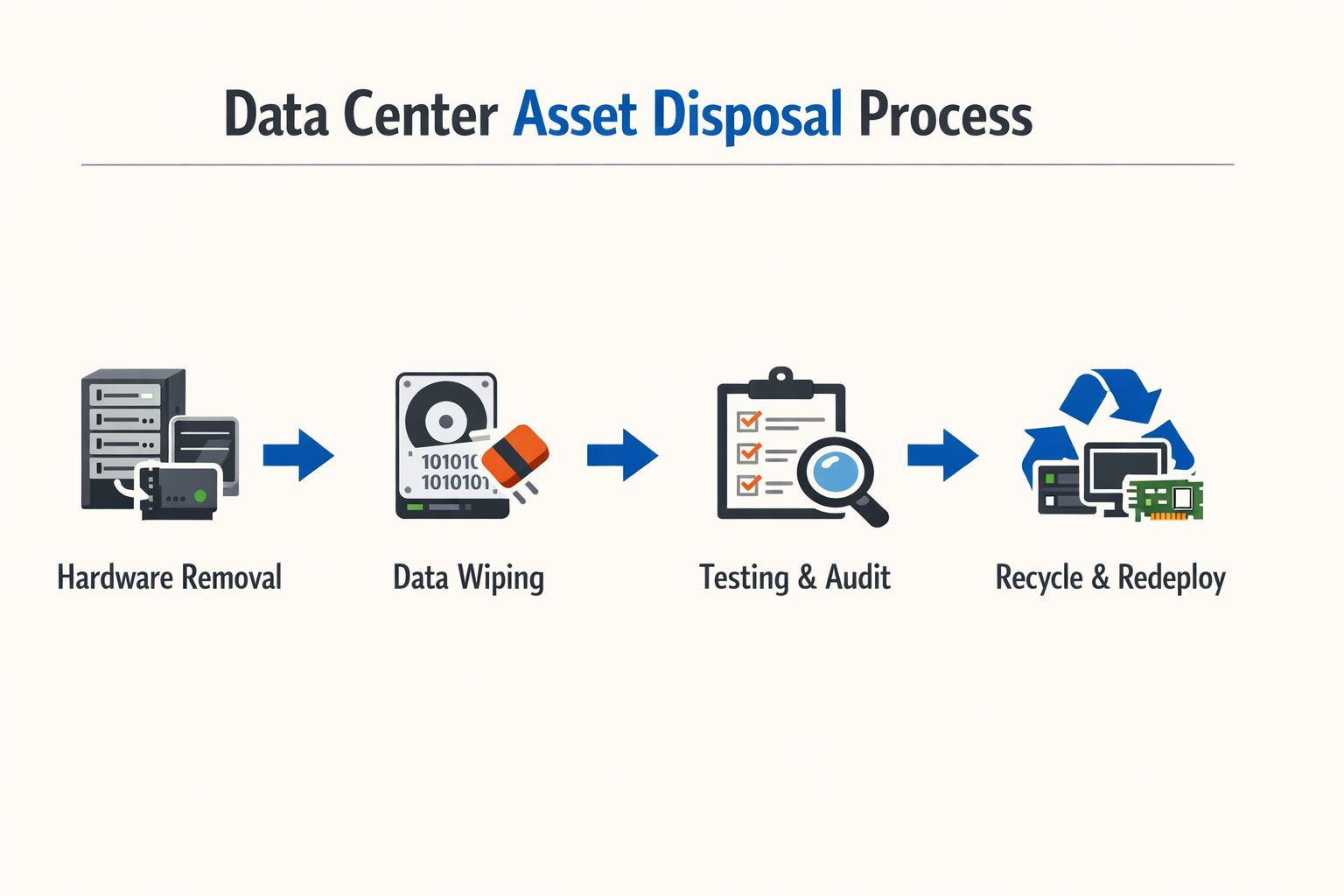
The asset disposition process is sequential. Each step builds on the last. Skip one, and the documentary record breaks — the thing that survives audit. This guide walks through the core steps that hold up under regulatory review.
Step 1: Inventory Every Asset Before Vendor Contact
Step 1
Catalog assets by serial, location, and data classification
Before any vendor sees your asset list, build a complete inventory. Record serial numbers, physical locations, and whether each device touched regulated data. If you cannot confirm a device's data status, classify it as data-bearing. Vendors price what they see; if your inventory is fuzzy, your chain of custody starts fuzzy.
In the 2016 data center decommissioning engagement that became the Morgan Stanley enforcement action, Moving Company handled approximately 4,900 devices. Many were non-data-bearing, but some contained unencrypted customer PII. The operator's inability to track which devices held what data contributed to the compliance failure.
Step 2: Define Sanitization Requirements by Asset Type
Not all assets require the same treatment. Hard drives holding customer financial records demand different handling than network switches that never stored persistent data. Map each asset class to a sanitization method that matches its risk profile and the regulatory framework you operate under.
NIST SP 800-88 (the withdrawn Rev. 1, now superseded by Rev. 2) provided a three-tier framework: Clear, Purge, Destroy. The current NIST SP 800-88 Rev. 2 refines these categories but retains the core principle — the sanitization method must match the confidentiality level of the data and the media type.
Step 3: Select a Vendor with Verified Credentials
Vendor selection is not a procurement exercise in finding the lowest bid. It is a risk-transfer decision. The vendor you choose becomes the custodian of your regulatory exposure. Their certification posture, their downstream processor relationships, and their documentary practices all determine what survives audit.
Look for vendors with current R2v3 or e-Stewards certification. Verify their NAID AAA certification if they perform on-site shredding. Confirm they do not subcontract data destruction to unnamed downstream processors without disclosure. In the Morgan Stanley case, Moving Company subcontracted to IT Corp A, then ceased using IT Corp A mid-engagement without notifying the operator. The inventory tracking database went dark, and certificates of destruction stopped being issued.
The cheapest vendor is the one whose paper trail you trust enough to hand the auditor without flinching.
For enterprise IT teams evaluating ITAD vendors, the Data Destruction Certificate: Key Elements and Auditor Expectations article provides a detailed breakdown of what the certificate must contain to survive regulatory scrutiny. Organizations new to the ITAD acronym should review the stakeholder roles before vendor selection.
Step 4: Establish Chain-of-Custody Documentation Before Pickup
Chain of custody begins the moment assets leave your physical control. The vendor must provide a manifest at pickup that matches your inventory. Serial numbers, asset tags, and counts must reconcile. Any discrepancy at pickup is a gap that never closes.
The contract should specify:
- Serialized tracking for all data-bearing assets
- Real-time access to the vendor's inventory database (if available)
- Certificates of data destruction issued per asset or per batch, depending on volume
- Certificates of indemnification (COIs) only after destruction is verified, not at pickup
In the Morgan Stanley engagement, IT Corp B provided COIs after taking possession of devices, indicating they assumed risk and ownership. But the devices had not been sanitized. The COIs created a false assurance of transfer when the underlying control — data destruction — had not occurred.
Step 4
Verify manifest accuracy at pickup
Have your team witness the loading process. Compare the vendor's pickup manifest against your master inventory in real time. Sign nothing until counts and serials reconcile. A mismatch at this stage is easier to resolve than a missing asset discovered six months later during an audit.
Step 5: Track Assets Through Sanitization
Once assets are in the vendor's custody, you lose physical control. Documentary control is all you have. The vendor must provide interim status updates and, critically, certificates of data destruction (CODs) that tie back to your original inventory by serial number.
CODs are the operator's primary documentary defense in a post-incident regulatory review. They must include:
- Serial number or asset tag for each device
- Sanitization method used (NIST-compliant overwrite, degaussing, shredding)
- Date and location of destruction
- Name and signature of the technician who performed the work
- Vendor's certification body and certificate number
During the 2016 data center decommissioning, IT Corp A ceased providing CODs early in the engagement. This information was available to the operator but not acted upon. The absence of CODs was a visible signal that the contracted process had broken.
Step 6: Reconcile Final Disposition Against Original Inventory
When the vendor declares the engagement complete, perform a full reconciliation. Every asset on your original inventory must have a corresponding COD, a resale record (if the asset was refurbished), or a destruction certificate (if it was shredded). Any asset without a final disposition record is a regulatory gap.
In the Morgan Stanley case, hard drive shelves were transported with drives still in place, contrary to the operator's policies. The shelves were sold to another purchaser with drives intact. The operator did not discover this until a consultant in Oklahoma purchased drives from an online auction and contacted the firm to report he had access to customer data.
Step 6
Audit the final disposition report
Request a final disposition report from the vendor that lists every asset by serial number, its disposition method, and the date completed. Cross-check this report against your master inventory. Any missing serials require a written explanation from the vendor before you close the engagement.
Step 7: Retain All Documentation for the Regulatory Period
The engagement does not end when the last asset is processed. It ends when the regulatory retention period expires. For financial services firms under SEC jurisdiction, that can be six years or more. For healthcare entities under HIPAA, the retention period is six years from the date of creation or last use.
Retain:
- The original inventory
- The vendor contract
- All pickup manifests
- All certificates of data destruction
- All certificates of indemnification (if issued)
- The final disposition report
- Any correspondence with the vendor regarding discrepancies or process changes
These documents are what the auditor will request. If you cannot produce them, the auditor will assume the process failed.
What Are Common Data Center Asset Disposition Failures?
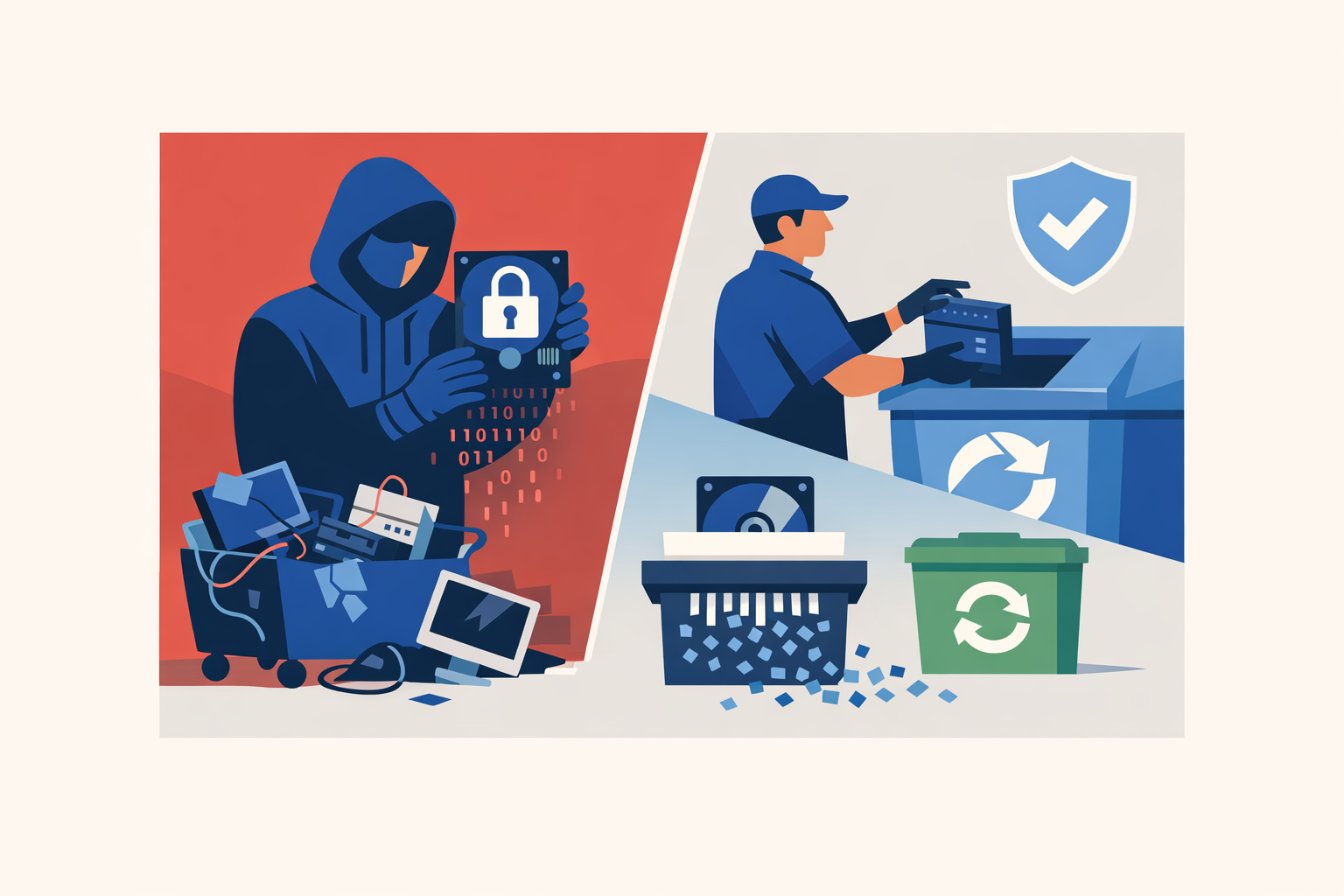
The documentary record is where most data center asset disposition failures surface. A vendor that provided certificates of destruction for six months can stop providing them without warning. A contract that required serialized tracking can shift to batch processing. In the Morgan Stanley case, the vendor changed subcontractors mid-engagement, the tracking database went offline, and no one at the firm noticed until devices appeared at auction a year later.
Vendor Changes Subcontractors Without Notice
The most common failure mode in multi-party engagements is undisclosed downstream changes. The primary vendor stops using the contracted destruction partner and shifts work to a different processor. The customer retains access to the original tracking system, which shows no new activity. The new processor does not provide certificates of destruction.
The fix: Contract language must require advance written notice of any subcontractor change, and the engagement must pause until the new processor's credentials are verified and the customer confirms the tracking mechanism still functions. If certificates stop arriving, the operator's first action is to halt asset movement until the vendor explains the gap in writing.
Hard Drives Transported in Enclosures
Internal policy often requires that drives be removed from shelves and cabinets before transport. The vendor receives the instruction, acknowledges it in the kickoff call, and then loads entire RAID arrays onto trucks with drives in place. The drives remain in their enclosures through transport, warehousing, and resale.
This failure occurs when the contract does not define "device" with the precision the downstream process requires. The vendor interprets "device" as the full cabinet; the customer's policy defines "device" as the individual drive. The mismatch is invisible until the devices appear intact at a secondary buyer.
The fix: The RFP and contract must specify the unit of custody. If the requirement is drive-level tracking, the contract must state "each drive serialized individually" and "drives removed from enclosures before transport." The operator should require photographic confirmation at the point of deinstallation, not at the vendor's warehouse.
Certificates Issued Before Destruction Occurs
Some vendors issue certificates of destruction at the time of pickup, before any destruction activity. The certificate lists the asset by serial number and states that destruction occurred on a specific date. The actual destruction happens weeks later, or in some cases, not at all.
This pattern emerges when the vendor's revenue model depends on resale rather than destruction fees. The certificate satisfies the customer's compliance checklist, and the vendor retains flexibility to refurbish and resell higher-value units. The documentary record shows compliant destruction; the physical reality is different.
The fix: The certificate must include the destruction method, the date destruction occurred, and the name of the facility where it occurred. If the vendor cannot provide those details at the time of issuance, the certificate is a placeholder, not a record. Operators should verify that the destruction date on the certificate post-dates the pickup date by a realistic interval.
Tracking Database Access Disappears Mid-Engagement
The vendor provides real-time access to an inventory tracking system. The customer's compliance team logs in weekly to confirm progress. Midway through the engagement, the database stops updating. Login credentials still work, but no new records appear. The vendor assures the customer that processing continues and that the database will be updated retroactively.
This scenario indicates that the original processor is no longer handling the work. The database belongs to the subcontractor, and when the subcontractor exits, the database goes dark. The vendor does not disclose the change because the contract prohibits subcontracting without approval.
The fix: The contract must require continuous access to a tracking system that updates within 48 hours of each custody event. If access is interrupted or data stops flowing, the engagement pauses until the vendor restores access or provides an equivalent system with full historical data. The operator should export the full database weekly as a local backup.
Vendor Sells Assets Described as Destroyed
The vendor provides certificates stating that devices were physically destroyed. Months later, the same serial numbers appear in an online auction or at a secondary reseller. The buyer contacts the original owner, believing the devices were stolen.
This failure occurs when the vendor's contract with the downstream processor allows resale of units that pass functional testing, overriding the destruction instruction from the customer. The vendor issues destruction certificates to satisfy the customer's compliance requirement, while the actual disposition is resale.
The fix: The contract must state that the customer's disposition instruction is binding on all downstream parties and that resale is prohibited for any unit the customer has designated for destruction. The operator should periodically search secondary markets for the firm's asset tags and serial numbers. For more on what the certificate must contain to hold up in audit, see our breakdown of data destruction certificate components and auditor focus.
Conclusion
Data center asset disposition is not a process you complete once and forget. It is a recurring operational requirement with regulatory exposure that compounds over time. The documented failure modes—hard drives sold at auction with customer data intact, certificates of destruction issued for devices never processed, subcontractors substituted mid-engagement without notification—are not edge cases. They are the predictable outcome of treating disposition as a procurement checkbox rather than an audit-defensible control.
The operator's posture matters more than the contract language. A vendor with R2v3 certification and a fixed-price bid is not inherently safer than one with higher pricing and transparent chain-of-custody documentation. The question the auditor will ask is not whether you selected a certified vendor. The question is whether you can produce serialized tracking records, timestamped certificates of data destruction, and contractual evidence that the downstream processor you paid for is the processor who actually handled the devices. If you cannot answer that question with documentary evidence, the certification is irrelevant.
In our review of operator-submitted RFPs and post-incident regulatory filings, the gap is structural. Enterprise IT teams run vendor selection processes optimized for cost and speed, not for the documentary record that survives discovery. The result is a contract that specifies data destruction but does not specify how you will verify it occurred, a certificate that confirms devices were received but not that they were processed, and an invoice that shows payment but not serialized proof of disposition. When the breach notification arrives—or the consultant in Oklahoma emails to say he bought your drives at auction—the operator discovers that the paper trail does not exist.
Start with inventory before you bid. Catalog every asset by serial number, data classification, and regulatory retention requirement before any vendor sees the list. Require serialized chain-of-custody tracking in the contract, not as an add-on service but as the baseline deliverable. Specify the data destruction method by name—NIST 800-88 Rev. 2 overwrite, physical shredding to defined particle size, degaussing with field-strength verification—and require timestamped certificates tied to individual serial numbers, not batch summaries. Audit the documentary record quarterly, not annually. Verify that the processor named in the contract is the processor handling the devices, and that no undisclosed subcontractors entered the chain.
The cheapest vendor is the one whose paper trail you trust enough to hand the auditor without flinching. If you are selecting on price alone, you are selecting for risk. For a deeper look at what makes a certificate audit-defensible, see our breakdown of data destruction certificate components and auditor focus. Organizations managing disposal of IT assets across multiple sites should review the process standardization guidance before scaling vendor engagements.
FAQ
What is the difference between data center asset disposal and data center asset disposition?
Data center asset disposition is the formal, auditable process that includes inventory, sanitization, chain-of-custody tracking, and final disposition (destruction or remarketing). Disposal is the informal term often used interchangeably, but disposition carries the regulatory and compliance weight.
What sanitization standard should data center operators follow?
NIST SP 800-88 Rev. 2 (published September 2025) is the current media sanitization standard. It superseded Rev. 1 in its entirety. Any program referencing Rev. 1 as current is citing a withdrawn standard.
How do I verify a vendor actually destroyed my data-bearing assets?
Require serialized certificates of data destruction that include the serial number, sanitization method (Clear, Purge, or Destroy per NIST 800-88 Rev. 2), destruction date, facility location, and technician signature. Reconcile every certificate against your original inventory before closing the engagement.
What happens if the vendor changes subcontractors without telling me?
The chain-of-custody breaks. If certificates stop arriving or the tracking database stops updating, halt the engagement immediately. Require written disclosure of any subcontractor change before resuming asset movement.
Can I rely on a vendor's R2v3 or e-Stewards certification alone?
Certification confirms the vendor follows a documented management system, but it does not guarantee your specific engagement will be executed correctly. Verify serialized tracking, real-time database access, and timely certificate issuance regardless of certification status.