
How Managed IT Services Handle Equipment Refresh Cycles
Introduction
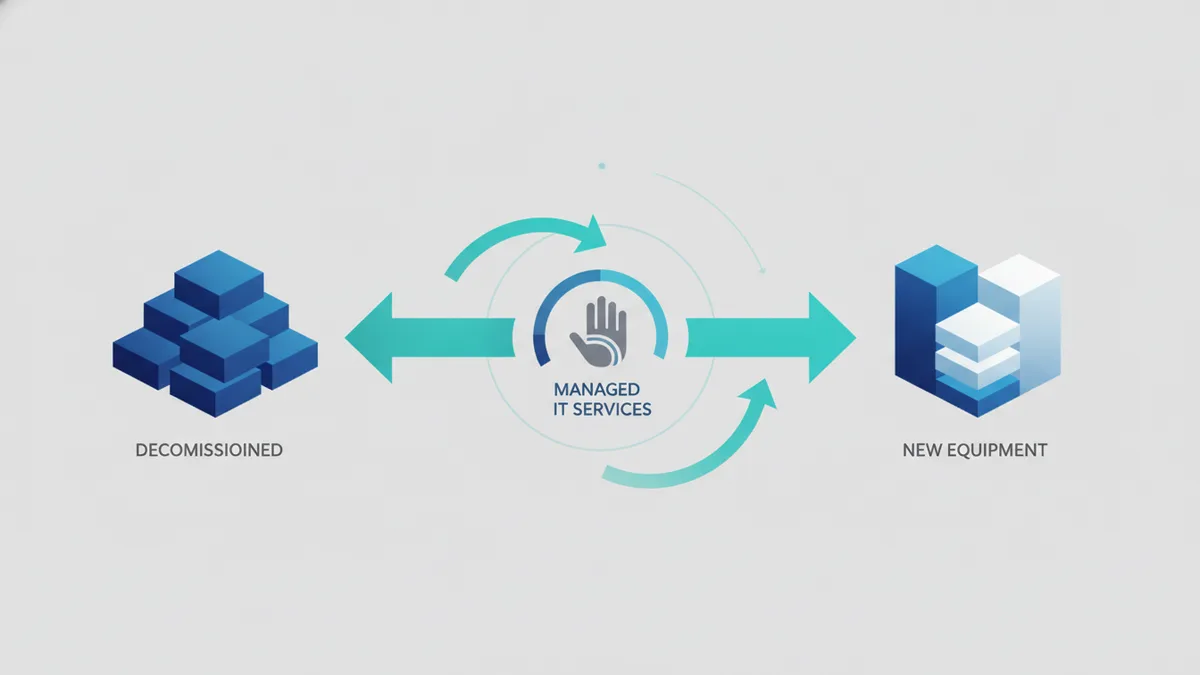
Managed IT services equipment refresh cycles sit at the intersection of operational performance, capital planning, and regulatory risk. In enterprise IT environments, the refresh cycle is not simply a procurement event—it is a chain-of-custody process that begins with asset deployment and ends with verified destruction or resale. The documentary record that survives this process determines what holds up in audit and what exposes the organization to enforcement.
In our editorial review of ITAD vendor engagements across the Compare ITAD directory, the pattern is clear: managed IT services equipment refresh cycles' operational efficiency depends on the quality of the underlying disposition process. Organizations that treat refresh as a procurement-only function routinely fail to address the chain-of-custody gaps that emerge when equipment leaves the building. The Morgan Stanley case serves as the canonical reference. The failure wasn't in the data destruction methodology—it was in the chain-of-custody documentation that should have survived the auction and didn't. When devices containing unencrypted customer data reached downstream purchasers with no verifiable destruction record, the cumulative regulatory cost exceeded $100M.
Managed IT services address this structural problem by integrating refresh planning with ITAD vendor oversight, serialized asset tracking, and contract language that specifies what the certificate of data destruction must contain. The operator-side implication is straightforward: if the refresh cycle does not produce audit-defensible records at every handoff, the cycle itself is a liability. For a deeper examination of what those records must contain and how to structure them for regulatory review, see our complete guide to IT asset documentation.
The sections that follow diagnose the common failure modes in unmanaged refresh cycles, outline the solution steps managed IT services deploy to address them, and provide operator-grade guidance on contract language, vendor selection, and chain-of-custody verification. The goal is not to describe an idealized process—it is to name what goes wrong at each stage and what to do about it.
What Goes Wrong Without Managed IT Services Equipment Refresh Cycles?
Organizations managing equipment refresh cycles without adequate IT support face a recurring set of operational and documentary failures. The most consequential failures are not in the technology itself but in the chain-of-custody documentation that should survive the decommissioning process. When that documentation fails, the organization's regulatory defense fails with it.
Undocumented Subcontracting and Vendor Substitution
A common failure mode: the primary vendor substitutes a downstream processor without formal approval or notification. In the 2016 Morgan Stanley data center decommissioning, Moving Company ceased working with its original subcontractor early in the engagement and shifted to a different processor. Morgan Stanley's policies did not ensure visibility into this substitution, and the firm never reviewed or approved the replacement subcontractor. The invoices continued to reference services that were no longer being performed, and the firm paid them.
This pattern recurs across industries. Organizations engage a vendor, assume the vendor's internal processes are stable, and do not build contract language or oversight mechanisms to detect when the vendor changes its downstream relationships. The result is a break in the chain of custody that the organization does not discover until after an incident.
Certificate-vs-Practice Gaps
The second failure mode is the gap between what a certificate of destruction says and what actually happened. In the same engagement, Moving Company provided certificates labeled as Certificates of Data Destruction (CODs) that were in fact Certificates of Indemnification (COIs) from the downstream processor. The COIs documented transfer of possession and assumption of risk, not data destruction. The firm's internal teams did not detect the substitution because the documents carried the downstream processor's logo and were transmitted via email in the same manner as prior CODs.
This is not a one-time incident. In our editorial review of vendor profiles and documented enforcement actions, the pattern is clear: certificates that do not specify serial-number-level verification, destruction method, and technician attestation are frequently certificates of something other than destruction. Organizations that accept batch attestations or generic statements of compliance discover the gap only when an auditor or regulator asks for the underlying records.
Incomplete Asset Tracking and Serial Number Reconciliation
The third failure mode is incomplete asset tracking at the point of decommissioning. Morgan Stanley's 2017 server decommissioning engagement required a COD identifying each of the 244 hard drives across 61 servers. The vendor provided a COD, but the serial numbers did not match the firm's records. The mismatch triggered an internal review, which eventually determined that the drives bore multiple serial numbers and that the firm and the vendor had inventoried using different identifiers. Because the devices had already been destroyed, the serial numbers could not be readily reconciled, and the firm had to obtain manufacturer records to validate the match.
This scenario is operator-grade risk. When asset tracking is not serialized at the point of handoff, and when the vendor's inventory does not map cleanly to the client's inventory, the documentary record becomes unreliable. The question the auditor will ask is whether the organization can prove that the devices it decommissioned are the same devices the vendor destroyed. If the answer depends on post-destruction manufacturer lookups, the chain of custody did not hold.
The cheapest vendor is the one whose paper trail you trust enough to hand the auditor without flinching.
Policy-vs-Practice Failures in Physical Handling
The fourth failure mode is the gap between documented policy and actual field practice. Morgan Stanley's policies required that hard drives be removed from their shelves before transport to ensure individual tracking and destruction. During the 2016 decommissioning, the drives were transported in their cabinets, and the cabinets were sold to a downstream purchaser with the drives still in place. Witnesses from both the moving company and the downstream processor confirmed the practice, which contradicted the firm's written procedures.
This is a structural risk in any engagement where the client does not have on-site oversight during the physical decommissioning process. Written policies that specify drive-by-drive handling are meaningless if the vendor's field teams do not follow them and the client has no mechanism to verify compliance in real time. For more on creating documentation that survives this kind of operational variance, see IT Asset Documentation: Creating Forms That Actually Work.
The Downstream Accountability Problem
The final failure mode is the assumption that once a vendor takes possession, the vendor owns the risk. In reality, the regulatory obligation remains with the data controller. When Morgan Stanley received an email in October 2017 from an IT consultant in Oklahoma who had purchased hard drives containing the firm's data from an online auction site, the failure was not the consultant's discovery but the firm's inability to prevent it. The consultant's email noted that the firm should have obtained verification of data destruction from the vendors it sold equipment to. The firm eventually repurchased the drives, but the regulatory exposure had already materialized.
This is the operator's posture in every ITAD engagement: the certificate of destruction is the primary documentary defense in a post-incident review, and if that certificate does not document what actually happened, the defense fails. Organizations managing refresh cycles without structured IT support routinely accept certificates that would not survive discovery.
How Do Managed IT Services Equipment Refresh Cycles Work?
Managed IT services handle equipment refresh cycles through a structured process that addresses both operational continuity and the documentary requirements that survive audit. The steps below reflect the mechanisms that hold up when the auditor asks to see the chain of custody.
Step 1
Asset inventory and classification
Catalog every device by serial number, location, and data classification before any vendor engagement begins. The inventory must identify which devices contain customer data, which touched regulated information, and which are non-data-bearing. Serial-number-level tracking is not optional — batch attestations do not survive discovery when the question is whether a specific device was sanitized.
Step 2
Vendor selection and sub-vendor approval
Select an ITAD vendor with verified credentials and document the approval process for any sub-vendors in the engagement. The Morgan Stanley case turned on an undisclosed sub-vendor change: the primary contractor stopped working with the approved data destruction provider and substituted a different processor without notifying the client. Policies must require explicit approval for downstream processors and a documented review when the sub-vendor changes.
Step 3
Chain-of-custody documentation
Establish a documented chain of custody from the moment the device leaves the data center to final disposition. The chain must track physical location, data security status, and custody transfers at each stage. For devices containing customer data, the standard is serialized tracking — each hard drive's movement and sanitization status must be individually documented, not aggregated into batch records. The certificate of data destruction is the operator's primary documentary defense in a post-incident regulatory review, and its evidentiary weight depends on whether it identifies the specific device by serial number.
Step 4
Data sanitization to published standards
Sanitize all data storage devices to a published national standard or NIST SP 800-88, whichever is more stringent. The sanitization method — whether physical destruction, cryptographic erasure, or overwrite — must be documented with evidence that the process was completed. Certificates of indemnification, which simply transfer risk of loss, are not certificates of data destruction. The document must state the sanitization method applied and identify the devices processed.
Step 5
Serial-number reconciliation and validation
Reconcile serial numbers between the client's inventory records and the vendor's certificate of data destruction before closing the engagement. When serial numbers do not match, the discrepancy must be investigated and resolved with manufacturer records or other corroborating evidence. A mismatch raises the question of whether the chain of custody was maintained, and that question does not resolve in the client's favor without documentary proof.
The cheapest vendor is the one whose paper trail you trust enough to hand the auditor without flinching.
Execution and ongoing oversight
Managed IT services maintain oversight throughout the refresh cycle by requiring progress reports, interim chain-of-custody updates, and serialized tracking at each custody transfer. The engagement does not close when the devices leave the building — it closes when the certificate of data destruction is received, validated against the original inventory, and archived in a format that survives the retention period. For a detailed framework on how to structure these records, see IT Asset Documentation: Creating Forms That Actually Work.
The execution phase also includes quality management system certification verification. Vendors certified to R2v3 or e-Stewards operate under documented processes for testing, repair, and data security that are audited annually. The certification does not eliminate the need for client-side oversight, but it establishes a baseline expectation that the vendor's processes meet published industry standards. For a comprehensive overview of the ITAD process from start to finish, see our complete guide to IT asset disposition.
Tips and Tricks
Organizations evaluating managed IT services for equipment refresh cycles face a documentary challenge that most procurement teams underestimate. The contract language you negotiate today determines what survives audit three years from now. In our editorial review of vendor engagements, the pattern is clear: the operators who avoid regulatory exposure are the ones who locked down chain-of-custody mechanics before the first asset left the building.
Verify the Sub-Vendor Approval Process
Most managed service agreements allow the primary vendor to subcontract disposal and data destruction work. The operator-side implication is that you need formal sub-vendor approval rights written into the contract. The 2016 Morgan Stanley data center decommissioning turned into a $100M+ regulatory case in part because the firm never conducted a review of the downstream processors handling its equipment — the policies did not ensure that sub-vendors were reviewed or approved, and the firm was not aware when the moving company changed processors mid-engagement.
The contract language to address this: require the managed service provider to submit sub-vendor credentials for your approval before any asset changes hands, and require written notice within 48 hours if a sub-vendor relationship terminates or a new processor is introduced. If the provider resists this clause, that resistance is diagnostic.
Demand Serial-Number-Keyed Certificates
A certificate of data destruction is only as strong as its specificity. Some certificates document drive-by-drive verification with serial-number-keyed records. Others document a batch attestation by the technician on duty. Only one survives discovery. The Morgan Stanley case provides the canonical example: when the firm engaged a vendor to decommission 61 servers comprising 244 hard drives, the initial certificate did not meet the firm's standards because it failed to identify each drive individually. The firm requested an updated certificate, but the serial numbers did not match internal records, raising concerns about a break in the chain of custody.
The RFP language to address this: require that every certificate of destruction include the manufacturer serial number, the asset tag, the destruction method, the date, the facility location, and the technician's name for every individual drive. Batch certificates are not audit-defensible when the regulator asks you to prove what happened to a specific device.
The cheapest vendor is the one whose paper trail you trust enough to hand the auditor without flinching.
Establish Transport Protocols Before Decommissioning Begins
Equipment transport is where chain-of-custody documentation most often fails. In the Morgan Stanley decommissioning, hard drives were transported in their cabinets rather than removed and inventoried individually, contrary to the firm's policies. The downstream processor then sold the cabinets with drives still in place. The failure mode is structural: if your policy requires individual drive removal but your contract does not specify the same requirement, the vendor will follow the contract.
The contract clause to address this: specify that all data-bearing devices must be removed from chassis, inventoried by serial number, and transported separately from non-data-bearing hardware. Require photographic documentation of the removal process and a signed chain-of-custody form at every handoff. If the managed service provider cannot meet this standard, the engagement carries more risk than most compliance teams are authorized to accept.
For organizations managing complex IT environments, IT Asset Documentation: Creating Forms That Actually Work provides additional guidance on building documentation systems that hold up under regulatory scrutiny.
Validate Invoices Against Documented Services
In the Morgan Stanley case, the moving company invoiced the firm — and was paid — for wiping and degaussing services that were never performed after the original data destruction vendor stopped working on the project. The invoices continued, the payments continued, and the services did not. The operator-side implication is that invoice review must be tied to documentary proof of service completion, not just to the vendor's billing cycle.
The mechanism to address this: require that every invoice for data destruction services be accompanied by a certificate of destruction covering the specific devices billed in that invoice, and require that your accounts payable team verify the certificate before releasing payment. This is not a trust issue. It is a control issue. The question the auditor will ask is whether you verified the work before you paid for it.
Conclusion
Managed IT services equipment refresh cycles are not administrative overhead—they are the mechanism that prevents catastrophic chain-of-custody failures. The operator's posture in an equipment refresh determines whether the documentary record survives audit or collapses under scrutiny. In our editorial review of vendor profiles and enforcement records, the pattern is clear: the refresh cycle is only as defensible as the documentation that tracks every asset from decommissioning through final disposition.
The Morgan Stanley case remains the canonical reference for what happens when chain-of-custody documentation fails. The failure wasn't in the data destruction methodology but in the absence of serialized tracking that should have survived the downstream sale and didn't. When Moving Company stopped working with IT Corp A, the inventory tracking database disappeared, certificates of data destruction ceased to arrive, and MSSB continued paying invoices for services no longer rendered. The hard drives surfaced at auction with customer data intact—not because degaussing failed, but because degaussing never occurred and no one verified it.
For organizations evaluating managed IT service providers, the refresh cycle is the moment to audit the vendor's chain-of-custody controls before the engagement begins. The RFP language must specify serialized tracking, require certificates that document drive-by-drive verification with serial-number-keyed records, and mandate approval of all downstream processors. The contract must prohibit undisclosed subcontracting and require real-time inventory visibility. These are not consultant recommendations—they are the controls that hold up in regulatory review.
The operator-side implication is straightforward: the cheapest vendor is the one whose paper trail you trust enough to hand the auditor without flinching. Managed IT services that build refresh cycles on audit-defensible documentation, verified downstream processors, and transparent chain-of-custody tracking materially reduce the risk of enforcement actions, data breaches, and the reputational damage that follows. For a deeper look at the documentation standards that survive discovery, see our Complete Guide to Secure Data Destruction for Business IT Assets.
Frequently asked questions
What are managed IT services equipment refresh cycles?
Managed IT services equipment refresh cycles are structured processes that integrate hardware replacement planning with ITAD vendor oversight, serialized asset tracking, and chain-of-custody documentation. They ensure that decommissioned equipment is tracked from deployment through verified destruction or resale, creating audit-defensible records at every handoff.
How often should equipment refresh cycles occur?
Refresh timing depends on hardware lifecycle, warranty periods, and operational requirements. Most enterprise environments refresh servers every 3-5 years, workstations every 3-4 years, and networking equipment every 5-7 years. Managed IT services align refresh schedules with budget cycles, vendor support windows, and regulatory compliance requirements.
Why is chain-of-custody documentation critical in equipment refresh cycles?
Chain-of-custody documentation is the primary documentary defense in post-incident regulatory review. When devices containing sensitive data leave the building, the organization must prove what happened to them. Without serialized tracking and verified destruction records, regulatory defense fails—as demonstrated by the Morgan Stanley case, where missing documentation resulted in over $100M in enforcement costs.
What should a certificate of data destruction include?
A valid certificate must include the manufacturer serial number, asset tag, destruction method, date, facility location, and technician attestation for every individual device. Batch certificates or generic compliance statements do not survive discovery when regulators ask for proof that a specific device was sanitized.
How do managed IT services prevent undisclosed subcontracting?
Managed IT services require explicit sub-vendor approval rights in contracts, demand written notice within 48 hours of any downstream processor change, and verify that invoices match documented services. This prevents the failure mode where vendors substitute processors mid-engagement without client awareness, breaking the chain of custody.