
IT Asset Documentation: Creating Forms That Actually Work

Introduction
IT asset documentation is the primary documentary defense when a regulator asks what happened to a specific hard drive, server, or storage array. In our review of vendor profiles and operator practices, it is also the document with the highest variance in what it actually means. Some certificates record only that a truck arrived and left. Others capture the serialized chain of custody, the specific sanitization technique applied, the tool version used, the verification method, and the name of the person who performed the validation.
NIST SP 800-88 Rev. 2 — the current media sanitization standard published in September 2025, which superseded Rev. 1 in its entirety — establishes minimum expectations for what a sanitization certificate should record. The standard specifies that following sanitization, a certificate should be completed for each information storage medium (ISM) that has been sanitized, per the organization's policies. At minimum, the certificate should record manufacturer, model, serial number, organizationally assigned media or property number (if applicable), media type, media source, sanitization method, sanitization technique, tool used including version, verification method, and information about individuals performing verification and validation.
The underlying control is not the form itself — it is the process that ensures every asset entering the environment is tracked when it leaves the place where it was last used and when it reaches the post-sanitization destination. If there is a breakdown in tracking at locations other than the post-sanitization destination, sanitization records will only show that specific devices were sanitized, not whether the organization is effectively sanitizing all devices introduced into the operating environment. For organizations managing data center decommissioning projects, this gap becomes material when an auditor compares the asset inventory at project start to the certificates produced at project end.
What Makes Documentation Audit-Defensible
An audit-defensible IT asset documentation form is one that answers the question the auditor will ask: what happened to this specific device, and how do you know? The form must tie a unique identifier — serial number, asset tag, or bar code — to a specific sanitization action, a verification result, a date, a location, and a person. Generic batch certificates that state "50 hard drives were shredded on this date" do not survive discovery when the question is "what happened to serial number XYZ123?"
The documentary record must also reflect the confidentiality categorization of the data on the device. NIST SP 800-88 Rev. 2 notes that organizations should align their data classification scheme (low, medium, and high security categorizations) with minimum acceptable sanitization methods (clear, purge, and destroy). A form that does not capture pre-sanitization confidentiality categorization cannot demonstrate that the chosen sanitization method was appropriate to the data.
In practice, the operator's posture on documentation quality is visible in the first draft of the certificate form they send during vendor evaluation. If the form lacks fields for serial numbers, verification methods, or personnel signatures, the operator is signaling that their process does not generate those records — and retrofitting documentation rigor after contract signature is structurally difficult.
Problem Statement
The gap between an organization's IT asset documentation forms and what survives regulatory review is wider than most IT teams realize. In post-incident enforcement actions, regulators do not accept process descriptions or policy statements — they ask for serialized records, chain-of-custody logs, and certificates of disposition. When those records are incomplete, missing, or internally inconsistent, the documented failure becomes the regulatory finding.
The Documentation Gaps That Trigger Enforcement
Three documented enforcement actions illustrate the failure modes. In the Morgan Stanley case, the firm failed to document final disposition of decommissioned devices, including certificates of data destruction and chain-of-custody records. When a subcontractor provided Certificates of Indemnification (COIs) — documents that merely acknowledged possession and risk transfer — and labeled them as Certificates of Destruction (CODs), the firm accepted them without verification. The regulatory finding was not that data was recovered; the finding was that the documentary record could not prove it had been destroyed.
In the Affinity Health Plan enforcement, the organization failed to assess and identify security risks in photocopier hard drives before disposal. The absence of a risk assessment record — not the discovery of a breach — became the HIPAA violation. The regulatory position was clear: if you did not document the risk assessment, you did not perform it.
The Structural Problems in Current Forms
Most IT asset documentation forms fail in predictable ways. They capture asset identifiers (make, model, serial number) but omit the confidentiality categorization that determines which sanitization method is acceptable. They record that an asset "left the building" but do not track custody transfers between the loading dock, the transport vendor, the processing facility, and the downstream buyer or destructor. They collect a vendor's certificate of destruction but do not verify that the certificate describes the specific devices listed in the shipment manifest.
The Morgan Stanley case documented a particularly instructive failure: the firm had direct access to the vendor's tracking database throughout the collection, wiping, and resale process, but no one at the firm monitored the database or maintained direct contact with the processor to ensure devices were handled according to contract terms. The form existed. The database existed. The verification step did not.
What the Standards Require
NIST SP 800-88 Rev. 2 specifies that a certificate of sanitization should record manufacturer, model, serial number, media type, media source, pre-sanitization confidentiality categorization, sanitization method and technique, tool used (including version), verification method, and the identity of personnel performing verification and validation. The standard notes that "the value of a certification of media disposition depends on the organization's handling of ISM over the ISM's life cycle" — records maintained when media is introduced to the environment, when it leaves its last-used location, and when it reaches post-sanitization destination.
When organizations track assets at the post-sanitization destination but not at earlier custody-transfer points, the sanitization records show only that specific devices were sanitized, not whether the organization is effectively sanitizing all devices introduced into the operating environment. The gap between "these devices were processed" and "all devices were accounted for" is where regulatory exposure lives.
Solution Steps for Creating Effective IT Asset Documentation Forms
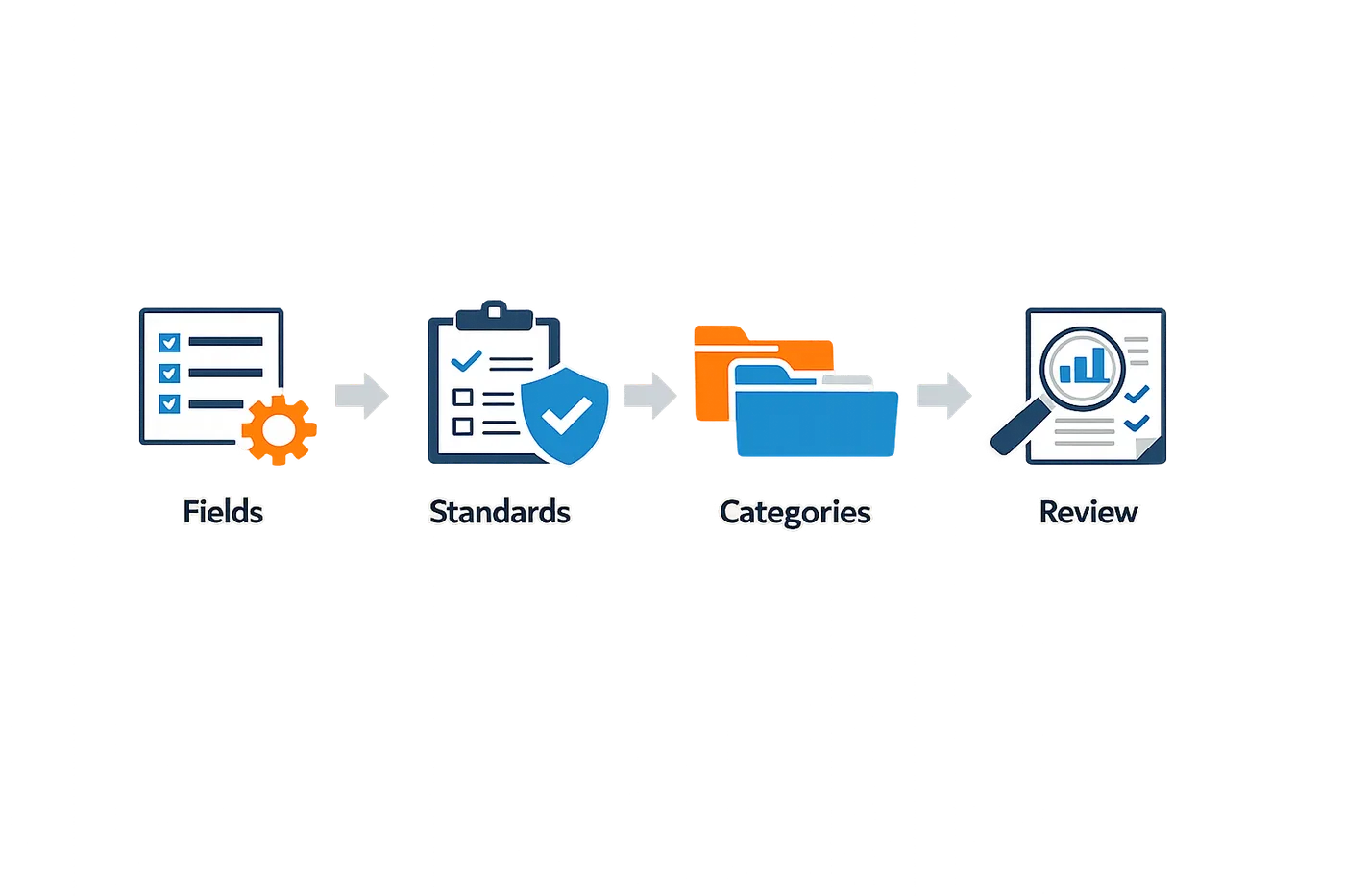
The gap between a form that exists and a form that survives audit is structural. Most IT asset documentation forms fail not because the operator forgot to fill them out, but because the form itself was designed without the audit question in mind. What follows is a sequential build — each step produces a documentary artifact that holds up when the question is asked.
How Do You Identify What the Auditor Will Ask For?
Step 1
Start with the regulatory requirement, not the workflow
Before designing a single field, identify the compliance obligations that govern the asset class. NIST SP 800-88 Rev. 2 requires documentation of sanitization method, verification method, and the individuals performing verification and validation. The e-Stewards Standard requires chain-of-custody documentation that tracks physical location and data security status throughout custody. These are not suggestions — they are the minimum documentary record that survives a post-incident review.
The form must capture these elements as discrete, auditable fields. A freeform "notes" field does not meet the requirement when the auditor asks for verification method. A checkbox for "sanitization complete" does not meet the requirement when the regulator asks who performed the validation and when.
How Do You Build the Minimum Viable Certificate?
Step 2
Use the NIST certificate template as the baseline
NIST SP 800-88 Rev. 2 provides a sample Certificate of Sanitization form in Appendix C. At minimum, the certificate should record manufacturer, model, serial number, media type, sanitization method, sanitization technique, tool used (including version), verification method, and information on individuals performing verification and validation (name, position, date, location, contact information, signature). Organizations operating under e-Stewards certification must additionally track accumulation containers' physical locations and sanitization status for non-serialized devices.
This is the operator-grade baseline. If your form does not capture these fields as structured data, it is not adequate to the risk. The certificate is not decoration — it is the primary documentary defense when the question is asked.
How Do You Implement Tracking Throughout the Chain of Custody?
Step 3
Document every custody transfer and location change
The chain-of-custody requirement is not satisfied by an intake form and a destruction certificate. The e-Stewards Standard requires documentation of physical location and data security status throughout the chain of custody. For serialized devices, this means tracking by manufacturer-designated serial number or assigned unique identifier. For non-serialized data storage devices, this means designating secure accumulation areas and tracking accumulation containers' physical locations until sanitization is complete.
The failure mode here is the gap — the period between intake and sanitization where the asset is in transit, in queue, or in temporary storage. If the form does not capture these intermediate states, the chain-of-custody claim does not hold up.
Step 4: Automate Where Physical Access Is Difficult
Automatic documentation becomes critical when systems make physical access to the information storage media very difficult. Some information storage media include bar codes on the label for model and serial numbers — the operator performing sanitization can scan each bar code as the media is sanitized, entering details directly into a tracking application. This approach reduces manual transcription errors and ensures real-time documentation even when the asset is embedded in a larger system.
For organizations managing data center asset disposition and decommissioning projects, automation is not optional. The volume of assets and the complexity of the environment make manual tracking infeasible at scale.
How Do You Verify Sanitization and Retain the Record?
Step 5
Close the loop with verification and retention
The e-Stewards Standard requires verification that prescribed overwrite instructions have been successfully executed for 100 percent of a device's physical memory locations when the device is going for reuse, and validation of physical destruction processes when the device is going for destruction. Verification records must be retained for each serialized device and for each container of non-serialized data storage devices. Failed sanitization must also be logged.
The value of the certificate depends on the organization's handling of information storage media over the media's life cycle. The organization can most effectively identify how well media sanitization is being applied across the enterprise if records are maintained when the media is introduced to the environment, when it leaves the place where it was last used, and when it reaches the post-sanitization destination.
Tips and Tricks for Enhancing IT Asset Documentation
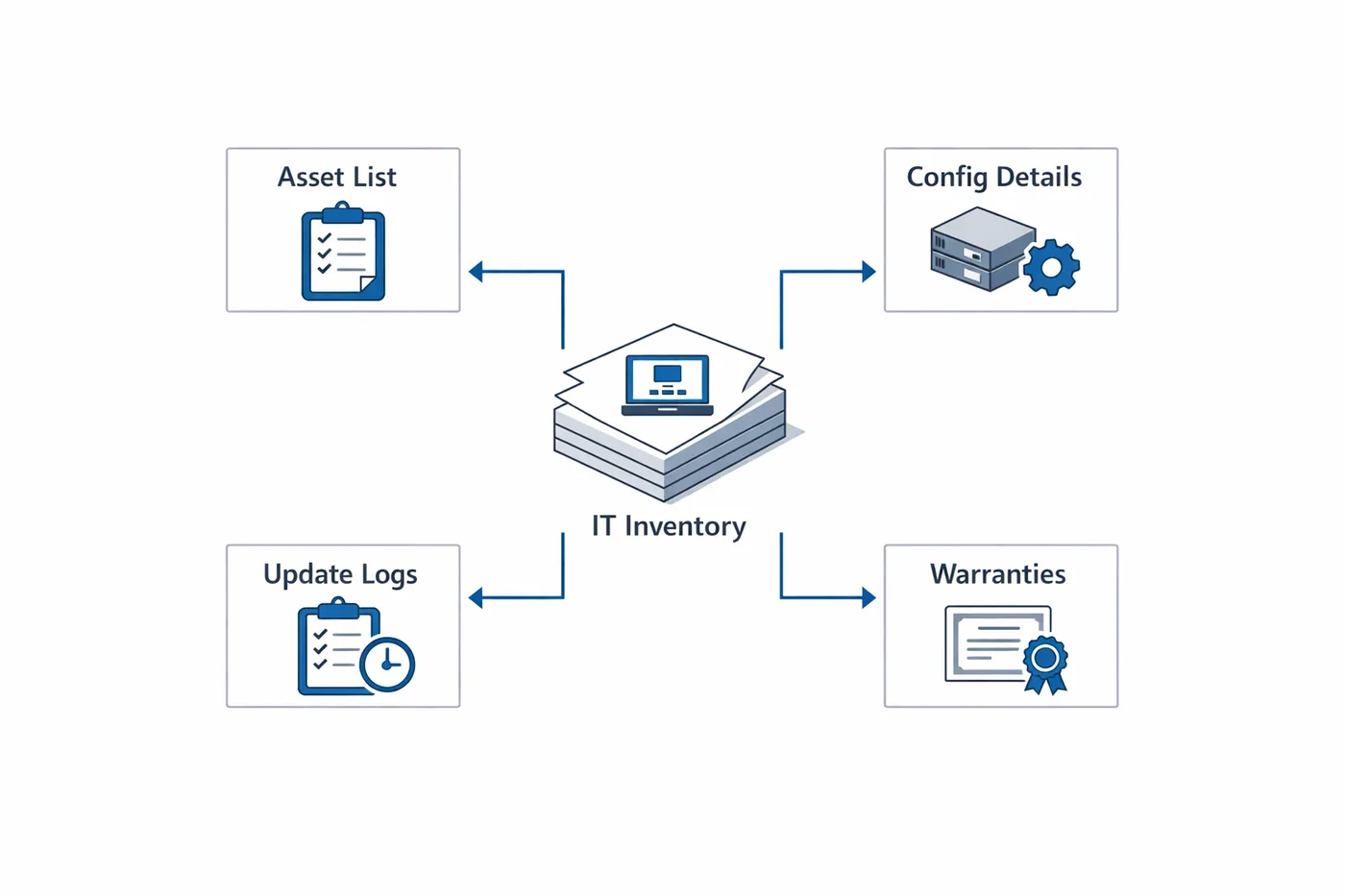
The difference between documentation that survives audit and documentation that collapses under scrutiny is not sophistication — it is discipline. The forms you build are only as defensible as the processes that maintain them. What follows are the operational practices that separate audit-ready documentation from the kind that generates post-incident discovery requests.
Make Documentation Available to the People Who Execute the Process
A form stored in a shared drive that only the compliance lead can access is not documentation — it is a liability waiting to surface. HIPAA's administrative safeguard requirements specify that documentation must be made available to those persons responsible for implementing the procedures to which the documentation pertains. In practice, this means the technician executing the asset transfer needs the same access to the chain-of-custody template as the director reviewing the quarterly audit log.
The failure mode is predictable: operators improvise when they cannot find the approved form, and the improvised record does not match the policy on file. When the auditor compares the two, the gap becomes the finding.
Review and Update Documentation on a Fixed Cadence
Regulatory frameworks expect documentation to reflect current operations. HIPAA requires periodic review and updates in response to environmental or operational changes affecting the security of electronic protected health information. The underlying principle applies across contexts: when your process changes and your documentation does not, the documentary record becomes evidence of non-compliance rather than proof of control.
Set a quarterly review cycle. Compare the form fields against the actual data your downstream processors require. If your ITAD vendor started requiring building-level location granularity in Q2 and your intake form still captures only city and state, the mismatch will surface in the next audit — or worse, in discovery after an incident.
The cheapest vendor is the one whose paper trail you trust enough to hand the auditor without flinching.
Maintain Written Policies in Electronic Form
The regulatory expectation is not paper — it is written, which may be electronic. What matters is that the policy, the procedure, and the record of execution are all retrievable and timestamped. Store policies and procedures in version-controlled systems that log who changed what and when. A PDF on a shared drive meets the letter of the rule; a Git repository or a document-management platform with audit trails meets the spirit.
When an enforcement action or civil discovery demands your documentation, the question is not whether you have a policy — it is whether you can prove the policy in effect on the date of the incident, and whether the records show you followed it. Version control answers both questions.
Label Media with Internal Confidentiality Levels
NIST SP 800-88 (now withdrawn and superseded by Rev. 2, though the principle remains) describes a practice worth adopting: organizations should label media with their internal operating confidentiality levels and associate a type of sanitization. This is not theoretical. When an asset moves from IT to the loading dock, the technician executing the transfer needs to know whether it requires physical destruction, cryptographic erasure, or simple redeployment.
The documentation form should capture this classification at intake, not at disposition. By the time the asset reaches the ITAD vendor, the decision about sanitization method should already be recorded and non-negotiable. For a detailed breakdown of what different data destruction methods actually accomplish and when each applies, the underlying controls matter more than the certificate language.
Build Accountability into the Form Structure
Every field on the form should answer one of two questions: what happened, or who is responsible if it did not happen the way the policy requires. Signature fields, timestamp fields, and operator-ID fields are not bureaucratic overhead — they are the mechanism that converts a checklist into a defensible record.
The form should capture:
- Asset identifier (serial number, not batch count)
- Custodian at transfer (name and employee ID)
- Receiving party (name, company, and timestamp)
- Confidentiality classification (per internal policy)
- Sanitization method required (mapped to classification)
- Approval authority (who authorized the transfer)
If the form does not capture these six elements, it is not a chain-of-custody document — it is a shipping manifest.
Conclusion
The certificate of sanitization you hand the auditor six months after an incident is either your defense or your liability. The difference is not the vendor you chose or the method you specified — it is the documentation structure you built before the first asset left the building. In our review of post-incident regulatory filings, the organizations that survived discovery with their compliance posture intact had one thing in common: they treated documentation as the primary control, not the secondary artifact.
NIST SP 800-88 Rev. 2 specifies what belongs in a sanitization certificate — manufacturer, model, serial number, sanitization method and technique, verification method, and the individuals who performed and validated the work. HIPAA's administrative requirements under 45 CFR § 164.316 and § 164.530 mandate that documentation be retained for six years from the date of creation or the date it was last in effect, whichever is later. These are not optional elements. When the regulatory review begins, the auditor will ask for serialized chain-of-custody, timestamped verification records, and the names of the individuals who performed the work. If your forms do not capture those fields at the point of transaction, you cannot reconstruct them later.
The operators who get this right do not treat documentation as a compliance burden. They treat it as the mechanism that makes the upstream process auditable and the downstream accountability enforceable. The form is not decoration — it is the control. Build it to survive discovery, staff it with individuals trained to complete it accurately, and retain it for the full regulatory period. When the question comes, and it will, the answer is already in the file.
For organizations evaluating vendors to handle these processes, understanding how to evaluate data center decommissioning companies provides a framework for assessing whether a provider's documentation practices align with regulatory and operational requirements.
Frequently asked questions
What is IT asset documentation?
IT asset documentation is the systematic recording of asset identifiers, custody transfers, sanitization methods, verification results, and personnel actions throughout an asset's lifecycle — from introduction to final disposition. It serves as the primary documentary defense when regulators or auditors ask what happened to specific devices.
What fields must an IT asset documentation form include?
NIST SP 800-88 Rev. 2 specifies minimum fields: manufacturer, model, serial number, media type, media source, pre-sanitization confidentiality categorization, sanitization method and technique, tool used (including version), verification method, and information about individuals performing verification and validation (name, position, date, location, contact information, signature).
How long must IT asset documentation be retained?
HIPAA's administrative requirements mandate that documentation be retained for six years from the date of creation or the date it was last in effect, whichever is later. Organizations subject to other regulatory frameworks should verify their specific retention obligations.
What makes IT asset documentation audit-defensible?
Audit-defensible IT asset documentation ties a unique identifier (serial number, asset tag, or bar code) to a specific sanitization action, verification result, date, location, and responsible person. Generic batch certificates do not survive discovery when the question is about a specific device.
Learn how to create effective IT asset forms that enhance data accuracy and streamline processes.
Table of Contents
- Introduction — To provide an overview of the importance of effective IT asset documentation forms.
- Problem Statement — To highlight the current challenges associated with IT asset documentation forms.
- Solution Steps for Creating Effective IT Asset Documentation Forms — To outline actionable steps for creating forms that enhance IT asset documentation.
- Tips and Tricks for Enhancing IT Asset Documentation — To provide best practices and tips for maintaining effective documentation.
- Conclusion — To summarize the importance of effective IT asset documentation forms and encourage action.
- Table of Contents