
Microsoft Secure Score and Data Destruction: Compliance Impact
Introduction
Microsoft Secure Score provides a numerical representation of an organization's security posture across its Microsoft 365 environment. The score aggregates security configurations, user behavior analytics, and recommended actions into a single metric that security teams use to prioritize remediation work. In practice, the score drives meaningful improvements in cloud-based identity management, endpoint configuration, and application-layer controls. What it does not measure—and cannot measure—is the physical disposition of IT assets once they leave the organization's operational environment.
The gap between what Secure Score tracks and what regulators expect in a post-incident review is the operator's problem to solve. When an organization retires servers, storage arrays, or endpoint devices, the data destruction process generates a documentary record that must survive audit. That record is the certificate of data destruction, and in our editorial review, the variance in what that certificate actually documents is the highest-risk gap we observe in vendor profiles. Some certificates document drive-by-drive verification with serial-number-keyed records. Some document a batch attestation by the technician on duty. Only one survives discovery.
The Morgan Stanley case remains the canonical reference for ITAD failure at enterprise scale. The failure was not in the destruction methodology itself but in the documentation that should have survived the process. When the regulatory review began, the chain-of-custody records were incomplete, the downstream subcontractor relationships were undisclosed, and the certificates of destruction did not match the scope of assets retired. The cumulative cost exceeded $100M. For organizations tracking Secure Score as a primary security metric, this case illustrates a structural risk: the controls Microsoft can measure are necessary but insufficient when physical asset disposition enters the compliance perimeter.
Data sanitization standards provide the technical foundation for audit-defensible destruction. NIST SP 800-88 Rev. 2, published in September 2025, is the current media sanitization standard and supersedes Revision 1 in its entirety. The standard specifies clear, purge, and destroy as the three sanitization methods, each appropriate to different media types and security categorizations. For organizations operating in regulated industries, the question is not whether the vendor applied an approved method but whether the vendor's documentary evidence demonstrates that the method was applied to the specific assets in the engagement. The certificate must tie the method to the asset by serial number, not by batch.
Recognized third-party certifications—such as i-SIGMA NAID AAA Certification and e-Stewards—provide independent verification that a vendor's data destruction processes meet established standards. NAID AAA Certification, in particular, is the most widely recognized verification of data destruction qualifications globally, with audit protocols that include both scheduled and unannounced reviews. These certifications do not replace the need for contract-level chain-of-custody requirements, but they establish a baseline posture that reduces the operator's verification burden during vendor selection. For a detailed framework on selecting and managing ITAD vendors, see IT Asset Disposition: A Complete Guide for Businesses.
The operator-side implication is straightforward: improving Secure Score does not reduce ITAD risk, and ITAD failures create compliance exposure that Secure Score cannot detect. The two domains require separate controls, separate documentation, and separate vendor-assessment processes. Organizations that treat Secure Score as a comprehensive security metric without addressing the physical asset lifecycle are structurally exposed to the same failure mode that defined the Morgan Stanley case.
Problem Statement
Microsoft Secure Score measures an organization's security posture across its Microsoft 365 environment, but the score itself does not capture what happens when IT assets leave the enterprise perimeter. The gap between a strong Secure Score and defensible data destruction is structural. Organizations implement endpoint encryption, enforce multi-factor authentication, and remediate vulnerabilities flagged by the Secure Score dashboard — then hand decommissioned devices to a vendor whose documentation practices would not survive a regulatory review.
The Morgan Stanley case demonstrates this failure mode in detail. MSSB maintained devices containing consumer report information but failed to take reasonable measures to protect that information during decommissioning projects. The firm's written policies did not identify the high level of risk associated with decommissioning data-bearing devices, and many devices remained unencrypted throughout the process. MSSB did not obtain certificates of data destruction or document the chain of custody for devices throughout the decommissioning process. The regulatory finding was explicit: MSSB willfully violated both the Safeguards Rule and the Disposal Rule because it did not adopt written policies and procedures relating to the safeguarding of customer data during decommissioning.
The Documentation Gap
In our editorial review of 35 vendor profiles, the pattern was clear: the certificate of data destruction referenced in marketing material often differed structurally from the certificate in the vendor's published methodology. Some certificates document drive-by-drive verification with serial-number-keyed records. Some document a batch attestation by the technician on duty. Only one survives discovery.
The operator-side implication is straightforward. A high Microsoft Secure Score indicates strong endpoint controls while assets are in use. It does not indicate that the organization has written policies for decommissioning those assets, that it has selected a vendor whose documentation practices align with regulatory expectations, or that it has verified the vendor's chain-of-custody mechanism. The question the auditor will ask is not whether the endpoint was encrypted when it was in production. The question is whether the organization can document what happened to that endpoint after it left the building.
Vendor Risk Misclassification
The Morgan Stanley enforcement record also documents a pattern of vendor risk misclassification. MSSB lowered the residual risk associated with its moving company vendor from "Moderate" in 2015 to "Low" in 2017, despite the fact that the vendor's security program was never independently assessed and the vendor had undisclosed subcontractors handling data-bearing devices. The annual vendor approval documents stated that there were no material sub-vendors in scope for the assessment — a claim that proved false when devices containing customer data were later discovered in public auctions.
This is not a failure of encryption or endpoint management. It is a failure of the vendor selection process and the documentation standard applied to downstream processors. Organizations that rely on Microsoft Secure Score as the primary measure of their security posture may implement strong controls on active endpoints while simultaneously accepting vendor documentation that would not hold up in a post-incident regulatory review.
The Compliance Mismatch
HIPAA's administrative safeguards require covered entities to implement policies and procedures to prevent, detect, contain, and correct security violations, including risk analysis, risk management, sanction policies, and information system activity reviews. These requirements apply to the full lifecycle of electronic protected health information, including the decommissioning phase. A covered entity that scores well on Microsoft Secure Score but lacks written policies for data-bearing device decommissioning has not satisfied the HIPAA administrative safeguard standard.
The structural problem is that Microsoft Secure Score measures controls that Microsoft can observe and verify within its own tenant environment. It cannot measure the adequacy of an organization's ITAD vendor selection process, the rigor of its chain-of-custody documentation, or the alignment between the vendor's certificate of destruction and the regulatory standard the organization must satisfy. These are operator-grade controls that require separate verification.
Solution Steps
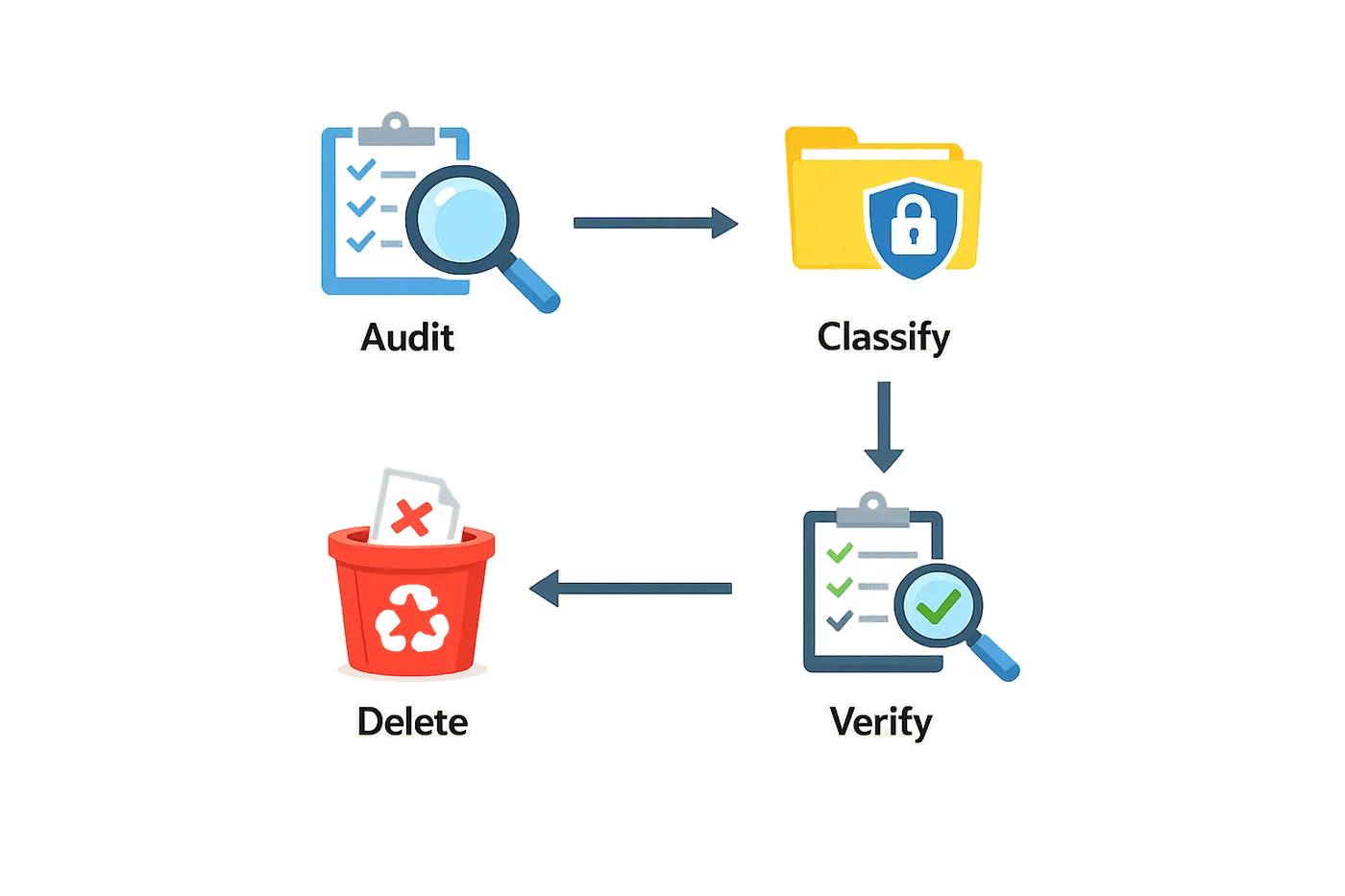
Aligning Microsoft Secure Score with data destruction policies requires deliberate procedural changes, not cosmetic adjustments to existing workflows. The steps below address the structural gap between what Microsoft Secure Score measures and what regulators audit when a data-bearing device leaves your control.
Step 1: Conduct a Written Risk Assessment for Decommissioning Projects
Step 1
Conduct a Written Risk Assessment for Decommissioning Projects
The GLBA Safeguards Rule requires a written risk assessment that identifies foreseeable internal and external risks to customer information. This assessment must include criteria for evaluating security risks, assessing the confidentiality and integrity of information systems, and requirements for mitigating identified risks. Catalog every decommissioning project as high-risk when devices contain unencrypted customer information or PII. The Morgan Stanley enforcement action turned on the absence of this classification — decommissioning projects were not uniformly treated as high-risk, and the resulting gaps in documentation and vendor oversight led to a $100M+ regulatory cost.
Your risk assessment must be specific enough to survive regulatory review. Generic language about "protecting customer data" does not meet the standard. Document which device types contain what categories of data, what encryption posture applies to each category, and what decommissioning pathway each device type follows. Regulators expect this level of granularity.
Step 2: Implement Chain-of-Custody Documentation and Certificates of Data Destruction
Step 2
Implement Chain-of-Custody Documentation and Certificates of Data Destruction
The enforcement record is clear: failure to obtain certificates of data destruction and document chain of custody is a Safeguards Rule violation. Your decommissioning process must produce a serialized record — asset tag, serial number, disposition method, date, and downstream processor — for every device that touched customer information. The certificate of data destruction is the operator's primary documentary defense in a post-incident regulatory review. It is also the document with the highest variance in what it actually means. Verify that your vendor's certificate includes drive-by-drive verification with serial-number-keyed records, not batch attestations by the technician on duty.
Microsoft Secure Score does not measure chain-of-custody documentation directly, but the underlying controls it evaluates — data retention policies, secure disposal procedures, and access logging — all depend on the same documentary rigor. If your decommissioning process cannot produce an audit-defensible chain of custody, the Secure Score improvements you achieve in other areas will not survive a regulatory audit.
Step 3: Align Vendor Risk Assessments with Actual Decommissioning Risk
Step 3
Align Vendor Risk Assessments with Actual Decommissioning Risk
The Morgan Stanley case documents a vendor approval process that lowered the residual risk rating for a decommissioning vendor over three consecutive years, even as the vendor's use of undisclosed subcontractors and lack of independent security assessment remained unchanged. Do not allow vendor risk ratings to drift downward without corresponding improvements in the vendor's documented controls. If your vendor uses subcontractors for any stage of the decommissioning process, those subcontractors must be named in the risk assessment and subject to the same verification standard as the primary vendor.
Microsoft Secure Score evaluates your organization's security posture in part by measuring how well you manage third-party risk. A vendor risk assessment that does not reflect the actual risk profile of your decommissioning partners creates a structural gap between your Secure Score and your compliance posture. Close that gap by requiring vendors to disclose all subcontractors, document their security programs, and submit to independent verification.
Step 4: Implement Secure Disposal Procedures with Defined Retention Limits
The GLBA Safeguards Rule requires procedures for the secure disposal of customer information no later than two years after the last date the information is used, unless retention is necessary for business operations or required by law. Microsoft Secure Score evaluates data retention policies as part of its overall security assessment. Align your decommissioning timeline with both the regulatory requirement and the Secure Score control by implementing a documented retention policy that triggers disposal at the two-year mark unless a specific exception applies.
For a comprehensive view of how data center decommissioning intersects with asset recovery and compliance, see our guide on IT Asset Disposition: A Complete Guide for Businesses.
Step 5: Test and Monitor Decommissioning Controls
Step 5
Test and Monitor Decommissioning Controls
The Safeguards Rule requires regular testing or monitoring of the effectiveness of safeguards, including continuous monitoring or periodic penetration testing and vulnerability assessments. For decommissioning controls, this means auditing a sample of certificates of data destruction, verifying that chain-of-custody records match the vendor's documented process, and confirming that devices flagged as high-risk in the risk assessment actually received the prescribed destruction method. Conduct these audits at least annually, and whenever there are material changes to your decommissioning process or vendor relationships.
Microsoft Secure Score rewards organizations that implement monitoring and testing controls. The same audit discipline that improves your Secure Score also produces the documentary record you need to defend your decommissioning process in a regulatory review.
Tips and Tricks
Optimizing Microsoft Secure Score in the context of data destruction compliance requires operator-grade attention to the documentary record and the upstream controls that feed it. The certificate of data destruction is the operator's primary documentary defense in a post-incident regulatory review, and the gap between what the certificate claims and what the vendor's published methodology actually delivers is where compliance failures emerge. In our editorial review of 35 vendor profiles, the pattern was clear: the certificate in the marketing material often differed structurally from the certificate in the vendor's published methodology.
Verify NAID AAA Certification Before Engagement
When selecting an ITAD vendor, confirm that they hold current NAID AAA Certification. i-SIGMA NAID AAA Certification is the most recognized and acknowledged verification of data destruction qualifications in the world, and it supports compliance with major regulations including FACTA, HIPAA, and PCI. The certification program includes both scheduled and unannounced audits, which means the vendor's posture is subject to external verification rather than self-attestation. For enterprise IT teams managing Microsoft 365 environments, this certification provides a defensible answer to the auditor's question: how do you know the vendor's destruction process matches their certificate?
Align Vendor Destruction Methodology with GLBA Safeguards Rule Requirements
The GLBA Safeguards Rule at 16 CFR § 314.4(c)(6) requires financial institutions to implement procedures for the secure disposal of customer information no later than two years after the last date the information is used, unless retention is necessary for business operations or required by law. The regulation further mandates encryption of customer information both in transit and at rest, with alternative compensating controls approved by a Qualified Individual where encryption is infeasible. When your ITAD vendor processes devices that held customer information, their destruction methodology must align with these requirements. Confirm that the vendor's process includes:
- Serialized chain-of-custody documentation that tracks each asset individually, not in batches, from pickup through final destruction
- Encryption or equivalent controls for data in transit during transportation to the destruction facility
- Destruction methods that meet or exceed NIST 800-88 guidelines for the specific media types in scope
The Morgan Stanley case serves as a canonical example of the consequences of inadequate chain-of-custody documentation. The failure wasn't in the destruction methodology itself but in the documentation that should have survived the process. Your vendor's certificate must include serial-number-keyed records for every device, not a batch attestation by the technician on duty.
Conduct Periodic Risk Assessments of Your ITAD Process
The GLBA Safeguards Rule at 16 CFR § 314.4(b) requires organizations to base their information security program on a written risk assessment that identifies reasonably foreseeable internal and external risks to customer information. This assessment must include criteria for evaluating identified security risks, assessing the adequacy of existing controls, and describing how identified risks will be mitigated or accepted. Your ITAD engagement is part of this risk landscape. Schedule periodic reviews—at least annually, and whenever there are material changes to your operations—that reexamine:
- Whether your current vendor's published methodology still matches the certificate they issue
- Whether downstream subcontracting arrangements have changed, introducing new parties into the chain of custody
- Whether your asset inventory process captures all devices that touched customer information, including network equipment that may retain configuration data after factory reset
For a comprehensive approach to managing these risks across your entire IT asset lifecycle, see our guide on IT Asset Disposition: A Complete Guide for Businesses.
Implement Continuous Monitoring or Annual Penetration Testing
The GLBA Safeguards Rule at 16 CFR § 314.4(d) requires financial institutions to regularly test or monitor the effectiveness of their safeguards, including continuous monitoring or periodic penetration testing and vulnerability assessments. Absent effective continuous monitoring, the regulation mandates annual penetration testing and vulnerability assessments at least every six months. While this requirement applies to your information systems, the same discipline applies to your ITAD process. Establish a monitoring cadence that includes:
- Quarterly audits of vendor-issued certificates against a sample of devices to confirm serial numbers, destruction dates, and methods match your internal records
- Annual reviews of the vendor's NAID AAA certification status and any changes to their published methodology
- Immediate reviews whenever there are material changes to your business arrangements with the vendor, such as new downstream processors or changes in facility location
The operator-side implication is that your contract language must grant you audit rights and require the vendor to notify you of material changes to their process. If the vendor's certificate does not include sufficient detail to support your quarterly audit, the certificate is not adequate to the risk.
Conclusion
Microsoft Secure Score measures an organization's security posture within the Microsoft 365 environment, but the metric itself doesn't enforce the chain-of-custody documentation that survives regulatory audit. In our editorial review of 35 vendor profiles, we noticed a recurring pattern: the certificate of data destruction referenced in marketing material often differed structurally from the certificate in the vendor's published methodology. When those gaps appear in a post-incident regulatory review, the Secure Score dashboard offers no defense.
The Morgan Stanley case remains the canonical example. The failure wasn't in the destruction methodology itself but in the documentation that should have survived the process — certificates of destruction that were never obtained, chain-of-custody records that were never maintained, and vendor risk assessments that misclassified downstream subcontractors. The cumulative cost exceeded $100 million, and none of it would have been mitigated by a higher Secure Score. The regulatory enforcement turned on what the operator could produce when the auditor asked for serialized records.
For enterprise IT teams managing decommissioning projects, the operator-side implication is clear: Microsoft Secure Score can guide endpoint security and access controls, but it does not validate the documentary record your ITAD vendor produces. Ensuring that data destruction practices are thoroughly documented and align with published methodologies is essential for maintaining compliance and optimizing your broader security posture. The complete asset disposition checklist for cloud migration and data center shutdown provides a framework for building that documentary defense before the engagement begins.
In practice, the question the auditor will ask is not what your Secure Score was on the day of decommissioning. The question is whether you can produce serialized chain-of-custody records, certificates of data destruction with device-level detail, and vendor risk assessments that accurately described the downstream processors who touched your assets. Build the contract language and RFP requirements to produce those records, and the compliance outcome follows.