
ITAD Services: Categories and Vendor Selection Guide
Explore itad services categories, vendor options, and selection criteria to choose the right approach for your organization's IT asset disposition needs.

Introduction to ITAD Services
IT asset disposition (ITAD) services are the management of decommissioning retired IT assets in a manner that ensures data security and environmental compliance while maximizing residual value. For organizations retiring servers, storage arrays, networking equipment, and end-user devices, ITAD solutions represent the structured process that sits between "we're done with this hardware" and "the auditor accepts our documentary record."
The stakes are material. A vendor's marketing description of its certificate of data destruction frequently differs in structure from the certificate described in its own published methodology. This gap between what the operator promises and what the documentary record actually delivers is the failure mode that survives regulatory scrutiny.
When navigating the ITAD vendor landscape, it's crucial to understand the distinct categories available: full-service ITAD, data-destruction-only providers, value-recovery brokers, e-waste recyclers, and SaaS platforms. Each category serves different needs, and selecting the right approach depends on the specific requirements of your organization. The server decommissioning checklist provides a structured framework for managing these transitions.
The Morgan Stanley case remains a pivotal reference point in our industry, highlighting that failures often stem not from destruction methodologies but from inadequate chain-of-custody documentation. The operator's posture on serialized tracking, downstream processor verification, and certificate issuance determines what holds up in audit. As you evaluate ITAD services, consider these insights to make informed decisions that align with your security and compliance needs.
What is ITAD Services?
IT asset disposition (ITAD) services are the structured process organizations use to decommission, sanitize, and retire IT assets—hardware and the data on it—once those assets reach end of life. The mechanism is straightforward: an organization's equipment ages out of useful life, but the data it contains and the materials it comprises remain sensitive. ITAD solutions manage both the documentary record and the physical handling required to retire that equipment without triggering regulatory exposure or environmental liability.
The term "ITAD services" refers to the full range of service categories, vendor types, and internal processes that accomplish this disposition. In practice, ITAD solutions encompass data destruction (both logical and physical), value recovery through resale or refurbishment, recycling of end-of-life materials, and chain-of-custody documentation that survives audit. The operator's posture—whether running an in-house program or engaging a third-party vendor—determines which components of the ITAD process are handled internally and which are outsourced.
Core Components of ITAD Services
Every ITAD service, regardless of vendor or service model, addresses three structural requirements. First, data sanitization: the verifiable destruction or erasure of data on storage media, aligned to a published standard (NIST SP 800-88 Rev. 2 or equivalent). Second, asset disposition: the physical handling of hardware—whether through resale, donation, recycling, or destruction—in a manner that complies with environmental regulations and contractual obligations. Third, documentation: the creation and retention of certificates, chain-of-custody logs, and audit trails that demonstrate compliance in the event of regulatory review or litigation.
These three components operate in sequence, but the failure mode typically appears in the handoff between them. An organization may execute data sanitization correctly but fail to document which specific assets were sanitized, or may document sanitization but fail to maintain chain of custody when assets move to a downstream processor. The ITAD solution must address all three components with equal rigor, because the weakest link determines what holds up in audit.
Service Categories Within ITAD Services
ITAD services are delivered through distinct service categories, each with different operational models and risk profiles. Full-service ITAD providers handle the entire lifecycle: pickup, inventory, data destruction, asset recovery, recycling, and documentation. Data-destruction-only vendors focus exclusively on sanitization and certification, leaving physical disposition to the client or a separate vendor. Value-recovery brokers prioritize resale and refurbishment, often subcontracting data destruction to a certified partner. E-waste recyclers handle end-of-life materials but may not offer data-destruction services at all. SaaS platforms provide software tools for inventory tracking and vendor management, but do not perform physical services themselves.
The selection of service category depends on the organization's internal capabilities, risk tolerance, and regulatory obligations. A healthcare provider subject to HIPAA may require a full-service vendor with NAID AAA certification and serialized chain-of-custody tracking. A consumer electronics retailer with lower data-sensitivity requirements may engage a value-recovery broker and handle data destruction in-house. The trade-off is between control (handling more components internally) and specialization (engaging vendors with deeper expertise in specific components). For a detailed comparison of data destruction methods and the certifications that underpin them, see How to Compare Data Destruction Services: Methods & Certifications.
How ITAD Services Work
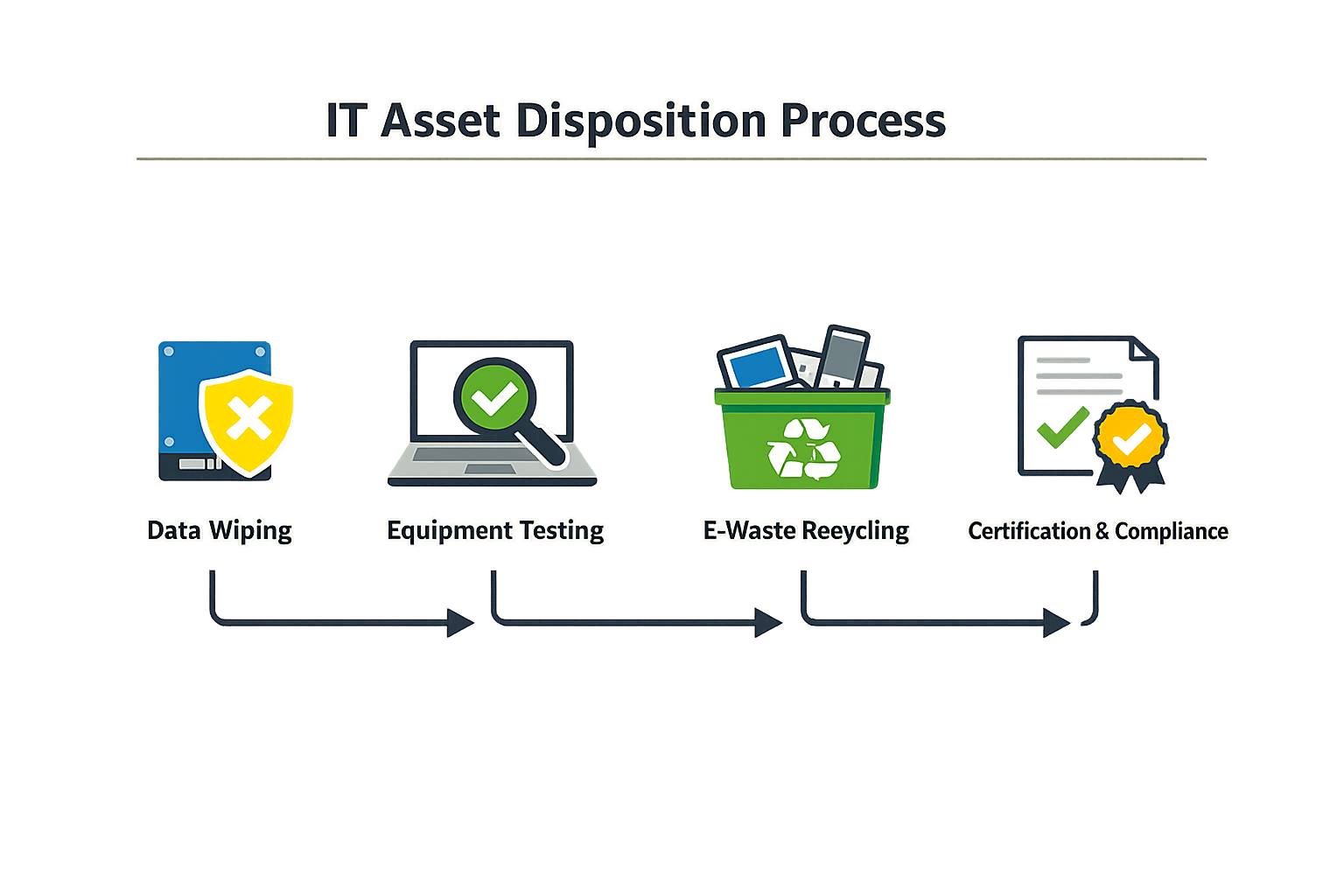
The ITAD process is a structured sequence designed to move retired IT assets from operational inventory to documented destruction or resale while maintaining chain-of-custody and regulatory compliance. The process runs through seven core stages: asset identification, data classification, data sanitization, asset valuation, vendor selection, chain-of-custody documentation, and environmental and regulatory reporting. Each stage has a specific control objective, and the documentary record produced at each stage is what survives audit.
Asset Identification and Inventory
The process begins when an organization flags hardware for retirement. Assets are cataloged by serial number, model, location, and data-sensitivity classification. This inventory becomes the baseline for chain-of-custody tracking. The common failure at this stage is batching assets without serialized records — a posture that collapses under regulatory scrutiny when a single device contains regulated data.
Data Classification and Sanitization
Once assets are inventoried, the operator classifies data by sensitivity and selects the appropriate destruction method. For magnetic hard drives, this typically means a NIST SP 800-88 Rev. 2 Clear-level overwrite or physical destruction. For SSDs and flash media, cryptographic erasure or shredding. The method must match the data classification — comparing data destruction services reveals significant variance in what vendors mean by "secure erasure."
Data sanitization produces a certificate of destruction. The certificate is the operator's primary documentary defense in a post-incident review. Certificates vary in what they actually attest to — some certify the method applied, others certify only that the asset was received.
Testing, Grading, and Value Recovery
After data destruction, assets with residual value move to testing and grading. Functional devices are evaluated for resale into secondary markets. Non-functional or low-value assets move to environmentally responsible recycling. The operator's ability to extract value here depends on the upstream data-destruction posture — assets destroyed physically cannot be resold, which is why the data-classification step matters economically.
Environmental Recycling and Downstream Accountability
Assets that cannot be resold are disassembled for material recovery. Responsible operators send components to R2v3 or e-Stewards certified downstream processors. The chain-of-custody must extend through the downstream processor to the final disposition — this is where undisclosed subcontracting becomes a structural risk. Sustainable server disposal requires verifying that the downstream processor maintains the same certification posture as the primary vendor.
Documentation and Regulatory Reporting
The final stage produces the audit-defensible record: certificates of data destruction, chain-of-custody logs, environmental compliance documentation, and downstream processor certifications. This documentation package is what the organization hands to auditors, regulators, and external counsel in the event of an incident. The Morgan Stanley case demonstrated that failures stem not from destruction methodologies but from gaps in this documentary record.
Real World Examples of ITAD Services
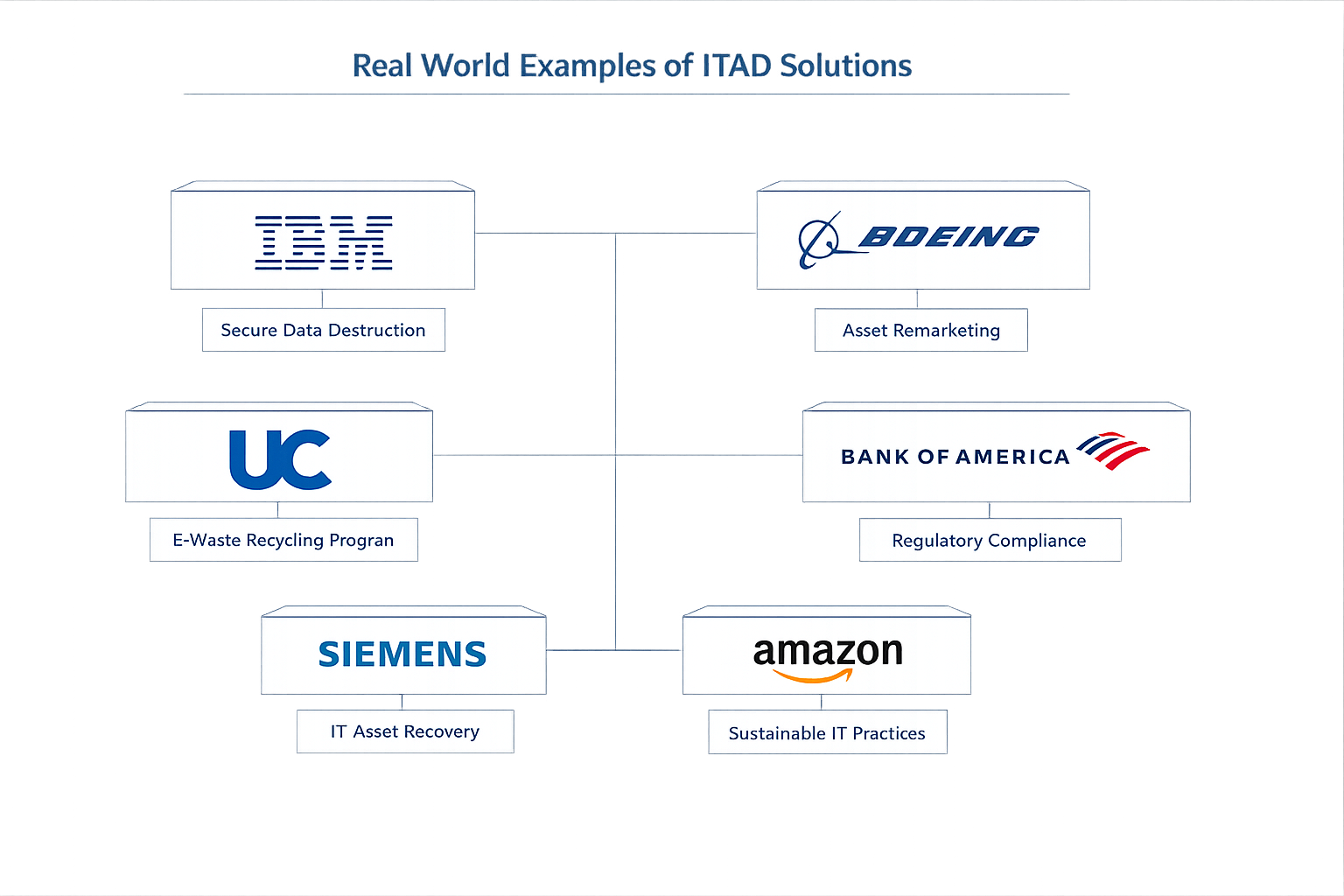
The documentary record from regulatory enforcement actions and enterprise case studies shows where ITAD services succeed and where they fail. The Morgan Stanley case remains the canonical reference: a $35 million SEC civil penalty stemming not from a destruction-methodology failure but from inadequate chain-of-custody documentation when decommissioned servers and hard drives left the operator's control. The failure mode was structural — the operator could not demonstrate to the regulator what happened to customer data after the hardware left the building.
Financial Services: When Chain of Custody Breaks
In the Morgan Stanley matter, the underlying control failure was straightforward. Decommissioned equipment containing customer account data moved through multiple downstream processors without serialized tracking. When the SEC asked for documentary proof of what had happened to specific drives, the operator could not produce it. The certificate of data destruction referenced in the original engagement did not map to the equipment the regulator was asking about.
The SEC penalty was one of four proceedings arising from the same decommissioning failures: a $60 million OCC civil money penalty against Morgan Stanley Bank, N.A. and Morgan Stanley Private Bank, N.A. in 2020, a $60 million class-action settlement approved in 2022, the $35 million SEC penalty in 2022, and a $6.5 million multistate attorney-general settlement in 2023. None of them turned on destruction methodology; all of them turned on the documentary record.
Value Recovery Through Corporate Buyback Programs
On the operational side, enterprises running refresh cycles at scale increasingly use a hybrid model: enterprise server ITAD for end-of-life equipment combined with manufacturer buyback programs for hardware still within resale windows. The mechanism is straightforward — equipment with residual value moves through OEM trade-in channels, while fully depreciated or end-of-support hardware moves to a full-service ITAD provider with R2v3 or e-Stewards certification.
The trade-off is documentary. Manufacturer buyback programs typically provide a purchase order and proof of payment but not the granular chain-of-custody documentation an auditor expects for data-bearing assets. Operators in regulated industries often route buyback-eligible equipment through the ITAD provider first to obtain the destruction certificate, then recover value through secondary resale channels where the data-destruction question is already closed.
Marketplace and Resale Channels
Online marketplaces for decommissioned IT assets serve a specific use case: equipment that never touched regulated data or where the operator has already obtained third-party destruction certificates before listing. The resale strategy works when the asset's data-destruction status is documented before the equipment enters the marketplace. Where that documentation is absent, the operator carries the liability forward — the fact that the equipment changed hands does not close the regulatory question about what happened to the data.
In practice, enterprises running large-scale refresh cycles treat resale channels as a downstream step after the data-destruction and chain-of-custody requirements are satisfied. The published verification of the ITAD provider handling the upstream destruction is the control that makes the downstream resale defensible.
Benefits of Implementing ITAD Services
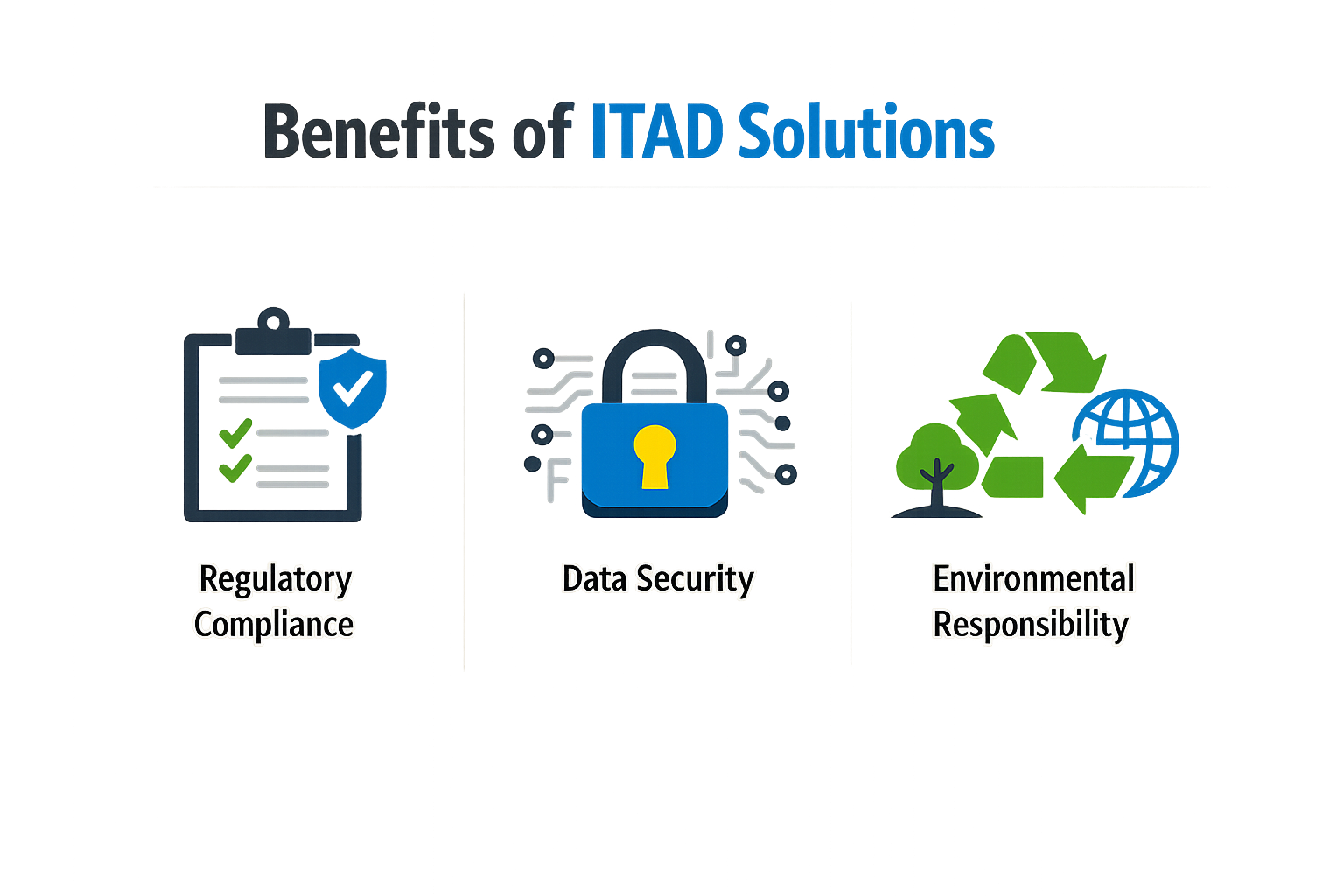
Implementing itad services delivers measurable advantages across three domains: regulatory compliance, data security, and operational efficiency. The benefits are not theoretical — they show up in audit records, breach-cost avoidance, and the documentary trail that survives regulatory review.
Compliance and Audit Defense
A structured ITAD process creates the chain-of-custody documentation that regulators expect when they ask how you handled retired assets. This includes serialized tracking from decommissioning through final disposition, certificates of data destruction that name the sanitization category applied, and downstream processor records for recycled materials. The retention period for those records is set by the buyer's own regulatory obligations, not by the vendor's document-retention policy — so the question to settle before signing is who holds the records, and for how long.
The absence of this documentation carries real cost. The global average cost of a data breach reached $4.44 million in 2025, according to IBM's Cost of a Data Breach Report. Many of those breaches trace back to retired assets that left the enterprise without adequate destruction verification or chain-of-custody controls.
Data Security and Risk Mitigation
The primary security benefit is straightforward: verified data destruction eliminates the risk that sensitive information persists on retired hardware. This matters most for assets that handled customer data, financial records, or protected health information. The destruction method must match the data classification — cryptographic erasure for SSDs, a NIST SP 800-88 Rev. 2 Clear-level overwrite for traditional hard drives, physical destruction for devices that cannot be reliably sanitized.
What survives audit is the certificate that names the method, the serial number, and the operator who performed the work. The certificate must reference a published methodology, not just assert that "data was destroyed." In practice, this means choosing vendors whose certificates cite specific NIST standards and whose destruction facilities hold third-party certifications like NAID AAA or R2v3.
Environmental and Financial Returns
Properly managed ITAD can help businesses achieve financial gains, enhance brand reputation, and reduce environmental impact. Value recovery from functional equipment offsets disposal costs, and in some cases generates net revenue. Environmental benefits come from responsible recycling that keeps hazardous materials out of landfills and recovers rare-earth elements for reuse.
The financial return depends on the asset mix and the vendor's downstream relationships. Enterprise-grade servers and networking equipment retain more value than commodity desktops. The operator's ability to refurbish and resell equipment into secondary markets determines how much of that value flows back to the client. For organizations managing large-scale retirements, this can materially offset the cost of data destruction services.
Operational Efficiency
A vendor relationship with clear service-level agreements and documented processes reduces the internal overhead of managing retirements. IT teams spend less time coordinating pickups, tracking assets, and chasing destruction certificates. The efficiency gain is most visible in organizations that retire assets continuously rather than in infrequent bulk events — a structured ITAD process turns a recurring administrative burden into a routine operational step.
The underlying control is the contract language that defines responsibilities, timelines, and documentation requirements. Terms left unspecified at signing — who schedules pickups, how long settlement takes, what the destruction record must contain — become the terms you negotiate during an incident instead.
How to Choose the Right ITAD Solution
The operator's posture on vendor selection determines what survives audit. The gap between a vendor's marketed capabilities and its verified credentials is the risk the operator can actually close before signing. The question the auditor will ask is not whether you hired an ITAD vendor — it is whether the vendor you hired held the certifications, maintained the chain of custody, and executed the destruction methodology your documented process required.
Certification as the Baseline Filter
No federal law requires an ITAD provider to hold a certification. What creates the requirement is the buyer: Compare ITAD's own Base Verification requires a current R2v3, e-Stewards, or NAID AAA certification for directory inclusion, and regulated buyers generally impose the same floor in their vendor agreements. These are not marketing badges — they represent third-party-audited controls that map to specific regulatory obligations. R2v3 certification, for example, requires documented data-destruction procedures aligned to NIST SP 800-88 and chain-of-custody tracking at the asset level. e-Stewards adds environmental requirements, including restrictions on exporting hazardous electronic waste to developing countries.
When evaluating a vendor, the published verification is the floor, not the ceiling. A vendor without current R2 or e-Stewards certification is structurally unable to meet the documentary requirements of a GDPR Article 30 processing record or an SEC Regulation S-P compliance filing. The certification does not guarantee performance — but the absence of certification guarantees a gap.
Chain-of-Custody Documentation
The certificate of data destruction is the operator's primary documentary defense in a post-incident regulatory review. What matters is not the certificate's design — it is whether the certificate references serialized asset identifiers, timestamps the destruction event, names the destruction method with sufficient specificity to map to a published standard, and identifies the technician or facility responsible.
In practice, many vendors issue certificates that describe destruction in aggregate: "500 hard drives destroyed via shredding on [date]." This language does not survive discovery when regulators ask for the record of a specific drive. The audit-defensible certificate lists each asset by serial number, maps it to a destruction method ("NIST SP 800-88 Rev. 2 Purge via degaussing" or "physical destruction via <4mm particle shred"), and provides a verifiable timestamp and operator signature.
The RFP language that produces this outcome is explicit: "Vendor shall provide serialized certificates of destruction referencing each asset by manufacturer serial number, destruction method per NIST SP 800-88 Rev. 2 category, facility location, and technician identifier." If the vendor's sample certificate does not meet this standard, the engagement will not meet it either.
Downstream Accountability
The failure mode in most ITAD incidents is not the destruction methodology — it is undisclosed downstream subcontracting. A vendor may hold R2 certification at their primary facility but route certain asset classes (batteries, CRTs, mixed e-waste) to uncertified downstream processors. When those processors fail — through data breach, environmental violation, or export to non-compliant markets — the liability flows upstream to the original generator.
The contract language that closes this gap is a representation-and-warranty clause: "Vendor represents that all processing, including downstream recycling and refurbishment, will occur at facilities holding current R2 or e-Stewards certification, and Vendor shall provide documentary evidence of downstream processor credentials upon request." If the vendor resists this language, they are signaling a structural gap in their supply chain.
Verification Beyond the Sales Deck
The Compare ITAD Verification Standard publishes three vendor classifications — Verified, Verified RI (Regulated Industries), and Verified CI (Critical Infrastructure) — derived from documented credentials and operational capabilities rather than from a vendor's own description of itself. Verified confirms the vendor exists, is licensed to operate as an ITAD vendor in the states it claims, and can lawfully dispose of equipment. Verified RI additionally confirms the documented certifications and controls required for regulated-industry work in healthcare, financial services, and government. Verified CI additionally confirms those required for critical-infrastructure environments.
When building a shortlist, filter first by certification, then by verification tier, then by geographic coverage and asset-class specialization. The vendor's marketing materials describe what they want you to believe; the verified position describes what they can prove. For a deeper breakdown of destruction-method verification, see How to Compare Data Destruction Services: Methods & Certifications.
The Trade-Off Between Cost and Documentary Risk
In the operator's defense, the lowest-cost vendor is often the one with the thinnest documentary controls. A vendor quoting $2/drive for destruction may be routing assets to an uncertified shredder with no serialized tracking. A vendor quoting $8/drive with serialized certificates, facility tours, and downstream processor disclosure is pricing the cost of maintaining an audit-defensible record.
The material question is not which vendor is cheaper — it is which vendor's documentation you can hand to a regulator or opposing counsel without structural exposure. The Morgan Stanley case remains the canonical reference: four separate proceedings — federal regulatory, private, and state — arose from the same disposal failures, none of them because the destruction methodology failed, all of them because the chain-of-custody documentation could not prove what happened to specific devices.
The underlying control is the vendor's willingness to commit, in writing, to the documentary standard your audit requires. If they will not commit, the engagement is mispriced — you are buying a service without the evidence layer that makes it defensible.
Conclusion
The ITAD vendor landscape presents a structural challenge: the gap between marketed capabilities and audit-defensible documentation. The certificate of data destruction is the operator's primary documentary defense in a post-incident regulatory review, and what it actually attests to varies from vendor to vendor. What survives discovery is not the vendor's marketing language but the chain-of-custody record and the underlying methodology that the certificate references.
The Morgan Stanley case remains the canonical reference because the failure mode was not the destruction methodology itself but the absence of serialized tracking for assets that touched customer data. Across all four proceedings the regulatory position was the same: inadequate chain-of-custody documentation is inadequate data protection, regardless of whether the drives were physically destroyed. That logic applies to every regulated entity evaluating ITAD services today.
When selecting an ITAD solution, the question the auditor will ask is not whether your vendor is certified but whether the documentary record — the inventory list, the pickup manifest, the destruction certificate, and the downstream processor attestation — forms an unbroken chain that accounts for every serialized asset. The operator's posture on that question determines whether the engagement is audit-defensible or a latent compliance risk. In practice, the cheapest vendor is the one whose paper trail you trust enough to hand the auditor without flinching.
The world generated 62 million tonnes of e-waste in 2022, and 22.3% of it was formally collected and recycled, according to the UN's Global E-waste Monitor 2024. That figure covers all electronic waste rather than enterprise IT hardware specifically, and the remaining 77.7% is not accounted for in any formal recovery channel — which is a chain-of-custody failure as much as an environmental one. For an enterprise IT team managing regulated data, the question is which side of that line your own retired assets land on, and whether you hold the documentation to show it.
For a deeper look at how data disposition integrates with broader information lifecycle management, see our guide on data disposition linking information lifecycle management to ITAD. The vendor you select today determines whether your next audit is a routine review or a regulatory event. Choose accordingly.