
Enterprise Data Destruction Standards for Corporate IT
Define enterprise data destruction standards for corporate IT with verified compliance measures, audit protocols, and secure disposal practices.

Introduction
The certificate of data destruction is the operator's primary documentary defense in a post-incident regulatory review. It is also, in our editorial review of 35 vendor profiles, the document with the highest variance in what it actually means. The discrepancy between marketed claims and operational reality creates exposure that most enterprise IT teams do not discover until an auditor asks to see the underlying methodology.
Data destruction standards help organizations choose a defensible way to remove data from retired computers, servers, and storage devices. The standard defines not just the technical method—overwrite, degaussing, physical destruction—but the documentary record that proves the method was applied to the specific asset in question. When that record is incomplete or contradicts the certificate language, the enterprise owns the gap.
NIST Special Publication 800-88 is the most widely recognized standard for media sanitization worldwide, ensuring that data on storage media cannot be recovered once it leaves organizational control. Secure erasure under this framework enables compliance with strict regulations, prevents data breaches, and supports device reuse while minimizing electronic waste. The standard is not a single method; it is a decision tree that accounts for media type, data sensitivity, and the intended downstream use of the asset. Understanding how to apply NIST 800-88 in practice—and how to verify that a vendor applied it correctly—is the foundation of enterprise ITAD services and vendor selection.
In the sections that follow, we define the problem statement, outline solution steps for establishing audit-defensible standards, and provide tips that reflect what survives discovery. The goal is not to prescribe a single methodology but to describe the decision framework that enterprise IT and procurement leads need when the asset leaves the building and the documentary record is all that remains.
Problem Statement
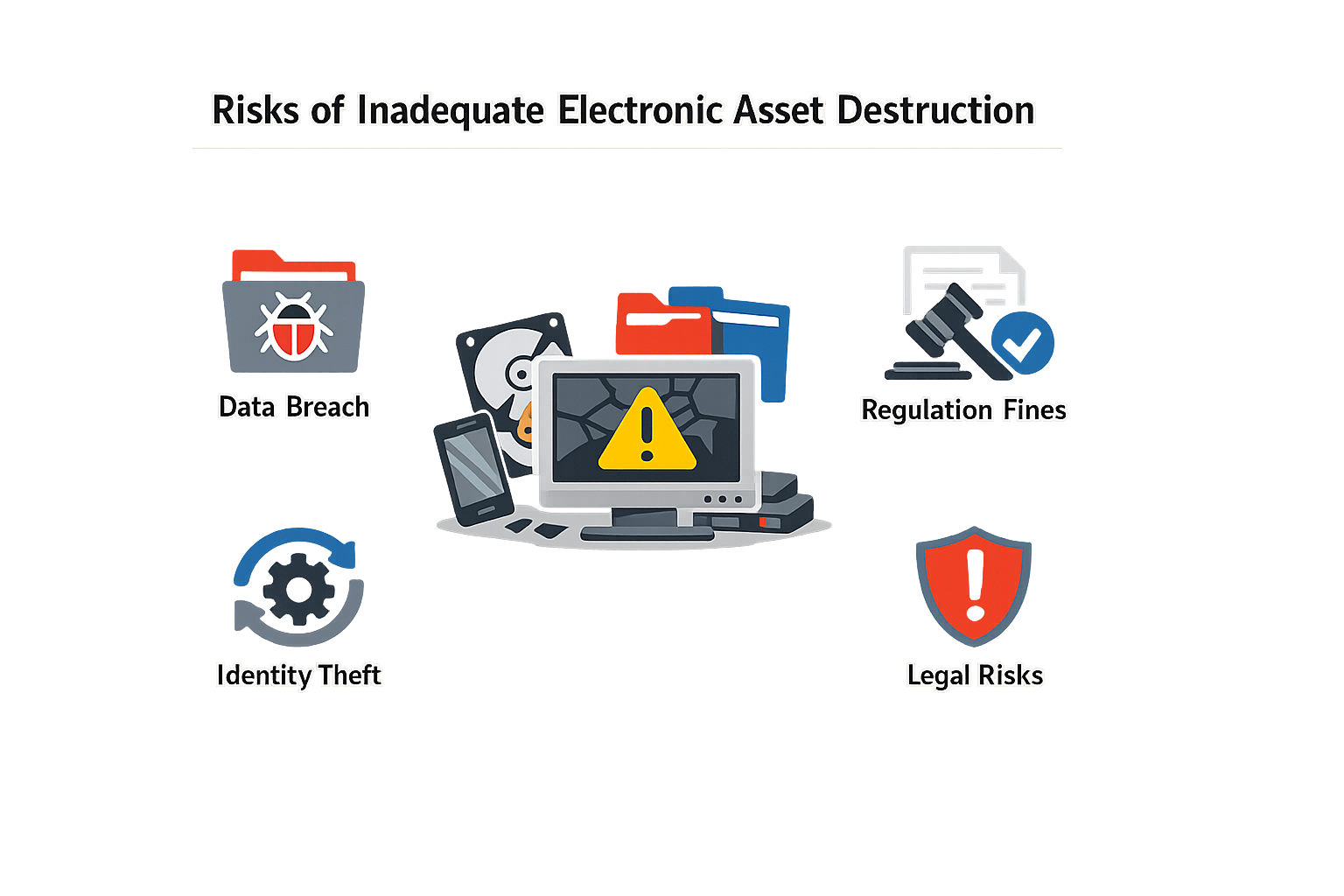
The enterprise data destruction problem is not primarily technical. Most operators know how to overwrite a drive or shred a circuit board. The problem is structural: the gap between what the certificate says happened and what the documentary record can prove happened. In our editorial review of vendor profiles, this gap appears most often in three places — undisclosed subcontracting, batch-level certificates issued for serialized assets, and destruction timelines that exceed the operator's stated SLA without explanation.
The Decentralization Risk
Hybrid work has scattered IT assets across home offices, coworking spaces, and regional hubs. The traditional model — a single loading dock, a single manifest, a single chain-of-custody document — no longer describes the physical reality. Assets now enter the destruction pipeline from dozens of endpoints, often without the inventory rigor that a centralized refresh cycle enforced. The operator's question is simple: if you cannot name the serial numbers that left your control, how do you prove they were destroyed?
The Cost of Failure
The global average cost of a data breach now sits around $5 million, and that figure does not include the regulatory enforcement that follows when the breach originated from an asset the enterprise believed was destroyed. The Morgan Stanley case remains the canonical reference: $100M+ in cumulative costs, not because the vendor failed to destroy the drives, but because the chain-of-custody documentation could not survive the audit that followed. The failure was documentary, not operational — and that distinction is what most RFP language misses.
What Survives Audit
The question the auditor will ask is not whether you hired a certified vendor. The question is whether you can produce a serialized record showing that the specific asset containing the specific data set was processed by the specific method at the specific facility on the specific date. Batch certificates do not answer that question. Marketing collateral about "military-grade destruction" does not answer that question. The only thing that answers that question is a certificate of data destruction that names the serial, names the method, names the operator, and carries a timestamp the auditor can reconcile against your asset ledger. For a comprehensive view of how to evaluate destruction methods and certifications, see How to Compare Data Destruction Services: Methods & Certifications.
The Upstream Control Problem
Most enterprises discover the documentation gap too late — during the post-incident review, when the regulator or the plaintiff's counsel asks for proof. By that point, the vendor relationship is historical, the contract is expired, and the operator who handled the engagement has moved to another role. The documentary record either exists in a form that survives discovery, or it does not. There is no retroactive fix. The time to verify the operator's posture is before the asset leaves your control, not after the breach is disclosed.
Solution Steps
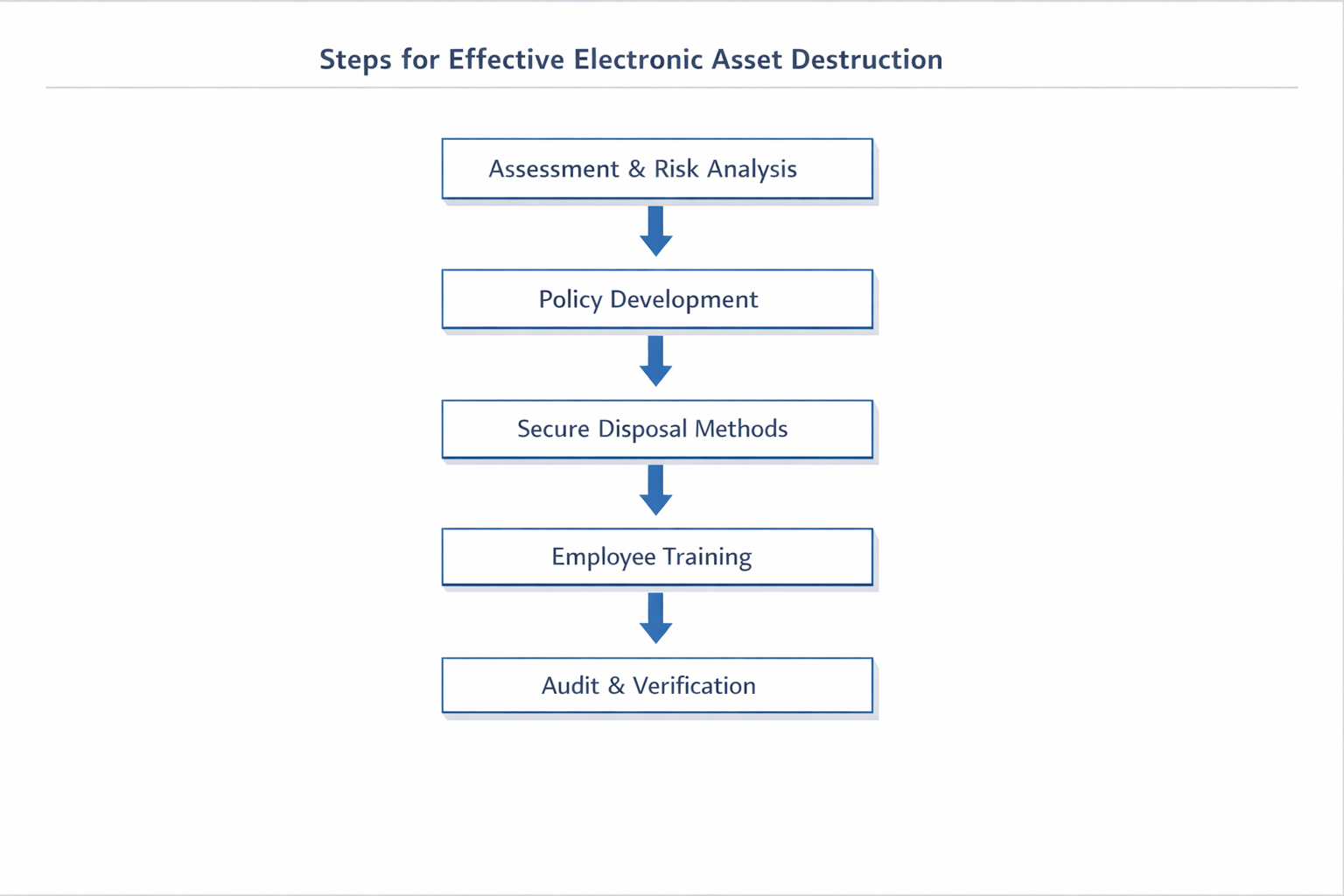
Establishing a defensible enterprise data destruction program is not a vendor-selection problem first. It is a documentation problem. The standard you define internally determines what you can enforce contractually and what will survive audit. The following steps provide a sequential framework for building that standard.
Step 1: Classify Assets by Data Sensitivity and Media Type
Before any destruction method is selected, every asset must be classified by the sensitivity of the data it held and the type of media it represents. NIST 800-88 defines three sanitization methods—Clear, Purge, and Destroy—each providing different levels of assurance based on data sensitivity and media disposition. For media leaving an organization, the Purge method is recommended for moderate to high sensitivity data, ensuring data is unrecoverable by any known method.
Step 1
Inventory and classify before engagement
Catalog every asset by serial number, media type (HDD, SSD, tape, mobile device), and data classification (public, internal, confidential, regulated). This inventory becomes the chain-of-custody baseline. If the inventory is incomplete, the destruction certificate is incomplete.
The classification drives the method. A laptop that touched ePHI requires a different sanitization posture than a desktop used for email. The operator's posture on this distinction is what you verify in the RFP.
Step 2: Adopt a Recognized Data Destruction Standard
Adopting recognized data destruction standards like NIST 800-88 or DoD 5220.22-M provides a clear framework for securely erasing data from devices. The standard you adopt must be named in the contract, referenced in the certificate, and auditable in the vendor's published methodology.
In our editorial review of vendor profiles, the vendors who score highest on audit-defensible documentation are the ones who name the standard, cite the specific method (e.g., "NIST 800-88 Purge via cryptographic erase for self-encrypting drives"), and provide serialized certificates that map back to the inventory. The vendors who score lowest use generic language like "secure data destruction" without specifying the underlying control.
Step 3: Implement a Multi-Layered Destruction Approach
Implementing a multi-layered data destruction approach combines software sanitization with physical destruction to ensure maximum security. For high-sensitivity assets, logical sanitization alone may not be sufficient. The layered approach means:
- Logical sanitization first: NIST 800-88 overwrite or cryptographic erase for assets that can be resold or redeployed.
- Physical destruction second: Shredding, crushing, or degaussing for assets that cannot be sanitized logically or where the risk profile demands it.
Step 2
Define the destruction matrix
Create a matrix that maps asset classification to destruction method. For example: ePHI-touching SSDs require cryptographic erase verified by SMART log plus physical shredding if the erase fails verification. Non-sensitive desktops require NIST Clear only. The matrix becomes the RFP specification.
The failure mode we see most often is the gap between the method specified in the contract and the method applied in practice. The certificate says "NIST 800-88 Purge," but the audit trail shows a batch-level certificate with no serialized verification. That gap is what regulators find.
Step 4: Establish Chain-of-Custody Documentation Requirements
The chain-of-custody documentation is the operator's primary defense in a post-incident review. It must be serialized, timestamped, and traceable from asset pickup to final disposition. The documentary record must answer:
- What asset (by serial number)?
- What method (by named standard and specific technique)?
- What result (pass/fail verification)?
- What disposition (resale, recycling, landfill)?
- What downstream processor (if any)?
For a detailed comparison of vendor approaches to chain-of-custody and certificate structure, see How to Compare Data Destruction Services: Methods & Certifications.
Step 5: Verify Vendor Compliance and Certification Posture
The vendor's certification posture (R2v3, e-Stewards, NAID AAA) is not the same as their compliance with your specified standard. The certification tells you the vendor has been audited against a framework. Your RFP language tells you what they must deliver to you. The two must align.
Step 3
Request methodology documentation in the RFP
In the RFP, require the vendor to provide their published data destruction methodology, sample certificates, and a description of their serialized tracking system. Compare what they provide to what the certification body requires. The gap between the two is your risk.
In the operator's defense, many enterprise IT teams do not ask for this documentation until after the engagement. At that point, the contract is signed and the leverage is gone. The time to verify is before the PO is issued.
Tips and Tricks
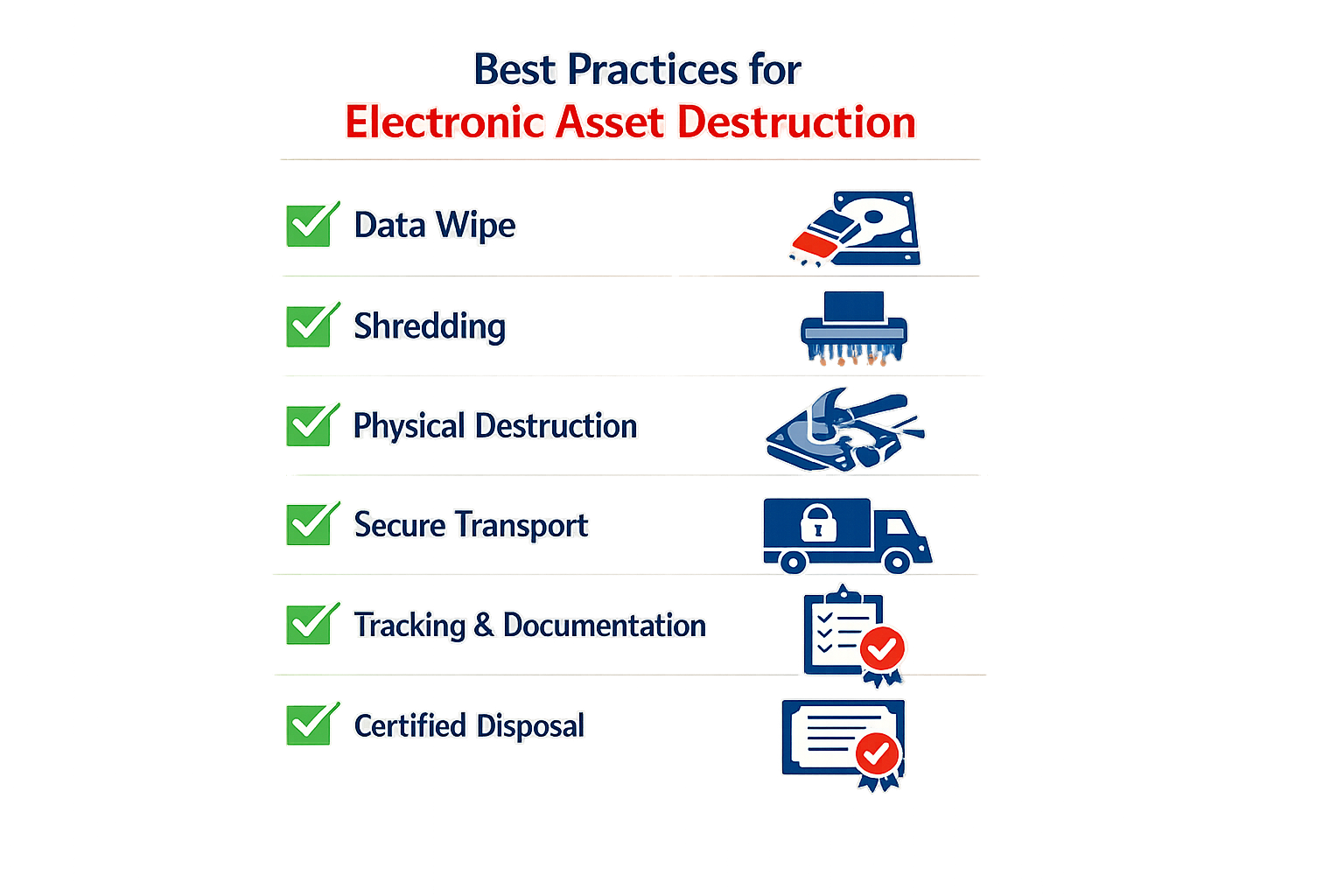
The difference between a defensible destruction program and one that fails audit often comes down to details the vendor didn't mention and the buyer didn't ask about. These practices separate operators who survive regulatory review from those who generate enforcement actions.
Treat Verification as Non-Negotiable
Wiping a drive without documented proof of the action leaves you in the same position as not wiping it at all when the auditor asks for evidence. NIST 800-88 emphasizes verification and documentation as core requirements, not optional enhancements. The certificate must specify the method, the date, the serial number, and the operator who performed the work. Generic batch certificates that reference "approximately 200 drives" do not survive discovery.
In regulated environments, the destruction record becomes part of the asset's permanent file. An ITAD company working with a hospital must ensure all patient data is purged from retired servers to avoid HIPAA violations, and the documentation proving that purge must persist for the full retention period. The question the auditor will ask is simple: show me the serialized record for the device that held this patient's data. If the answer is a batch summary, the program failed.
Match Destruction Method to Data Classification
Physical destruction methods like shredding and incineration are recommended for highly regulated data, providing complete assurance that data cannot be recovered. Logical methods—overwriting per NIST 800-88 or cryptographic erasure—work when the asset has residual value and the data classification permits reuse. The trade-off is economic and risk-based, not a matter of vendor preference.
For assets that touched ePHI, cardholder data, or classified information, the default posture should favor physical destruction unless the operator can demonstrate why logical methods meet the regulatory standard and produce equivalent audit-defensible documentation. The cheapest method is the one whose paper trail you trust enough to hand the auditor without flinching.
Verify Downstream Accountability Before Contract Signature
The vendor you contract with is rarely the only entity in the chain. Subcontractors, downstream processors, and third-party shredding facilities all introduce points where chain of custody can break. The RFP language must require disclosure of all downstream entities, and the contract must specify that subcontracting without written approval constitutes a material breach.
The cheapest vendor is the one whose paper trail you trust enough to hand the auditor without flinching.
In our editorial review of vendor profiles, undisclosed downstream subcontracting appeared as a recurring failure mode. The vendor marketed itself as a single-point-of-contact operator but routed physical destruction to a regional facility that lacked the certifications the primary vendor claimed. The certificate bore the primary vendor's logo, but the work happened elsewhere, and the chain-of-custody documentation did not reflect the handoff. When the buyer's auditor asked for proof, the gap became a finding.
For enterprises managing large-scale retirements, a server decommissioning checklist can help ensure that all steps—including vendor verification and documentation requirements—are captured before the first asset leaves the building.
Audit the Operator's Posture, Not Just the Sales Deck
Certifications matter, but only when they apply to the facility performing the work and the personnel doing the destruction. A vendor with R2v3 certification at one location and uncertified operations at another creates risk if the contract does not specify which facility receives your assets. The published verification on the Compare ITAD directory reflects the operator's verified position as of the last review; it does not guarantee that every site and every technician operates at that standard.
Request facility-specific certifications, recent audit reports, and serialized documentation samples. If the vendor resists, that resistance is data. The operator's posture under scrutiny tells you more than the polished capability deck ever will.
Conclusion
The certificate of data destruction is the operator's primary documentary defense in a post-incident regulatory review. In our editorial review of 35 vendor profiles, we noticed a recurring pattern: the 'certificate of data destruction' referenced in marketing material often differed structurally from the certificate outlined in the vendor's published methodology. That gap — between what the vendor says they deliver and what the document actually proves — is where enterprise risk lives.
Defining standards for corporate electronic asset destruction is not about selecting the most sophisticated destruction method. It is about building a documentary record that survives audit, regulatory scrutiny, and the question an auditor will ask three years after the asset left your loading dock: "How do you know it was destroyed, and how do you know who handled it between here and there?" The Morgan Stanley case serves as a canonical example of the consequences when chain-of-custody documentation fails to survive audit scrutiny. The failure wasn't in the destruction methodology itself but in the documentation that should have persisted beyond the asset's lifecycle.
NIST SP 800-88r2 provides the core U.S. media sanitization framework, which includes methods like Clear, Purge, or Destroy based on risk. That framework is operator-grade because it forces the enterprise to classify the asset's residual risk before selecting a destruction method. In 2026, over 60 million metric tons of e-waste are projected to be generated globally, and the volume alone makes undocumented destruction untenable. The enterprise that treats destruction as a logistics problem rather than a compliance problem will eventually face a regulatory enforcement action it cannot explain away.
The Operator's Posture
The vendors in the Compare ITAD directory with Verified classifications have published methodologies, third-party certifications, and audit-defensible chain-of-custody processes. The vendors without those classifications may perform the same physical destruction, but they do not produce the same documentary record. The difference is material. When procurement teams evaluate ITAD vendors on price alone, they are optimizing for the wrong variable. The cheapest vendor is the one whose paper trail you trust enough to hand the auditor without flinching.
For enterprises building or refining their electronic asset destruction standards, the question is not whether to adopt NIST 800-88 or R2v3 or e-Stewards. The question is whether the standard you adopt can be verified in the field, whether the vendor you select can produce serialized chain-of-custody documentation, and whether the contract language you negotiate holds up when the asset is six processors deep in a downstream supply chain you never approved.
The industry has spent thirty years failing to count what it processed. The enterprises that define standards now — standards that prioritize documentary evidence over vendor assurances — will be the ones that avoid the next $100M regulatory settlement. For a structured approach to vendor evaluation and service category selection, see our ITAD Services: Categories and Vendor Selection Guide.