
Data Destruction Certificate: Components & Auditor Focus
Explore what a data destruction certificate should contain and what auditors specifically look for when reviewing certificate of data destruction documentation.

Introduction
The data destruction certificate is the operator's primary documentary defense in a post-incident regulatory review. It is also, in our review of vendor profiles, the document with the highest variance in what it actually means. A certificate is not a marketing flourish. It is a documented record that connects a specific service to specific devices, usually down to the serial number.
When an auditor reviews a data destruction certificate, they are asking a specific question: does this document prove that the data destruction service occurred as claimed, and does it tie back to the chain of custody for the assets in question? The certificate must answer that question with serialized asset lists, destruction methods, dates, locations, operator identification, and witness signatures. When these elements are missing or inconsistent, the certificate fails its primary function.
A certified vendor proves the chain of custody, documenting the history of equipment from pickup to final destruction. This documentation is what survives discovery. In regulatory enforcement cases, the failure is rarely in the destruction methodology itself — it is in the documentary record that should have connected the asset to the service and didn't. For a detailed breakdown of how enterprise data destruction standards translate into vendor selection criteria, understanding certificate structure is the starting point.
This guide walks through the components of a data destruction certificate, what auditors specifically look for when reviewing certificate of data destruction documentation, and the common failure modes that create audit risk. The structure follows a step-by-step breakdown of certificate elements, troubleshooting guidance for common documentation gaps, and the underlying controls that make a certificate audit-defensible.
Prerequisites
Before evaluating a data destruction certificate or engaging with an ITAD vendor, you need to define what you are asking them to destroy and to what standard. The certificate is the documentary endpoint of a process that begins with your internal classification decisions. If those decisions are unclear, the certificate that arrives six weeks later will reflect that ambiguity — and the auditor will notice.
Understanding Media Types and Data Classification
Start by cataloging the media types in scope: spinning hard drives, solid-state drives, tape cartridges, mobile devices, network equipment. Each category has different destruction mechanics and different failure modes. A vendor certified to shred spinning drives may subcontract SSD destruction to a downstream processor you have never vetted. The RFP language must specify media types and quantities with precision.
Data classification drives the destruction method. NIST 800-88 defines three outcomes: Clear (logical techniques applied, data not feasibly recoverable with standard tools), Purge (physical or logical techniques applied, data not recoverable even with state-of-the-art laboratory methods), and Destroy (physical destruction rendering the media unusable). Your internal data classification — confidential, restricted, public — maps to one of these outcomes. If you classify patient health information as restricted, the destruction method must meet the Purge or Destroy threshold, and the certificate of data destruction must document which method was applied to which serialized asset.
Retention, Legal Hold, and Release Authority
Before any asset leaves your facility, confirm that retention obligations and legal holds have been cleared. The destruction certificate documents what happened after release; it does not absolve you of destroying an asset still under hold. In our editorial review, we have seen operators receive certificates for assets that were never authorized for destruction — the certificate was accurate, but the upstream release decision was not. The auditor will ask who signed the release and on what date. That signature is part of the chain of custody, and it precedes the destruction certificate in the documentary sequence.
Define the required outcome in the RFP: Clear, Purge, or Destroy. The vendor's methodology statement should describe how they achieve that outcome for each media type. The certificate should reference the methodology by name and confirm that the specified outcome was applied. If the methodology says "NIST 800-88 Purge via cryptographic erase for self-encrypting SSDs," the certificate should say the same thing, not a generic "data destroyed per industry standards."
Step-by-Step Guide to Understanding Certified Data Destruction Certificates
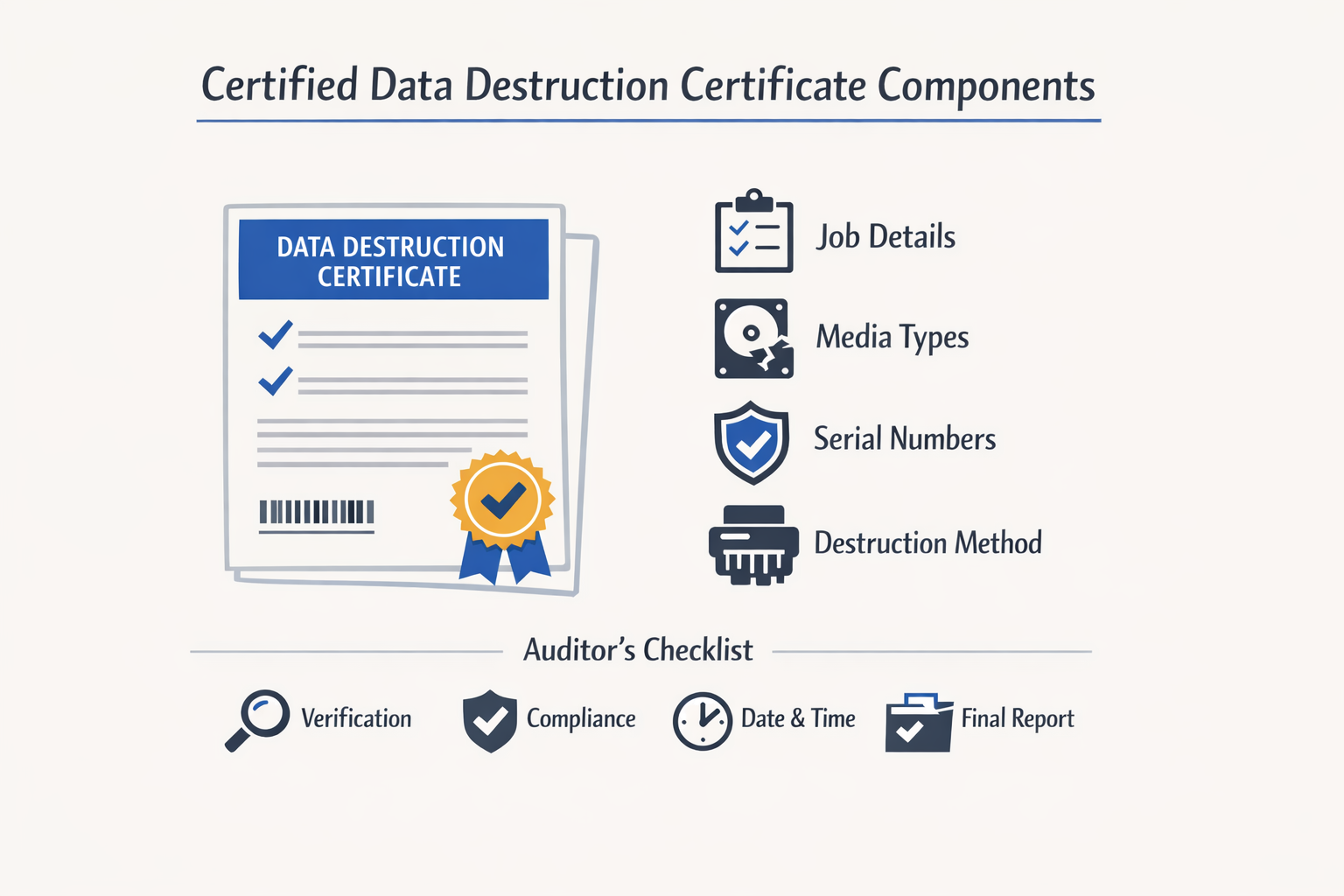
A data destruction certificate is the primary documentary defense when an auditor asks what happened to retired storage media. The certificate's structure determines whether it survives scrutiny. The following steps break down what a defensible certificate contains and how to verify that the document matches the operator's actual process.
Step 1
Verify serialized asset enumeration
Each certificate must list every destroyed asset by exact serial number. Batch descriptions like "40 hard drives" or "mixed storage media" do not meet audit standards. The serialized list ties the certificate to the chain-of-custody manifest that preceded destruction. When an auditor cross-references the certificate against the intake manifest, the serial numbers must match one-to-one.
Step 2
Confirm the stated destruction method
The certificate must name the NIST sanitization method applied to each asset class. For magnetic media, this typically means NIST 800-88 Clear, Purge, or Destroy. For solid-state media, the method should specify cryptographic erasure or physical destruction. Generic language like "securely destroyed" or "wiped" does not satisfy the standard. The method stated on the certificate must align with the vendor's published methodology and the client's data-sensitivity classification.
Step 3
Check timestamp and location precision
The certificate must state the date and physical location where destruction occurred. Vague entries like "Q1 2026" or "offsite facility" introduce ambiguity that auditors flag. The timestamp ties the certificate to the operator's activity log, and the location confirms whether destruction occurred at a certified facility or an undisclosed subcontractor site. This is the mechanism that reveals undisclosed downstream processing.
Step 4
Identify the responsible technician and witness
A defensible certificate includes the technician's ID or signature and, where required by contract, a witness signature. The technician signature creates individual accountability; the witness signature, when present, provides independent verification. In regulated industries, the witness requirement is standard. When a certificate lacks either signature, it becomes a unilateral assertion rather than a verified record.
The cheapest vendor is the one whose paper trail you trust enough to hand the auditor without flinching.
Step 5
Verify certifying authority reference
The certificate should reference the certifying body that governs the destruction process — typically R2v3, e-Stewards, NAID AAA, or an equivalent standard. This reference ties the certificate to a third-party-audited framework. When the certificate omits the certifying authority, or when the referenced authority does not appear in the vendor's published credentials, the certificate's validity is in question. Cross-check the stated authority against the vendor's current certification status in the Compare ITAD directory.
What Auditors Look For in Certificate Review
Auditors approach the data destruction certificate with three questions. First: does the certificate's serialized asset list match the chain-of-custody manifest that preceded destruction? A mismatch indicates lost tracking or substituted assets. Second: does the stated destruction method align with the client's data-sensitivity classification and the vendor's published methodology? A mismatch suggests the vendor applied a cheaper method than contracted. Third: does the certificate's timestamp and location confirm that destruction occurred at a certified facility within the contracted retention window? A mismatch reveals undisclosed subcontracting or delayed processing.
Certification can support due diligence, but it does not remove the client's responsibility to define data sensitivity and retention. The certificate is the output of a process the client specified. When the client's RFP language is vague, the certificate reflects that vagueness. For guidance on structuring ITAD engagements with precise destruction requirements, see Enterprise Data Destruction Standards for Corporate IT.
Troubleshooting Common Issues with Data Destruction Certificates
The certificate of data destruction is the operator's primary documentary defense in a post-incident regulatory review. It is also, in our review of 35 vendor profiles, the document with the highest variance in what it actually means. The failure modes cluster around three structural issues: incomplete asset enumeration, ambiguous destruction method language, and the absence of verifiable witness or operator identity. Each of these gaps becomes a question the auditor will ask.
Missing or Generic Asset Identifiers
A certificate that lists "15 laptops" or "batch 2024-03" without serialized asset identifiers is not audit-defensible. The auditor's question is simple: which specific devices were destroyed, and how do you prove it? If the certificate does not include manufacturer, model, and serial number for each asset, the chain of custody breaks at the destruction event. The fix is structural: before issuing an RFP, define media types and quantities with serialized inventory. If the vendor cannot accept a serialized input list and return a serialized certificate, the vendor cannot meet the documentary standard.
Ambiguous Destruction Method Language
Certificates that state "secure data destruction" or "industry-standard sanitization" without naming the specific method applied fail the verification test. The auditor needs to know whether the method was physical (shredding to 2mm particle size, degaussing to NIST 800-88 Purge standard) or logical (NIST 800-88 Clear overwrite, cryptographic erasure with key destruction). The distinction matters because different regulatory frameworks require different methods for different data classifications. The fix is to require method-specific language in the RFP and contract: "NIST 800-88 Purge via three-pass overwrite" or "physical destruction via cross-cut shredding to 2mm maximum particle size per DIN 66399 P-7." Verification asks whether the technique completed; validation asks whether the verified result is acceptable.
Unsigned or Undated Certificates
A certificate without a witness signature, operator ID, destruction date, and destruction location is not a certificate — it is a template. The auditor's question is: who performed the destruction, where did it occur, and when? If the certificate does not answer all three, it does not survive discovery. The fix is to specify in the contract that the certificate must include the operator's full name and employee ID, the witness's full name and role, the destruction facility address, and the destruction date in ISO 8601 format. If the vendor resists this level of specificity, the vendor is not prepared for the audit standard.
The cheapest vendor is the one whose paper trail you trust enough to hand the auditor without flinching.
Certificate-vs-Practice Gaps
The most common failure mode we observe is the gap between the certificate the vendor markets and the certificate the vendor's operational process actually produces. A vendor may advertise "serialized certificates" in marketing material but deliver batch-level certificates in practice. The fix is to request a sample certificate during the RFP process and verify that it contains all required elements before awarding the contract. If the sample certificate does not match the advertised standard, the vendor's posture is not what it claims to be. For additional context on how to evaluate vendor claims systematically, see our guide on how to compare data destruction services.
Conclusion
The data destruction certificate is the operator's primary documentary defense in a post-incident regulatory review. It is also, in our editorial review of 35 vendor profiles, the document with the highest variance in what it actually means. When a certificate lacks serialized asset tracking, method specificity, or verifiable chain-of-custody references, it becomes a liability rather than a defense — the auditor's first question will be whether the certificate can substantiate the destruction claim under discovery.
What survives audit is not the vendor's assurance or the marketing promise. It is the documentary record: serialized asset lists, timestamped destruction events, operator identifiers, witness attestations, and references to the certifying standard. The Morgan Stanley case remains canonical because the failure was not in destruction methodology — it was in the chain-of-custody documentation that should have survived the auction and didn't. A certificate that cannot connect a specific device to a specific destruction event, performed by a specific operator on a specific date, is structurally insufficient.
For enterprise IT and procurement leads, the trade-off is clear. The cheapest vendor is the one whose paper trail you trust enough to hand the auditor without flinching. A robust data destruction certificate should contain the elements outlined in this guide: serialized inventory, method and standard reference, destruction date and location, operator and witness signatures, and certifying authority. When these elements are present and internally consistent, the certificate becomes audit-defensible. When they are absent or misaligned with the vendor's published methodology, the certificate is a placeholder — and the risk remains with the asset owner.
In practice, the question is not whether your vendor provides a certificate. The question is whether that certificate, as written, would hold up in a regulatory review six months after the engagement closed. If the answer is uncertain, the operator's posture is uncertain — and the documentary defense is incomplete.