
R2v3 e-Stewards Comparison: Which ITAD Certification is Right for You?
Explore the r2v3 e-stewards comparison to determine which ITAD certification your vendor should hold for responsible electronics recycling.
Introduction
The r2v3 e-stewards comparison starts with a practical reality: when an organization retires servers, laptops, or network equipment, the choice of IT asset disposition vendor determines whether those assets are handled responsibly or become a liability. Certification choice shapes outcomes — from audit trails that survive scrutiny to gaps that surface only when regulators ask questions.
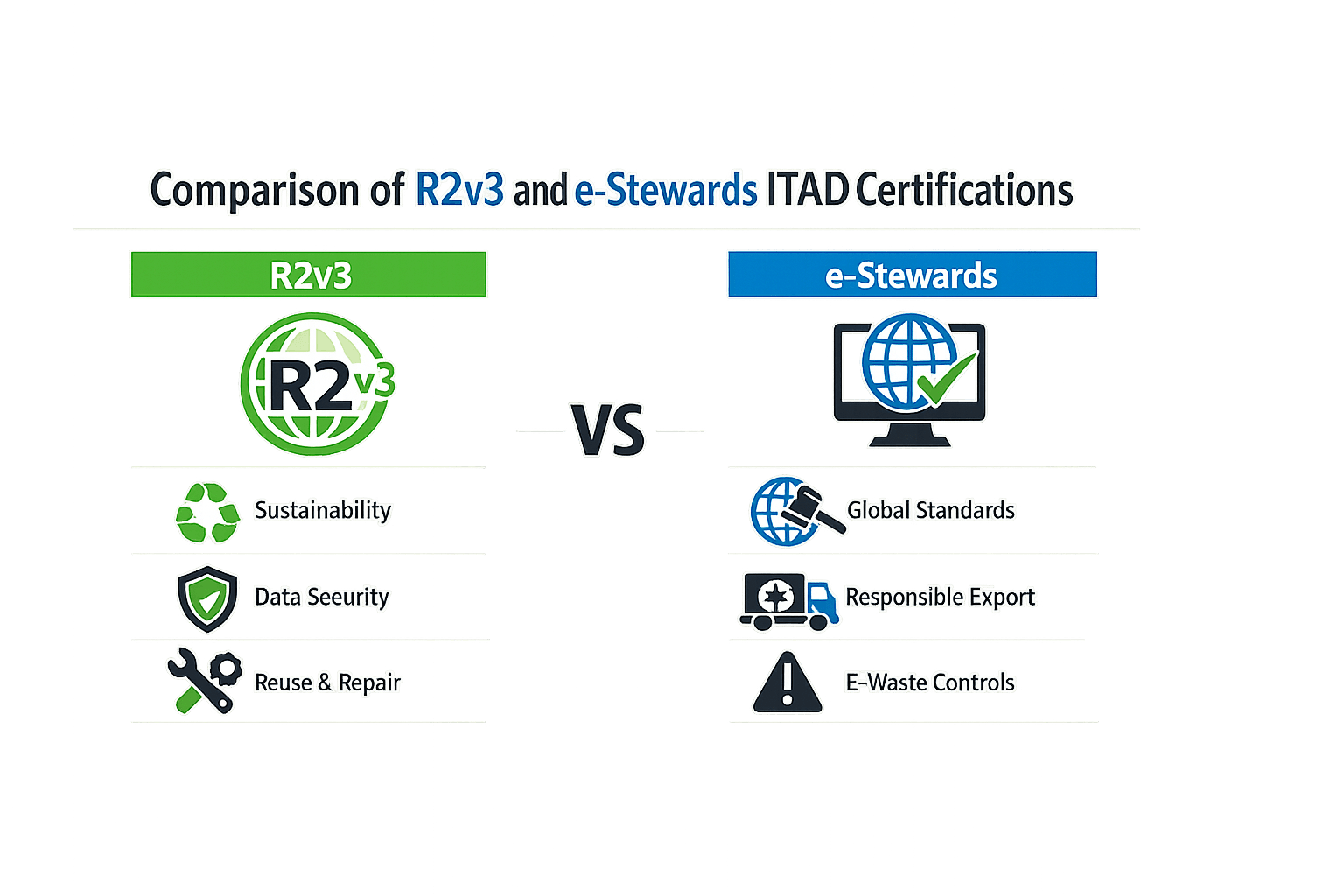
The r2v3 e-stewards comparison matters because these two certifications represent different philosophies about what "responsible recycling" means. R2v3, developed by the Sustainable Electronics Recycling International (SERI), focuses on increasing the value of end-of-life electronics through repair, reuse, or recycling. e-Stewards, created by the Basel Action Network (BAN), emphasizes preventing hazardous e-waste export and protecting workers and communities from toxic exposure. Both certifications require third-party audits, documented data destruction, and environmental management systems—but the details diverge in ways that affect vendor selection.
For organizations managing IT asset retirement, the practical question is not which certification is "better" in the abstract, but which one aligns with your risk tolerance, regulatory obligations, and operational needs. A healthcare system facing HIPAA disclosure timelines evaluates certification differently than a retail chain prioritizing equipment resale value. The vendor's certification tells you what standard they committed to meet; your contract and verification practices determine whether they actually deliver on that commitment.
This guide walks through the structural differences between R2v3 and e-Stewards, how each certification operates in practice, and what those differences mean for buyers. Understanding the R2v3 Certification Guide: ITAD Standards Explained (2026) provides additional context on how R2v3 functions as a baseline standard, but the comparison here focuses on decision points that matter when you're choosing between vendors holding different credentials.
Understanding the R2v3 e-Stewards Comparison: What is R2v3 and e-Stewards?
R2v3 and e-Stewards represent the two dominant third-party certification frameworks in the ITAD industry, each with distinct origins, oversight bodies, and philosophical approaches to responsible electronics recycling. Understanding these foundational differences is essential when evaluating vendor credentials or building procurement requirements.
R2v3: The Responsible Recycling Standard
R2v3 is the third revision of the Responsible Recycling standard, developed and maintained by Sustainable Electronics Recycling International (SERI). The standard focuses on increasing the value of end-of-life electronic products through repair, reuse, or recycling, with requirements spanning environmental management, worker health and safety, and data security.
SERI designed R2v3 as a broad-tent framework that accommodates diverse business models—from small regional recyclers to global asset recovery operations. The standard prescribes specific controls for data destruction, downstream vendor management, and material tracking, but allows certified facilities flexibility in how they implement those controls. This design philosophy has made R2v3 the most widely adopted ITAD certification globally, with hundreds of certified facilities across North America, Europe, and Asia.
e-Stewards: The Environmental Rigor Standard
The e-Stewards standard was created by the Basel Action Network (BAN), a Seattle-based environmental advocacy organization focused on preventing the export of hazardous electronic waste to developing nations. BAN developed e-Stewards in response to concerns that existing frameworks permitted practices—particularly transboundary shipment of untested equipment and hazardous materials—that violated the spirit of the Basel Convention on hazardous waste.
e-Stewards is regarded as the most rigorous environmental standard in the ITAD industry. It prohibits the export of functional and non-functional electronics to most developing countries, mandates higher standards for downstream vendor vetting, and requires more stringent environmental controls than R2v3. The certification also incorporates ISO 14001 environmental management system requirements as a foundational element.
While e-Stewards has fewer certified facilities than R2v3—reflecting both its stricter requirements and BAN's nonprofit governance model—it commands significant recognition among enterprises with strong environmental, social, and governance (ESG) commitments. Organizations in healthcare, finance, and technology sectors often specify e-Stewards certification in vendor contracts when export restrictions and environmental rigor are non-negotiable.
Governance and Oversight
The two standards operate under fundamentally different governance structures. SERI functions as a membership organization with industry representation, while BAN operates as an environmental advocacy nonprofit. This distinction influences everything from standard revision processes to enforcement philosophy. SERI's approach emphasizes stakeholder consensus and market adoption; BAN's approach prioritizes environmental outcomes and strict compliance.
For procurement teams evaluating ITAD certifications, the practical implication is that R2v3 and e-Stewards certifications signal different vendor priorities. R2v3 indicates broad operational competence and market acceptance; e-Stewards indicates a commitment to environmental rigor and export restriction compliance that exceeds baseline industry practice.
How R2v3 vs e-Stewards Works
Both R2v3 and e-Stewards certifications share a common foundation: environmental management systems, worker protection, data security aligned with NIST SP 800-88, and downstream accountability. Where they diverge is in how strictly they interpret responsible practice — particularly around export policy and data destruction methods. Understanding these operational differences helps you evaluate which standard better fits your risk tolerance and compliance requirements.
Core Requirements: The Shared Foundation
Both certifications require ITAD vendors to demonstrate structured management across the same operational domains. R2v3 is not built on a small set of pillars: it sets out ten Core Requirements that apply to every certified facility, plus seven Process Requirements that apply only to the activities a given facility actually performs. Data security sits in Core Requirement 7; environmental and worker protection, downstream accountability and chain of custody are all addressed inside that same structure rather than alongside it. e-Stewards follows a similar shape but layers additional restrictions on top of the baseline.
Every certified vendor must maintain documented procedures for asset intake, tracking, processing, and final disposition. They must show evidence of worker safety programs, environmental compliance, and regular third-party audits. The gap between the two standards emerges when you examine what counts as acceptable practice within those shared categories.
Data Destruction: Method Flexibility vs. Certification Mandate
e-Stewards requires NAID AAA certification for data destruction, which means vendors must submit to unannounced audits and demonstrate physical destruction capabilities that meet specific throughput and particle-size requirements. R2v3 accepts multiple methods — physical destruction, cryptographic erasure, or NIST SP 800-88 overwrite — without mandating a specific third-party certification. Both approaches align with NIST SP 800-88, but e-Stewards adds a layer of operational verification that R2v3 leaves to the vendor's discretion.
For organizations with strict audit requirements, the NAID AAA mandate offers a clear compliance signal. For those prioritizing flexibility — particularly when handling devices where physical destruction isn't economically viable — R2v3's method-agnostic approach may be more practical. The trade-off is between prescriptive assurance and operational adaptability. Organizations seeking detailed guidance on secure data destruction methods can evaluate which certification aligns with their data sanitization requirements.
Export Policy: The Brightest Line
R2v3 does not work from a list of approved destination countries. Core Requirement 4 makes the vendor responsible for confirming, shipment by shipment, that a movement is legal under the receiving country's import rules and the sending country's export rules, and for tracking the material through the downstream chain. e-Stewards draws a harder line, prohibiting the export of hazardous end-of-life electronics to developing countries. That difference often determines which certification a vendor pursues, because it directly shapes their business model.
Vendors who remarket equipment internationally typically hold R2v3 certification. Those who focus exclusively on domestic resale or downstream destruction often choose e-Stewards to signal a zero-export posture. If your organization's policy prohibits any possibility of international resale — even to developed nations with robust e-waste regulations — e-Stewards offers a simpler compliance story. If you're comfortable with documented export to OECD countries, R2v3 provides that flexibility without sacrificing environmental accountability.
| Requirement | R2v3 | e-Stewards |
|---|---|---|
| Export policy | No country whitelist; per-shipment legality (Core 4) | Bars hazardous e-waste export to developing countries |
| Data destruction | Accepts multiple NIST SP 800-88 methods | Requires NAID AAA certification |
| Environmental management | Required | Required |
| Downstream accountability | Required | Required |
Audit and Recertification: Ongoing Verification
Both certifications require annual surveillance audits and full recertification every three years. The audit process examines documentation, interviews staff, and traces sample assets through the full chain of custody. Auditors verify that written procedures match actual practice — a gap that has ended certifications when vendors couldn't demonstrate consistent execution.
The recertification cycle means a vendor's certificate represents current practice, not a one-time achievement. When evaluating vendors, check the certificate issue date and confirm the certification is active. A lapsed certification indicates either an operational failure or a deliberate choice to exit the program, and both scenarios warrant scrutiny.
For a deeper look at how these certifications fit into the broader ITAD compliance landscape, see our ITAD Certifications: What R2v3, NAID AAA and e-Stewards Cover guide.
Real-World Examples of R2v3 and e-Stewards
The choice between R2v3 and e-Stewards plays out differently across vendor types and market segments. Federal contractors, regional processors, and enterprise-focused vendors each navigate certification decisions based on client expectations and competitive positioning.
Federal Procurement and OEM Programs Favor R2v3
Federal procurement channels and original equipment manufacturer take-back programs increasingly specify R2v3 as a baseline requirement. Vendors pursuing contracts with government agencies or participating in OEM reverse-logistics networks find R2v3 certification opens doors that e-Stewards alone may not. This trend reflects R2v3's broader market penetration and its explicit alignment with federal electronics stewardship goals.
The pressure to transition is commercial rather than philosophical. When federal RFPs list R2v3 as a mandatory credential and OEM partners require it for authorized downstream processing, the certification becomes a prerequisite rather than a differentiator.
Enterprise Buyers and Dual-Certification Vendors
Large enterprise clients frequently request both certifications in vendor qualification documents, particularly when environmental commitments extend beyond regulatory minimums. Vendors holding dual certification—R2v3 and e-Stewards simultaneously—position themselves to serve clients with diverse priorities without limiting their addressable market.
Dual-certified vendors absorb higher audit costs and maintain parallel documentation streams, but they avoid the opportunity cost of declining contracts that specify one certification or the other. For vendors already operating at scale, the incremental burden of dual certification is manageable compared to the revenue risk of a narrower credential set.
Regional Processors and Certification Trade-Offs
Smaller regional processors often commit to a single certification based on their primary customer base. A processor serving municipal contracts and regional healthcare systems may prioritize R2v3 to align with government procurement language and federal healthcare compliance frameworks. Conversely, a vendor embedded in corporate sustainability networks—serving clients with published zero-landfill commitments—may choose e-Stewards to signal alignment with stricter environmental standards.
The certification choice reflects the vendor's strategic focus rather than an absolute quality judgment. Both pathways require third-party audits, documented chain-of-custody, and adherence to data destruction standards that meet regulatory thresholds. The operational impact lies in which doors the certification opens, not in the baseline rigor of the standard itself.
Benefits of R2v3 vs e-Stewards Certification
Choosing between R2v3 and e-Stewards is not about identifying a universal winner — it's about matching certification philosophy to operational priorities. Both standards deliver measurable value, but they optimize for different outcomes. Understanding these trade-offs helps procurement teams align vendor selection with compliance posture, asset recovery goals, and stakeholder expectations.
Operational Flexibility vs Environmental Rigor
R2v3 covers more practice areas but allows greater operational flexibility, making it more accessible for smaller ITAD vendors. The standard's prescriptive structure — spanning data security, environmental health and safety, and downstream accountability — provides a comprehensive framework without mandating single-path solutions. Vendors can tailor processes to facility capabilities while maintaining certification compliance. That breadth shows up in how many facilities hold the standard: SERI put R2 certification at roughly 1,250 facilities across 43 countries as of January 2026. The number comes from the certifying body itself and counts facilities rather than companies, so it is not directly comparable to the counts other standards publish.
e-Stewards certification takes a stricter approach with fewer but more rigid principles, prioritizing environmental protection. The standard prohibits export of non-working electronics to developing countries and requires upstream supply chain transparency that exceeds R2v3's downstream focus. For organizations with aggressive sustainability mandates — particularly those facing investor or regulatory scrutiny on environmental, social, and governance metrics — e-Stewards' narrower scope delivers clearer alignment with zero-waste and circular economy commitments.
| Dimension | R2v3 | e-Stewards |
|---|---|---|
| Operational scope | Broad (data, EHS, downstream) | Focused (environment, export) |
| Vendor accessibility | Broad (~1,250 facilities — SERI, Jan 2026) | Narrower (stricter entry barriers) |
| Asset recovery emphasis | Explicit value recovery focus | Secondary to environmental goals |
| Export restrictions | Permits functional equipment export | Prohibits non-working export |
Financial Performance and Asset Recovery
Certification shapes what surplus IT assets recover, though we have no defensible public figure for the size of that effect and will not quote one. What a buyer is paying for is chain-of-custody documentation, tested data destruction protocols, and audited environmental compliance. For organizations managing large-scale hardware refreshes or datacenter decommissions, that paperwork is what makes recovered value defensible after the fact. The advantage compounds when vendors hold both R2v3 and ISO certifications, signaling mature quality management systems that reduce risk throughout the disposition lifecycle.
e-Stewards certification delivers value through reputational differentiation rather than direct price premiums. Organizations in regulated industries — healthcare, finance, government — often face stakeholder pressure to demonstrate environmental leadership beyond minimum compliance. An e-Stewards vendor relationship provides third-party validation of rigorous environmental practices, strengthening sustainability reporting and mitigating greenwashing accusations. The certification's stricter export prohibitions also reduce legal exposure in jurisdictions with evolving e-waste legislation.
Risk Mitigation and Audit Readiness
Both certifications reduce operational risk, but they address different failure modes. R2v3's comprehensive scope covers the full spectrum of ITAD risks — from incomplete data sanitization to downstream processor violations — making it the safer choice for organizations lacking internal ITAD expertise. The standard's annual surveillance audits and mandatory corrective action processes create continuous improvement pressure that prevents certification decay between renewal cycles.
e-Stewards' focused environmental requirements make it easier to audit but harder to achieve. The certification's prohibition on prison labor and conflict minerals, combined with upstream supply chain traceability requirements, demands documentation depth that smaller vendors often cannot sustain. For buyers, this translates to higher confidence in certified vendors' operational maturity. The narrower scope also simplifies contract language: an e-Stewards requirement eliminates the need for separate export restriction clauses or downstream processor approval workflows.
Choosing Based on Organizational Priorities
Organizations prioritizing asset recovery and broad vendor choice benefit most from R2v3 certification requirements. The standard's market penetration ensures competitive bidding, and its explicit focus on value recovery aligns vendor incentives with buyer financial goals. Companies managing diverse IT portfolios — from enterprise servers to consumer electronics — gain operational flexibility from R2v3's device-agnostic approach.
Organizations with non-negotiable environmental commitments or facing regulatory pressure on e-waste exports should require e-Stewards certification. The standard's stricter requirements reduce vendor pool size but eliminate ambiguity around environmental performance. This clarity matters most when sustainability metrics flow into executive compensation, investor relations, or regulatory reporting. For detailed guidance on evaluating vendor capabilities beyond certification status, see our guide on how to choose an ITAD vendor.
Conclusion
The r2v3 e-stewards comparison reveals two credible but fundamentally different approaches to ITAD certification. R2v3 offers a comprehensive, process-oriented framework with broad market adoption, making it the practical choice for most organizations seeking vendor accountability. e-Stewards takes a stricter environmental stance with fewer but more rigid principles, appealing to organizations where zero-landfill commitments and upstream supply-chain transparency are non-negotiable.
Neither certification guarantees perfect execution—what matters is how rigorously your vendor implements the standard they hold. Certified vendors do fail basic chain-of-custody requirements, and uncertified shops sometimes run cleaner operations than their papered competitors. The certificate opens the conversation; your due diligence closes it.
For most buyers, R2v3 provides sufficient rigor with maximum vendor selection flexibility. Choose e-Stewards when your compliance posture, stakeholder expectations, or industry vertical demand the highest environmental standard—and be prepared to pay a premium for that positioning. The decision isn't really a values question; it's a market positioning question that should align with your organization's risk tolerance and operational requirements.
When finalizing your vendor selection, verify that certification scope matches your asset types, confirm audit currency, and ensure contract language requires maintained certification throughout the engagement term. The right certification is the one your vendor can defend in an audit—and the one you can defend to your board when asked why you chose them. For a complete vendor evaluation framework, review our guide on how to choose an ITAD vendor to ensure your certification requirements integrate with broader operational and compliance criteria.
Related reading
Data Disposition: Linking Information Lifecycle Management to ITAD