
IT Asset Disposition: A Framework for Enterprise Buyers
Explore IT asset disposition with this framework designed for enterprise buyers, ensuring compliant and secure asset management practices.

Introduction
The certificate of data destruction is the operator's primary documentary defense in a post-incident regulatory review. It is also, in our editorial review of vendor profiles across the Compare ITAD directory, the document with the highest variance in what it actually means. IT asset disposition — the full lifecycle from decommissioning to final destruction or resale — sits at the intersection of IT operations, regulatory compliance, and enterprise risk management. When the process works, it is invisible. When it fails, the failure is public, expensive, and often irreversible.
In the 2016 Morgan Stanley Smith Barney data center decommissioning, the breakdown was structural. The firm contracted with a moving company that subcontracted data destruction to a vendor, which then ceased providing services mid-engagement without notifying the enterprise buyer. Devices containing consumer report information were sold at auction without data destruction, and the SEC concluded that Morgan Stanley "failed to take reasonable measures to protect against unauthorized access" in violation of the Disposal Rule. The cumulative cost exceeded $100M when settlement, remediation, and reputational damage were tallied.
That case is not an outlier in mechanism — it is canonical in failure mode. The enterprise buyer believed it had contracted for compliant asset disposition. The vendor's subcontractor stopped performing the contracted work. The buyer did not verify the documentary record in real time, and the gap was discovered only after devices appeared for resale with data intact. The regulatory finding was straightforward: the buyer's due diligence was inadequate to the risk.
For enterprise IT and procurement teams, the question is not whether asset disposition is regulated — it is. The question is what the documentary record must contain to survive an auditor's review. The answer begins with understanding what asset disposition actually covers, which vendors can deliver audit-defensible documentation, and how to structure an engagement that holds up under regulatory scrutiny. This framework addresses those questions in operator-grade detail, starting with the prerequisites and moving through a step-by-step process for vendor selection, contract structure, and post-engagement verification.
For a broader overview of what IT asset disposition entails and the scope of services covered, see ITAD Meaning: What IT Asset Disposition Actually Covers.
Prerequisites for Understanding IT Asset Disposition
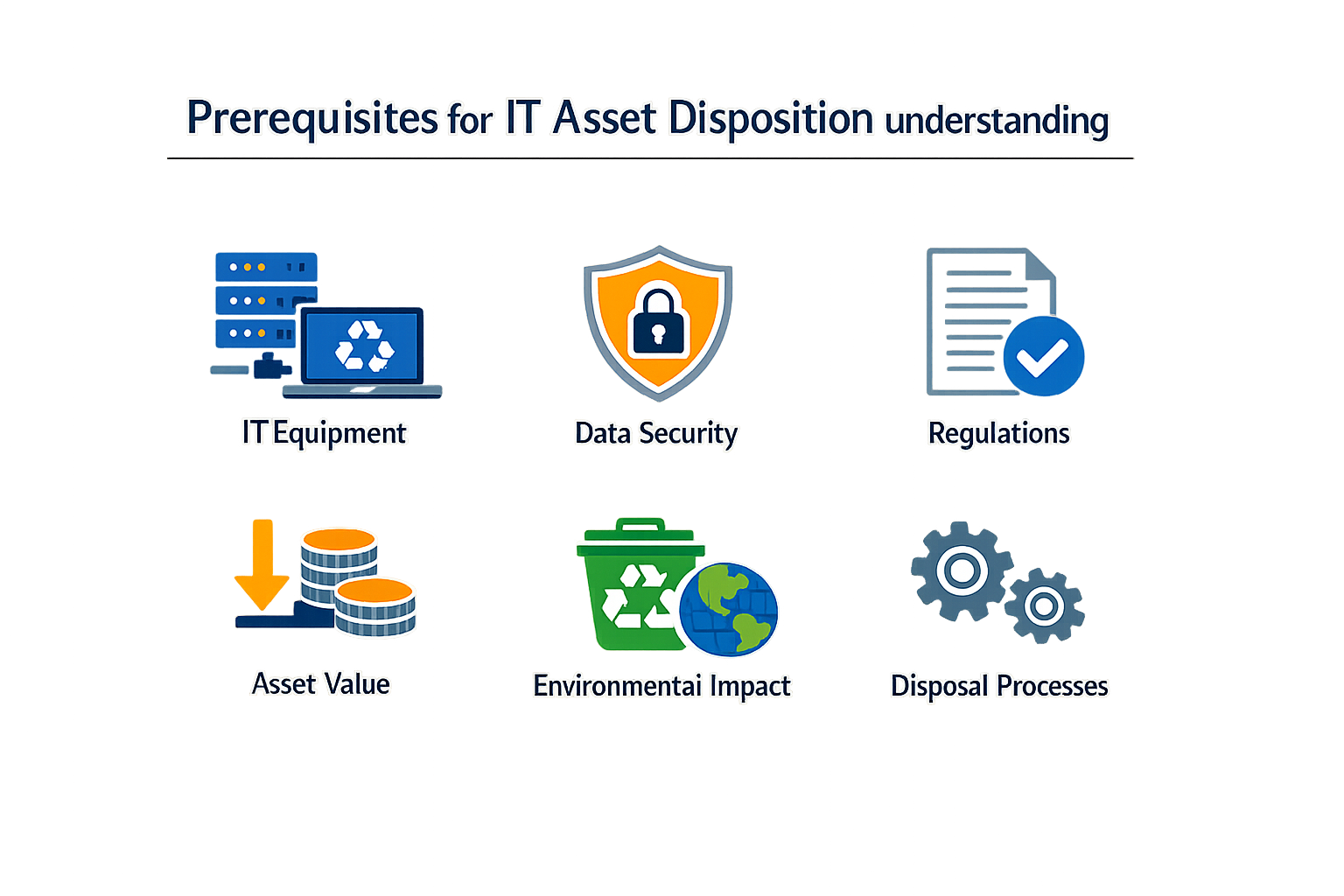
Before an enterprise buyer can evaluate vendors or build an RFP, the organization must establish the foundational controls and knowledge that make asset disposition decisions defensible. This section outlines the internal prerequisites — the policies, roles, and documentation patterns — that must be in place before the first asset leaves the building.
Organizational Policy and Alignment
NIST SP 800-88 Rev. 2, the current media sanitization standard published in September 2025, describes a storage sanitization policy as addressing alignment of the organization's risk posture, information categories, and confidentiality impact levels. The policy should identify how sanitization decisions map to the system life cycle — not as an afterthought at disposal, but as a control designed and documented before the system goes into production.
In practice, this means the enterprise must have already categorized its information by confidentiality impact and documented which sanitization methods apply to which asset classes. If the organization cannot correctly identify appropriate information categories and confidentiality impact levels, the downstream disposition process inherits that ambiguity — and so does the vendor's certificate of destruction.
Defined Roles and Responsibilities
Asset disposition is not a single-owner process. NIST SP 800-88 Rev. 2 identifies the property management officer as responsible for identifying and tracking sanitized media that are redistributed within the organization, donated to external entities, or destroyed. The FTC Disposal Rule (16 CFR Part 682) requires that any person who maintains or possesses consumer information for a business purpose must properly dispose of such information by taking reasonable measures to protect against unauthorized access.
The question the auditor will ask: who signed off on the disposition decision, and what documentary record exists to prove that person had the authority and the information to make it? If the answer is "the IT manager sent an email," the organization has a gap. If the answer is "the property management officer reviewed the confidentiality classification, confirmed the sanitization method, and logged the decision in the asset ledger," the organization has an audit-defensible posture.
Inventory and Tracking Mechanisms
The enterprise must be able to produce a serialized inventory of what it owns, where it is, and what information categories it has touched. NIST SP 800-88 Rev. 2 presumes that organizations can correctly identify information locations; if the organization cannot, the sanitization control cannot be applied consistently.
This is not a theoretical concern. In the Morgan Stanley case, the failure mode was not that the vendor performed inadequate sanitization — it was that the organization could not account for which assets had been sanitized and which had not. The documentary record did not survive the engagement. For a deeper exploration of what IT asset disposition entails and how it fits into the broader lifecycle, see ITAD Meaning: What IT Asset Disposition Actually Covers.
Understanding Regulatory Baselines
The FTC Disposal Rule establishes a baseline: proper disposal requires reasonable measures to protect against unauthorized access. The rule permits entering into and monitoring compliance with a contract with another party engaged in the business of record destruction, provided the buyer conducts due diligence — which could include reviewing an independent audit of the disposal company's operations and compliance with the rule.
The contract language matters. The RFP language matters. If the buyer's due diligence consisted of "we Googled them and they had a website," the regulatory baseline is not met. If the due diligence consisted of "we reviewed their R2v3 certification, confirmed the scope covered the asset classes we were disposing of, and verified the chain-of-custody documentation matched the serialized inventory we provided," the baseline is met.
Step-by-Step Guide to IT Asset Disposition
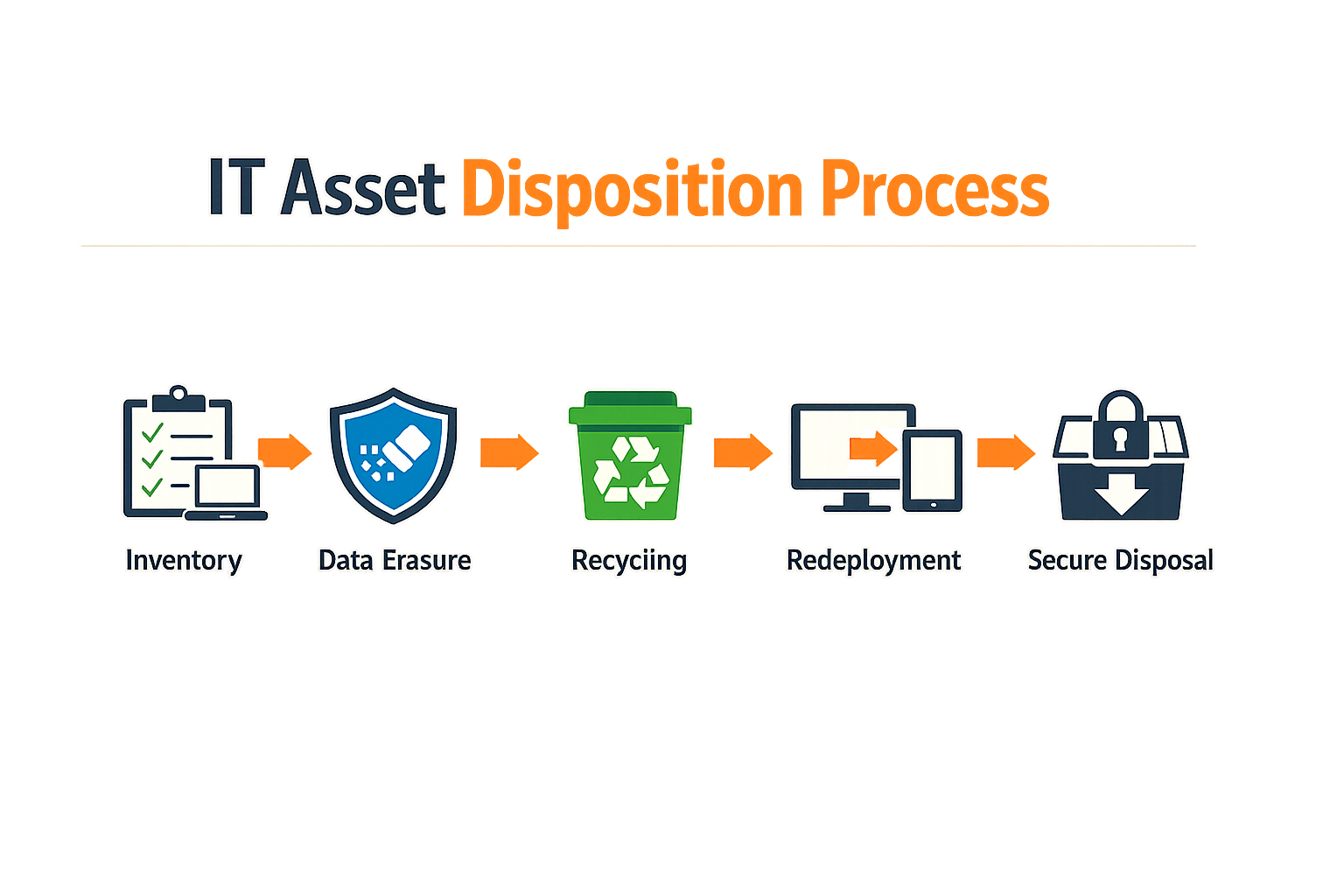
An asset disposition program is not a single transaction — it is a documented process that survives audit. The steps below reflect the underlying controls that regulators and auditors expect to see in the documentary record, drawn from NIST SP 800-88 Rev. 2, the FTC Disposal Rule, and the e-Stewards Standard.
Step 1: Identify and Categorize Assets by Data Sensitivity
Step 1
Identify and categorize assets by data sensitivity
Catalog every retiring asset by serial number, location, and the confidentiality impact level of the data it holds. NIST SP 800-88 Rev. 2 presumes organizations can correctly identify information categories and confidentiality impact levels before sanitization begins. If your inventory is fuzzy, your sanitization decision is fuzzy too — and the auditor will ask for the classification logic that drove the sanitization method.
The property management officer is responsible for tracking sanitized media through redistribution, donation, or destruction. In practice, this means a serialized inventory tied to a documented classification scheme. Batch-level tracking does not meet the standard when regulated data is in scope.
Step 2: Develop Sanitization Policy Before Disposal
Step 2
Develop sanitization policy before disposal
Document your sanitization policy before arriving at the disposal phase. NIST SP 800-88 Rev. 2 states that sanitization controls should be developed, documented, and deployed well before end-of-life. The policy must address alignment with organizational risk tolerance, roles and responsibilities, and the specific sanitization methods approved for each asset type and confidentiality level.
The presence or absence of a sanitization policy significantly impacts the effectiveness of the program. A policy-free engagement is a documentation gap waiting to be discovered.
Step 3: Select Sanitization Method by Asset Type and Final Disposition
Step 3
Select sanitization method by asset type and final disposition
Match the sanitization method to the asset type and its next destination. For assets going to reuse, verify that prescribed overwrite instructions have been successfully executed for 100% of physical memory locations. For assets going to destruction, validate physical destruction sufficient to render data recovery infeasible using state-of-the-art laboratory techniques. The destroy sanitization method is appropriate for all hard copy and most storage media, except logical or virtual storage.
The e-Stewards Standard requires verification of successful sanitization for all customer data, whether clearing, purging, or destroying data storage devices. In our editorial review, verification is the step with the highest variance in vendor practice — what the certificate says happened and what actually happened are not always the same.
Step 4: Verify Downstream Processor Credentials and Chain of Custody
Step 4
Verify downstream processor credentials and chain of custody
If you engage a third-party processor, the FTC Disposal Rule requires due diligence before contract execution and ongoing monitoring of compliance. Due diligence may include reviewing an independent audit of the disposal company's operations and obtaining information from several references or reliable sources. The contract must specifically identify the material as consumer information and require disposal consistent with the rule.
The e-Stewards Standard requires physical and electronic protection of all customer data throughout the chain of custody until it is sanitized or returned to the customer, regardless of final disposition. If the downstream processor subcontracts any step, your chain-of-custody documentation must reflect that handoff — and the subcontractor's credentials must meet the same standard.
Step 5: Obtain and Retain Certificates of Data Destruction
Step 5
Obtain and retain certificates of data destruction
For every sanitized asset, obtain a certificate of data destruction that includes the serial number, the sanitization method applied, the date of sanitization, and the identity of the party who performed it. Retain these certificates for the full regulatory retention period applicable to the data that was on the asset. The certificate is your primary documentary defense in a post-incident review.
For a detailed breakdown of what auditors expect to see in a certificate, see Data Destruction Certificate: Key Elements and Auditor Expectations.
Troubleshooting Common IT Asset Disposition Issues

The failure modes in asset disposition cluster around three mechanisms: the vendor stopped performing the contracted service but the buyer didn't notice, the documentary record diverged from the physical process, or the downstream processor was never qualified in the first place. Each of these creates a gap that survives discovery.
Vendor Stopped Performing but Contract Remained Active
In documented enforcement cases, the contracted processor ceased using its inventory tracking system early in the engagement. The buyer had direct access to that database and could see when entries stopped appearing, but no internal control flagged the absence. The vendor's subcontractor then stopped issuing certificates of destruction entirely, and devices moved to a second subcontractor that was never asked to perform data destruction and understood the devices had already been sanitized.
The mechanism of failure: the enterprise relied on the vendor's self-reporting rather than independent confirmation that each contracted step occurred. The contract specified inventory tracking and certificates of destruction, but no internal process verified their continued delivery on the expected schedule.
How to troubleshoot this:
- Establish a monthly reconciliation between the number of assets released from your inventory system and the number of serialized certificates received. A gap of more than 5% triggers escalation.
- Require the vendor to provide read-only access to their chain-of-custody system. Assign one internal stakeholder to review it quarterly and confirm entries are appearing.
- In the RFP and contract, specify that any change in downstream processors requires written notice and re-verification of credentials before the change takes effect.
For enterprises managing multi-site decommissioning projects, the ITAD services vendor selection framework describes the control categories that prevent mid-engagement process drift.
Documentary Record Diverged from Physical Process
The second common failure: the vendor issues a certificate, but the certificate describes a process that did not occur. The buyer receives a document labeled "Certificate of Data Destruction" and files it as proof of compliance, but the certificate was issued before sanitization, or it covers only a subset of the devices, or it describes a method the vendor is not equipped to perform.
The certificate of data destruction is the operator's primary documentary defense in a post-incident regulatory review. It is also the document with the highest variance in what it actually means.
In one documented pattern, the moving company collected devices and briefly delivered them to a processor that inventoried and sanitized them. Early in the engagement, the moving company stopped working with that processor. The inventory tracking database was no longer used, and certificates of destruction ceased. The buyer had access to this information but did not act on it. Devices then moved to a reseller that had data-destruction capability but was never asked to use it.
How to troubleshoot this:
- Require certificates to include: asset serial number, sanitization method per NIST SP 800-88 Rev. 2 (the current standard), date of sanitization, and the name and certification credentials of the technician who performed it.
- Audit a random sample of certificates against your internal asset release log. If a certificate lists an asset you have no record of releasing, or omits an asset you did release, escalate immediately.
- Verify that the processor named on the certificate holds current third-party certification (R2v3, e-Stewards, NAID AAA). If the certificate names a subcontractor, verify that subcontractor's credentials independently.
Downstream Processor Was Never Qualified
The third mechanism: the contracted vendor subcontracts to a downstream processor, and the enterprise never verified that downstream party's qualifications. The vendor's own certifications do not transfer to subcontractors. If the vendor holds R2v3 certification but uses an uncertified subcontractor for physical destruction, the chain of custody is broken at the handoff.
In regulatory enforcement records, enterprises were penalized not because they failed to hire a certified vendor, but because the certified vendor then used uncertified subcontractors and the enterprise's contract did not prohibit that practice.
How to troubleshoot this:
- In the RFP and contract, specify that all downstream processors must hold equivalent third-party certification. Require the vendor to disclose the names and certification status of all subcontractors before the engagement begins.
- Request a copy of the vendor's contract with each subcontractor. Verify that the subcontract imposes the same data-security and chain-of-custody obligations your contract imposes on the vendor.
- If the vendor refuses to name downstream processors or claims that information is proprietary, treat that as disqualifying. The regulatory expectation is that you can trace every asset to a named, credentialed processor.
Missing or Incomplete Inventory at Handoff
A fourth common failure occurs at the physical handoff: the vendor's driver picks up a pallet of devices, and the count on the signed manifest does not match the count in your internal asset register. Weeks later, when you reconcile certificates against released assets, the gap appears — but by then, the devices are gone and the documentary record is incomplete.
How to troubleshoot this:
- Require serialized manifests at pickup. The vendor's driver and your internal asset custodian both sign a document listing every serial number on the truck. No aggregated counts, no "approx. 47 laptops."
- Reconcile the signed manifest against your internal release log within 24 hours. If there is a discrepancy, contact the vendor immediately and do not release additional assets until it is resolved.
- Specify in the contract that any asset on the signed manifest but not later covered by a certificate of destruction triggers a breach-notification process, even if no data exposure is confirmed.
The underlying control: you cannot verify destruction of an asset you never confirmed left your facility. The serialized manifest is the first document in the chain of custody; if it is wrong, everything downstream is wrong.
Conclusion
The regulatory record is unambiguous. The FTC Disposal Rule and its enforcement history—most visibly in the Morgan Stanley case—establish that asset disposition is not a facilities function delegated to the cheapest bidder. It is a risk-management function that survives audit, discovery, and regulatory review. The documentary record you produce during the engagement is the only thing standing between a clean decommissioning and a multi-year enforcement action.
Enterprise buyers who adopt a structured approach to asset disposition treat vendor selection, contract language, and chain-of-custody documentation as first-order controls. They inventory before bidding, specify data destruction methods in the contract, require serialized certificates, and verify that the contracted processor is the processor who actually touches the equipment. These are not best practices—they are minimum controls for an audit-defensible posture.
In our editorial review of vendor assessments and marketplace transactions, the operators who run defensible programs share a common discipline: they count what they process, they document who touched it, and they verify that the destruction method specified in the contract is the destruction method applied to the serialized asset. The framework outlined in this guide is not aspirational—it describes the minimum structure required to meet regulatory expectations in a post-Morgan-Stanley enforcement environment.
For enterprise IT and procurement teams building or refining their ITAD programs, the path forward is clear. Treat asset disposition as a compliance obligation with a documented control framework, not a cost-minimization exercise. The regulatory standard is reasonable measures to protect against unauthorized access during disposal, and reasonable is defined by what holds up when the regulator or auditor asks to see the record. Build your program to that standard, and the operational mechanics follow.
For a deeper dive into the regulatory foundations and vendor verification mechanics that underpin a defensible ITAD program, see our complete guide to ITAD meaning and what IT asset disposition actually covers.