
Server Decommissioning Checklist: The Discipline Inside Data Centers
Master server decommissioning checklist essentials for secure data erasure, asset recovery, and compliance in data center retirement projects.

Introduction
The certificate of data destruction is the operator's primary documentary defense in a post-incident regulatory review. It is also, in our review of the ITAD vendor landscape, the document with the highest variance in what it actually means. When Morgan Stanley Smith Barney decommissioned two primary data centers in 2016, the engagement appeared routine on paper—a contracted vendor, a defined scope, devices inventoried and transported. What emerged in the SEC's enforcement action was a case study in how undocumented process changes, unapproved subcontractors, and missing destruction certificates can convert a standard retirement project into a $100M+ regulatory settlement.
The 2016 engagement handled approximately 4,900 devices, including 53 RAID arrays containing unencrypted customer personally identifiable information. The contracted vendor began working with an unapproved subcontractor partway through the project, ceased providing certificates of destruction, and eventually sold devices—with drives still in their shelves—to a third party that had never been vetted by the enterprise. A consultant in Oklahoma purchased hard drives from an online auction and contacted the firm to report he had access to customer data. The failure was not technical; it was procedural. The policies existed, but they did not classify decommissioning as high-risk, did not mandate serialized tracking, and did not require formal approval of downstream processors.
This is the discipline problem inside data center decommissioning. The hardware leaves the building, the vendor submits an invoice, and the IT team moves to the next project. What survives audit is not the vendor's assurance—it is the serialized inventory, the chain-of-custody log, and the certificate that names each device by serial number and destruction method. In the Morgan Stanley case, the firm did not obtain certificates of destruction or document the chain of custody for devices throughout the process. When the consultant's email arrived, there was no documentary record to defend the engagement.
A server decommissioning checklist is not a compliance formality—it is the mechanism that converts a vendor relationship into an audit-defensible process. The checklist must address vendor approval at every tier, serialized asset tracking from rack to certificate, and documentary proof that data destruction occurred before any device changed hands. The question the auditor will ask is not whether the vendor was reputable—it is whether the enterprise verified, in writing, that every serialized asset was accounted for and every data-bearing component was destroyed or cryptographically erased before resale.
Problem Statement
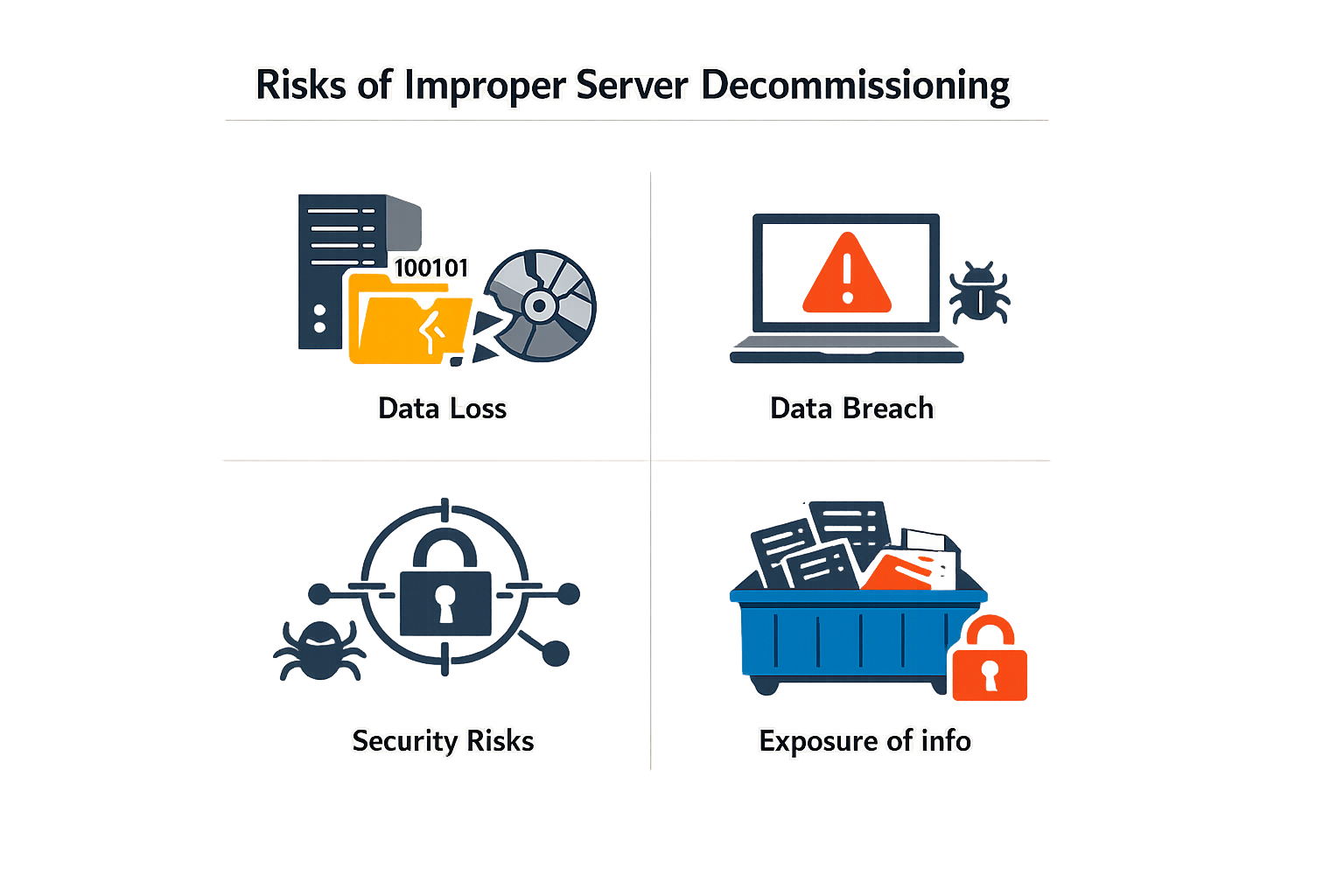
The documentary record is where server decommissioning projects fail. In the 2016 Morgan Stanley Smith Barney data center decommissioning, the firm moved approximately 4,900 devices out of two primary facilities in Poughkeepsie and Columbus. The engagement was structured with a prime contractor and an approved process. What survived discovery was a chain-of-custody gap wide enough to put unencrypted customer data on an online auction site, where an IT consultant in Oklahoma purchased the drives and contacted the firm a year later. The cumulative cost exceeded $100M in fines, remediation, and regulatory settlement.
The Failure Mode Is Structural
The Morgan Stanley case is canonical because it names the specific mechanisms that enterprise IT teams routinely miss. The firm failed to obtain certificates of data destruction for decommissioned devices. It failed to document chain of custody throughout the process. It failed to vet and approve subcontractors when the prime vendor switched from one downstream processor to another mid-engagement—without notifying the client. Hard drive shelves were transported with drives still in place, contrary to the firm's own policies. When the prime contractor sold the devices in what it characterized as an auction, there was only one bidder, and that bidder understood the drives had already been wiped. They had not been.
These are not edge-case failures. They are the predictable outcome when the controls inside a server decommissioning checklist are treated as administrative overhead rather than the primary defense in a post-incident regulatory review.
The Vendor-Selection Problem
MSSB approved a prime contractor for data decommissioning services without the use of a sub-vendor. Early in the engagement, the contractor ceased working with the first subcontractor and began working with a second entity—never vetted, never approved, never disclosed. The inventory tracking database that provided visibility into device status went offline when the first subcontractor exited. No certificates of destruction were issued after that point. The firm had direct access to the tracking system and could see that it was no longer being updated. No escalation occurred.
The question the auditor will ask is not whether the vendor was certified. The question is whether the client verified that the contracted process was actually followed, and whether the documentary evidence supports that claim under cross-examination. In the Morgan Stanley case, the answer was no on both counts.
MSSB failed to adopt written policies and procedures that identified the high level of risk associated with the decommissioning of devices containing unencrypted PII and consumer report information.
What the Certificate Omission Cost
A certificate of destruction is not a receipt. It is a serialized attestation that a specific device, identified by make, model, and serial number, was processed using a defined method, on a specific date, under chain-of-custody controls that tie the certificate to the physical asset. When MSSB engaged a contractor to decommission 61 servers at a New Jersey location, the contractor provided a certificate—but it did not meet the firm's standards, which required specific identification of each of the 244 hard drives that comprised those servers. The certificate covered the server count but not the component count. That gap is material. Drives can be removed from servers during transport. Without serialized component-level documentation, there is no audit-defensible record that the drives left the facility, arrived at the processor, and were destroyed.
The regulatory finding was that MSSB willfully violated the Disposal Rule by failing to take reasonable measures to protect consumer report information during the 2016 data center decommissioning and other projects. The underlying control failure was the absence of serialized certificates and chain-of-custody documentation. The firm's policies required both. The decommissioning projects produced neither.
Solution Steps for Effective Server Decommissioning
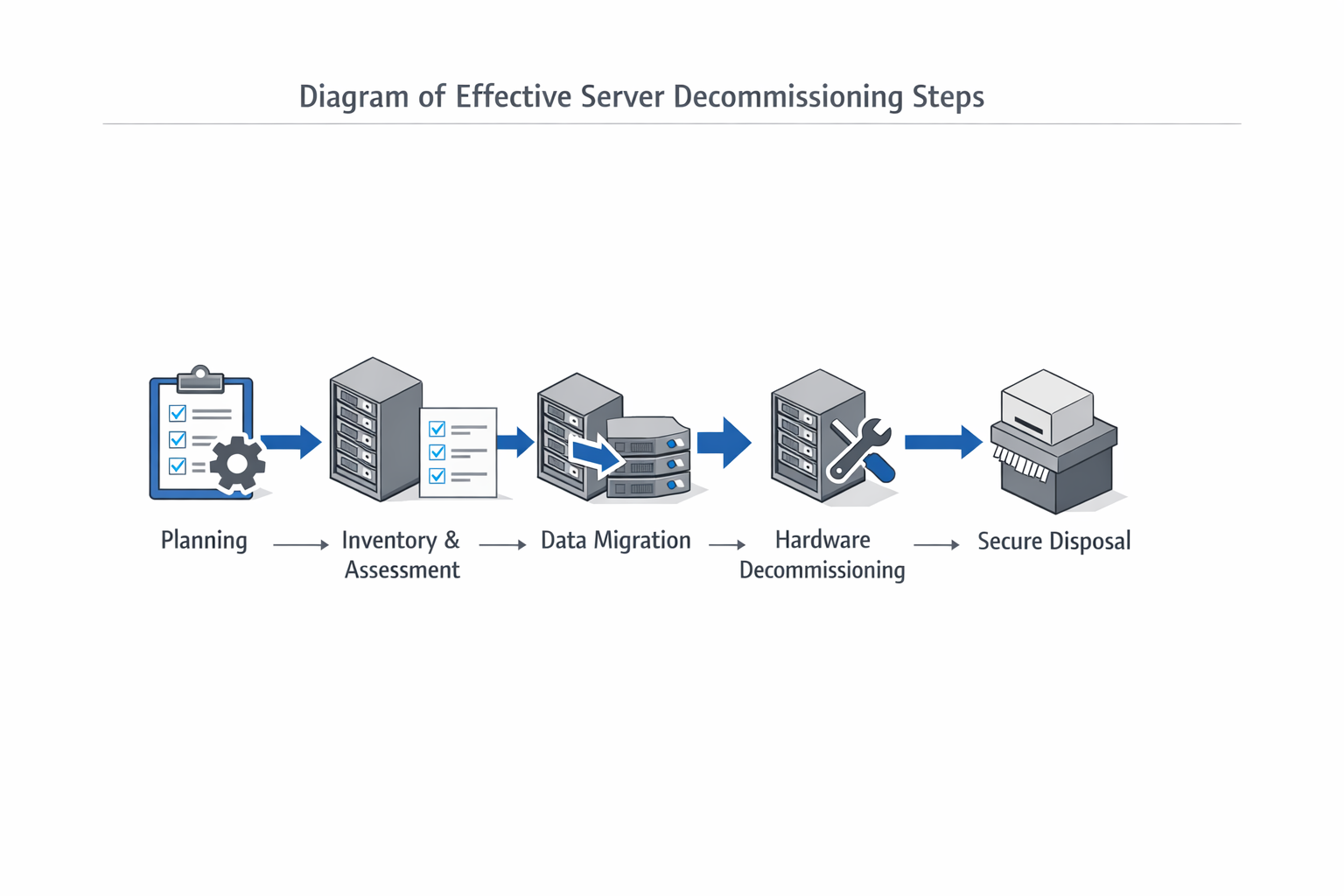
An effective server decommissioning checklist is not a static list — it is a documented control structure that survives audit. The Morgan Stanley enforcement record makes the mechanism clear: the firm transported hard drive shelves with drives in place, contrary to its own policies, and failed to obtain certificates of destruction or document chain of custody throughout the process. The cumulative cost exceeded $100M. The discipline required to prevent that outcome is procedural, not aspirational.
Step 1: Inventory Before Engagement
Step 1
Catalog assets by serial, location, and data classification
Before any vendor sees the asset list, catalog every server by serial number, physical location, and data classification. If the server touched regulated data — customer PII, ePHI, consumer report information — mark it individually. Vendors price what they can see; if your inventory is fuzzy, your bid is fuzzy too, and the downstream chain of custody starts with an unverifiable count.
The SEC enforcement record shows MSSB moved approximately 4,900 devices through a 2016 data center decommissioning, including 53 RAID arrays containing unencrypted customer PII. The firm had no serialized inventory at the point of vendor handoff. When discrepancies emerged later, there was no documentary baseline to resolve them against.
Step 2: Vendor Selection and Sub-Vendor Approval
Step 2
Vet the vendor and any downstream processors
Formal vendor approval must extend to every entity that will touch the equipment. If the primary contractor intends to use a sub-vendor for data destruction, asset remarketing, or logistics, that sub-vendor requires the same vetting and formal approval as the primary. The contract must explicitly prohibit undisclosed subcontracting.
In the Morgan Stanley case, the firm approved Moving Company as a vendor without a sub-vendor. Moving Company worked first with IT Corp A, then ceased that relationship and began working with IT Corp B — neither entity was vetted or approved by MSSB. The firm had no visibility into who was handling its equipment or where it was being processed.
Step 3: Data Sanitization to Published Standard
Step 3
Execute sanitization per NIST SP 800-88 or equivalent
Data sanitization must conform to a published national standard. For devices going to reuse, verify that prescribed overwrite instructions have been successfully executed for 100% of the device's physical memory locations. For devices going to destruction, verify physical destruction sufficient to prevent data recovery. The verification must be documented per device, not per batch.
The e-Stewards Standard requires organizations to verify successful sanitization of all customer data, whether clearing, purging, or destroying data storage devices. For reuse, this means confirming 100% overwrite completion for every drive. The enterprise data destruction standards that govern this process are not negotiable — they are the regulatory floor.
Step 4: Chain of Custody Documentation
Step 4
Maintain serialized custody records from rack to final disposition
Chain of custody must be serialized and continuous. Every asset movement — from data center to transport vehicle, from vehicle to processing facility, from facility to destruction or resale — requires a timestamped custody transfer with asset-level identifiers. Batch-level tracking is insufficient for regulated data.
The enforcement record shows MSSB did not document chain of custody for devices throughout the decommissioning process. When an IT consultant in Oklahoma purchased hard drives from an online auction site and found MSSB customer data still accessible, the firm had no documentary trail to explain how those drives left custody or who had handled them.
Step 5: Certificate of Destruction Verification
Step 5
Obtain asset-specific certificates, not batch summaries
The certificate of destruction is the primary documentary defense in a post-incident review. It must identify each sanitized or destroyed asset by serial number, specify the method used (overwrite passes, shred particle size, degauss field strength), and be signed by the processor who performed the work. A certificate that summarizes "61 servers" without enumerating the 244 hard drives those servers contained does not meet the standard.
In early 2017, MSSB engaged Moving Company to decommission 61 servers at its Weehawken location. Moving Company provided a certificate of destruction, but it did not meet MSSB's standards — it failed to specifically identify each of the 244 hard drives that comprised those servers. The batch-level certificate was not audit-defensible.
The cheapest vendor is the one whose paper trail you trust enough to hand the auditor without flinching.
Step 6: Post-Decommissioning Audit and Reconciliation
Step 6
Reconcile inventory against certificates before project closure
Before closing the project, reconcile the original asset inventory against the certificates of destruction and any resale documentation. Every serial number that left the data center must appear in one of three places: a destruction certificate, a resale invoice with downstream buyer identity, or an exception log with documented management approval. Unaccounted assets are a control failure.
The discipline here is not complicated — it is the same reconciliation process used in financial controls. The Morgan Stanley case demonstrates what happens when that reconciliation never occurs: devices containing customer PII were sold at online auction, and the firm had no mechanism to detect the breach until a third party reported it nearly a year after project completion.
Tips and Tricks for Successful Server Decommissioning
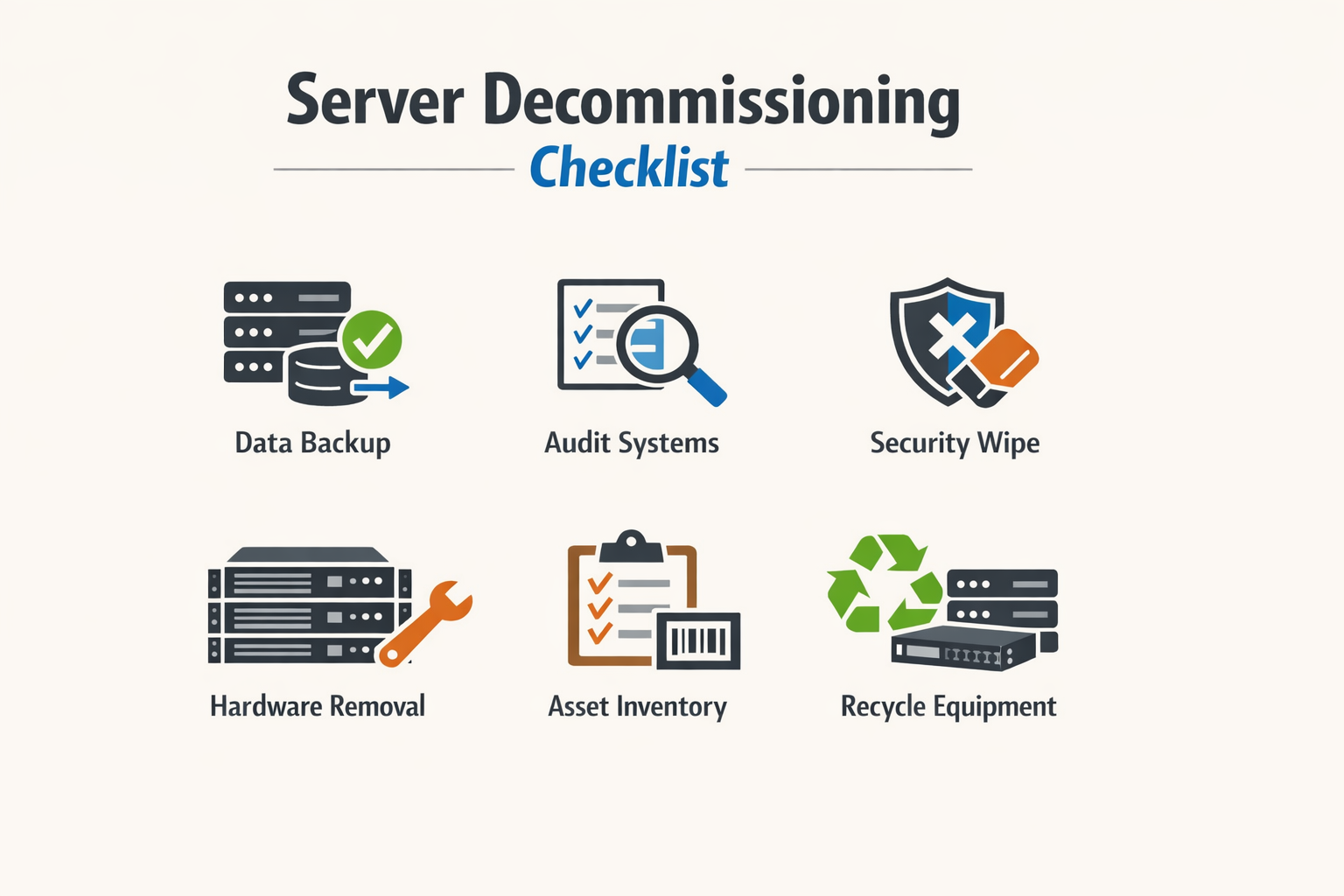
The difference between a clean decommissioning and a regulatory event often comes down to a handful of operational habits that operators either build in from the start or learn the hard way. These are not theoretical improvements — they are the controls that hold up when the auditor asks to see the chain of custody or when a device resurfaces in the wrong place.
Require Serial-Level Specificity in Every Certificate
A certificate of destruction that lists "61 servers" is not a certificate of destruction. The document that survives audit names every serialized component that held data — hard drives, SSDs, RAID arrays — and maps each serial number to a destruction method and a timestamp. When Morgan Stanley's vendor provided a COD for 61 servers without identifying the 244 constituent hard drives, the certificate failed to meet the organization's own standards, and the gap became part of the enforcement record.
In our editorial review of vendor profiles, the operators with the cleanest documentary records issue CODs at the component level, not the chassis level. If the server contains four drives, the certificate lists four serials. If one drive fails sanitization, the certificate flags it individually and documents the fallback to physical destruction.
Validate Downstream Processor Credentials Before the First Pickup
The vendor you contract with is not always the vendor who processes your assets. In the 2016 Morgan Stanley data center decommissioning, the approved vendor ceased working with the original subcontractor early in the engagement and began working with a second entity that was never vetted, never approved, and never disclosed. The second processor understood the devices had already been sanitized — they had not been — and sold them at auction with customer data intact.
The control that prevents this failure mode: verify the credentials of every entity in the downstream chain before the engagement begins, and require contractual notification if any processor changes. If the vendor cannot name the facility where your drives will be wiped or shredded, or cannot produce current R2v3 or e-Stewards certification for that facility, the vendor is not ready to take custody. For a detailed breakdown of the full process, see our server decommissioning checklist covering each verification step.
The cheapest vendor is the one whose paper trail you trust enough to hand the auditor without flinching.
Treat Inventory Reconciliation as a Blocking Step
Serial-number mismatches between the client's inventory and the vendor's intake log are not administrative noise — they are chain-of-custody breaks that auditors interpret as loss of control. In the Morgan Stanley case, discrepancies in serial numbers raised immediate concerns about whether the right devices were being tracked, and those concerns proved well-founded when drives appeared at auction.
The discipline: reconcile serials at every custody transfer. When the vendor picks up the assets, compare the pickup manifest against your pre-decommissioning inventory line by line. When the vendor delivers the assets to the processing facility, require a second reconciliation at intake. When the COD arrives, map every serial on the certificate back to the original inventory. Any mismatch triggers an investigation before the certificate is accepted.
Retain Verification Records for the Full Retention Period
Successful sanitization is not a one-time event — it is a claim that must be defensible for as long as the data would have been subject to regulatory retention. The e-Stewards standard requires organizations to retain verification records of successful sanitization for each serialized device and to log any failed sanitization attempts. The retention period for those records should match or exceed the retention period for the data that was sanitized.
In practice, this means the COD and the chain-of-custody documentation live in a records-management system with the same controls as the data itself. If the underlying data was subject to a seven-year retention under SEC rules, the destruction records carry the same timeline. The operator who can produce a serialized COD from six years ago, with a matching chain-of-custody log and a timestamp showing NIST 800-88 purge completion, is the operator who survives the regulatory review.
Audit the Vendor's Subcontracting Practices in the Contract
The contract should explicitly prohibit undisclosed subcontracting and require written approval for any downstream processor. The Morgan Stanley enforcement order documents multiple failures in this area: the approved vendor worked with an unapproved subcontractor, then switched to a second unapproved entity without notice, and the client's policies did not ensure review or approval of sub-vendors.
The contract language that closes this gap: "Vendor shall not subcontract any data destruction, transportation, or processing services without Client's prior written approval. Vendor shall provide Client with the name, facility location, and current certification status of any proposed subcontractor at least 30 days before the subcontractor takes custody of any Client asset." The operator who builds this clause into the RFP and enforces it during the engagement is the operator who maintains control of the chain of custody.
Conclusion
The server decommissioning checklist is not a formality—it is the documentary spine of a defensible process. In our editorial review of the Morgan Stanley case and the patterns that emerged across dozens of vendor engagements, the conclusion is consistent: the operator who treats decommissioning as a compliance exercise rather than a data-handling discipline pays the price in regulatory exposure, audit findings, and recovery cost. The checklist itself is the mechanism by which an enterprise IT team translates policy into verifiable action, and the discipline to execute it is what separates a controlled retirement from a documentary gap that survives discovery.
What holds up in audit is not the vendor's assurance or the contract's intent—it is the serialized chain of custody, the certificate of destruction that names every component, and the inventory reconciliation that closes the loop between what left the data center and what the processor documented. The failure mode is always the same: undocumented handoffs, unapproved subcontractors, and certificates that describe a batch rather than the individual drives that contained the data. The Morgan Stanley enforcement record makes it clear that even a major financial institution with dedicated compliance teams can lose track of 4,900 devices when the underlying controls are not built into the decommissioning process itself.
For enterprise IT leads and procurement teams planning a data center retirement or a rack-level refresh, the question the auditor will ask is not whether you hired a certified vendor—it is whether you can produce the documentary record that proves every data-bearing device was accounted for, processed to the specified standard, and destroyed in a manner consistent with the contract. The server decommissioning checklist is the instrument that answers that question before the auditor asks it. In practice, the checklist is the operator's primary defense, and the discipline to maintain it is the difference between a clean audit and a $100M enforcement action.
Explore the discipline of server decommissioning and best practices for efficient data center management.