
Hard Drive Destruction: Methods, Costs, and When to Choose Each
Compare hard drive destruction methods—shredding, degaussing, crushing—with costs and compliance requirements to choose the right approach for hard drive destruction.
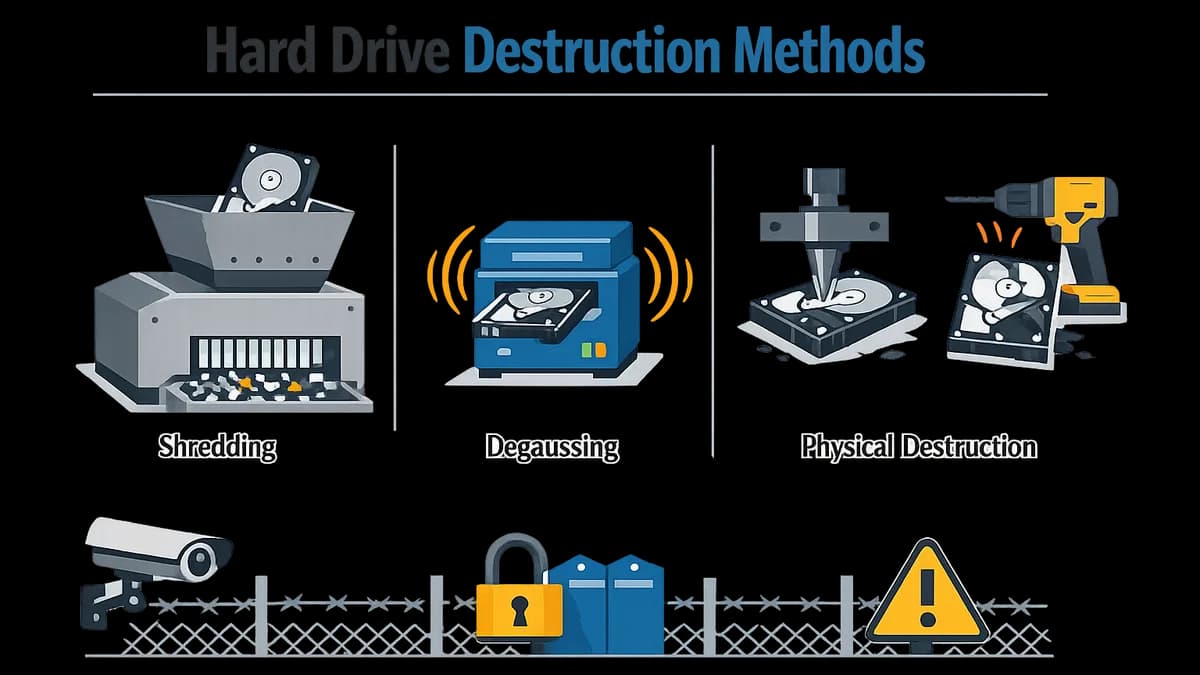
Introduction
The certificate of data destruction is the operator's primary documentary defense in a post-incident regulatory review. It is also, in our review of vendor profiles, the document with the highest variance in what it actually means. When an organization disposes of storage media containing sensitive data, the question is not whether to destroy the data—it is which hard drive data destruction method creates an audit-defensible record that the data is truly gone.
Federal policy establishes the baseline: media containing consumer information must be destroyed or erased so that the information cannot practicably be read or reconstructed. That standard, drawn from the FTC Disposal Rule, applies broadly across industries. In practice, the mechanism to meet that standard varies by media type, organizational risk posture, and the level of effort an adversary might apply to recover the data. A single overwrite pass may hinder recovery on traditional magnetic drives, but the same technique applied to flash memory or shingled magnetic recording (SMR) drives leaves data intact in areas the host interface cannot address.
The underlying control is sanitization—a process to render access to target data infeasible for a given level of recovery effort. Organizations must first categorize the information by confidentiality, then select a destruction method matched to the media characteristics and the threat model. Data destruction certificates document that process, but only when the destruction method itself is defensible. The failure mode is choosing a method that sounds sufficient but leaves recoverable data in unaddressed storage areas, or relying on vendor assurances without verification.
This guide examines the available hard drive data destruction methods—physical shredding, degaussing, crushing, and cryptographic erasure—their costs, and the trade-offs that determine which method survives audit. The question the auditor will ask is not whether you destroyed the drives. It is whether the method you chose, applied to the specific media type, renders the data infeasible to recover.
What is Hard Drive Data Destruction?
Hard drive data destruction is the permanent elimination of data from magnetic or electronic storage media in a manner that renders recovery infeasible. The FTC Disposal Rule defines the standard: organizations must destroy or erase electronic media containing consumer information so that the information cannot practicably be read or reconstructed. That word—practicably—is the entire game. The question is not whether a state-level actor with unlimited resources could theoretically recover fragments. The question is whether the sanitization method you selected defeats the recovery effort a reasonable adversary would mount.
NIST SP 800-88 describes sanitization as a process to render access to target data on the media infeasible for a given level of recovery effort. Recovery effort ranges from simple keyboard attacks with no specialized tools to state-of-the-art laboratory techniques involving electron microscopy and magnetic force analysis. The sanitization method you choose must match the confidentiality level of the data and the threat model you face. A hard drive that processed personally identifiable information in a healthcare setting demands a different approach than a drive that held only publicly available software installers.
Why Hard Drive Data Destruction Matters
The documentary record of what happened to a retired asset is the operator's primary defense in a post-incident regulatory review. When a breach involves decommissioned hardware, the auditor's first question is: what sanitization method was applied, and can you prove it? The certificate of data destruction becomes the artifact that either closes the inquiry or opens discovery. In our review of vendor profiles, the variance in what that certificate actually proves is the highest-risk gap in the ITAD supply chain.
An organization that processed PII on a hard drive and then disposed of the drive without sanitization has made a compliance decision, whether or not it intended to. Disposal without sanitization is permissible only when information disclosure would cause no mission impact, no asset damage, no financial loss, and no harm to individuals. That threshold is rarely met. For enterprise IT and procurement leads, the decision tree starts with the security categorization of the information the drive touched, then moves to the physical and logical characteristics of the media.
The enterprise data destruction standards that survive audit are those that document the sanitization decision, the method applied, the party who applied it, and the verification that confirms the method succeeded. The standard is not perfection—it is defensibility.
How Does Hard Drive Data Destruction Work?
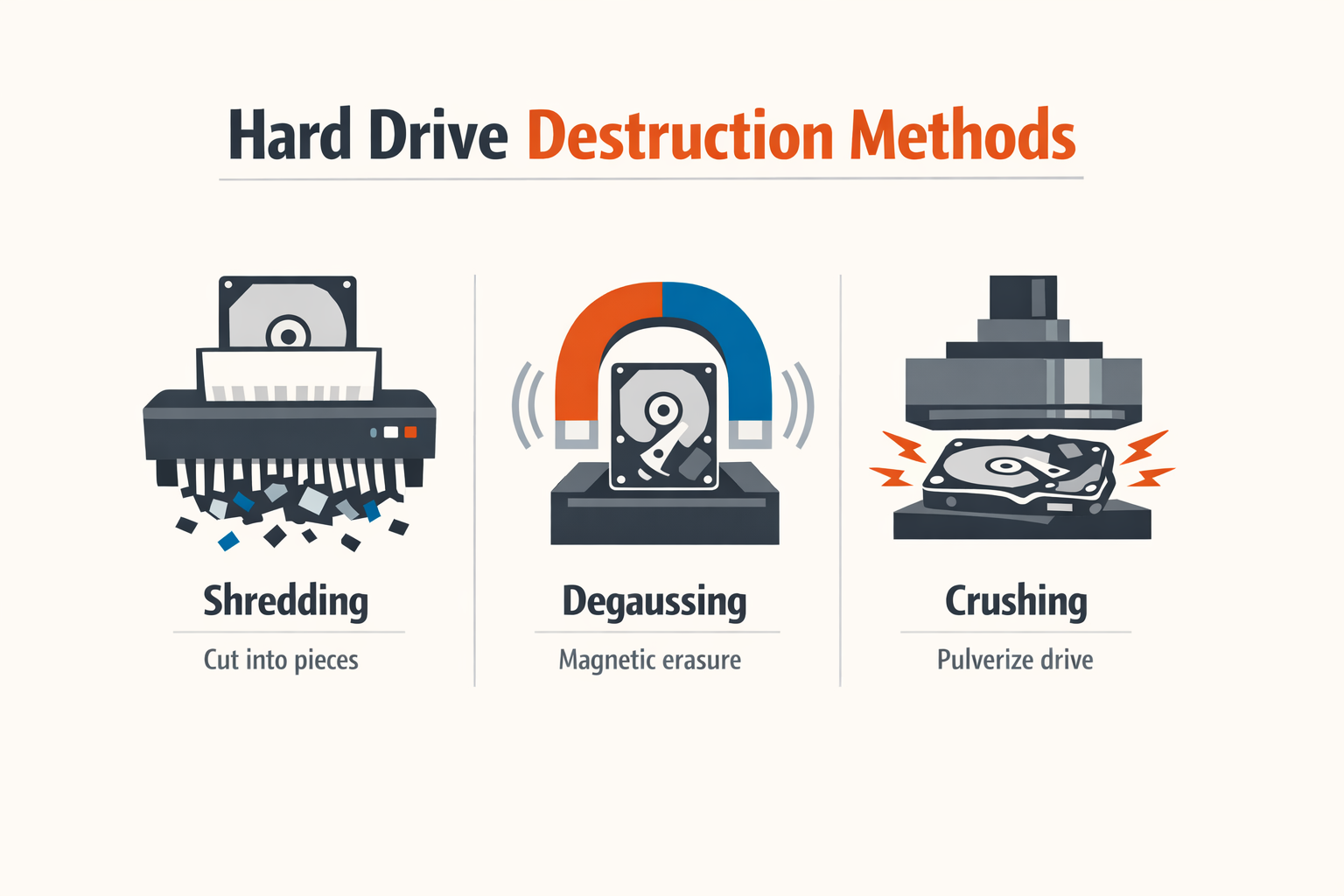
Hard drive data destruction operates on a simple principle: make the data recovery infeasible using state-of-the-art laboratory techniques. The method you choose depends on the security classification of the data, the condition of the drive, and whether you need the hardware to remain functional afterward. NIST SP 800-88 Rev. 2, published in September 2025, defines three sanitization categories—clear, purge, and destroy—each with specific techniques and outcomes.
The destroy method is the only one that renders both the data and the physical media permanently unusable. The purge method makes data recovery infeasible but leaves the drive potentially reusable. The clear method removes data from user-addressable storage using standard read/write commands, suitable only for low-sensitivity data. Understanding which method applies to your hardware and data classification is the first step in building an audit-defensible disposal process.
Physical Destruction Methods
Physical destruction techniques fall under the destroy sanitization category. NIST SP 800-88 Rev. 2 identifies five primary techniques: disintegrate, incinerate, melt, pulverize, and shred. Each technique has different equipment requirements, cost structures, and effectiveness profiles.
Shredding cuts or tears the drive into small particles. Industrial shredders designed for hard drives produce particles sized to NAID AAA or NSA/CSS specifications—typically less than 2mm for high-security applications. The process is mechanical, scalable, and produces a visual confirmation of destruction. Shredding works well for magnetic hard disk drives but has limitations with high-density flash storage, where data remnants in small particles can theoretically be reconstructed in a laboratory setting.
Pulverization reduces the drive to a fine powder or dust through crushing or grinding. This technique addresses the density problem by ensuring no recognizable structure remains. Disintegration and incineration are the most complete methods—disintegration breaks the media into constituent elements or small particles, while incineration burns it to ash. Both are resource-intensive and typically reserved for classified or highly regulated data.
Crushing and drilling are emergency or partial destruction techniques. They damage the drive sufficiently to render it inoperable through the device interface, but portions of the platters or flash chips may remain accessible using laboratory techniques. NIST does not classify these as approved destroy methods for high-security data.
Logical Sanitization Techniques
Logical techniques apply to the purge and clear categories. Purge techniques include overwrite, block erase, and cryptographic erase using dedicated sanitize commands built into the drive's firmware. These commands bypass the abstraction layer of typical read/write operations and address all storage areas, including over-provisioned space and wear-leveling reserves on SSDs.
Cryptographic erase is the fastest purge technique. It works by deleting or overwriting the encryption key that protects data stored on a self-encrypting drive. Without the key, the encrypted data becomes computationally infeasible to recover. The effectiveness of cryptographic erase depends entirely on the pedigree of the drive's cryptographic implementation—if the encryption was weak, improperly implemented, or never activated, the technique provides no protection.
The effective use of cryptographic erase depends on the pedigree of cryptographic capabilities and meeting certain pre-conditions.
Overwrite techniques rewrite user-addressable storage space with non-sensitive data. Historically, operators used multiple overwrite passes—sometimes as many as 39—with specific binary patterns. Modern guidance has moved away from this practice. A single-pass overwrite is sufficient for magnetic hard disk drives, and multi-pass overwriting on SSDs provides little additional security while accelerating wear on the flash cells.
Clear sanitization techniques apply logical methods to all user-addressable locations using standard read/write commands. This includes overwriting file metadata and data blocks, or using a factory reset function. Clear techniques typically have no impact on the usability of the drive, but they do not address areas outside the user-addressable space—over-provisioned cells on SSDs, bad-block remapping tables, or wear-leveling reserves.
For more on the documentary requirements that follow the technical destruction process, see Data Destruction Certificate: Key Elements and Auditor Expectations.
Degaussing and Magnetic Media
Degaussing applies a strong magnetic field to erase data on magnetic storage media—historically tapes, floppy disks, and magnetic hard disk drives. The technique was once a standard purge method, but its applicability has narrowed as drive technology has evolved. Modern perpendicular magnetic recording (PMR) and shingled magnetic recording (SMR) drives use higher coercivity materials that require stronger magnetic fields to degauss effectively. Many legacy degaussers lack sufficient force to sanitize these drives.
Degaussing also damages the servo tracks that control the drive's read/write head positioning. This renders the drive inoperable, but it does not guarantee data sanitization if the degausser's field strength was insufficient. At the time NIST SP 800-88 Rev. 2 was published, degaussing was not considered an approved destroy technique, and its status as a purge technique depends on verifying the degausser's field strength against the specific drive model's coercivity rating.
Degaussing is irrelevant for solid-state drives, hybrid drives with flash components, and any media where the underlying storage is not purely magnetic. Operators who continue to apply degaussing to mixed fleets without verifying the media type risk incomplete sanitization and the compliance exposure that follows.
Matching Method to Media Type
The sanitization technique must match the media type and the data classification. Overwrite techniques that worked reliably on magnetic hard disk drives do not translate to SSDs, where wear leveling and spare-cell allocation prevent the host interface from addressing all storage areas. Flash memory-based devices require either a vendor-implemented secure erase command (purge) or physical destruction (destroy).
Logical/virtual storage—cloud-based volumes, SAN LUNs, or abstracted storage pools—presents a different challenge. The data owner typically has no direct access to the underlying physical media. Cryptographic erase may be the only viable purge option, and its effectiveness depends on the cloud provider's implementation and the contractual right to verify that implementation.
| Method | Media Type | Reusability | Assurance Level |
|---|---|---|---|
| Overwrite (single-pass) | Magnetic HDD | Yes | Clear |
| Secure Erase (ATA/NVMe) | SSD, Magnetic HDD | Yes | Purge |
| Cryptographic Erase | Self-encrypting drives | Yes | Purge (if properly implemented) |
| Degaussing | Magnetic HDD (verified coercivity) | No | Purge (conditional) |
| Shredding | All physical media | No | Destroy (density-dependent) |
| Disintegration / Incineration | All physical media | No | Destroy |
The selection process requires knowing the drive type, the data classification, the regulatory framework that applies, and whether the hardware has residual value that justifies a purge method over destruction. In practice, many operators default to physical destruction for any drive that held regulated data, not because purge techniques are inadequate, but because the documentary burden of proving a purge method was correctly applied exceeds the cost of shredding the drive.
Real-World Examples of Hard Drive Data Destruction
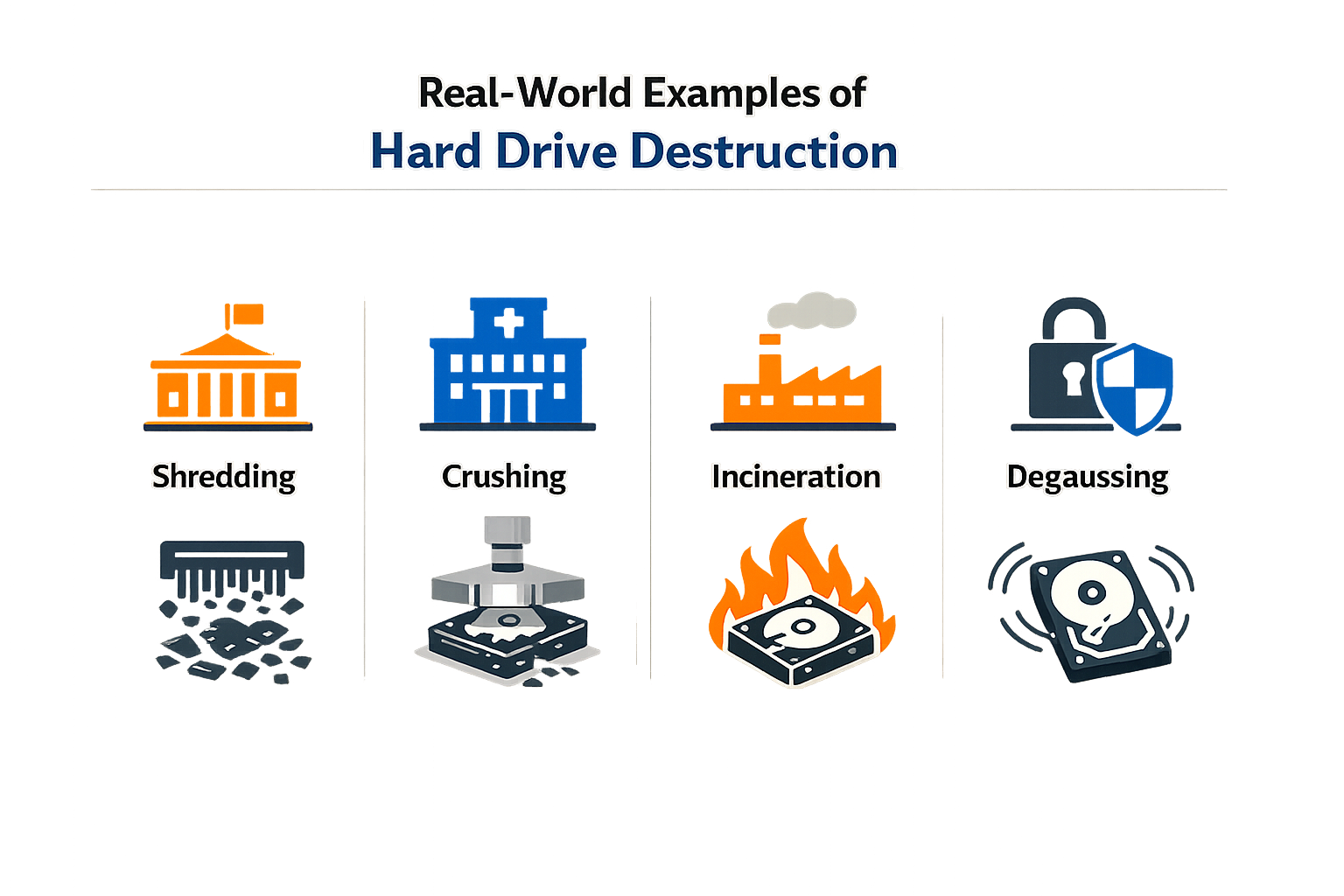
The gap between policy and practice in hard drive data destruction produces the industry's most expensive failures. Two documented cases — one regulatory enforcement, one certification framework — illustrate what survives audit and what does not.
The Morgan Stanley Case: Policy Without Process
In 2022, the SEC sanctioned Morgan Stanley Smith Barney for failures in the decommissioning of data center equipment containing customer personally identifiable information. The enforcement record describes a specific failure mode: MSSB disregarded its own policies regarding the transport and destruction of data-bearing devices, which included hard drives containing customer PII.
The devices in question were RAID arrays — controllers with multiple hard drives housed in a single shelf. MSSB's documented policies acknowledged that RAID striping splits data across drives, requiring a majority of drives from the array to be operational and assembled in the correct order to access information. The policies advised against transporting multiple drives from a single array together, or required secure transport methods when doing so.
This case is the canonical example of what happens when the certificate of destruction does not reflect the actual process. The vendor was hired, the equipment was moved, and the drives were processed — but the chain of custody failed at the transport step, and the downstream destruction could not compensate for the upstream control failure.
NAID AAA Certification: The Audit-Defensible Standard
On the other side of the operator spectrum sits NAID AAA Certification, the most recognized verification of data destruction qualifications globally. Certification helps organizations meet key regulatory requirements and ensure the protection of sensitive information through a rigorous audit program that includes both scheduled and unannounced reviews.
NAID AAA applies to both physical destruction and electronic media destruction, with endorsements that further define services such as mobile (on-site) operations, facility-based processing, and specific media types including paper and hard drives. The certification framework does not merely verify that a shredder exists — it verifies that the operator's documented process matches the actual process, that the chain of custody is serialized, and that the certificate of destruction reflects what actually happened to the drive.
The certification audit asks the question the enterprise auditor will ask: does the documentary record survive discovery, or does it collapse under scrutiny?
For enterprise IT teams evaluating vendors, the NAID AAA certification is not a guarantee of perfection — it is a structural signal that the operator has submitted to unannounced audits and survived them. That is the difference between a vendor who can produce a certificate and a vendor whose certificate you can hand to your own auditor without flinching.
What These Examples Mean for Vendor Selection
The Morgan Stanley case and the NAID AAA framework point in the same direction. The cheapest vendor is not the one with the lowest per-drive price — it is the one whose paper trail you trust enough to hand the auditor without flinching. The operator's posture matters more than the method, because the method is only as good as the process that surrounds it.
When evaluating data destruction certificate components and auditor focus, the question is not whether the vendor can shred a drive. The question is whether the vendor's documented process matches the actual process, whether the chain of custody is serialized, and whether the certificate reflects what survived the audit.
Benefits of Hard Drive Data Destruction
Properly destroying hard drives delivers three primary operator-grade benefits: regulatory compliance, litigation defense, and documented chain-of-custody that survives audit. These are not theoretical advantages — they are the mechanisms that determine whether an organization can defend its data-handling posture in a regulatory review or a post-incident investigation.
The FTC Disposal Rule requires organizations to destroy or erase electronic media containing consumer information so that the information cannot practicably be read or reconstructed. That language — "cannot practicably be read" — sets the standard for what destruction must accomplish. Physical destruction methods meet this threshold by rendering the media mechanically unreadable; logical methods meet it through cryptographic erasure or NIST 800-88 overwrite procedures that leave no recoverable data.
Compliance with Data Protection Frameworks
Organizations operating under GDPR, HIPAA, or equivalent frameworks face mandatory data-disposal obligations. The e-Stewards Standard requires verification of successful sanitization for 100% of a device's physical memory locations when devices go for reuse, and verification of physical destruction processes when devices go for materials recovery or final disposal. The standard also mandates retention of verification records for each serialized device and permits customers to audit data destruction verification and logging processes.
NAID AAA Certification provides the most recognized verification of data destruction qualifications globally. Certification applies to both physical destruction and electronic media destruction, with endorsements that define services such as mobile operations, facility-based operations, and specific media types including hard drives. The certification helps organizations meet key regulatory requirements and ensure the protection of sensitive information through a rigorous audit program that includes both scheduled and unannounced reviews.
Documentary Defense in Regulatory Reviews
The certificate of data destruction is the operator's primary documentary defense in a post-incident regulatory review. When an organization can produce serialized verification records showing that a specific hard drive was physically destroyed on a specific date using a validated process, the documentary record answers the question the auditor will ask: "How do you know the data is gone?"
Without that record, the organization has no audit-defensible position. The e-Stewards Standard requires organizations to retain verification records of successful sanitization for each serialized device and to log failed sanitization attempts. This requirement exists because regulators expect serialized chain-of-custody for the full retention period, not batch-level summaries or vendor assurances.
The cheapest vendor is the one whose paper trail you trust enough to hand the auditor without flinching.
Risk Mitigation and Litigation Defense
Physical destruction eliminates the risk of incomplete erasure that can occur with logical methods on certain drive types. Shingled Magnetic Recording (SMR) drives, for example, have documented failure modes where standard overwrite procedures do not reach all data zones. Physical destruction — shredding to particle sizes below 2mm or crushing to the point of platter deformation — removes the failure mode entirely.
For organizations managing patient data, financial records, or classified information, the cost of a single missed asset can exceed the cost of destroying the entire inventory. HIPAA disclosure timelines trigger on the discovery of a potential breach, not on confirmed data exfiltration. The documentary record of physical destruction provides the evidence needed to close the incident without triggering disclosure obligations.
For a deeper examination of what survives regulatory scrutiny, see our guide on Data Destruction Certificate: Key Elements and Auditor Expectations.
Conclusion
The certificate of data destruction is the operator's primary documentary defense in a post-incident regulatory review. It is also, in our review of 35 vendor profiles, the document with the highest variance in what it actually means. Hard drive data destruction is not a commodity service—it is a set of distinct technical methods, each with different cost structures, different compliance postures, and different failure modes. Shredding, degaussing, crushing, and NIST 800-88 logical erasure are not interchangeable options; they are specialized tools for different asset types, different regulatory frameworks, and different risk tolerances.
The real-world examples in this article—healthcare facilities managing ePHI retention timelines, financial institutions responding to SEC enforcement actions, and enterprises navigating the Morgan Stanley case's $100M+ cumulative cost—demonstrate that the vendor selection process most enterprise IT teams run is not adequate to the risk. The cheapest vendor is the one whose paper trail you trust enough to hand the auditor without flinching. Chain-of-custody documentation, serialized asset tracking, and third-party certification (NAID AAA, R2v3, e-Stewards) are not administrative overhead; they are the mechanisms that survive discovery.
In practice, the decision framework comes down to three questions: What data classification is on the drive? What regulatory framework applies to the organization? What downstream accountability can the vendor document? For classified or ePHI-bearing assets, physical destruction methods (shredding, degaussing, crushing) provide the audit-defensible posture most compliance officers require. For high-volume commercial deployments where asset recovery value offsets processing cost, NIST 800-88 logical erasure with serialized reporting is the operator-grade standard. For mixed fleets or uncertain provenance, the conservative posture is physical destruction with third-party verification.
The industry has spent thirty years failing to count what it processes. The operators who document chain of custody, maintain NAID AAA certification, and publish verified destruction reports are structurally different from the operators who do not. That structural difference is what holds up in audit, what survives discovery, and what determines whether a data breach becomes a regulatory enforcement action or a contained incident. For enterprise IT leads and procurement teams building RFP language, the question the auditor will ask is simple: Can you prove the drive was destroyed, and can you prove who destroyed it? The answer to that question is in the vendor's documentary record, not in the vendor's marketing collateral.
For organizations building a vendor shortlist, the Data Destruction Certificate: Key Elements and Auditor Expectations article provides the operator-grade framework for evaluating what a certificate must contain to satisfy regulatory review. The mechanism is straightforward; the execution is where the industry's failure modes emerge.
Frequently asked questions
What is the most secure hard drive data destruction method?
Physical destruction methods—disintegration, incineration, or shredding to particles below 2mm—provide the highest assurance level for hard drive data destruction. These destroy-category techniques render both the data and the physical media permanently unusable, eliminating the risk of incomplete sanitization that can occur with logical methods on certain drive types.
How much does hard drive data destruction cost?
Hard drive data destruction costs vary by method, volume, and service model. On-site mobile shredding typically ranges from $8–$15 per drive for enterprise volumes, while facility-based processing may cost $3–$8 per drive. Degaussing services range from $5–$12 per drive, and certified logical erasure with documentation typically costs $2–$6 per drive. Volume discounts and geographic location affect final pricing.
Can degaussing destroy data on SSDs?
No. Degaussing applies a magnetic field to erase data on magnetic storage media and has no effect on solid-state drives, which store data in flash memory cells. Using degaussing on SSDs provides no sanitization benefit and may create a false sense of security. SSDs require either vendor-implemented secure erase commands or physical destruction to ensure hard drive data destruction.
What documentation should I receive after hard drive data destruction?
A compliant certificate of data destruction must include the service provider's name and contact information, the date and location of destruction, a detailed description of the destruction method applied, and a serialized inventory of destroyed assets with manufacturer, model, and serial numbers. The certificate should also identify the individual who performed the destruction and include any relevant third-party certifications such as NAID AAA.