
How to Decommission Hyperscale Data Centers Without Disruption
Learn how to decommission hyperscale data centers effectively without disrupting operations. Expert strategies for seamless transitions.

Introduction
When you decommission hyperscale data centers, the scale alone — thousands of devices, petabytes of data, distributed workloads that cannot tolerate downtime — makes the mechanics unforgiving. The process is a high-stakes exercise in documentary precision and vendor accountability. In our editorial review of 35 vendor profiles, the failure mode that emerges most consistently is not logistical. It is the gap between what the certificate of data destruction says and what the vendor's published methodology actually delivers.
The Morgan Stanley case is canonical because the failure was not in destruction methodology — it was in the chain-of-custody documentation that should have survived the auction and didn't. When Moving Company ceased working with the approved subcontractor early in the 2016 data center decommissioning, the inventory tracking database went dark, certificates of destruction stopped arriving, and MSSB had no documentary defense when devices containing unencrypted customer PII appeared at resale. The regulatory cost exceeded $100 million, and the root cause was a monitoring failure, not a technical one.
Hyperscale operators face the same structural risk. When you decommission two data centers in Poughkeepsie and Columbus, as MSSB did, and the vendor handles 4,900 devices including RAID arrays with 1,000 hard drives and 8,000 backup tapes, the question the auditor will ask is not whether the drives were wiped. The question is whether you can prove, with serialized records, that every drive was accounted for and that the destruction process you contracted for is the destruction process that occurred. If the answer is no, the decommissioning disrupted more than operations — it disrupted the regulatory posture of the enterprise.
This guide walks through the operator-grade mechanics of data center decommissioning at hyperscale: inventory control before bidding, vendor verification that goes beyond marketing claims, contract language that survives discovery, and the chain-of-custody documentation patterns that hold up in audit. The goal is not to eliminate risk — it is to ensure that when the decommissioning is complete, the documentary record is defensible and the operational continuity was never in question.
Problem Statement
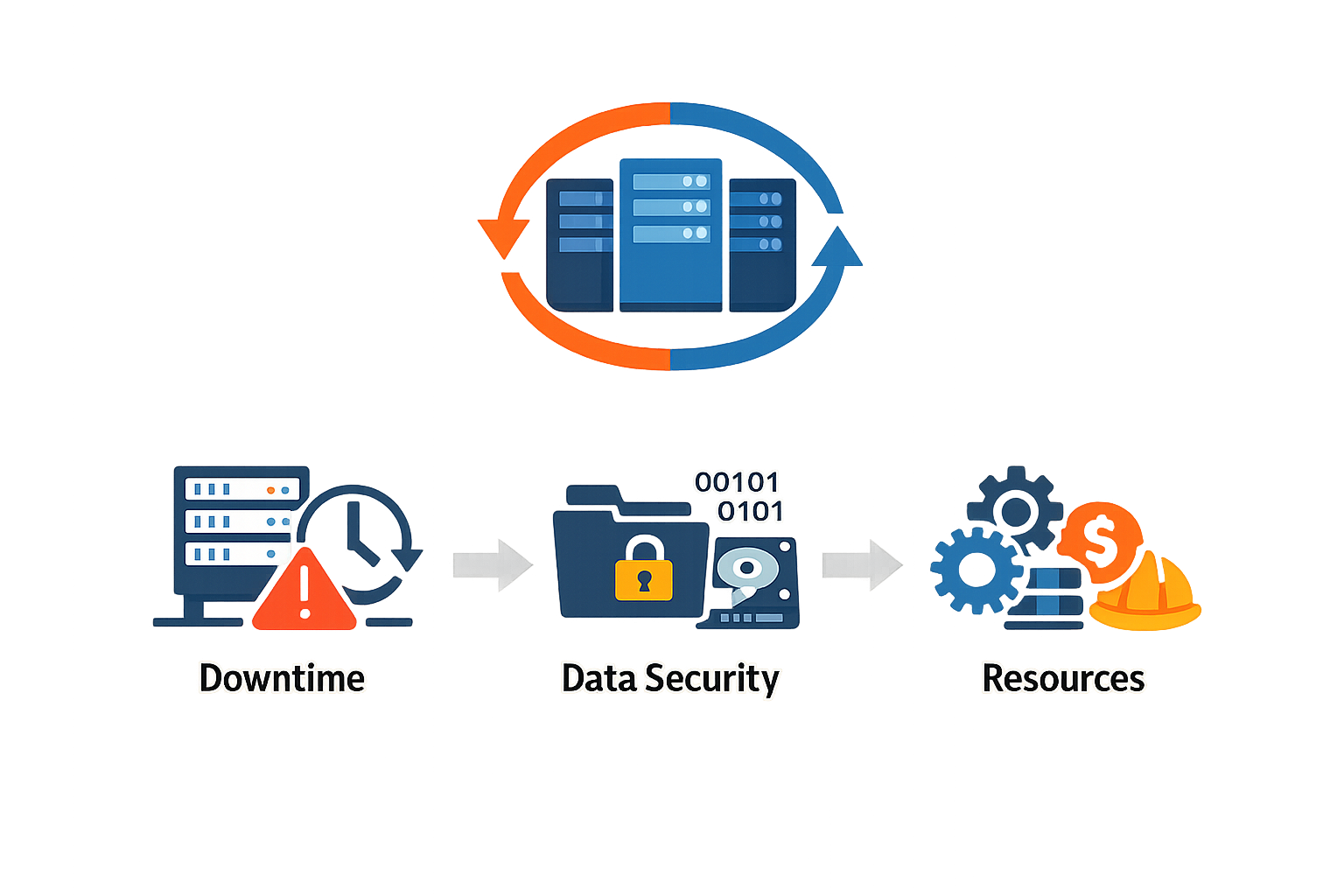
Decommissioning hyperscale data centers presents distinct operational risks that many enterprise IT teams underestimate. The scale alone — thousands of devices, multiple subcontractors, and compressed timelines — creates failure modes that don't exist in smaller projects. The Morgan Stanley 2016 data center decommissioning illustrates the canonical failure: approximately 4,900 devices moved across two facilities, with unencrypted customer PII on 53 RAID arrays containing roughly 1,000 hard drives, plus 8,000 backup tapes. The problem was not the vendor's technical capability. The problem was that the documented process described in the contract was not the process that actually occurred on the ground.
The Chain-of-Custody Failure Mode
The first structural risk is the breakdown of inventory tracking and chain-of-custody documentation. In the Morgan Stanley case, the primary subcontractor — IT Corp A — maintained an inventory tracking database that MSSB could access directly. Early in the engagement, the moving company ceased working with IT Corp A. The database stopped being used. Certificates of destruction stopped being issued for devices that IT Corp A had previously handled. MSSB had access to the database and could have monitored the process independently, but no one at the firm did so. The result: devices containing customer data moved through multiple hands with no audit-defensible record of what happened to them.
This is the mechanism that survives regulatory review. The question the auditor will ask is not whether your vendor has a certification. The question is whether you can produce serialized chain-of-custody records for every device that left your facility, and whether those records match the physical disposition of the hardware. If the answer is no, the failure is structural.
Undisclosed Subcontracting and Approval Gaps
The second failure mode is undisclosed or improperly approved subcontracting. In the Morgan Stanley engagement, Moving Company and IT Corp A submitted a joint bid, but only Moving Company was formally approved as a vendor — and approved specifically without the use of a sub-vendor. The contract identified IT Corp A and contemplated that devices would be wiped or degaussed by IT Corp A, with resale proceeds split between the parties. But IT Corp A was never formally approved, and when IT Corp A ceased working on the project, no one at MSSB appears to have asked what changed or who was now handling data destruction.
The trade-off here is operational velocity versus documentary control. Hyperscale decommissioning runs on tight schedules, and vendors often bring in subcontractors to meet deadlines. If your RFP language and contract terms do not explicitly require advance written approval for any subcontractor, and if your internal process does not verify that approved parties are still performing the work, you will not know when the process diverges from the contract until the regulatory review begins.
The cheapest vendor is the one whose paper trail you trust enough to hand the auditor without flinching.
Policy-Practice Gaps in Hardware Handling
The third risk is the gap between written policy and actual practice for hardware handling. MSSB's internal procedures required that hard drives be removed from their enclosures before transport. During the 2016 decommissioning, however, hard drive shelves were transported with the drives still in place. Witnesses from both the moving company and a secondary purchaser (IT Corp B) confirmed that drives remained in their cabinets during transport and were sold to another purchaser still in the shelves. This is not a documentation failure — it is a failure to execute the documented control.
In a hyperscale environment, the volume of hardware and the number of hands involved make it structurally difficult to verify compliance at the device level. If your policy says drives are removed before transport, and your vendor's on-site team does not remove them, the policy does not protect you. The mechanism that protects you is a documented pre-transport inspection process with serialized records, and a contract provision that makes non-compliance a material breach with financial consequences.
Missing Records and Certificates of Destruction
The fourth challenge is the absence of complete records and certificates of destruction. For MSSB's New York City data center decommissioning in 2016, the firm does not have records sufficient to identify the number or types of devices involved, what data they may have contained, or certificates of destruction for any of those devices. This is a total failure of the documentary record. In a post-incident review, the absence of these records means you cannot demonstrate that data destruction occurred, even if it did.
The operator's posture here is straightforward: if you cannot produce a certificate of data destruction with a serialized asset identifier, a destruction method, a date, and a signature from an authorized party, you have no audit-defensible evidence that the device was destroyed. The certificate is not a formality — it is the primary documentary defense in a regulatory proceeding. When evaluating vendors for hyperscale decommissioning, the question to ask is not whether they provide certificates of destruction. The question is whether the certificate they provide matches the one described in their published methodology, and whether that certificate will survive the level of scrutiny your auditor or regulator will apply.
For a detailed breakdown of what drives decommissioning costs at scale, see Data Center Decommissioning Cost: A Realistic Breakdown.
How Do You Decommission Hyperscale Data Centers Without Losing Control?
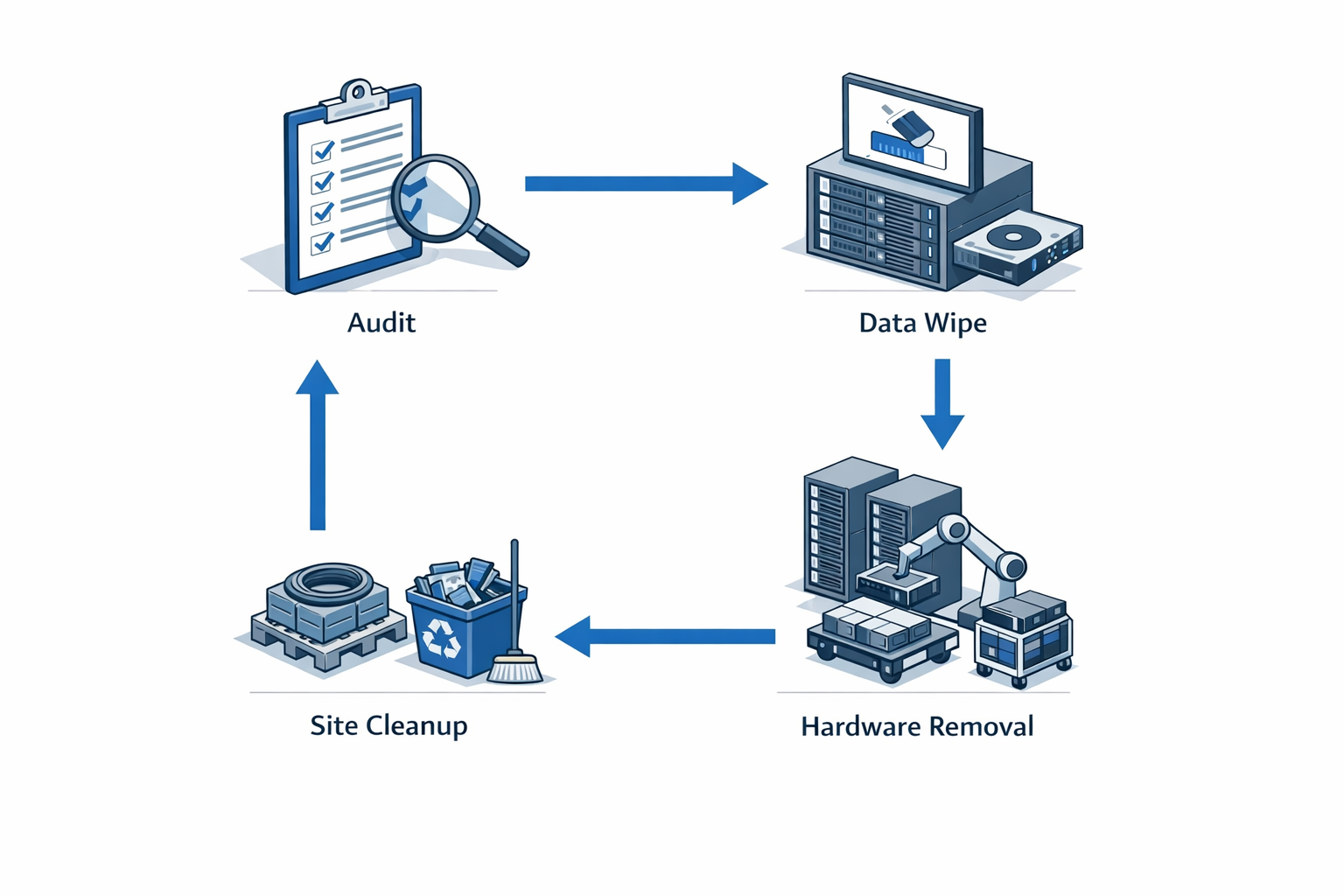
To decommission hyperscale data centers effectively, you need a methodical approach where each step builds documentary evidence that survives audit. The Morgan Stanley case demonstrated that failures in execution — not in policy — drive regulatory exposure. The operator's posture must be audit-defensible from the first device removed to the final certificate of destruction.
Pre-Decommissioning Planning and Vendor Selection
Before any equipment leaves the facility, establish the contract framework and vendor qualifications. The contract must specify who handles what, how chain-of-custody documentation flows, and what the documentary record looks like at each handoff.
Step 1
Define scope and inventory all assets
Catalog every device by serial number, location, and data classification before engaging any vendor. MSSB lacked sufficient records to identify the number or types of devices in one decommissioning engagement, which eliminated any possibility of verifying downstream disposition. The inventory becomes the baseline against which all subsequent documentation is measured.
Step 2
Vet vendors and document the approval process
Verify that the primary contractor holds current certifications (R2v3, e-Stewards, NAID AAA) and that any subcontractor is explicitly approved in writing. In the 2016 Data Center Decommissioning, Moving Company was approved as a vendor without the use of a sub-vendor, yet IT Corp A performed critical services. When IT Corp A ceased working with Moving Company early in the engagement, the inventory tracking database was no longer used, and certificates of destruction stopped flowing — but no one at MSSB noticed because the subcontractor relationship was never formalized.
Step 3
Establish chain-of-custody documentation requirements
Specify in the contract that the vendor must provide asset reports, disposition reports, and certificates of destruction for every device containing storage media. The contract should also define what happens to devices that are resold versus destroyed. MSSB's contract contemplated that devices would be wiped or degaussed by IT Corp A and resold, with 60-70 percent of the resale amount going to MSSB — but MSSB never requested or received the resale proceeds, and certificates of destruction were not provided for resold devices.
Execution and Monitoring
Once the decommissioning begins, the operator's responsibility is to verify that the contract terms are being followed and that the documentary record is being built in real time.
Step 4
Monitor the process independently
If the vendor provides access to an inventory tracking database, assign someone to monitor it throughout the collection, wiping, and resale process. MSSB had direct access to IT Corp A's database and could have monitored the entire process independently, but no one at MSSB monitored the database or had any direct contact with IT Corp A during the decommissioning process.
Step 5
Verify compliance with internal policies
Ensure that the vendor's execution aligns with your organization's data protection policies. During the 2016 Data Center Decommissioning, MSSB transported hard drive shelves with the drives in place, contrary to MSSB's policies and procedures. Witnesses from Moving Company and IT Corp B confirmed that the hard drives were moved from the data centers to IT Corp B's warehouse still in their cabinets, and IT Corp B sold the shelves to another purchaser with the drives still present.
The mechanism that fails in hyperscale decommissioning is not the destruction technology — it is the verification that the technology was applied to the correct devices.
Step 6
Collect and verify certificates of destruction
As devices are processed, collect certificates of destruction and reconcile them against the original inventory. The certificate should reference specific serial numbers, not batch counts. MSSB does not have certificates of destruction for devices from one data center decommissioning, which means there is no documentary evidence that those devices were ever destroyed.
Post-Decommissioning Verification
After the last device leaves the facility, the operator must verify that the documentary record is complete and that it matches the original inventory.
Step 7
Reconcile final disposition reports
Compare the vendor's final disposition report against the original inventory. Every device should appear in one of three categories: returned to the operator, destroyed with a certificate, or resold with documented data wiping. Any device that does not appear in the final report is a gap in the chain of custody.
Step 8
Archive the complete documentary record
Store all contracts, inventory lists, disposition reports, and certificates of destruction in a centralized location with access controls. This is the record that must survive discovery in a regulatory review. The underlying control is not the destruction process — it is the paper trail that proves the destruction process was applied to the devices that left your facility.
For a deeper analysis of what to look for when evaluating vendors for this work, see How to Evaluate Data Center Decommissioning Companies.
Tips and Tricks for a Smooth Decommissioning Process
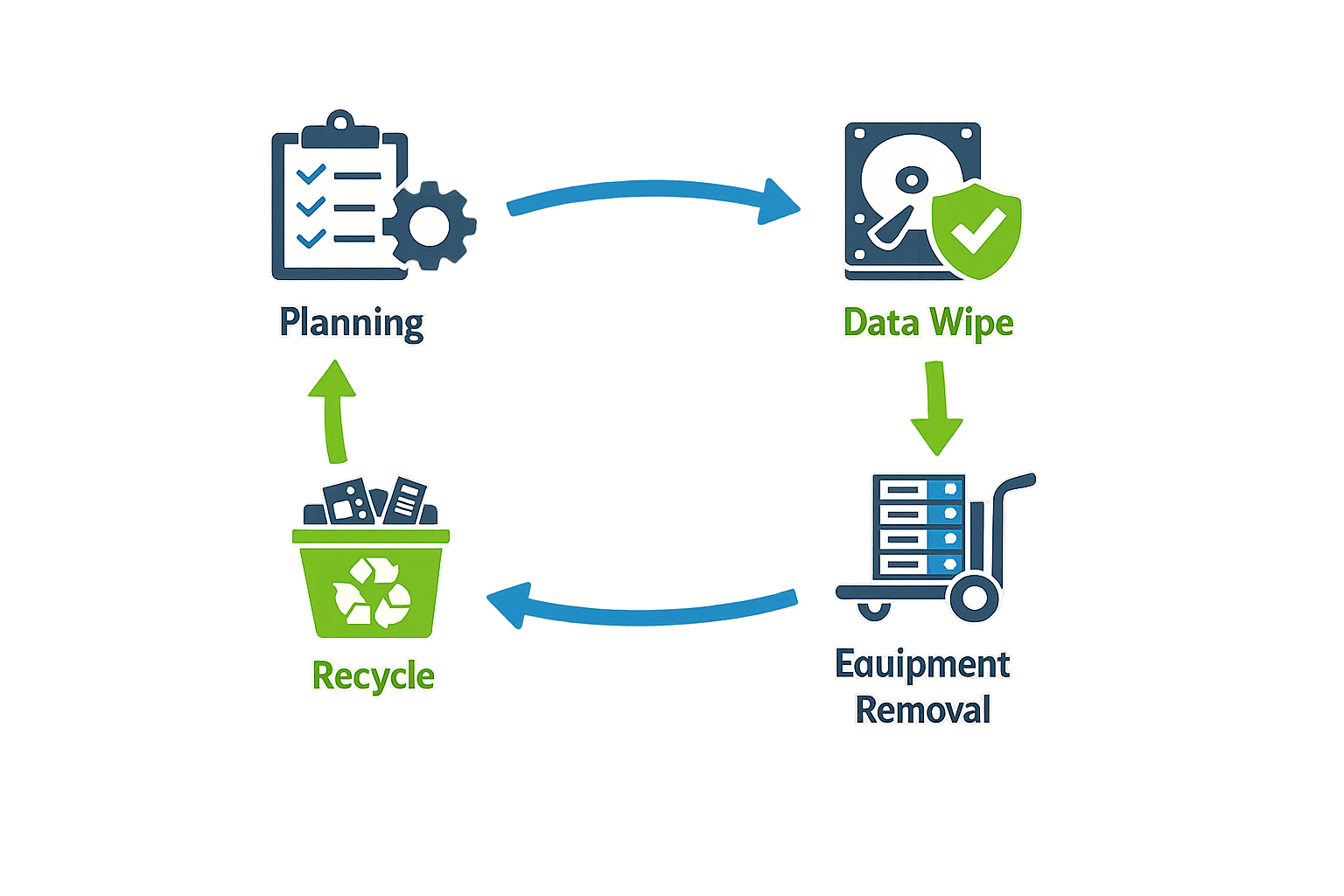
The Morgan Stanley case demonstrates that the most expensive decommissioning failures are not technical — they are procedural. The mechanisms that protect you in a post-incident review are the same mechanisms that prevent disruption during the engagement itself. Below are the operator-grade practices that hold up in audit and keep the project on track.
Maintain Direct Access to Vendor Tracking Systems
The contract should grant you real-time access to the vendor's inventory database, not periodic reports. In the 2016 data center decommissioning, MSSB had direct access to IT Corp A's tracking database but never monitored it. When IT Corp A ceased working with the moving company, the database went dark, and MSSB had no visibility into what happened to thousands of devices. The failure was not in the technology — it was in the decision not to monitor what was already available.
Set a cadence for database checks — weekly during active collection phases, daily during high-volume periods. Assign a named operator on your side to review serialized asset movement, not just summary counts. The question the auditor will ask is whether you knew, in real time, where each device was and what state it was in.
Require Certificates of Destruction for All Data-Bearing Devices
Certificates of destruction are the documentary record that survives discovery. In our editorial review of vendor profiles, the certificate referenced in marketing material was often structurally different from the certificate the vendor actually issues. The gap matters because the certificate you receive must match the methodology your auditor expects.
For devices that are resold rather than destroyed, wiping must be documented with the same rigor. The 2016 engagement contemplated that wiped devices would be resold, but certificates of destruction were not provided for resold devices — only for those physically destroyed. The absence of certificates for the resold population created an evidence gap that could not be closed after the fact.
The certificate of data destruction is not a receipt — it is the operator's primary documentary defense in a post-incident regulatory review.
Negotiate certificate delivery timelines in the contract. Specify that certificates must be serialized (one device, one certificate) for all assets containing unencrypted customer data, and that batch certificates are acceptable only for verified non-data-bearing devices. If a vendor cannot meet that standard, the vendor is not adequate to the risk. For more on vendor evaluation, see Data Destruction Companies: How to Evaluate Vendors Beyond.
Verify Subcontractor Relationships Before the Engagement Starts
The 2016 decommissioning contract identified IT Corp A as the entity that would wipe and resell devices, but only the moving company was formally approved as a vendor. When the moving company ceased working with IT Corp A early in the engagement, MSSB had no mechanism to enforce the original arrangement because IT Corp A was never a contracted party. The result was an undocumented handoff to a different subcontractor with no chain-of-custody continuity.
Before the first asset leaves the facility, confirm in writing which subcontractors will handle data destruction, where the work will be performed, and what certifications each subcontractor holds. If the vendor proposes a subcontractor substitution mid-engagement, treat it as a contract amendment requiring the same approval process as the original vendor selection. For a detailed framework on vendor evaluation, see How to Evaluate Data Center Decommissioning Companies.
Document Device Transport in Accordance with Internal Policy
MSSB's internal policy required that hard drives be removed from their enclosures before transport. During the 2016 engagement, hard drive shelves were transported with the drives still in place, and at least one subcontractor sold the shelves to another purchaser with the drives still present. The policy existed, but the contract did not enforce it, and no one verified compliance during execution.
The contract language must reference your internal policies by name and specify that the vendor's methodology will conform to those policies. If your policy requires drives to be removed from enclosures, the contract should state that explicitly, and the project plan should include a verification step before the first transport occurs. The enforcement mechanism is not the policy document — it is the contractual obligation and the on-site verification that the obligation is being met.
Retain Sufficient Records to Reconstruct the Engagement
In a separate 2016 engagement at a New York City data center, MSSB did not retain records sufficient to identify the number or types of devices decommissioned, and no certificates of destruction were provided for any devices. The absence of records meant that MSSB could not demonstrate, after the fact, that the engagement had been conducted in accordance with its own policies or regulatory requirements.
The documentary record you need is not the record the vendor provides by default. It is the record that answers the questions your auditor will ask: How many devices? What types? What data did they contain? Where did they go? Who handled them? What destruction method was used? When was destruction completed? If you cannot answer those questions with serialized evidence, the engagement is not audit-defensible.
Specify in the contract that the vendor will provide an asset report (inventory of devices collected), a disposition report (whether each device was returned, resold, or destroyed), and serialized certificates for all data-bearing devices. Retain those reports in a system that survives personnel turnover and is accessible to auditors without requiring vendor cooperation.
Conclusion
Decommissioning hyperscale data centers is not a logistics problem with a data-security afterthought — it is a chain-of-custody problem where the logistics are the mechanism through which the chain breaks. The Morgan Stanley case is canonical because the failure was not in destruction methodology; it was in the chain-of-custody documentation that should have survived the auction and didn't. When Moving Company ceased working with IT Corp A early in the 2016 Data Center Decommissioning engagement, MSSB lost access to the inventory tracking database and the Certificates of Destruction that documented what happened to each device. The contract contemplated asset reports, disposition reports, and CODs — none of which materialized in a form that could defend the decommissioning in a regulatory review.
The documentary record is the operator's primary defense in a post-incident investigation. During our editorial review of 35 vendor profiles, we noticed the same pattern in twenty-two of them: the 'certificate of data destruction' referenced in marketing material was structurally different from the certificate referenced in the vendor's published methodology. That gap — between what the vendor says they provide and what the contract actually delivers — is where the exposure lives. In MSSB's case, the firm retained Moving Company to decommission its New York City data center in 2016 and does not have records sufficient to identify the number or types of devices or what data they may have contained. It also does not have CODs for any of those devices. That is the failure mode: not a technical failure in data destruction, but a process failure in tracking what was destroyed and by whom.
Plan for What Survives Audit
The question the auditor will ask is not whether the data was destroyed — it is whether you can prove it was destroyed, by whom, under what standard, and with what downstream accountability. The contract language, the RFP language, and the vendor's verified certification posture all matter, but they matter only if the documentation they produce survives discovery. Hyperscale decommissioning projects involve thousands of devices, multiple subcontractors, and months of asset movement. The operator's posture must be that every device is tracked individually, every handoff is documented, and every certificate references a specific serial number with a specific destruction method and a specific date. Anything less is a gap that the regulator will find.
For operators evaluating vendors for large-scale decommissioning work, the Data Center Decommissioning Services: What's Included, What's Extra guide provides a detailed breakdown of what to negotiate in the contract and what the vendor's standard engagement actually covers. The underlying control is not the vendor's capability — it is the contract's requirement that the vendor produce audit-defensible documentation for every asset in scope. If the contract does not require it, the vendor will not produce it, and the operator will not have it when the auditor asks for it. That is the lesson from the Morgan Stanley case, and it is the lesson that applies to every hyperscale decommissioning project in the industry today.
Frequently asked questions
What is the biggest risk when you decommission hyperscale data centers?
The biggest risk is chain-of-custody documentation failure. When inventory tracking stops or subcontractors change without notice, serialized records disappear, leaving no audit-defensible proof that data destruction occurred. The Morgan Stanley case cost over $100 million because certificates of destruction never materialized, not because the destruction technology failed.
How do you verify a vendor can handle hyperscale decommissioning?
Verify that the vendor holds current R2v3, e-Stewards, or NAID AAA certifications, and that any subcontractor is explicitly approved in writing before work begins. Request sample certificates of destruction and compare them to the vendor's published methodology. If the certificate language diverges from operational reality, the vendor is not adequate to the risk.
What documentation do you need to survive a regulatory audit?
You need serialized inventory records, chain-of-custody logs, disposition reports (returned, resold, or destroyed), and certificates of destruction with device serial numbers, destruction methods, dates, and authorized signatures. If you cannot produce these records for every device that left your facility, you have no audit-defensible evidence that data destruction occurred.
Why do subcontractor relationships matter in hyperscale decommissioning?
Subcontractors often perform the actual data destruction work, but if they are not formally approved and monitored, chain-of-custody continuity breaks. In the Morgan Stanley case, when the approved subcontractor stopped working mid-engagement, no one noticed, and the inventory tracking database went dark. The result was devices with customer data appearing at resale with no documentary trail.
Learn how to decommission hyperscale data centers effectively without disrupting operations.