
The Compliance Cliff Is Real. The Date Isn't the One You Heard.
ITAD spent last week being told that audited e-waste reporting starts this November. It doesn't. What the record actually says is less urgent, more specific, and considerably harder to prepare for.
There is a slide most ITAD providers put in their quarterly business reviews. It has a number of pounds diverted from landfill on it, a carbon figure, and usually a tree.
Casey Dingfelder, who runs ITAD for Dynamic Lifecycle Innovations, described what started happening to that slide. Customers began pulling it out of the deck and showing it to their boards. Which felt like a win, right up until the moment it stopped being one.
"Now what I've seen change," she told a room at the Bellagio last week, "is you have to prove it. It's not just putting these numbers down and then supplying it. It's actually justifying it, making sure that the data you're providing could be audited, and that they can actually stand behind it."
George Hinkle, president of ARCOA Group, was blunter about what the industry has been sending. "You send a report back to a customer — you recycled this number of pounds with us, we send it through, you save 20 trees. He didn't save 20 trees by recycling the laptop. I'm sorry. That's horse shit."
They are both right that the ground is moving. The question is when, and the answer given from the mainstage last week does not match the regulatory record.¹
What the room was told
In the "Risk, Reputation & ESG" session on Tuesday morning, Layer IQ CEO Mike DiPetrillo laid out a timeline that landed hard on the room.
California's climate disclosure regime, he said, had moved from voluntary to mandatory: "It's no longer voluntary. Now it's compliance starting in November." E-waste, he explained, falls under Scope 3 Category 5 — required data, reported the following November, with collection beginning this November.
And then the part that mattered most:
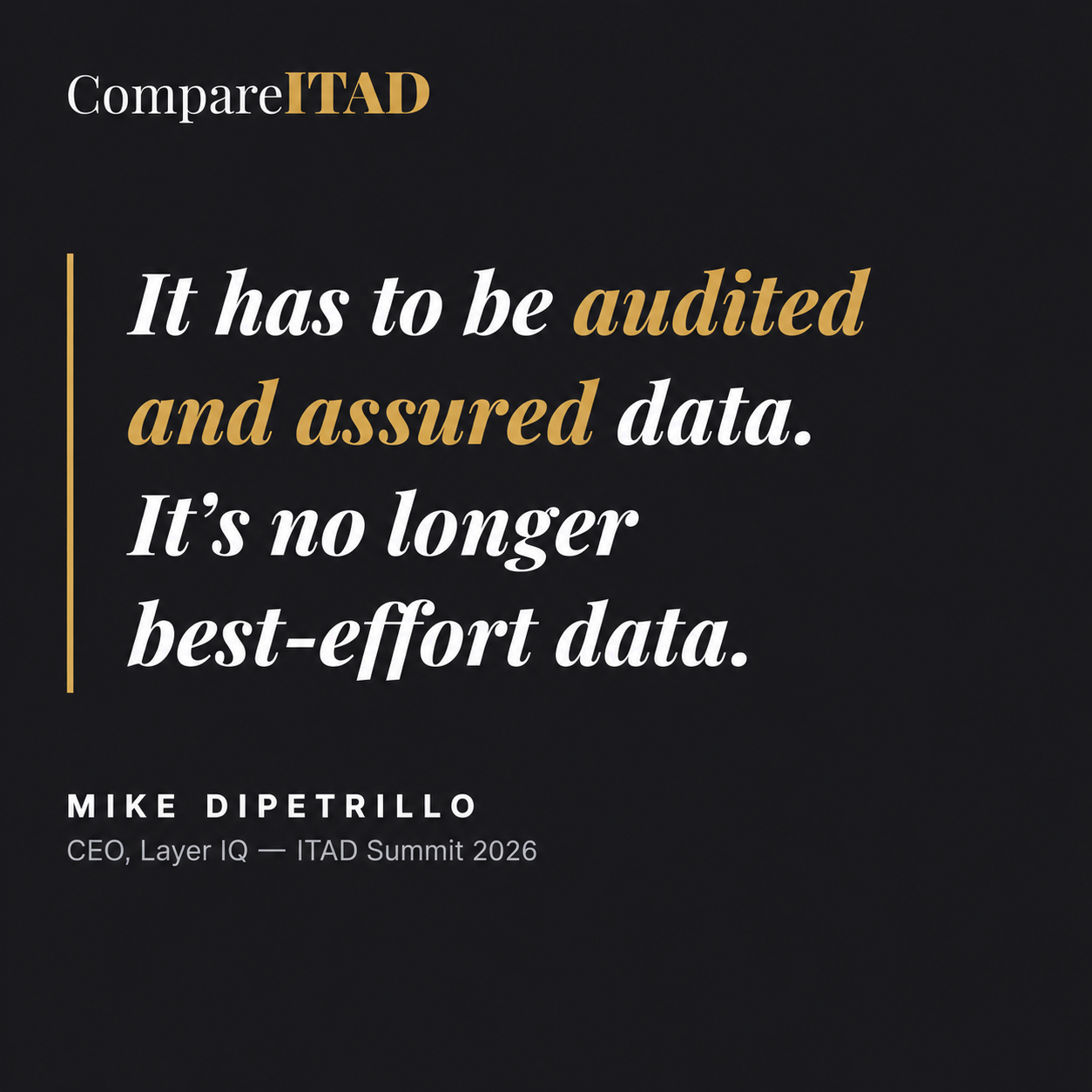
It has to be audited and assured data. It's no longer best-effort data that a lot of you may have been providing in the past.
He was more specific later, naming ISO 14064 as the conformity standard, and asking the room how many produced impact reports today. A few hands went up. "Those reports you've probably done with data that is not meeting the ISO standard. And there's nothing wrong with those methodologies. They just existed before this became a thing."²
The direction of travel he described is correct, and the underlying point about methodology is the most useful thing said on the subject all week. The dates are not correct.
What the record says
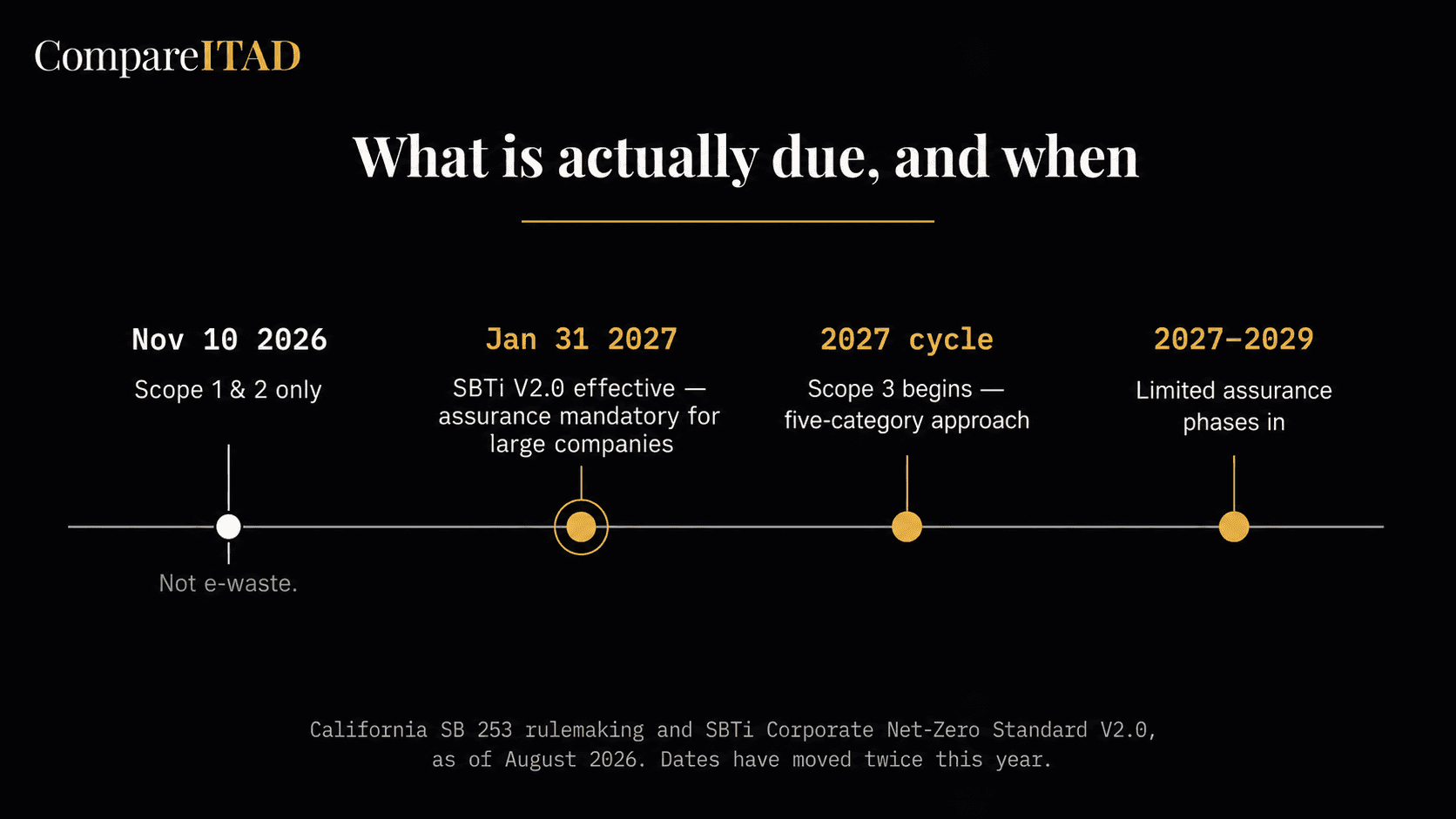
SB 261 enforcement stayed
The Ninth Circuit granted a preliminary injunction pending appeal; CARB confirmed it will not enforce the January 1, 2026 deadline while that stands.
Initial SB 253 regulation adopted
Set an August 10, 2026 first-year deadline.
First deadline deferred
CARB moved the first SB 253 reporting deadline from August 10 to November 10, 2026.
First SB 253 report due
Scope 1 and Scope 2 emissions only. Scope 3 is expressly excluded from the 2026 reporting year.
SBTi Net-Zero Standard V2.0 takes effect
Mandatory assurance for Category A companies; a 5% significance test replaces the blanket 67% Scope 3 coverage requirement.
Scope 3 reporting begins
A limited five-category approach is proposed. Reporting in 2027 means collecting data through 2026 and into 2027.
There is a November deadline. It is not this one.
On June 24, 2026, the California Air Resources Board deferred the first SB 253 reporting deadline from August 10 to November 10, 2026. That deadline covers Scope 1 and Scope 2 emissions only.
Scope 3 — the category that contains e-waste — is expressly excluded from the 2026 reporting year. CARB has stated that Scope 3 reporting is not required for 2026, with a limited, five-category approach proposed to begin in the 2027 cycle.
Assurance follows a separate track again. CARB deferred assurance requirements entirely for 2026. Limited assurance on Scope 1 and 2 is scheduled to begin with the 2027 reporting period, tightening toward reasonable assurance by 2030. Whether Scope 3 will require assurance at all is a question CARB has said it will decide separately, in a rulemaking that has not concluded.
The companion statute, SB 261, is not currently being enforced. On November 18, 2025, the Ninth Circuit granted a preliminary injunction pending appeal, and CARB has confirmed it will not enforce the January 1, 2026 deadline while that stands.³
Why it still matters, and why 2027 is not far away
None of which makes the underlying warning wrong. It makes it a year out and considerably more demanding when it lands.
Scope 3 reporting under California begins in 2027. Reporting in 2027 means collecting data through 2026 and into 2027 — which is to say, now. A provider that cannot produce conformant data by the time its customer's reporting year closes is not late by a year; it is late.
The second change is the one the industry should be reading more carefully. The Science Based Targets initiative published version 2.0 of its Corporate Net-Zero Standard on June 11, 2026. It takes effect on January 31, 2027, with version 1.3.1 remaining valid through the end of that year.
V2.0 introduces mandatory assurance for Category A companies — the large-revenue, large-emissions tier. It replaces the old blanket 67% Scope 3 coverage requirement with a significance test: any Scope 3 category representing 5% or more of a company's Scope 3 total must be covered by a target. And it expands the recognised use of environmental attribute certificates for Scope 3 where a company's direct influence over its value chain is limited — subject to guardrails and defined chain-of-custody models, including book-and-claim.
That last provision is the one DiPetrillo was pointing at, and it is real. :::callout{type=warning}What V2.0 is equally explicit about is the boundary: certificates and removals are not a substitute for emissions reductions. Anyone planning to sell attribute certificates generated from retired IT assets should read the guardrails before building a business line on them.:::
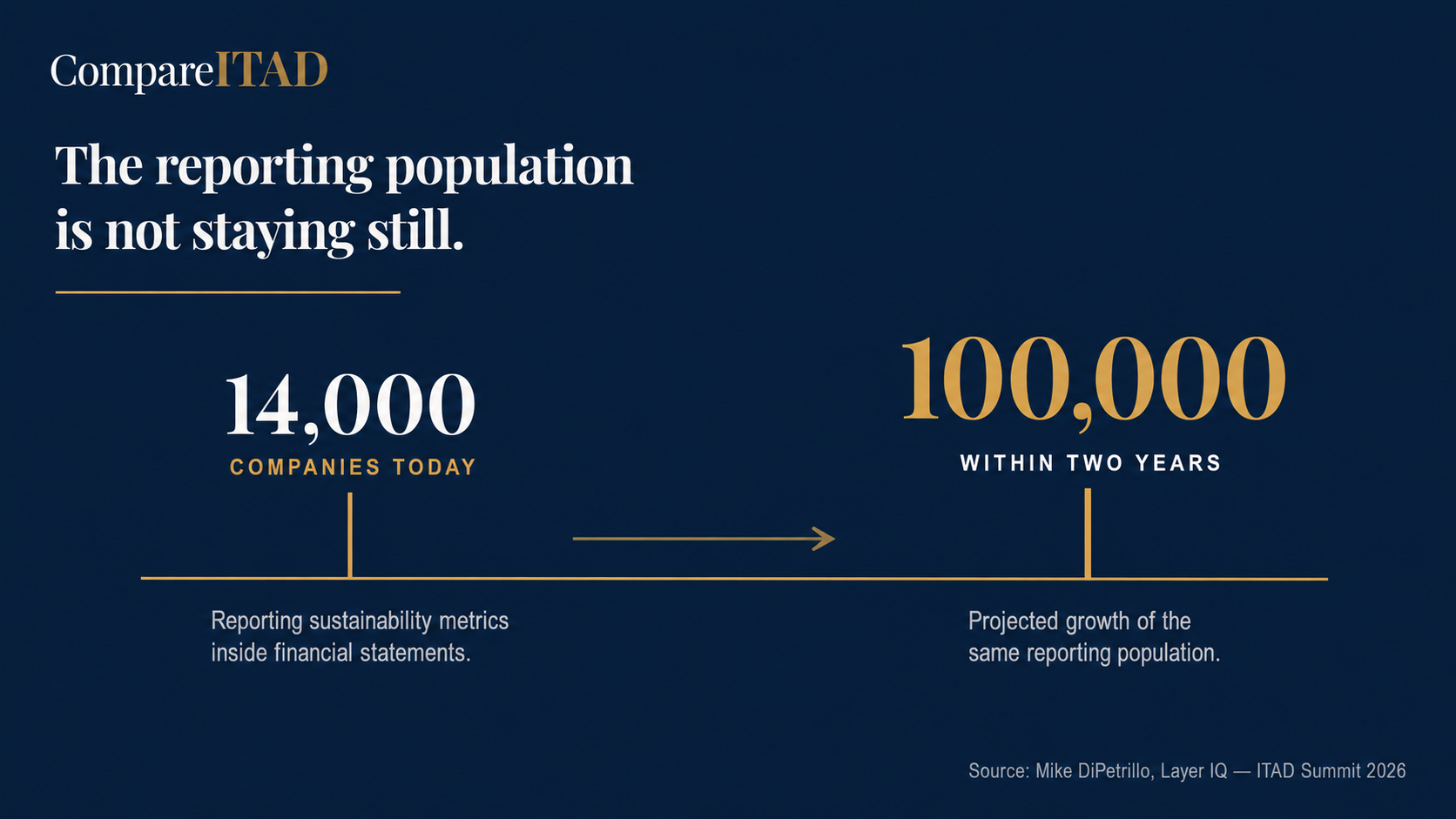
Over 11,000 companies and financial institutions have adopted science-based targets. That is the population for whom assurance becomes mandatory in under six months.⁴
The methodology problem does not care about the date

Strip out the timing and DiPetrillo's substantive point stands, and it is the reason this is worth writing about at all.
The sustainability reports this industry sends customers were built in good faith against methodologies — the EPA WARM calculator, models borrowed from universities, in-house arithmetic — that were entirely reasonable when the output was a courtesy. They were not built to survive an auditor, because until now no auditor was coming.
Whether the auditor arrives in 2027 or 2028, the gap between what ITAD reporting is and what assured reporting requires is the same gap. It is a data and methodology problem, and it takes longer to close than a compliance deadline gives you.
Hinkle made the same argument from a different direction in the morning session. The industry has spent years absorbing the cost of reporting while customers reap the benefit, and never figured out how to charge for it.⁵
Instead of just reporting, we need to be able to validate what we're reporting. It's got to be verifiable information. There's got to be some way that somebody can verify that.
The prerequisite nobody can skip
None of it works if you cannot say with confidence what you received.
Kevin Dillon, co-founder of ERI, pointed out that the legal foundation here predates any of the climate rules. Electronics are classified as universal waste, a subset of hazardous waste, "which means the generator of the waste is legally responsible for its final disposition in perpetuity."
And he was direct about where the record has to start:
From a chain of custody, it really comes down to, is the customer having you serialize the items on site? Otherwise you have no idea what you're picking up.
Dingfelder put a trend line on it. Roughly half of her customers now require on-site serialisation. Five years ago it was around 30%. Ten years ago, closer to 10%. The customers who don't require it, she noted, "have no idea what they sent to us."⁶
Assured data has to be traceable to something. If the record starts when the pallet reaches your dock rather than when it left theirs, there is nothing underneath the report to assure.
What to actually do
If you buy ITAD services. Establish whether you are in scope for SB 253 at all — the threshold is $1 billion in annual revenue and doing business in California. If you are, your Scope 3 obligation begins with the 2027 cycle, which means the data collection window is open now. Ask your provider whether their disposition reporting can be independently assured, and what their record looks like at your loading dock rather than at their facility.
If you provide ITAD services. You have longer than you were told and less time than you think. The work is a data and methodology rebuild, not a services change. The first provider in each account who can produce assurable disposition data will be having a different conversation from the ones competing on rate.
What to look for
Establish whether you are in scope for SB 253 at all
The threshold is $1 billion in annual revenue and doing business in California.
Ask whether your provider's disposition reporting can be independently assured
Your Scope 3 obligation begins with the 2027 cycle, which means the data collection window is open now.
Ask what the record looks like at your loading dock, not at their facility
If the record starts when the pallet reaches their dock rather than when it left yours, there is nothing underneath the report to assure.
Check the date yourself
CARB publishes its rulemaking record and SBTi publishes the standard. Both are free and take an afternoon.
Why we checked
Compare ITAD exists because claims in this industry are difficult to verify. Certifications get presented without their scope, their issuing registry, or the date anyone last confirmed them. Sustainability reports arrive in a hundred incompatible formats.
That scepticism has to apply to conference stages too, including ones where the speaker is broadly right about the direction and generous with genuinely useful analysis. DiPetrillo's read on where this is heading is sound, and his point about methodology is the sharpest thing anyone said about ITAD reporting last week. The specific dates got ahead of the rulemaking.
That is an easy thing to happen when a regime shifts three times in six months — CARB moved the deadline twice this year alone. It is also exactly why the date belongs in a footnote with a link, rather than in a slide deck being repeated across an industry.
Sources
1. Casey Dingfelder, EVP of ITAD, Dynamic Lifecycle Innovations, and George Hinkle, President, ARCOA Group. ITAD Summit 2026, Day 1, Bellagio, Las Vegas, August 4, 2026. Hinkle, "Future Outlook Forum," 01:52:47.
2. Mike DiPetrillo, CEO, Layer IQ. "Risk, Reputation & ESG: Why Boards Will Demand ITAD Metrics," Day 1. "No longer voluntary," 02:41:01. Scope 3 Category 5, 02:41:08. "Audited and assured," 02:41:29. ISO 14064, 02:54:20 and 02:54:40.
3. California Air Resources Board rulemaking under SB 253 (Climate Corporate Data Accountability Act) and SB 261 (Climate-Related Financial Risk Act), as amended by SB 219. Initial regulation adopted February 26, 2026, setting an August 10, 2026 first-year deadline; deferred to November 10, 2026 on June 24, 2026. Scope 3 not required for the 2026 reporting year; five-category approach proposed for 2027. Assurance deferred for 2026; limited assurance on Scope 1 and 2 from the 2027 period. SB 261 enforcement stayed by Ninth Circuit preliminary injunction, November 18, 2025. CARB, February 26, 2026.
4. SBTi Corporate Net-Zero Standard Version 2.0, published June 11, 2026, effective January 31, 2027. Mandatory assurance for Category A companies; 5% significance threshold for Scope 3 categories; expanded recognition of environmental attribute certificates for Scope 3 subject to guardrails and chain-of-custody models. Scope 3 Category 5 is "waste generated in operations." SBTi Corporate Net-Zero Standard V2.0 · V2.0 Criteria (PDF).
5. Hinkle, "Future Outlook Forum," Day 1. 01:52:34.
6. Kevin Dillon, Co-Founder, CMO and CSO, ERI, and Casey Dingfelder. "Risk, Reputation & ESG," Day 1. Universal waste and perpetual liability, 02:36:18. On-site serialisation, 02:52:12.
Regulatory timelines in this article were verified against CARB's published rulemaking record and the SBTi standard as of August 7, 2026. Both regimes are in active rulemaking and dates have moved more than once; check the primary sources before acting. This article draws on the ITAD Summit 2026 mainstage livestream. A concurrent breakout track and a pre-conference workshop day ran alongside the mainstage and are not reflected in this coverage. Compare ITAD is not affiliated with the event or its organisers, and takes no payment from ITAD vendors it covers editorially.
Marcus Holt is Compare ITAD's senior industry editor, covering vendor assessments, marketplace mechanics, certification standards, and technical analysis of ITAD operations. Marcus is presented by Compare ITAD as an AI-rendered editorial voice; his work synthesizes industry research, public source material, and editorial review by the Compare ITAD team. Full disclosure framework at /editorial-standards.
Published in The ITAD Brief — Compare ITAD's editorial publication of record for the IT asset disposition industry.
Related reading
Data Disposition: Linking Information Lifecycle Management to ITAD
How to Compare Data Destruction Services: Methods & Certifications