
Disposal of IT Assets: Processes, Challenges & Management
Learn disposal of it assets processes, regulatory challenges, and management strategies for secure IT equipment retirement and data protection.

Introduction
The disposal of IT assets is the structured retirement process for hardware that has reached end-of-life. It covers every step from decommission and data sanitization through resale, recycling, or final destruction. In our editorial review of vendor profiles, we noticed the same pattern in twenty-two of them: the certificate of data destruction referenced in marketing material was structurally different from the certificate referenced in the vendor's published methodology. This discrepancy is not academic — it is the gap that fails audit.
IT asset disposition (ITAD) addresses both physical and non-physical assets. The physical side includes servers, storage arrays, laptops, mobile devices, and networking equipment. The non-physical side is the documentary record: inventory manifests, chain-of-custody logs, destruction certificates, and downstream processor attestations. Both must be audit-defensible. When enterprise IT teams evaluate ITAD vendors, they often focus on destruction capability — shredding tonnage, degaussing equipment, NIST 800-88 compliance. The underlying control question is whether the vendor's paper trail will hold up when the auditor asks for serialized proof that a specific drive was destroyed.
The disposal process has three structural phases. First, identification and approval: cataloging assets by serial number, location, and data classification, then routing them through internal decommission workflows. Second, sanitization: applying data destruction methods appropriate to the asset type and regulatory requirement, with documentation at the individual-asset or batch level depending on risk profile. Third, disposition: resale through secondary markets, recycling through certified downstream processors, or physical destruction with a certificate that specifies method and facility. Enterprise Server ITAD: Why Hardware Needs Different Process explains why server-class equipment requires individual serialized tracking rather than batch processing.
The Morgan Stanley case is canonical because the failure was not in destruction methodology — it was in the chain-of-custody documentation that should have survived the auction and didn't. The regulatory enforcement record shows that the vendor claimed destruction, but the documentary record did not establish which specific drives were destroyed or when. The drives surfaced at auction with customer data intact. The cumulative cost exceeded $100M in fines, remediation, and reputational damage. This case anchors the industry's understanding of what constitutes adequate proof: serialized asset tracking, timestamped destruction records, and downstream processor attestations that close the loop.
Problem Statement
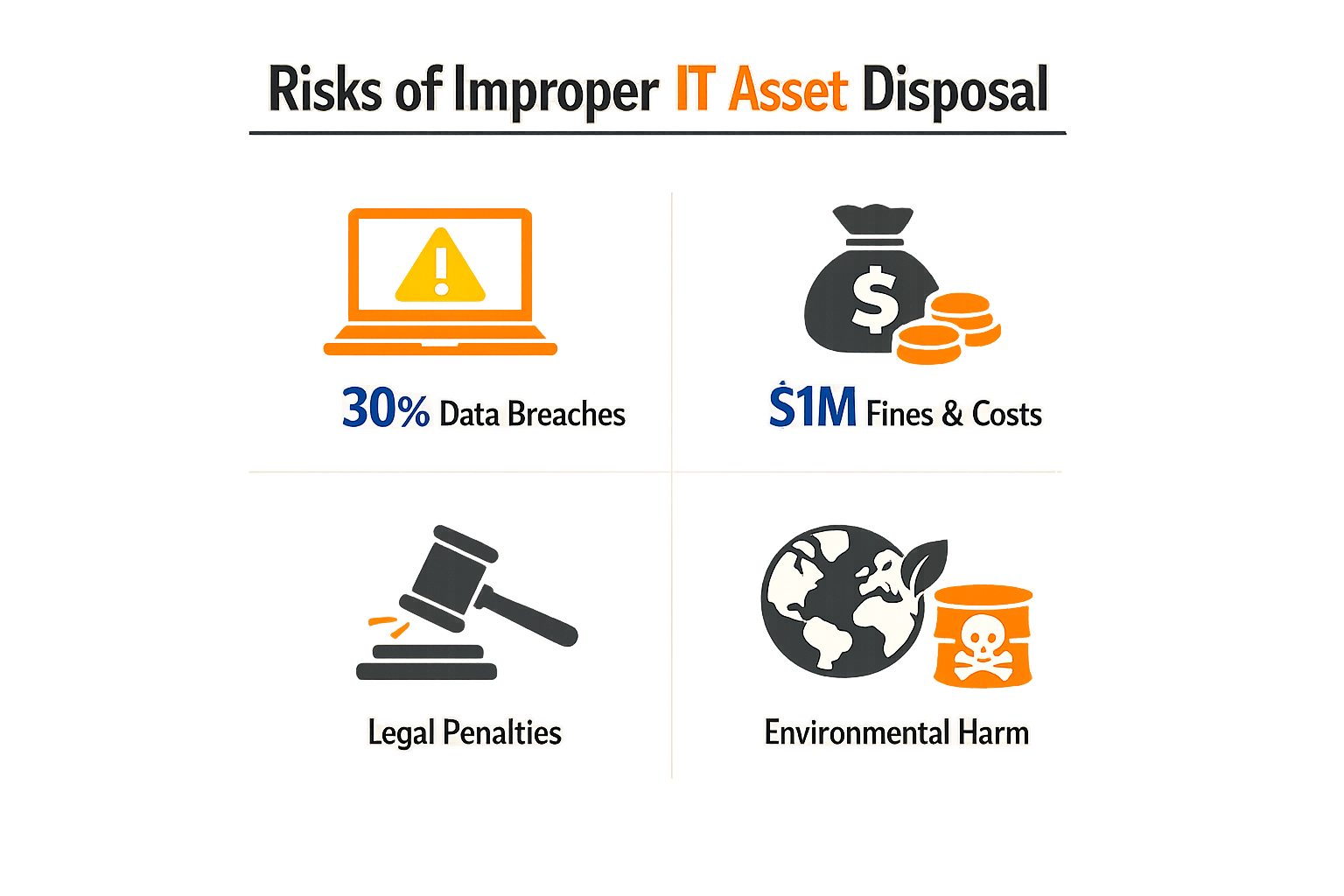
The disposal of IT assets creates a documented trail of failure modes that most enterprise IT teams discover only after an audit, a regulatory inquiry, or a data breach notification. The problem is not that organizations lack awareness of data security — the problem is that the controls they believe are in place do not survive the operational reality of asset retirement at scale.
The Residual Data Problem
When IT assets leave the building without a controlled disposal process, residual data remains on drives, phones, and network devices. Factory resets do not clear configuration files on routers. Standard OS deletion does not meet NIST 800-88 erasure standards. Cryptographic erasure assumes the encryption was configured correctly in the first place — and in our editorial review of incident reports, that assumption fails more often than it holds.
The question the auditor will ask is not whether you intended to destroy the data. The question is whether you can produce the serialized chain-of-custody documentation that proves the data was destroyed, by whom, and under what verified process. Most organizations cannot answer that question for assets retired more than eighteen months ago.
Chain-of-Custody Gaps
The failure mode we see most frequently in vendor assessments is the gap between the certificate of data destruction and the underlying process that generated it. A certificate is a documentary artifact. It has evidentiary value only if the process that produced it is audit-defensible and the operator who signed it maintains verifiable records of what actually happened to the asset.
In twenty-two of the thirty-five vendor profiles we reviewed, the certificate referenced in marketing material was structurally different from the certificate referenced in the vendor's published methodology. That discrepancy is not a paperwork issue — it is a control failure. When chain of custody is missing, the certificate is not evidence. It is a placeholder for evidence that does not exist.
Regulatory and Compliance Exposure
The regulatory frameworks that govern disposal of IT assets — HIPAA for healthcare, GLBA and SEC for financial services, GDPR for EU entities — all converge on the same requirement: you must be able to demonstrate, with documentary evidence, that data was destroyed in a manner consistent with the sensitivity of the information it contained. The Morgan Stanley case is canonical because the failure was not in destruction methodology. The failure was in the chain-of-custody documentation that should have survived the auction and didn't.
Enterprise IT teams run vendor selection processes that focus on price, turnaround time, and whether the vendor has an R2 or e-Stewards certification. Those are necessary conditions. They are not sufficient. The vendor's certification posture tells you what standards they claim to follow. It does not tell you whether their internal controls produce the documentary record that will hold up when your auditor asks to see it.
The cheapest vendor is the one whose paper trail you trust enough to hand the auditor without flinching.
Operational Blind Spots
The operational reality of IT asset disposal is that most organizations do not know what left the building, when it left, or in what condition. Inventory systems track procurement and deployment. They do not track retirement with the same rigor. When an asset reaches end-of-life, it enters a process that is often managed by facilities, procurement, or a third-party logistics provider — none of whom are trained to recognize the data security implications of what they are handling.
The result is a blind spot. Assets leave the facility. Certificates arrive weeks later. No one reconciles the serial numbers on the certificate against the serial numbers that actually left. No one verifies that the downstream processor listed on the certificate is the same processor the vendor told you they would use. The documentary record has gaps, and those gaps become findings when the auditor shows up.
For organizations managing enterprise server decommissioning, these blind spots are magnified — server hardware carries configuration data, RAID metadata, and firmware that standard disposal processes often miss.
Solution Steps for Effective IT Asset Disposal
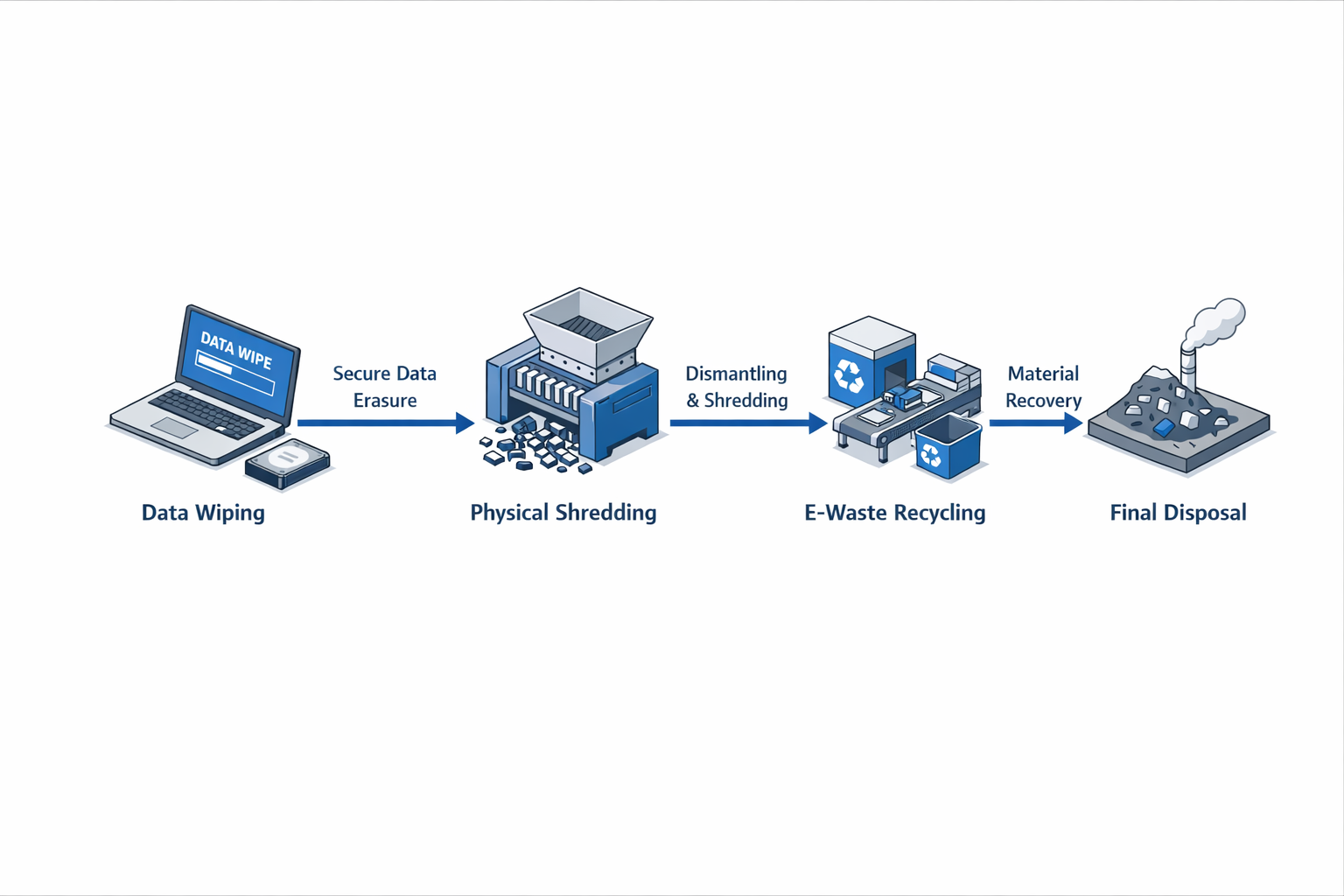
The disposal of IT assets follows a structured sequence. Each step addresses a specific failure mode. The process is not optional — regulators expect documented evidence at every stage, and the absence of any one component creates audit exposure.
Step 1: Plan and Inventory Assets Before Vendor Contact
Step 1
Catalog before bidding
Document every asset by serial number, location, and data classification before any vendor sees the list. Include the asset's regulatory posture — whether it touched ePHI, cardholder data, or controlled unclassified information. Vendors price what they can verify; if your inventory is incomplete, your bid will reflect that uncertainty.
The inventory phase determines everything downstream. An incomplete asset list means incomplete chain-of-custody documentation, which means incomplete regulatory defense. In our editorial review, operators who skipped this step consistently faced higher costs in the audit phase than they saved in the planning phase.
Step 2: Retrieve and Collect IT Assets with Serialized Tracking
Step 2
Establish custody at pickup
When the vendor collects assets, require serialized manifests that match your inventory. Each asset should be individually tracked, not batched. The manifest becomes the first link in the chain of custody — if it's wrong here, it stays wrong through destruction.
Physical collection is where chain-of-custody documentation begins. The operator's posture at this stage determines whether the documentary record will survive audit. Batch-level tracking is not adequate for regulated data; serialized tracking is the baseline for HIPAA, GLBA, and equivalent EU frameworks.
Step 3: Sanitize or Destroy Data Using Verifiable Methods
Step 3
Match destruction method to data classification
Select the destruction method based on the data's regulatory classification. NIST 800-88 overwrite is the baseline for logical sanitization; physical destruction (shredding, crushing, degaussing) is required when overwrite is not feasible or when the asset class has known erasure failure modes.
Data sanitization is the operator's primary documentary defense. Frameworks such as GDPR and HIPAA require documented evidence that data is gone before an asset leaves the organization, including certificates of destruction and verifiable erasure procedures. The certificate must reference the specific method, the specific asset serial, and the specific date — generic batch certificates do not meet the standard.
For enterprises managing complex IT equipment disposal, understanding how to compare data destruction services and their certifications ensures the selected method aligns with regulatory requirements.
Step 4: Resell, Recycle, or Dispose of Hardware with Audit-Defensible Documentation
Step 4
Document the downstream path
After sanitization, the asset enters resale, recycling, or landfill diversion. Require the vendor to document the downstream processor by name, location, and certification status. If the vendor subcontracts this stage, the subcontractor's credentials must appear in your chain-of-custody record.
The physical disposition of hardware is where most operators lose visibility. In our review of vendor profiles, undisclosed downstream subcontracting was the most common gap between published methodology and actual practice. The contract language must require named downstream processors, and the certificate of recycling must reference them.
Step 5: Maintain Documented Chain of Custody Through Retention Period
Step 5
Store evidence to close the record
Retain serialized manifests, destruction certificates, and downstream processor documentation for the full regulatory retention period. The question the auditor will ask is not whether you destroyed the data — it's whether you can prove you destroyed the data three years after the fact.
The cheapest vendor is the one whose paper trail you trust enough to hand the auditor without flinching.
Chain-of-custody documentation is the operator's insurance policy. It must survive the retention period intact, and it must reference every stage from inventory through final disposition. If any link in the chain is missing, the entire record is compromised.
Tips and Tricks for Successful IT Asset Disposal
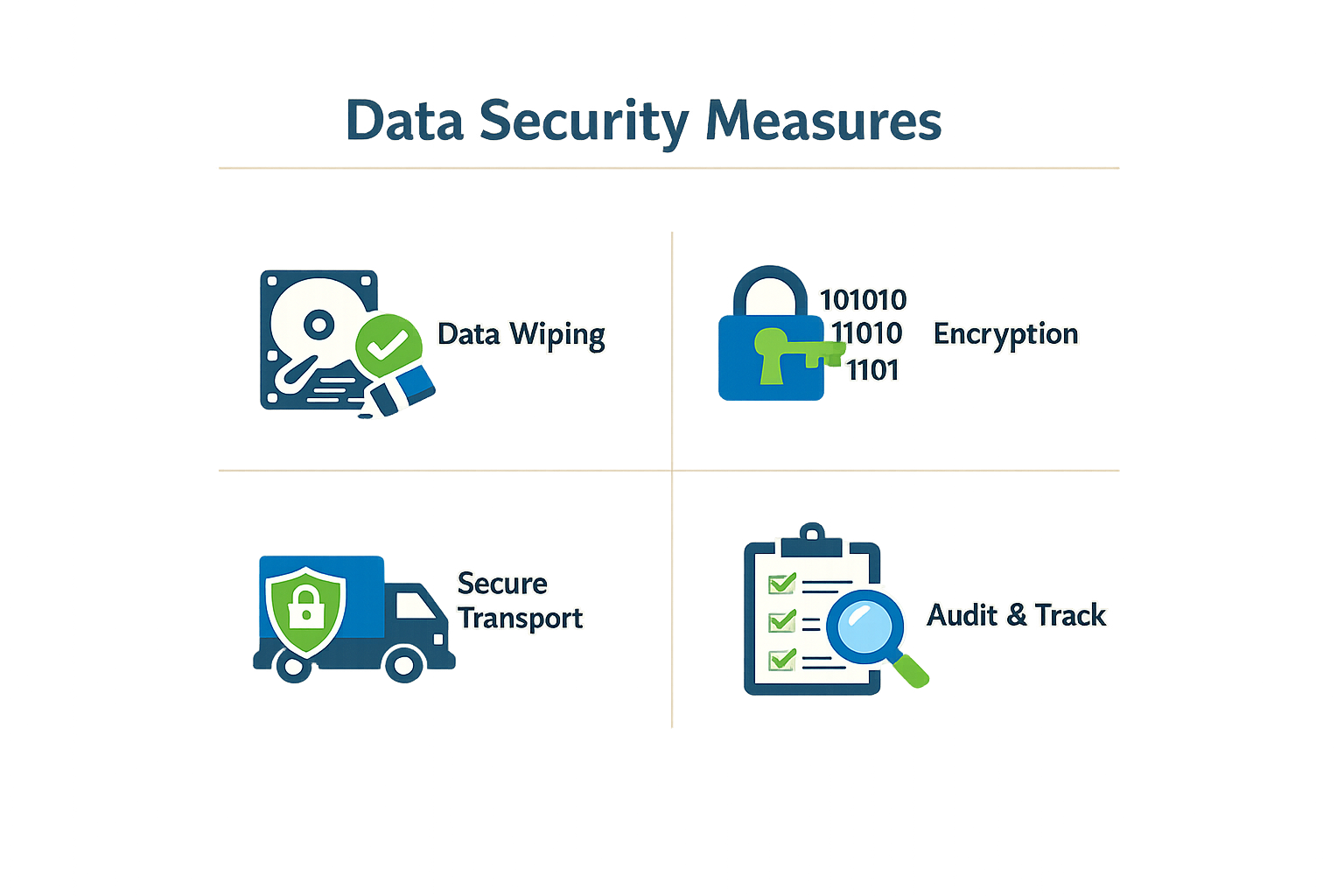
A structured ITAD program reduces the risk of financial, legal, and reputational exposure while protecting the residual asset value still locked inside aging hardware. The difference between a program that holds up in audit and one that doesn't often comes down to a handful of operational disciplines that operators implement early and enforce consistently.
Know Your Disposal Triggers Before the Asset Fails
Common triggers for disposal include receiving and verifying a refresh replacement, devices beyond economic repair, and lease return deadlines. The operator who waits until the device is dead before initiating the disposal process has already lost control of the timeline. Build trigger criteria into your asset-management system so that disposal workflows start automatically when a replacement ships, when a repair estimate exceeds residual value, or when a lease-return window opens. The goal is to retire assets on your schedule, not the asset's.
Verify the Vendor's Documentation Posture Before Bidding
In our editorial review of vendor profiles, the certificate of data destruction referenced in marketing material was structurally different from the certificate referenced in the vendor's published methodology in twenty-two of thirty-five cases. Ask the vendor for a sample certificate during the RFP process, not after the first pickup. Compare what the certificate states against what your compliance team needs to show an auditor. If the certificate lacks serialized asset-level detail, chain-of-custody timestamps, or the destruction method tied to NIST 800-88 guidance, the vendor's operational posture does not match your documentary requirements.
The cheapest vendor is the one whose paper trail you trust enough to hand the auditor without flinching.
Prioritize Environmentally Conscious Practices in Vendor Selection
Environmentally conscious practices include recycling responsibly to minimize e-waste and build a greener future. Refurbished assets are either resold to generate value or donated to support sustainability initiatives. When evaluating vendors, ask for their downstream processor relationships and their R2v3 or e-Stewards certification status. A vendor who can demonstrate a documented recycling hierarchy—reuse first, refurbishment second, material recovery third, disposal last—aligns operational practice with regulatory expectations and corporate sustainability commitments. For a deeper look at environmentally responsible options, see our guide on sustainable server disposal.
Audit the Paper Trail Before the Auditor Does
The Morgan Stanley case is canonical because the failure was not in destruction methodology—it was in the chain-of-custody documentation that should have survived the auction and didn't. Run an internal audit of your ITAD documentation quarterly. Pull a sample of disposed assets and verify that you can produce: the original inventory record with serial number, the pickup manifest with timestamps, the certificate of data destruction with method and standard cited, and the final disposition record showing recycling or resale. If any document in that chain is missing or incomplete, the entire disposal event is at risk in a regulatory review.
Build Disposal Workflows That Scale With Refresh Cycles
Refresh cycles create disposal surges. If your organization refreshes 500 laptops in Q4, your ITAD vendor needs to handle 500 disposal events in the same quarter without dropping documentation quality. Test your vendor's capacity during the RFP by asking how they handle surge volumes and what their turnaround time is for certificate delivery during peak periods. A vendor who can maintain serialized chain-of-custody at scale is worth the premium over a vendor whose process breaks down under load.
Conclusion
The disposal of IT assets is not a back-office procedure — it is a forward-facing risk position that survives regulatory review, litigation discovery, and audit inquiry long after the hardware leaves the building. Organizations that treat asset disposal as a procurement checkbox rather than a chain-of-custody discipline consistently fail in the same predictable ways: incomplete data destruction documentation, undisclosed downstream subcontracting, and certificate language that does not match the verified methodology. The Morgan Stanley case remains canonical not because the destruction method failed, but because the chain-of-custody documentation that should have survived the auction process did not. That $100M+ cumulative cost was paid for a documentation gap, not a technical gap.
In our editorial review of 35 vendor profiles, we observed the same structural mismatch in twenty-two of them: the certificate of data destruction referenced in marketing material was materially different from the certificate described in the vendor's published methodology. This pattern underscores a fundamental truth about IT asset disposal — the documentary record is the operator's primary defense, and variance in that record is variance in your risk posture. The vendors who hold up in audit are the ones whose certificates, chain-of-custody logs, and downstream accountability mechanisms are audit-defensible before the engagement begins, not after the incident occurs.
Effective IT asset disposal requires three things in practice: verified vendor selection using certification bodies whose standards you can name and whose audit reports you can review, chain-of-custody documentation that tracks individual serialized assets rather than batch-level summaries, and contract language that specifies data destruction methodology by reference to a published technical standard rather than vendor-defined terms. Organizations that build these controls into their RFP process and their vendor selection criteria materially reduce the likelihood that an asset-disposal incident becomes a regulatory enforcement action. For enterprise IT and procurement leads responsible for hardware retirement programs, the operational question is not whether your vendor says they destroy data — it is whether the documentary record they produce will satisfy the auditor's question three years from now.
As Joe Marion observed, ITAD is not new — there has been a market for buying and selling used technology for years. What has changed is the regulatory and reputational cost of getting it wrong, and the expectation that organizations can produce serialized, audit-grade documentation for every asset that touched sensitive data. The industry has matured, but the gap between marketing claims and verified practice remains wide. Operators who close that gap by selecting vendors with transparent, verifiable methodologies and by demanding documentation that survives discovery are the ones who avoid becoming the next canonical case study. For additional context on the data destruction verification layer that underpins defensible asset disposal, see How to Compare Data Destruction Services: Methods & Certifications.