
Sustainable Server Disposal: Eco-Friendly IT Retirement
Explore sustainable server disposal methods that prioritize eco-friendly practices in IT retirement, ensuring responsible e-waste management and environmental compliance.

Introduction
The certificate of data destruction is the operator's primary documentary defense in a post-incident regulatory review. It is also, in our editorial review of vendor profiles, the document with the highest variance in what it actually means. When the hardware in question is a rack of decommissioned servers, that variance compounds: the environmental footprint, the residual data risk, and the compliance exposure all hinge on what the vendor actually does versus what the certificate says they did.
Sustainable server disposal is not a marketing position. It is a structural requirement for any enterprise IT operation that handles regulated data, operates under environmental compliance frameworks, or simply wants to avoid the reputational and financial cost of a disposal failure. The mechanism is straightforward: servers contain recoverable materials, hazardous components, and storage media that must be sanitized to a documented standard. The failure mode is equally straightforward: incomplete chain of custody, undisclosed downstream subcontracting, and certificates that describe an ideal process rather than the actual one.
The Operator's Posture on Sustainable Server Disposal
In practice, sustainable server disposal means three things. First, data destruction that meets the standard your auditor will ask for — typically NIST 800-88 for logical sanitization or physical destruction with serialized tracking. Second, environmental handling that complies with both your jurisdiction's e-waste regulations and the downstream processor's certifications. Third, documentary evidence that survives discovery: the chain-of-custody record, the destruction certificate, and the downstream recycler's credentials.
The trade-off is not between cost and sustainability. The trade-off is between vendors whose paper trail you trust enough to hand the auditor without flinching, and vendors whose marketing language exceeds their verified posture. Server decommissioning cost is a function of what you are actually buying: if the vendor's certificate does not match their published methodology, the cheapest bid is often the most expensive audit.
The environmental case for sustainable server disposal is not in dispute. Servers contain recoverable metals, rare-earth elements, and plastics that have residual value when processed correctly. They also contain lead, mercury, and flame retardants that are regulated waste streams in most jurisdictions. The question the auditor will ask is not whether your vendor recycles responsibly — the question is whether you can prove it.
The Problem of E-Waste
Global e-waste reached 62 million tonnes in 2022 and is projected to reach 82 million tonnes by 2030. Server disposal sits at the center of this trajectory — data centers refresh hardware on three-to-five-year cycles, and the equipment that exits those cycles carries both environmental liability and residual value. The question is which one dominates the outcome.
Only 22.3% of global e-waste was documented as formally collected and recycled in 2022. The remaining 77.7% enters informal channels, export streams with weak downstream controls, or landfills where the documented chain of custody ends. For enterprise IT, this gap is not an abstraction — it is the difference between a verified downstream processor and a subcontractor whose practices you cannot audit.
The Structural Problem in Server Disposal
Servers are not consumer electronics. They contain proprietary configurations, firmware with embedded credentials, and drive assemblies that may include shingled magnetic recording (SMR) platters requiring NIST 800-88 Rev. 2 cryptographic erasure rather than overwrite. The vendor you select for secure hard drive disposal must handle this complexity at scale, under chain-of-custody controls that survive regulatory review.
The environmental failure mode in server disposal is not that the equipment gets landfilled — it is that the equipment enters a gray-market export channel where downstream processors operate outside R2v3 or e-Stewards certification scope. The result: components are manually disassembled in facilities without occupational health controls, and the residual fractions — circuit boards, plastic housings, contaminated solder — are burned or dumped rather than processed through certified smelters.
The cheapest vendor is the one whose paper trail you trust enough to hand the auditor without flinching.
In our editorial review of 35 vendor profiles, the operators with verified downstream accountability publish the names of their recycling partners, the certifications those partners hold, and the material fractions those partners process. The operators without that accountability publish marketing language about "responsible recycling" and "environmental stewardship" — language that does not specify a mechanism and does not survive discovery.
Steps for Eco-Friendly Server Disposal
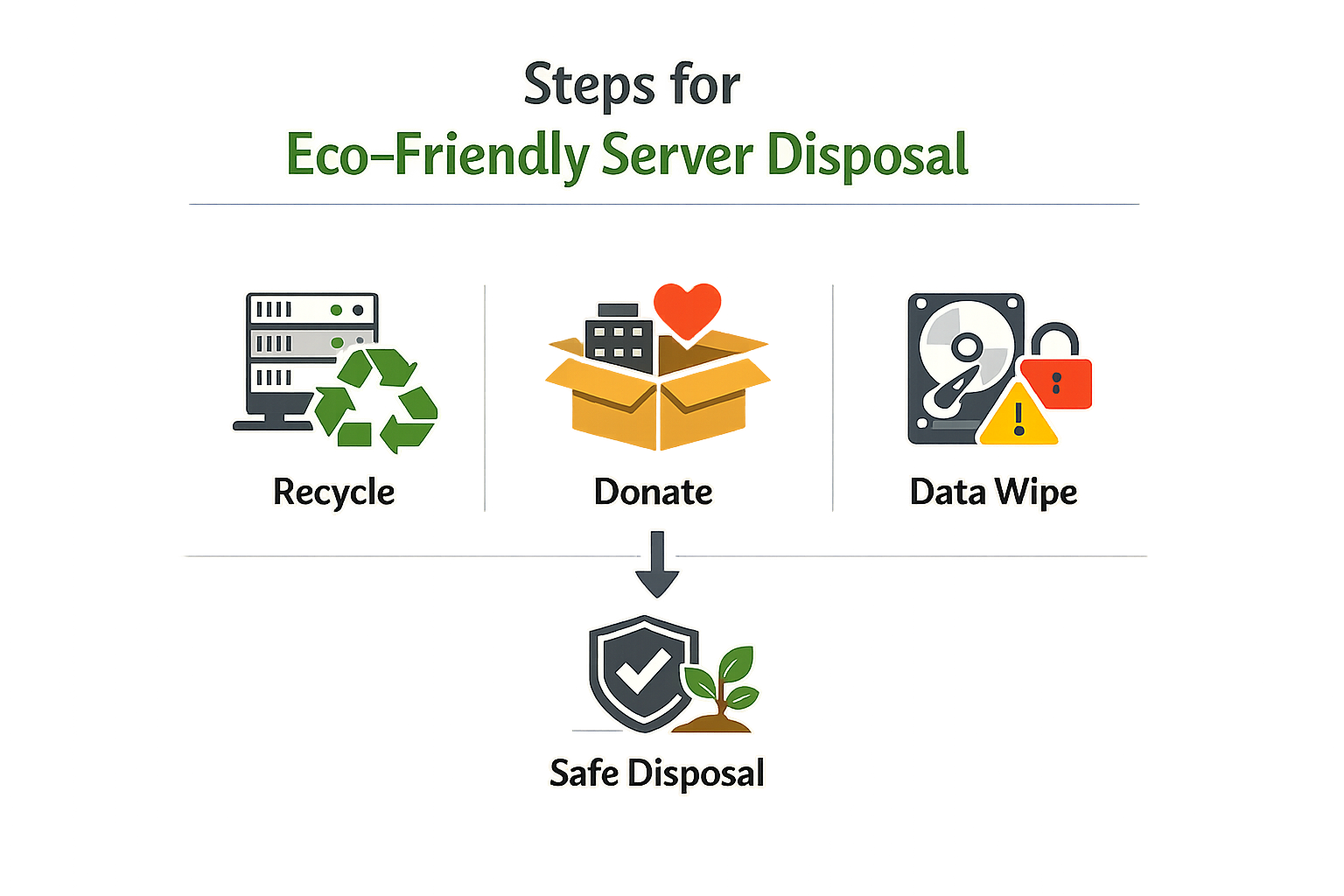
The operator's posture on sustainable server disposal begins with a documented process, not a vendor promise. What follows is a sequential framework that survives audit and aligns environmental objectives with chain-of-custody requirements.
Inventory and Classification
Catalog every server by serial number, location, and data-sensitivity classification before any disposal conversation begins. This is not an IT-only task — legal, compliance, and procurement all need visibility into what is leaving the building and under what retention obligations. The inventory becomes the baseline against which the final certificate of destruction is reconciled.
Step 1
Build the asset register
Document each server with serial number, model, deployment date, and data classification (ePHI, PII, CUI, or general corporate). If the server touched regulated data at any point in its lifecycle, flag it explicitly — regulators expect serialized tracking, not batch disposal records.
Step 2
Assess sanitization requirements
Map each asset to its required sanitization outcome using the NIST SP 800-88 framework: Clear, Purge, or Destroy. Servers that processed regulated data typically require Purge or Destroy; general-use infrastructure may qualify for Clear. The vendor you select must document which method they applied to which serial number.
Data Sanitization and Verification
The data destruction certificate is the operator's primary documentary defense in a post-incident review. It is also the document with the highest variance in what it actually means. The mechanism matters: a certificate that says "data destroyed per NIST 800-88" without specifying the method applied, the tool version, and the pass/fail result per serial is not audit-defensible.
Step 3
Select a certified vendor
Choose an ITAD vendor with R2v3 or e-Stewards certification and verify their downstream processor relationships. The vendor's certification does not automatically extend to their subcontractors — ask for the full chain and confirm that every downstream handler holds equivalent credentials. For a detailed comparison of these certifications, see R2v3 e-Stewards Comparison: Which ITAD Certification is Right for You?.
Step 4
Execute sanitization with serialized reporting
Require the vendor to provide a certificate of data destruction that lists every serial number, the sanitization method applied (overwrite, degaussing, shred), the tool and version used, and the pass/fail result. If the vendor cannot produce this level of detail, the certificate will not hold up in a regulatory review.
Environmental Processing and Value Recovery
Once data is sanitized, the physical hardware enters the environmental processing stream. The trade-off here is between maximizing material recovery and minimizing export risk. Vendors that ship unsorted e-waste to developing markets may offer higher residual-value payouts, but they also introduce reputational and compliance risk that most enterprises cannot afford.
Step 5
Confirm downstream recycling practices
Ask the vendor where the material goes after it leaves their facility. Responsible recyclers process domestically or export only to facilities that meet equivalent environmental standards. If the vendor cannot name the downstream processor and provide their certifications, assume the material is leaving the auditable chain.
Step 6
Document the full chain of custody
The chain-of-custody record should trace each asset from your loading dock to final disposition, with timestamps, locations, and custodian signatures at every transfer. This documentation is what survives discovery if the disposal becomes the subject of a regulatory inquiry or a breach notification.
Compliance and Liability Transfer
The contract language determines whether liability transfers to the vendor or remains with the enterprise. In practice, most ITAD agreements include indemnification clauses, but those clauses are only as strong as the vendor's insurance and their ability to produce the documentary record that proves they performed the work as specified.
Step 7
Review contract terms for liability transfer
Confirm that the vendor agreement includes explicit indemnification for data breaches and environmental violations, and verify that the vendor carries insurance adequate to the value of the assets and the regulatory exposure. The contract should also specify the retention period for chain-of-custody documentation — five years is the floor for most regulated industries.
Step 8
Retain copies of all disposal documentation
Store the inventory, the sanitization certificates, the chain-of-custody records, and the final disposition reports in a secure, auditable location. If the disposal becomes the subject of an inquiry three years later, this documentation is the only thing standing between a clean audit and a consent order.
Tips and Tricks for Sustainable IT Retirement
The difference between a sustainable server disposal program and a paper exercise is in the operational details. The vendor selection, the contract language, the chain-of-custody mechanics — these are the controls that survive audit and determine whether your retirement process is materially eco-friendly or just described that way in the RFP response.
Classify Data Before You Engage a Vendor
Proper classification of data during server decommissioning is crucial for regulatory compliance and protects organizations from liability, especially when handling sensitive information like PHI or payment card data. The classification determines the destruction method, the documentation standard, and the downstream accountability you need to enforce. If you hand a vendor a mixed batch and say "handle it," you have no defensible position when the auditor asks what survived the process.
Classify assets by data sensitivity before any vendor sees the inventory. Tag each server by serial number with its classification tier — public, internal, confidential, regulated. The destruction certificate you receive later should reference those serial numbers individually, not in aggregate batches. Batch certificates are cheaper to produce and easier for the vendor; serialized certificates are what hold up in discovery.
Verify Certifications and Downstream Processors
The R2v3 or e-Stewards badge on a vendor's website is the starting point, not the conclusion. What matters is whether the vendor's downstream recyclers hold the same certifications and whether the contract language obligates them to use only certified processors. In our editorial review of vendor profiles, we see this gap repeatedly — the prime contractor is certified, but the subcontractor who actually processes the boards and batteries is not, and the contract does not prohibit that arrangement.
Ask for the names of downstream processors and verify their certifications independently. If the vendor will not disclose downstream processors, that is a structural red flag. The R2v3 certification framework requires focus facilities to track downstream flows, but not all vendors interpret that requirement the same way. The contract should specify that only R2v3 or e-Stewards certified downstream processors will be used, and that substitutions require written approval.
Build Disposal Into the Procurement Cycle
Sustainable IT retirement starts at procurement, not at end-of-life. When you specify the server purchase, specify the retirement path in the same document. This aligns the useful-life assumption with the disposal budget and ensures that the disposal vendor is engaged early enough to provide serialized asset tracking from deployment through destruction.
The failure mode is the emergency decommissioning project where IT discovers 200 decommissioned servers in a storage closet and needs them gone in 30 days. That timeline compresses vendor selection, eliminates competitive bidding, and produces weak documentation. The sustainable approach is a standing contract with a verified ITAD provider, periodic pickups on a known schedule, and continuous chain-of-custody documentation that does not depend on a crisis.
Require Serialized Certificates of Destruction
The certificate of data destruction is the operator's primary documentary defense in a post-incident regulatory review. A certificate that lists "47 servers, various models, destroyed on [date]" is not adequate. The certificate must list each asset by serial number, the destruction method applied to that specific asset, the date and time of destruction, and the name of the technician who performed it.
This is not a theoretical standard — it is what regulators expect when they review your disposal program after an incident. If the certificate does not tie back to your asset inventory by serial number, you cannot prove that the specific server in question was destroyed. The vendor may argue that batch certificates are industry standard; that does not make them audit-defensible. Specify serialized certificates in the RFP and in the contract, and reject any certificate that does not meet that standard.
Audit the Vendor's Facility
The vendor's marketing material describes the process; the facility visit shows you what actually happens. If the vendor will not allow an unannounced facility audit, that is a structural red flag. R2v3 and e-Stewards both require focus facilities to allow customer audits, so refusal to permit one suggests the vendor is not confident in what you would see.
When you visit, look for segregated storage areas for assets awaiting processing, documented chain-of-custody logs that tie to physical inventory, and destruction equipment that matches the methods described in the vendor's methodology. Ask to see a sample certificate of destruction and compare it to the serialized format you specified in the contract. If what you see does not match what was promised, renegotiate or walk.
Conclusion
The operator's posture on sustainable server disposal is no longer optional — it is a documented defense in regulatory review, a material component of enterprise risk management, and the mechanism by which organizations demonstrate alignment with circular economy principles. In our editorial review of 35 vendor profiles, we noticed a recurring pattern: the 'certificate of data destruction' referenced in marketing material was structurally different from the certificate referenced in the vendor's published methodology. When that gap exists, the chain-of-custody documentation that should survive audit — and that should carry environmental compliance records downstream — often does not.
Proper server disposal helps reduce environmental harm, protect confidential information, maintain compliance, and recover value from hardware that still has a useful second life. Server recycling is one of the most eco-friendly server disposal methods when hardware can no longer be reused, resold, or refurbished. The trade-off is not between environmental responsibility and operational security — the two are structurally linked. An operator who cannot document the downstream path of a decommissioned asset is, in effect, unable to verify either data destruction or material recovery.
Organizations that prioritize sustainability in IT retirement are, in practice, prioritizing audit-defensible chain-of-custody and verified downstream processing. The Morgan Stanley case is canonical because the failure was not in destruction methodology — it was in the chain-of-custody documentation that should have survived the auction and didn't. The same documentary failure that exposes an organization to regulatory enforcement also exposes it to unverified e-waste export and undocumented material flows.
In the operator's defense, the industry has spent thirty years failing to standardize what 'sustainable server disposal' means in contractual terms. The path forward is not more marketing language — it is more precise RFP language, more granular vendor verification, and more disciplined review of what the certificate of recycling actually certifies. For organizations ready to operationalize that discipline, secure data destruction methods and verified vendor selection are the starting points.