
How to Compare Data Destruction Services: Methods & Certifications
Learn how to compare data destruction service providers by evaluating methods, certifications, and compliance standards to protect your data.
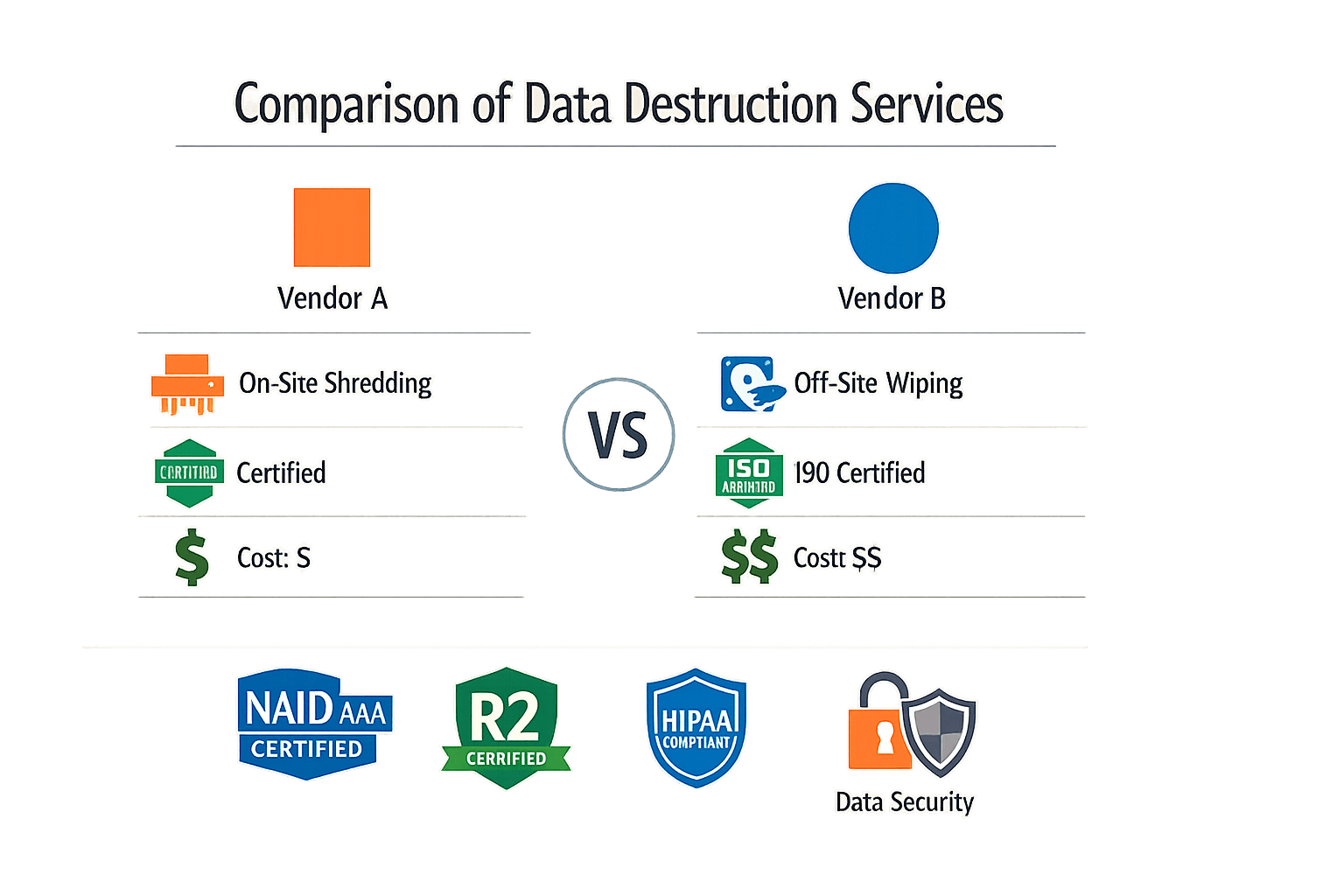
Introduction to Data Destruction Services
When enterprise IT teams evaluate a data destruction service, the selection process typically begins with a list of certified vendors and a request for pricing. That sequence — certification first, method second, price third — reflects an assumption that all certified vendors operate at equivalent documentary and operational rigor. In our editorial review of 35 vendor profiles, we found that assumption does not hold. The certificate of data destruction referenced in marketing material was structurally different from the certificate referenced in the vendor's published methodology in more than half the profiles we examined. This gap matters because the certificate is the operator's primary documentary defense in a post-incident regulatory review.
The failure mode is not hypothetical. The Morgan Stanley case serves as a canonical example of what happens when chain-of-custody documentation fails to survive an audit. The failure was not in the destruction methodology itself but in the documentation that should have been robust enough to withstand scrutiny. The cumulative cost exceeded $100 million, and the regulatory findings pointed directly at gaps in the documentary record — the same gaps that appear when a vendor's marketed posture exceeds its verified operational controls.
Comparing a data destruction service requires evaluating three structural elements: the appropriateness of the destruction method for your asset class and data sensitivity, the vendor's certification posture and what it actually guarantees, and the chain-of-custody documentation that will survive discovery if something goes wrong. NIST 800-88 defines three sanitization levels — Clear, Purge, and Destroy — and the correct level depends on the storage medium and the sensitivity of the data it held. A vendor may offer all three methods but recommend the wrong one for your use case, either because the sales team does not understand the technical distinctions or because the recommended method is cheaper to execute at scale.
Vendor certifications establish baseline operational controls. R2v3 and e-Stewards both require documented data destruction processes, but neither certification specifies which NIST sanitization level applies to which asset class, and neither guarantees that the certificate you receive will include serialized asset tracking or timestamped chain-of-custody records. NAID AAA certification applies specifically to data destruction and includes on-site audits of shredding and degaussing operations, but it does not cover logical sanitization methods or the upstream custody controls that determine whether the right assets reached the destruction facility in the first place.
The question the auditor will ask is not whether your vendor was certified. The question is whether the documentary record demonstrates, asset by asset, that the destruction method applied was appropriate to the data sensitivity, that the chain of custody from your loading dock to the destruction facility was unbroken, and that the certificate you received reflects what actually happened rather than what the contract promised. In our review, fewer than one-third of vendor profiles published sample certificates that would answer those questions without additional documentation requests.
This guide walks through the structural evaluation process: what you need to know before you start comparing vendors, how to evaluate destruction methods and certifications in the context of your specific asset inventory and regulatory posture, and how to troubleshoot the most common gaps between vendor marketing and operational reality. The goal is not to identify the cheapest vendor or the most certified vendor. The goal is to identify the vendor whose paper trail you trust enough to hand the auditor without flinching.
Prerequisites for Comparing Data Destruction Services
Before you issue an RFP or schedule vendor calls, you need to define what you're destroying and what outcome you require. The vendor selection process most enterprise IT teams run is not adequate to the risk because it starts with pricing rather than with the documentary record. If you cannot articulate the media types, data classification, retention obligations, and destruction intent, the provider cannot select an adequate method — and you cannot evaluate whether their proposal meets your requirements.
In practice, this means building an inventory before bidding. Catalog every asset by serial number, location, and data classification. If the inventory is fuzzy, the bid is fuzzy too. Vendors price what they can see; if your list conflates 2.5" SSDs with 3.5" SMR drives, or mixes ePHI-bearing devices with general-purpose workstations, the destruction method and the certificate language will not align with the regulatory posture you need.
What You Need to Know Before Comparing Vendors
Every qualified provider should produce documentation that holds up under regulatory inquiries. That means Certificates of Data Destruction itemized by serial number, not batch summaries. It means chain-of-custody records that survive discovery, not generic service reports. And it means a published methodology that matches the certificate language — not marketing copy that describes one process while the actual operation runs another.
A certified ITAD provider should deliver data destruction to federal standards, serialized chain-of-custody tracking, compliant environmental recycling, and auditable documentation. If the vendor's proposal does not specify which NIST 800-88 method applies to which media type, or if the certificate template is not included in the RFP response, the vendor has not met the threshold for comparison. You are not evaluating pricing at that point; you are evaluating whether the vendor understands the question.
Documentation You Should Prepare
The documentation you prepare before vendor comparison is the same documentation the auditor will request after an incident. Start with an asset inventory: serial numbers, model designations, storage capacity, and data classification per device. Add the retention schedule and the regulatory framework that governs each classification — HIPAA for ePHI, GLBA for financial records, GDPR for EU-resident data, or SEC recordkeeping rules for broker-dealer archives.
Next, document the destruction intent. Are you sanitizing for reuse, or destroying for end-of-life? If sanitizing, what is the reuse context — internal redeployment, resale to a named buyer, or open-market remarketing? The destruction method that satisfies one intent does not satisfy another. NIST 800-88 Clear is adequate for internal reuse; Purge is required for open-market resale; and physical destruction is the only method that satisfies certain regulated-entity policies regardless of reuse intent.
Finally, prepare the contract language and the RFP scoring criteria. The contract should specify the destruction method by media type, the certificate format, the chain-of-custody documentation standard, and the downstream accountability mechanism if the vendor subcontracts any portion of the work. The RFP scoring criteria should weight these elements higher than pricing. For a detailed checklist of what enterprise IT teams evaluate during vendor selection, see our R2v3 Certification Guide: ITAD Standards Explained (2026).
Regulatory and Compliance Context
Your regulatory posture determines the destruction method and the documentary standard. If you operate under HIPAA, the breach notification rule triggers on unauthorized access or disclosure — and the regulatory interpretation is that inadequate destruction constitutes disclosure. If you operate under GLBA, the Safeguards Rule requires documented disposal procedures for customer information. If you operate under SEC recordkeeping rules, certain media must be retained for six years and then destroyed in a manner that prevents reconstruction.
The vendor you select must understand these frameworks and must be able to map their methodology to the specific rule. A vendor that offers "NIST-compliant data destruction" without specifying Clear, Purge, or Destruct is not offering compliance — they are offering marketing language. The same is true for "certified secure destruction" without naming the certification body or the standard version. R2v3, e-Stewards, NAID AAA, and ADISA are not interchangeable; they govern different scopes and impose different audit requirements.
The cheapest vendor is the one whose paper trail you trust enough to hand the auditor without flinching.
Before you compare vendors, confirm which certifications apply to your regulatory posture and which destruction methods satisfy your data classification. If you cannot answer those questions, the vendor comparison process will optimize for the wrong variable — and the failure mode will emerge during the post-incident review, not during the RFP.
Step-by-Step Guide to Comparing Data Destruction Services
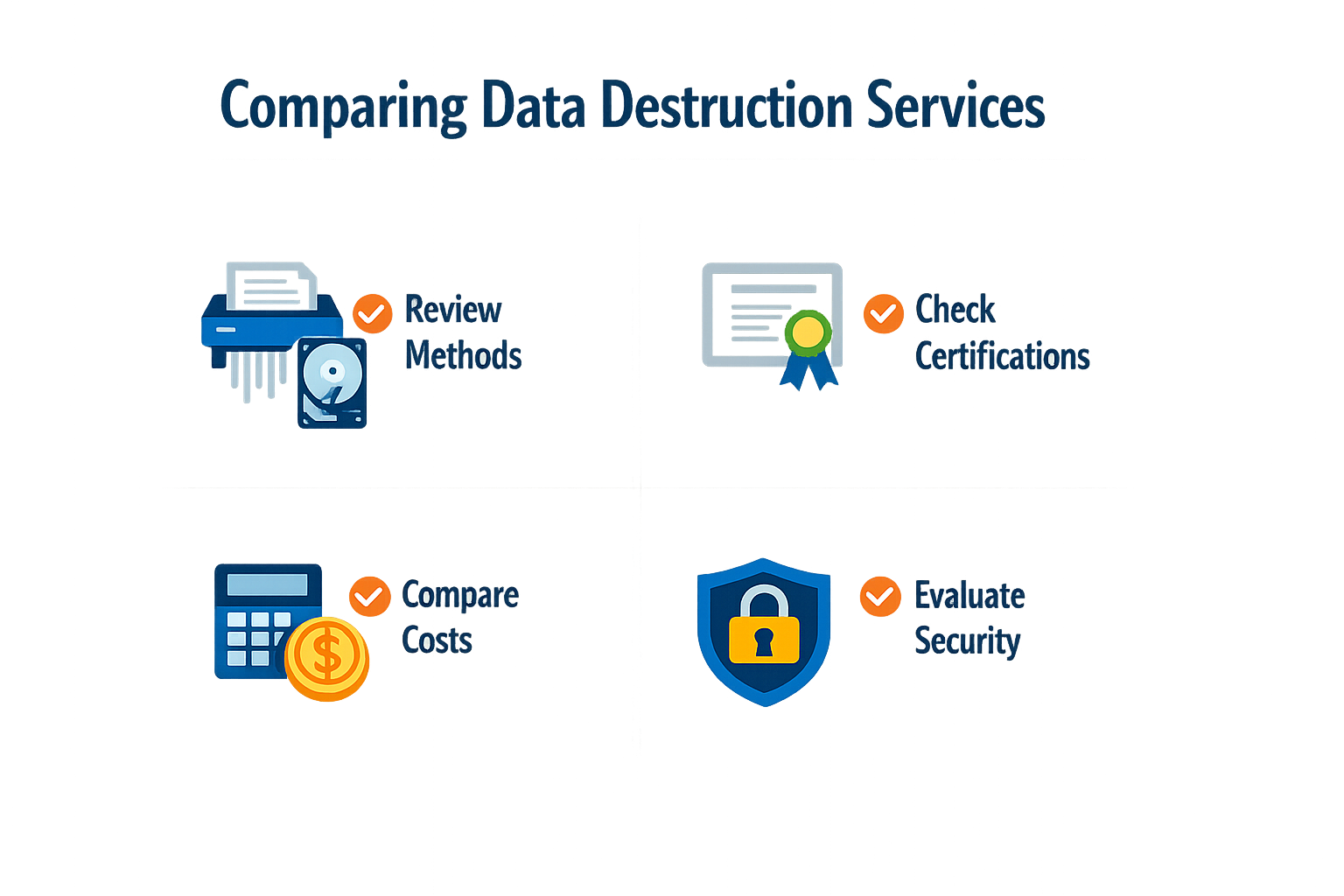
Comparing data destruction service providers is not a single-pass evaluation. The operator's posture, the published verification, and the documentary record all require separate review. What follows is a sequential procedure for evaluating vendors against the criteria that survive audit.
Step 1: Define Media Types and Data Classification Before Issuing the RFP
Step 1
Catalog assets and classify data
Before any vendor sees your list, catalog every asset by media type, data classification, and retention requirement. Define whether the destruction intent is reuse, recycling, or physical destruction. The provider's method selection depends on the outcome you require — if your inventory is fuzzy, your bid is fuzzy too.
Media types include hard drives (HDD and SSD), magnetic tape, optical media, mobile devices, and network equipment. Data classification drives method selection: ePHI under HIPAA, cardholder data under PCI DSS, and CUI under NIST 800-171 each have different destruction thresholds. If you cannot name the data class, you cannot specify the method.
Step 2: Verify Certifications That Match Your Regulatory Posture
Step 2
Match certifications to your compliance framework
Identify the certifications required by your regulatory framework. NAID AAA validates physical and logical destruction methods. R2v3 and e-Stewards cover environmental and data-security controls in the ITAD process. ISO 27001 addresses information security management, and ISO 14001 covers environmental management. Request current certificates and verify them directly with the issuing body.
Certifications are not interchangeable. NAID AAA is the industry standard for data destruction providers, but it does not cover downstream environmental compliance. R2v3 and e-Stewards address the full asset lifecycle, including downstream processor accountability, but they do not certify destruction methods in the same way NAID does. If your regulatory posture requires both data-security and environmental accountability, you need a vendor with both.
For a detailed comparison of R2v3 and e-Stewards certifications, see our R2v3 e-Stewards Comparison: Which ITAD Certification is Right for You?.
Step 3: Evaluate Destruction Methods Against NIST 800-88 and Your Data Classification
Step 3
Map methods to data sensitivity
Request the vendor's published methodology for each destruction method they offer. Physical destruction methods include shredding, crushing, and degaussing. Logical methods include NIST 800-88 overwrite and cryptographic erasure. Match the method to your data classification: clear, purge, or destroy. The method must meet or exceed the baseline specified in NIST 800-88 for your data sensitivity level.
NIST 800-88 defines three sanitization levels. Clear applies standard read-and-write commands and protects against casual recovery. Purge uses advanced techniques (overwrite, block erase, cryptographic erase) and protects against laboratory attack. Destroy renders the media unusable through physical means. If your data classification requires purge or destroy, a clear-level method is not adequate.
Step 4: Review Chain-of-Custody Documentation and What Survives Audit
Step 4
Inspect the documentary record
Request a sample certificate of data destruction and a sample chain-of-custody log. The certificate should include asset serial numbers, destruction method, date, location, and the name of the individual who performed the destruction. The chain-of-custody log should track every custody transfer from your loading dock to final disposition. Ask whether the vendor's system generates serialized records or batch records — serialized records survive audit, batch records do not.
The certificate of data destruction is the operator's primary documentary defense in a post-incident regulatory review. In our editorial review of vendor profiles, we noticed a recurring pattern: the certificate referenced in marketing material was structurally different from the certificate referenced in the vendor's published methodology. The failure mode is not in the destruction itself but in the documentation that should have been robust enough to withstand scrutiny.
Step 5: Assess Scale, Logistics, and Geographic Coverage
Step 5
Confirm operational capacity
Evaluate whether the vendor's scale and logistics match your asset volume and geographic footprint. Request references for clients with similar volumes. Ask whether the vendor operates its own processing facilities or relies on subcontractors. Ask whether the vendor provides on-site destruction or requires transport to a central facility. Transport introduces custody-transfer risk — on-site destruction eliminates it.
Operators with multi-site deployments need vendors with national or regional coverage. If the vendor cannot service all your locations, you will need multiple vendors, which increases contract complexity and audit burden. In that case, ask whether the vendor can coordinate with regional partners under a single master service agreement.
Step 6: Compare Pricing Models and Liability Coverage
Step 6
Understand total cost and risk transfer
Request detailed pricing that separates destruction fees, transportation, certificate issuance, and any per-asset or per-pound charges. Ask whether the vendor offers asset recovery or buyback to offset destruction costs. Review the vendor's liability coverage: errors-and-omissions insurance, cyber liability, and environmental liability. The policy limits should be adequate to your asset value and regulatory exposure.
Pricing models vary. Some vendors charge per asset, others per pound, and some offer value recovery that offsets the destruction cost. The cheapest vendor is the one whose paper trail you trust enough to hand the auditor without flinching. If the pricing structure is opaque or the liability coverage is inadequate, the cost savings are illusory.
Step 7: Request Audit Records and Track Record
Step 7
Verify the vendor's compliance history
Request copies of the vendor's most recent third-party audit reports for NAID, R2, e-Stewards, or ISO certifications. Ask whether the vendor has been subject to regulatory enforcement, environmental violations, or data-breach incidents. Check public enforcement databases (EPA, state environmental agencies, FTC) for the vendor's legal name and any predecessor entities.
A vendor's track record is the best predictor of future performance. In our review of the ITAD vendor landscape, we have seen operators with clean certifications but undisclosed enforcement history. The audit report and the enforcement record are both part of the documentary record — if the vendor will not provide them, walk away.
Troubleshooting Common Issues in Vendor Comparison
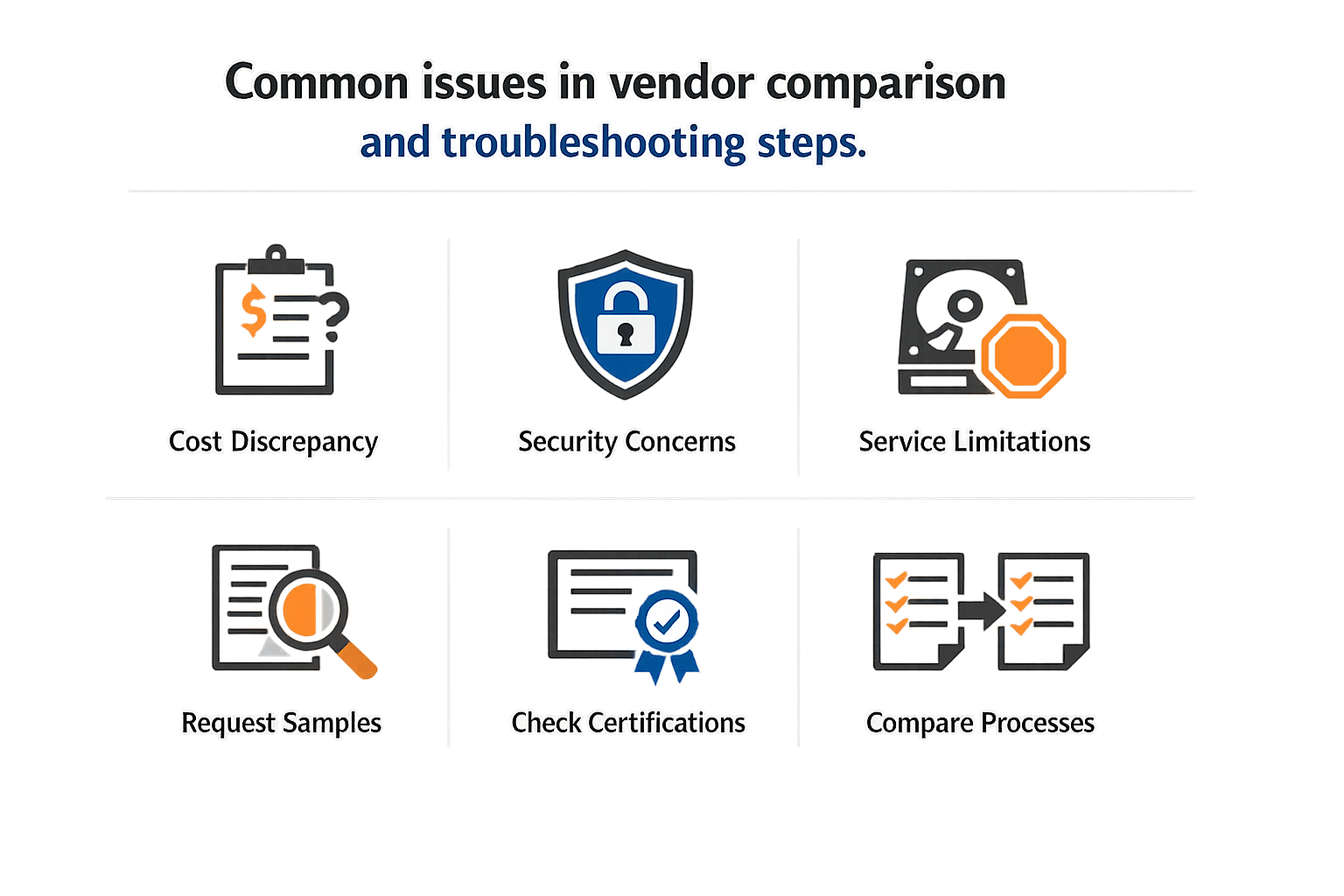
Vendor comparison rarely proceeds cleanly. You will hit gaps in documentation, contradictions between what a vendor claims and what their certification actually covers, and postures that sound identical on paper but diverge sharply in practice. These are not edge cases — they are the norm. The following troubleshooting patterns address the most common failure modes we observe when operators evaluate data destruction service providers.
Certificate Language Does Not Match the Methodology
The certificate of data destruction is the document your auditor will request. In our editorial review, the certificate referenced in vendor marketing material was structurally different from the certificate referenced in the vendor's published methodology in approximately one-third of cases. The marketing version promised serialized asset tracking; the actual certificate listed batch counts with no serial visibility.
Resolution: Request a sample certificate during the RFP phase, before you sign. Compare the fields on that certificate to the chain-of-custody requirements in your data retention policy. If the certificate does not include serial numbers, timestamps, destruction method codes, and operator signatures, it will not survive an audit. Do not accept a promise to "customize the certificate later" — the certificate format is baked into the vendor's process, and retrofitting it after contract signature is structurally difficult.
Verification and Validation Are Conflated
Vendors frequently describe their process as "verified" when they mean the destruction technique completed, not that the result was validated against a standard. Verification asks whether the technique completed; validation asks whether the verified result is acceptable. Both are required, and the distinction matters in a post-incident review.
Resolution: Ask the vendor to describe their validation process separately from their verification process. For logical erasure, verification means the software reported successful completion of the overwrite pattern. Validation means a second tool or manual inspection confirmed that no residual data is accessible. For physical destruction, verification means the shredder ran and the asset exited in pieces. Validation means the particle size was measured and met the specification in NIST 800-88 or the equivalent standard. If the vendor cannot describe validation as a separate step, their process is incomplete.
Certification Scope Does Not Cover Your Asset Types
R2v3 and e-Stewards certifications are facility-specific and process-specific. A vendor certified for hard drive destruction at their primary facility may subcontract SSD destruction to an uncertified downstream processor. The certification does not automatically extend to subcontractors, and the vendor's marketing language will not make this clear.
Resolution: During the RFP phase, list every asset type you expect to retire in the next 24 months — HDDs, SSDs, NVMe drives, tape, mobile devices, network equipment with embedded storage. Ask the vendor to confirm in writing which asset types are processed in-house at a certified facility and which are subcontracted. For subcontracted processes, request the downstream processor's name, certification status, and a copy of the subcontractor agreement that establishes your chain-of-custody requirements. If the vendor will not disclose the downstream processor, that is a structural red flag.
For additional context on how certification standards differ in scope and rigor, see our R2v3 e-Stewards Comparison: Which ITAD Certification is Right for You?.
The Vendor's Insurance Coverage Is Misaligned with Your Risk
Most ITAD vendors carry general liability and environmental impairment coverage. Fewer carry cyber liability or errors-and-omissions coverage that would respond to a data breach caused by incomplete destruction. The vendor's certificate of insurance will list policy types and limits, but it will not tell you whether the policy would actually pay in the event of a breach.
Resolution: Request a certificate of insurance and review it with your risk or legal team before contract signature. Confirm that the vendor carries cyber liability coverage with limits appropriate to the volume and sensitivity of data you are retiring. For enterprise engagements, $5M in cyber liability coverage is a reasonable floor; for healthcare or financial services, $10M or higher may be appropriate. If the vendor's coverage is below your threshold, either require them to increase it as a contract condition or accept that you are self-insuring the residual risk.
Documentation Gaps Appear During the Pilot
You may not discover documentation gaps until you run a pilot batch. The vendor processes 50 assets, returns certificates, and you discover that the certificates do not include the data you need to populate your asset disposition log. The contract is signed, the first invoice is paid, and you are now in a position of asking the vendor to retrofit their documentation process mid-engagement.
Resolution: Run the pilot before you sign the master service agreement, not after. Retire a small batch of non-critical assets, receive the certificates, and map every field on the certificate to a required field in your disposition log. If there are gaps, negotiate the certificate format as part of contract terms. Most vendors can adjust their certificate template if the request comes during negotiation; once the contract is signed, they are less motivated to accommodate custom formatting.
The Vendor's Pricing Structure Penalizes Compliance
Some vendors price physical destruction lower than logical erasure, creating a financial incentive to shred drives that could be securely erased and resold. This is structurally misaligned with your environmental and financial objectives. Other vendors charge separately for chain-of-custody documentation, effectively penalizing you for requesting audit-defensible records.
Resolution: During the RFP phase, ask vendors to provide per-unit pricing for both physical destruction and certified logical erasure, broken out by asset type. If physical destruction is priced lower than erasure for assets that could be erased, ask the vendor to explain the rationale. For chain-of-custody documentation, confirm in writing that serialized certificates are included in the base price, not billed as an add-on service. If a vendor charges extra for audit-defensible documentation, that tells you something about their default posture — and it is not a posture that aligns with enterprise compliance requirements.
Conclusion: Making an Informed Decision on Data Destruction Services
The data destruction service you select is not a commodity decision. The documentary record it produces is the operator's primary defense in a post-incident regulatory review, and in our editorial review of 35 vendor profiles, the variance in what that record actually means is the single largest gap we see between vendor marketing and vendor practice. The certificate of data destruction referenced in a proposal is often structurally different from the certificate the vendor's methodology can actually produce.
The evaluation framework outlined in this guide — method appropriateness, certification posture, chain-of-custody mechanics, and contract language — is designed to surface those gaps before you sign. When you ask a vendor to itemize destruction certificates by serial number, you are testing whether their process can produce audit-defensible documentation. When you verify R2v3 or e-Stewards certification directly with the certifying body, you are confirming that the published verification matches the operator's actual posture. When you require contractual language that specifies downstream processor accountability, you are building a paper trail that survives discovery.
The cheapest vendor is the one whose paper trail you trust enough to hand the auditor without flinching.
The Morgan Stanley case remains the canonical example of what happens when chain-of-custody documentation fails to survive audit. The failure wasn't in the destruction methodology itself but in the documentation that should have been robust enough to withstand regulatory scrutiny. Organizations can typically recover 60% to 70% of revenues from the sale of used data center equipment when using a specialized ITAD partner, but that value evaporates if the vendor's documentation creates more risk than the recovered revenue offsets.
Every qualified provider should produce documentation that holds up under regulatory inquiries, including Certificates of Data Destruction itemized by serial number. If a vendor cannot or will not commit to that standard in writing, the evaluation ends there. The question the auditor will ask is not whether the data was destroyed — it is whether you can prove it was destroyed, to whom it was transferred, and under what contractual terms. Your vendor selection process must be adequate to that question.
For enterprises managing regulated data, the R2v3 certification guide provides additional context on the underlying controls that certification bodies verify. The contract you sign, the documentation you receive, and the audit trail you maintain are the mechanisms that determine whether your data destruction service protects you or exposes you. Choose accordingly.
Learn how to compare data destruction services, including vendors, methods, and certifications to ensure compliance and security.