
Data Disposition: Linking Information Lifecycle Management to ITAD
Explore how data disposition relates to Information Lifecycle Management and IT Asset Disposition (ITAD) for secure end-of-life handling.

Introduction
The structured retirement of information and the hardware that stores it is not a single event. It is the terminal phase of a lifecycle that begins when data is created, continues through retention and use, and ends when the organization can demonstrate—on paper, in audit—that the data no longer exists in any recoverable form. This terminal phase is data disposition, and it sits at the intersection of two disciplines that enterprise IT teams often manage separately: Information Lifecycle Management (ILM) and IT Asset Disposition (ITAD).
ILM defines the governance layer: what data the organization retains, for how long, under what legal or regulatory obligations, and when disposal is both permitted and required. ITAD provides the operational layer: the physical and logical processes that render data unrecoverable, the documentation that proves those processes occurred, and the downstream accountability mechanisms that survive discovery. When these two layers are not structurally connected—when retention schedules do not map to defensible disposal practices, or when the ITAD vendor's certificate references a methodology the organization has never verified—the gap becomes the failure mode.
In our editorial review of 35 vendor profiles, we noticed a recurring pattern: the certificate of data destruction referenced in marketing material often differed structurally from the certificate referenced in the vendor's published methodology. This discrepancy matters because the certificate is the primary documentary defense in a post-incident regulatory review. If the retention schedule says data was disposed of on a specific date, but the ITAD certificate does not identify the serialized assets that contained that data, the organization cannot prove disposition occurred. The data is legally presumed to still exist.
Effective data destruction services require more than a vendor relationship—they require a documented connection between the governance layer and the operational layer, between the retention schedule and the sanitization method, between the legal hold and the chain-of-custody record. This article walks through that connection: the problem statement that emerges when ILM and ITAD are managed in isolation, the solution steps that link them structurally, and the operator-grade practices that make the linkage audit-defensible.
Understanding the Problem Statement
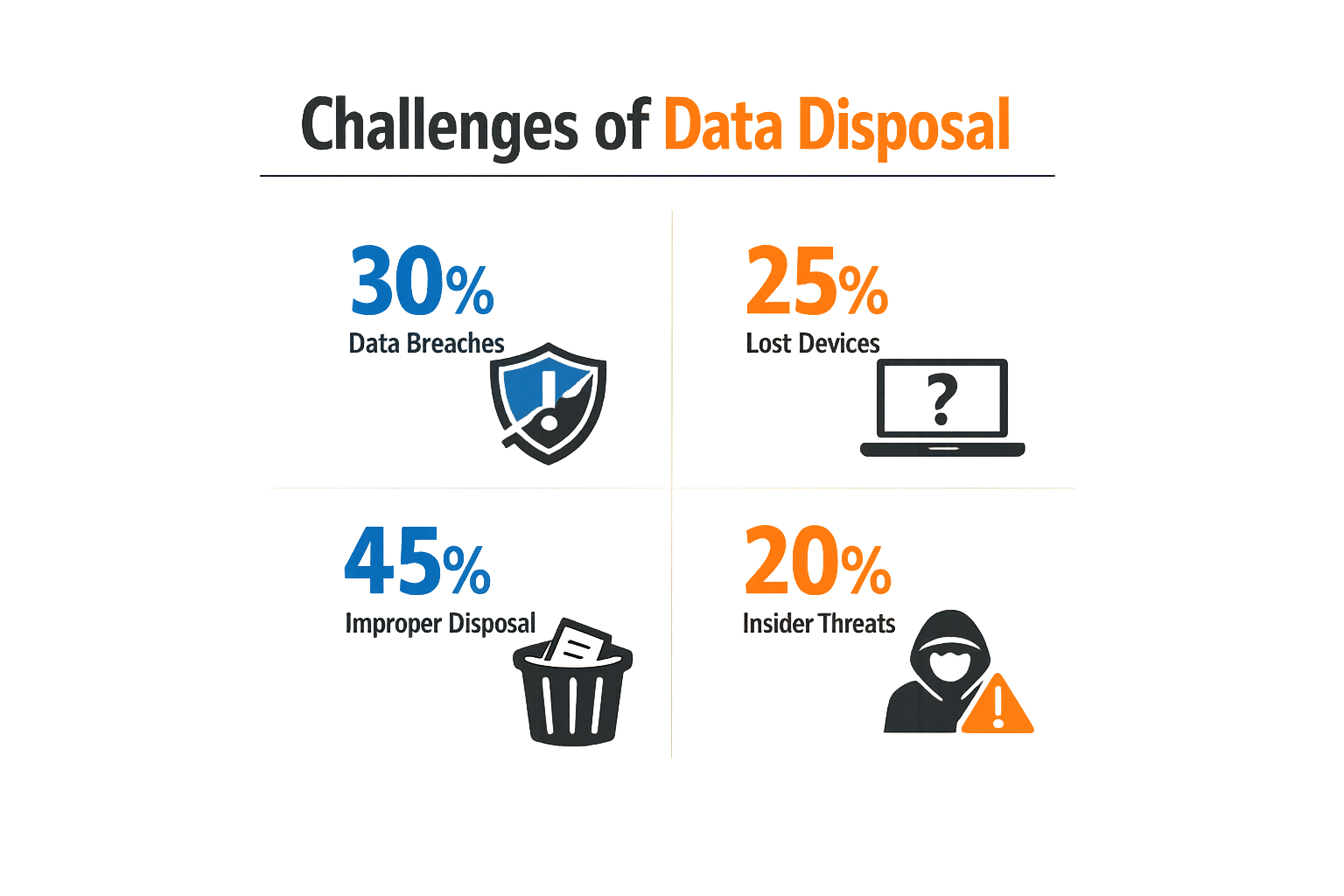
The disposition of data at end-of-life creates three overlapping failure modes: the technical gap, the documentary gap, and the downstream gap. The technical gap is what happens when an organization believes it has sanitized a device but the underlying process was incomplete or misapplied. The documentary gap is what happens when the process was adequate but the evidence trail does not survive audit. The downstream gap is what happens when the operator hands custody to a subcontractor whose controls are unknown or unverified.
In our review of vendor profiles, the most common technical failure is the assumption that a factory reset equals data sanitization. When Blancco and Ontrack bought used drives off eBay, 42% still held residual data and 15% carried personally identifiable information. That finding is not an indictment of consumer behavior — it is an indictment of the industrial process that allowed those drives to reach secondary markets without verified sanitization. The same pattern holds in regulated environments: cloud artifacts must follow the same data sanitization and evidence process as physical hardware to avoid audit findings.
The Documentary Gap
The certificate of data destruction is the operator's primary documentary defense in a post-incident regulatory review. It is also, in our editorial review, the document with the highest variance in what it actually means. Some vendors issue a certificate per serialized asset with timestamped method and technician signature. Others issue a batch certificate covering a shipment with no asset-level granularity. The question the auditor will ask is not whether you have a certificate — it is whether the certificate you have proves the specific asset in question was sanitized to the standard you claimed in your retention schedule.
Improper data disposal is a hidden risk, and it's not talked about enough. Every business IT leader needs to understand its responsibilities.
Improper disposal of IT assets creates financial, legal, and reputational exposure, making a structured ITAD program essential to reduce risks and protect residual asset value. The documentary gap is not a paperwork problem — it is a control problem. If the chain of custody does not link the asset serial to the destruction method to the downstream processor, the documentary record does not hold up in discovery. For organizations managing enterprise server ITAD, this gap is particularly acute when hardware carries ePHI, PII, or financial data subject to regulatory retention and disposal schedules.
The Downstream Gap
The downstream gap is what happens when the operator hands custody to a subcontractor whose controls are unknown or unverified. In the Morgan Stanley case, the operator contracted with a vendor who subcontracted the physical work to a third party who failed to sanitize the drives before resale. The operator's contract language did not prohibit subcontracting, and the operator's audit process did not verify the subcontractor's controls. The result was $100M+ in cumulative regulatory and remediation costs.
The underlying control failure is structural: the operator's risk does not transfer when custody transfers. If the downstream processor fails, the operator is still the party named in the enforcement action. The contract language and the audit-defensible chain of custody are the only mechanisms that survive that failure mode. In practice, most enterprise IT teams do not run a vendor selection process adequate to the risk — they select on price, on convenience, or on the vendor's marketing collateral rather than on the verified documentary posture.
Solution Steps for Effective Data Disposition
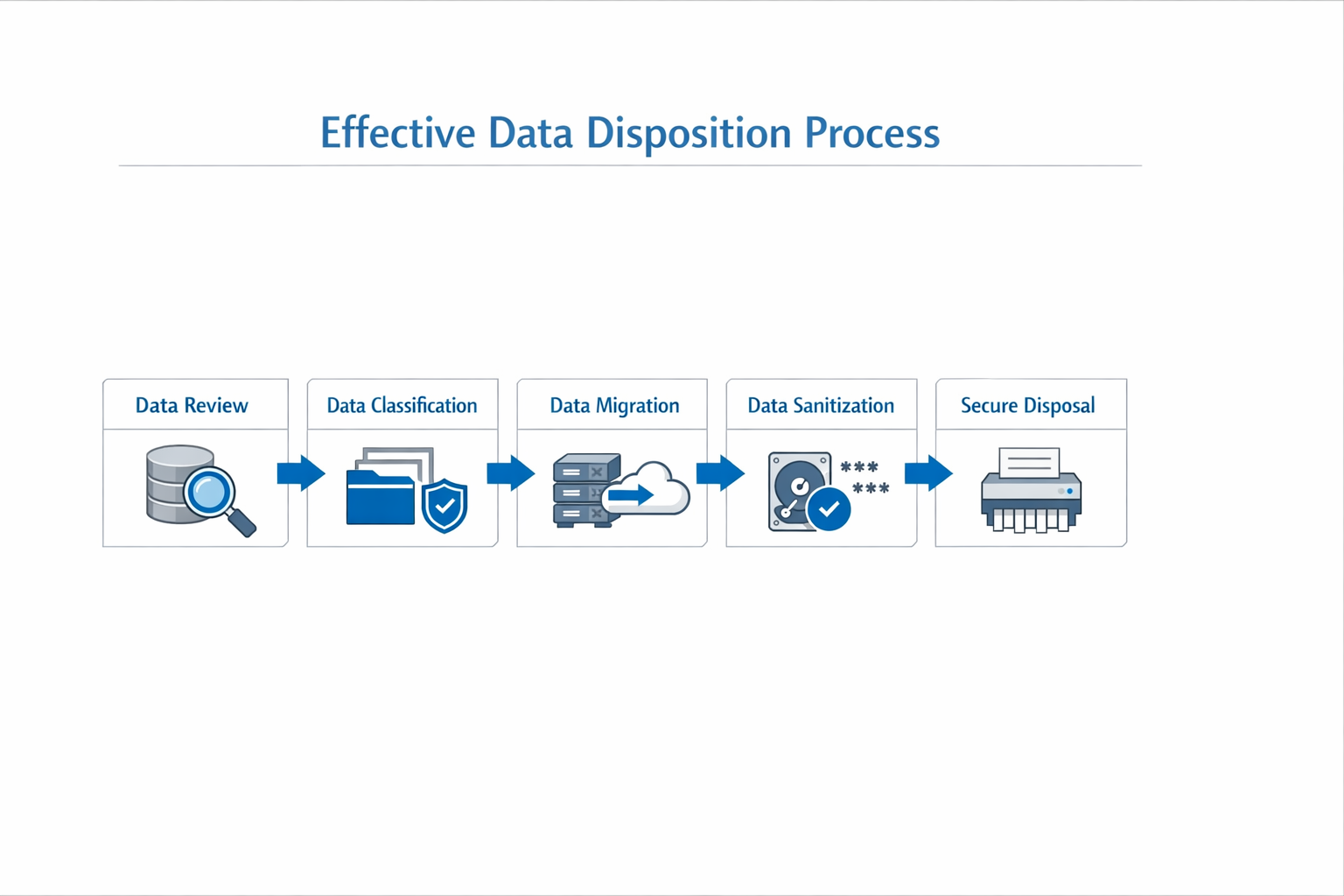
A defensible data disposition program requires more than policy documents. It requires a sequence of documented steps that connect retention schedules to physical asset handling, and that produce records an auditor will accept. The steps below reflect the underlying structure common to formal ITAD programs built on standards like NIST 800-88.
Step 1: Inventory and Establish Ownership
Step 1
Inventory and Establish Ownership
Catalog every asset by serial number, location, data classification, and custodian before any disposition decision. The inventory must distinguish between assets that touched regulated data and those that did not. If the asset list is incomplete or the data-classification column is blank, the rest of the process inherits that ambiguity.
The ITAD process typically includes four steps: inventory and ownership, data sanitization, lifecycle update, and evidence collection. Ownership means knowing which business unit or legal entity holds title, which matters when value recovery or liability allocation is in play. In our editorial review of vendor RFP responses, the operators who required serialized inventories before bidding were the same operators whose certificates of data destruction held up in audit.
Step 2: Select and Document the Sanitization Method
Step 2
Select and Document the Sanitization Method
Choose a data-sanitization method that aligns with the asset's data classification and the regulatory framework that governs it. For assets containing ePHI, PCI data, or CUI, the method must meet NIST 800-88 guidelines or an equivalent standard. Document the method in the disposition plan before the asset leaves your facility.
A complete disposition program rests on four pillars: data security and sanitization, value recovery, responsible recycling, and compliance and reporting. The sanitization pillar is the one that determines whether the documentary record survives discovery. When comparing data destruction services, the question is not which method sounds most thorough — it is which method produces a certificate that names the standard, the tool, the operator, and the timestamp.
Step 3: Execute Sanitization and Collect Evidence
Step 3
Execute Sanitization and Collect Evidence
Run the sanitization process and collect serialized evidence for every asset. The evidence must include the asset serial number, the method applied, the timestamp, and the operator or vendor who performed the work. If sanitization fails or cannot be completed, document the failure and escalate to physical destruction.
The evidence-collection step is where the gap between policy and practice becomes visible. A formal ITAD program built on standards like NIST 800-88 provides a clear, defensible process for handling data at the end of an asset's life. In practice, the operators who produce serialized certificates with verifiable chain-of-custody are the minority. The rest produce batch certificates or summary reports that do not tie a specific serial number to a specific sanitization event.
Step 4: Update Lifecycle Records and Close the Loop
Step 4
Update Lifecycle Records and Close the Loop
Record the disposition event in the asset-management system, linking the certificate of data destruction to the asset record. The lifecycle update must include the disposition date, the method, the vendor (if applicable), and the certificate reference. This step closes the loop between ILM retention schedules and physical asset handling.
A compliant ITAD program rests on four pillars: data security, regulatory compliance, value recovery, and environmental responsibility. The compliance pillar depends on the lifecycle update — without it, the retention schedule and the disposition record exist in separate systems, and the auditor sees a gap. The question the auditor will ask is whether you can prove, for a given serial number, that the data was destroyed in accordance with the retention policy. If the answer requires manual reconciliation across three systems, the answer is no.
The cheapest vendor is the one whose paper trail you trust enough to hand the auditor without flinching.
Tips and Tricks for Successful Data Disposition
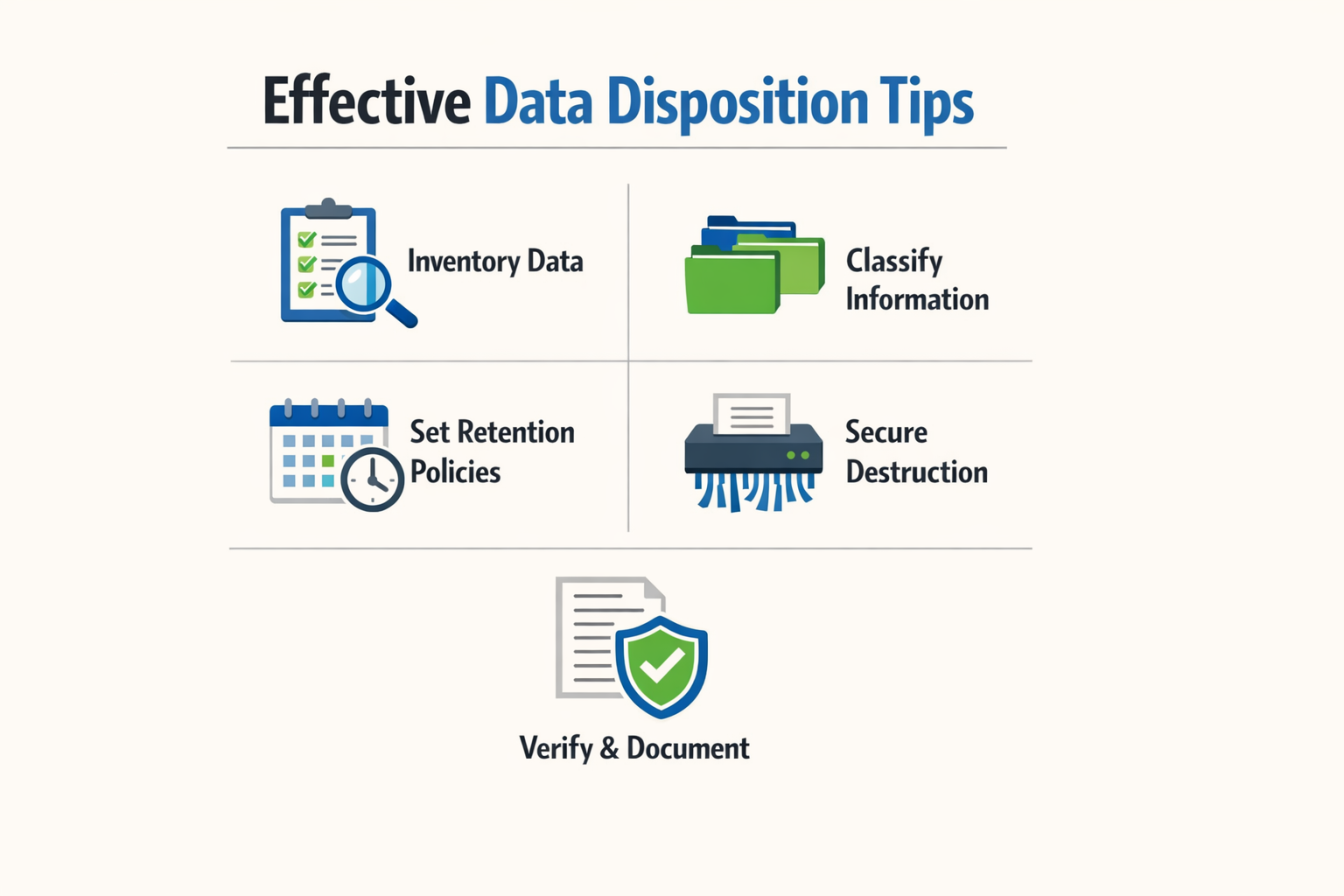
The difference between disposal and disposition is not semantic. Disposal is throwing the device away; disposition is making a deliberate decision about the fate of each retiring asset, with proof of proper handling. The operator's posture on this distinction determines whether the documentary record survives audit.
In our editorial review, the vendors who treated disposition as a decision-point rather than a discard-point maintained materially stronger chain-of-custody documentation. The question the auditor will ask is not whether you disposed of the asset — it is whether you can prove what happened to the data it carried.
Start From a Complete Inventory
The single biggest ITAD failure mode is retiring assets that were never accurately tracked. Errors in the inventory record cascade into gaps in the chain of custody, and those gaps become the breach surface in a regulatory review.
Before any vendor sees the retirement list, catalog every asset by serial number, location, and data classification. Vendors price what they can see; if your inventory is fuzzy, your bid is fuzzy too. More critically, if the inventory is incomplete, the disposition process cannot be audit-defensible.
Treat Disposition as a Decision, Not a Discard
Every retiring asset requires a disposition decision: data destruction method, downstream processor selection, certificate requirements, and the retention period for the documentary record. The decision should be documented before the asset leaves the facility, not reconstructed after the fact.
The cheapest vendor is the one whose paper trail you trust enough to hand the auditor without flinching.
For enterprises managing server decommissioning at scale, the disposition decision includes verifying that the vendor's published methodology matches the certificate language in the contract. In our review of vendor profiles, this alignment was inconsistent — some operators used different destruction methods for different asset classes but issued identical certificates.
Verify the Vendor's Documented Process
The certificate of data destruction is the operator's primary documentary defense in a post-incident review. It is also the document with the highest variance in what it actually means. The underlying control is not the certificate itself — it is the vendor's published methodology and the audit trail that connects the certificate to the actual destruction event.
When evaluating vendors, ask for the full methodology document, not just the certificate template. The methodology should specify:
- The data destruction method by asset class (NIST 800-88 overwrite for HDDs, cryptographic erasure for SSDs, physical destruction for non-functional drives)
- The chain-of-custody mechanism from pickup through final disposition
- The retention period for serialized destruction records
- The downstream processor selection criteria and subcontracting disclosure policy
If the vendor cannot produce this documentation during the RFP process, the documentation will not exist when the auditor requests it.
Align Retention Schedules With Disposition Timelines
Data governance requires that retention schedules align with defensible disposal practices. The asset may retire on a predictable schedule, but the data it carries may be subject to legal holds, regulatory retention requirements, or active litigation discovery.
The disposition process must check the retention schedule before any destruction event. If the data is still within its retention period, the disposition decision is to migrate the data to a successor system — not to destroy the asset. If the data is subject to a legal hold, the disposition decision is to preserve the asset in place until the hold lifts.
This alignment is structural, not procedural. The information lifecycle management framework must include disposition as a terminal state, with documented decision points and audit trails that survive the retention period.
Conclusion
The disposition of data is not a final step — it is a control point that tests every upstream decision made during acquisition, deployment, and retention. Organizations that treat ITAD as a procurement afterthought discover, often during a regulatory review, that their documentary record does not support the claims they made about data security. The organizations that struggle most with ITAD are not the ones that made bad decisions at end of life; they are the ones that made no decisions at acquisition.
In our editorial review of 35 vendor profiles, we noticed a recurring pattern: the certificate of data destruction referenced in marketing material often differed structurally from the certificate referenced in the vendor's published methodology. This discrepancy becomes material when an auditor asks to see the documentary evidence that data is gone. Frameworks such as GDPR and HIPAA require documented evidence that data is gone before an asset leaves the organization, including certificates of destruction and verifiable erasure procedures. The chain-of-custody record must connect the asset serial number to the destruction method, the timestamp, and the operator who performed it — anything less creates a gap that does not survive discovery.
Effective data disposition requires aligning retention schedules with defensible disposal practices, ensuring that data is retained only as long as necessary and disposed of in a manner that withstands legal scrutiny. When Information Lifecycle Management defines the retention period and ITAD executes the disposal, the connection between the two must be documented, audit-defensible, and repeatable. The vendor you select, the contract language you negotiate, and the certificate you receive all become part of the permanent record. Choose accordingly.
For organizations evaluating vendor capabilities and certification posture, understanding how to compare data destruction services provides a framework for assessing whether a vendor's published methodology matches the documentary record they deliver.
Related reading
Sustainable Server Disposal: Eco-Friendly IT Retirement
Related reading
ITAD RFP: 12 Essential Questions for the Best Vendor Selection