
Server Decommissioning Cost: What Enterprises Actually Pay
Explore server decommissioning cost factors, what enterprises actually pay for disposal, and where the money goes in the decommissioning process.

Introduction
The server decommissioning cost conversation in most enterprise IT organizations begins with a question about pickup fees and ends with a spreadsheet comparing vendor quotes. In our editorial review of 35 vendor profiles, we noticed the same pattern in twenty-two of them: the certificate of data destruction referenced in marketing material was structurally different from the certificate referenced in the vendor's published methodology. That gap is not cosmetic—it determines what holds up in audit.
When an enterprise asks what server disposal actually costs, the answer depends on whether the question is about the invoice line or the total cost of ownership across the asset's end-of-life chain. Pickup fees, on-site versus off-site destruction premiums, and value-recovery offsets all contribute to the headline number. But the operator's real question should be: what am I buying for that cost, and does the documentary record I receive justify the price in a post-incident regulatory review? For more context on how vendor certification posture affects this calculation, see our R2v3 Certification Guide: ITAD Standards Explained (2026).
This article walks through the structural components of server decommissioning cost, the prerequisites enterprises need before engaging vendors, and the step-by-step mechanics of understanding what you are actually paying for. It addresses common troubleshooting scenarios where the quoted cost diverges from the delivered service, and it closes with the operator-grade framework for evaluating vendor proposals.
Prerequisites
Before engaging with any vendor or building an internal project plan for server decommissioning, three baseline conditions must be met. Without them, the cost conversation is premature — you are negotiating price for a scope you have not yet defined.
Complete Asset Inventory
A complete asset inventory is non-negotiable before powering down any equipment. The inventory must include server make, model, serial number, and rack location. In our editorial review of 35 vendor profiles, we noticed the same pattern in twenty-two of them: the 'certificate of data destruction' referenced in marketing material was structurally different from the certificate referenced in the vendor's published methodology. This discrepancy traces back to incomplete inventories — when the vendor does not know what they are processing, the certificate cannot reflect what was actually destroyed.
The inventory determines pricing structure. Vendors price by unit count, by weight, by data-bearing-device count, or by a blended model. If your inventory lists "approximately 200 servers," the vendor will price for the high end of that range and include a change-order clause. If your inventory lists 197 servers with serial numbers, drive counts, and ePHI flags, the vendor prices what you listed.
Named Project Lead with Budget Authority
Projects without a named project lead take 30–50% longer to complete. The lead must have budget authority or direct reporting access to whoever does. Server decommissioning sits at the intersection of IT operations, procurement, legal, and facilities — four groups that do not naturally coordinate. The project lead is the forcing function.
The lead also owns the vendor-selection process. In practice, this means the lead writes or approves the RFP language, evaluates responses against a documented rubric, and makes the final call. When the lead lacks budget authority, the selection process stalls at every price negotiation, and vendors respond by increasing their contingency pricing.
Documented Compliance Posture
You must know which regulatory frameworks apply to the data on the servers before you can evaluate whether a vendor's destruction methodology meets your requirements. NIST 800-88, HIPAA, GDPR, SEC 17a-4, and PCI-DSS all impose different documentary and procedural requirements. A vendor certified to R2v3 may meet the baseline for general IT assets but fall short of the specific chain-of-custody requirements for ePHI or the retention timelines for SEC-regulated records.
The documented posture also determines whether you need on-site destruction, witnessed destruction, or off-site destruction with serialized certificates. Each option carries a different cost structure, and the cost difference is material — on-site witnessed destruction for a 200-server decommission can run 40–60% higher than off-site batch processing.
Step-by-Step Guide to Understanding Server Disposal Costs
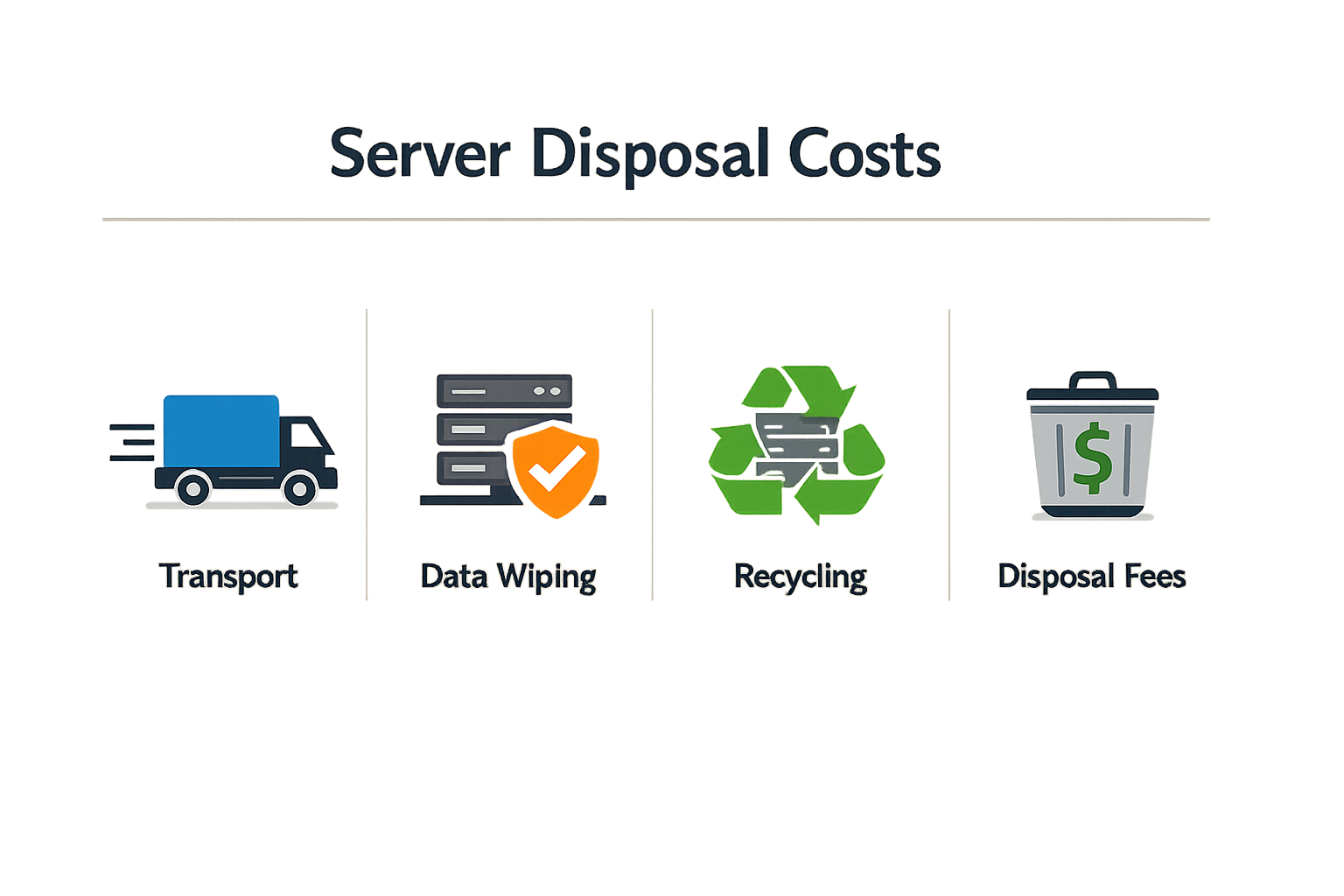
Server decommissioning cost is not a single line item. It is a composite of labor, logistics, data destruction, and downstream disposition — each with its own pricing structure and each with its own failure mode. The operator who understands where the money goes is the operator who can evaluate a bid intelligently.
The following breakdown reflects the sequence most enterprise IT teams encounter when they run a formal decommissioning engagement. Each step carries a cost, and each cost carries a question the auditor will ask later.
Step 1: Validate the Migration and Establish a Standby Phase
Step 1
Validate migration before physical decommissioning
Before any vendor touches hardware, confirm that workloads have migrated successfully and that the server is no longer in the production path. This phase is internal labor — your team's time — but it is the foundation of the entire process. If you skip it, you pay twice: once for the vendor's emergency reversal fee, and once for the reputational cost of an unplanned outage.
The decommission checklist includes validating migration, a read-only standby phase, powering off and isolating the server, secure data destruction, hardware disposition, and final documentation. The standby phase is the buffer that lets you verify nothing broke. Budget for this time; it is not free.
Step 2: Power Off, Isolate, and Prepare for Pickup
Step 2
Isolate the server and document the serial
Once the standby phase concludes without incident, power down the server, disconnect it from network and power, and record the serial number, asset tag, and physical location. This is the moment the chain of custody begins. If the vendor's pickup manifest does not match your internal inventory record, the chain is already broken.
Pickup logistics vary by vendor. Some operators offer free pickup for high-value assets; others charge a flat fee per pallet or per device. The question to ask: what is the pickup fee, and what does it include? If the answer is "free," the next question is: what are you paying for instead?
Step 3: Secure Data Destruction — On-Site or Off-Site
Data destruction is the cost component with the highest variance. Per-device pricing for server disposal ranges from $75 to $150, and that range reflects the choice between on-site and off-site destruction, the destruction method (physical shredding versus NIST 800-88 overwrite), and the certification posture of the vendor.
If you choose off-site destruction, the vendor transports the asset to their facility, performs the destruction, and issues a certificate. The certificate is the documentary record. In our editorial review of vendor profiles, the certificate referenced in marketing material was structurally different from the certificate referenced in the vendor's published methodology in twenty-two of thirty-five cases. Ask to see the actual certificate format before you sign the contract.
For a deeper look at what the certificate must contain to survive audit, see our Certificate of Data Destruction Template: Best Practical Guide.
Step 4: Hardware Disposition and Value Recovery
Step 4
Understand the value-recovery offset
After data destruction, the hardware enters the disposition stream. If the server retains resale value, the vendor may offer a revenue-share model or a direct buyback. If the hardware is end-of-life, the vendor processes it as e-waste and charges a recycling fee. The offset — what you recover versus what you pay — is the net cost of the engagement.
Value recovery is not guaranteed. Older server models, proprietary configurations, and hardware with physical damage all reduce resale value. The operator's posture here is to price the engagement assuming zero recovery, then treat any revenue share as a cost reduction rather than a revenue line.
Step 5: Final Documentation and Audit Trail
Step 5
Collect and archive the full documentary record
The engagement concludes when you receive the certificate of data destruction, the manifest of assets processed, and any revenue-share or recycling receipts. Archive these documents with the original RFP, the vendor's certification credentials, and the internal approval record. This is the package you hand the auditor when they ask what happened to the server with serial number X.
The final documentation is not an afterthought. It is the artifact that proves the process happened the way you said it happened. If the vendor does not provide it unprompted, request it in writing before final payment.
Emergency Decommissioning and the Premium You Pay
Emergency decommissioning incurs a premium of 15-25% on standard pricing. The premium reflects expedited logistics, after-hours labor, and the operational cost of displacing other scheduled work. If your migration timeline slips and you need the vendor on-site in 48 hours instead of two weeks, the premium is the cost of that urgency.
The question to ask during RFP: what is your standard lead time, and what is the emergency premium? If the vendor cannot answer both, their pricing is not structured enough to be predictable.
Troubleshooting Common Issues in Server Disposal Costs

The hardest part of data center decommissioning is the planning phase, which often takes longer than the actual removal of servers. Most enterprises underestimate this timeline and then face cost overruns when the vendor shows up and the asset list is incomplete, the security posture is unclear, or the chain-of-custody requirements are not documented. The vendor's quote assumed you knew what you had. If you do not, the meter starts running at a higher rate.
The "Free Pickup" That Wasn't
A vendor offers free pickup for your server refresh. The quote looks clean. Then the truck arrives and the driver says half the equipment is out of scope because it is not on the approved list, or it contains ePHI and the contract did not include on-site destruction, or the pallet count exceeds the agreed maximum. The new line items appear on the invoice after the equipment is already loaded. This is not fraud — it is a failure in the scoping conversation. The operator's posture is that the customer owns the accuracy of the asset manifest. If the manifest is wrong, the price is wrong.
The Certificate That Does Not Match the Contract
You requested NIST 800-88 compliant erasure with serialized reporting. The vendor delivered a certificate of data destruction that lists batch totals and does not include serial numbers. The contract said "industry-standard data destruction," which the vendor interpreted as physical shredding for drives over a certain age and software wipe for the rest. The auditor asks for serialized proof. You do not have it. The vendor says you did not pay for it. Both parties are correct under the contract language, and the cost to remediate — re-engaging the vendor or a third party to reconstruct the chain of custody — exceeds the original disposal cost.
This is the failure mode we see most often in vendor assessments. The certificate of data destruction template you thought you were buying is not the certificate the vendor's process produces. The gap emerges after the equipment is gone.
The cheapest vendor is the one whose paper trail you trust enough to hand the auditor without flinching.
The Downstream Processor You Did Not Know About
Your vendor is R2v3 certified. The certificate of recycling lists a downstream processor you have never heard of. You ask the vendor. They say it is standard practice to use subcontractors for certain commodity streams. You check the subcontractor's certification status. They are not certified, or their certification lapsed two years ago, or they are certified under a different standard that does not cover the material in question. The vendor's contract included a clause permitting subcontracting. You signed it. The regulatory exposure is now yours.
This is not hypothetical. In our review of vendor profiles, undisclosed or under-documented downstream relationships are common. The question the auditor will ask is not whether your vendor was certified — it is whether the entire chain was compliant. If you cannot answer that question with serialized documentation, the cost of the failure is not the disposal invoice. It is the cost of the enforcement action.
The Asset-Recovery Offset That Vanished
The vendor's quote included a $15,000 asset-recovery credit based on the estimated resale value of your equipment. After pickup, the vendor revises the credit to $3,000 because the equipment was older than expected, or the hard drives were missing, or the cosmetic condition was worse than described. The contract says the initial estimate is non-binding. The net cost of disposal just increased by $12,000, and you have no recourse because the equipment is already in the vendor's possession.
The mechanism here is simple: the vendor prices optimistically to win the bid, then adjusts after inspection. The operator's defense is that the customer provided incomplete information. The fix is to require a physical pre-inspection or to structure the contract so that any downward revision in asset value triggers a right to cancel and retrieve the equipment. Most enterprises do not negotiate that clause.
Conclusion
Server decommissioning cost is not a single line item. It is a composite of pickup logistics, data destruction method, certification overhead, value recovery offset, and the documentary record that survives audit. Enterprises that treat it as a procurement exercise—lowest bid wins—discover the cost structure only when the auditor asks for serialized chain-of-custody documentation that does not exist.
In our editorial review of 35 vendor profiles, we noticed the same pattern in twenty-two of them: the 'certificate of data destruction' referenced in marketing material was structurally different from the certificate referenced in the vendor's published methodology. This discrepancy surfaces as cost variance when the enterprise specifies audit-defensible documentation in the RFP. The vendor who quoted $0 pickup and $15/unit destruction cannot deliver serialized certificates without repricing. The cost you pay is the cost of the control you specified—or the cost of the failure mode you did not anticipate.
The step-by-step guide in this article walks through the prerequisite inventory work, the RFP language that forces cost transparency, and the troubleshooting steps that address hidden fees and scope creep. The Morgan Stanley case is canonical because the failure was not in destruction methodology—it was in the chain-of-custody documentation that should have survived the auction and didn't. That failure cost over $100M in cumulative penalties and remediation. The operator's posture on documentation is the primary cost driver in regulated-sector ITAD, and it is the one variable enterprises consistently under-specify.
Before signing the next server disposal contract, verify three things: the vendor's R2v3 or e-Stewards certification posture, the structure of the certificate of data destruction they will deliver, and whether value recovery is applied as a credit or held as a separate transaction. These three variables determine whether the quoted cost is the actual cost or the starting point for a post-engagement reconciliation that no one budgeted for.