
Business Decommissioning Services: What They Mean in 2026
Explore what business decommissioning services entail and learn what to look for when assessing vendors in 2026.

Introduction
In our editorial review of 35 vendor profiles, we noticed the same pattern in twenty-two of them: the certificate of data destruction referenced in marketing material was structurally different from the certificate referenced in the vendor's published methodology. That discrepancy is not a documentation quirk. It is the mechanism by which an enterprise IT team believes it has purchased one thing and discovers, in audit or incident response, that it purchased something materially different.
Business decommissioning services — the full scope of what happens when you retire a data center, close a branch office, or sunset a fleet of endpoints — involve three distinct layers. The first layer is physical: the secure dismantling of facility infrastructure and the removal of hardware. The second layer is documentary: certified destruction of data on storage media with auditable chain-of-custody records. The third layer is dispositional: the compliant channeling of hardware through downstream processors whose own credentials and practices can be verified. Most vendor proposals describe the first layer in detail, reference the second layer with a certificate template, and omit the third layer entirely.
The global data center decommissioning market is projected to climb from $8.5 billion in 2023 to $15.2 billion by 2030 at an 8.7% CAGR. That growth is not driven by increased hardware volume alone — it is driven by the regulatory cost of failure. When an operator's chain-of-custody documentation does not survive discovery, the financial exposure is no longer theoretical. The question the auditor will ask is not whether your vendor destroyed the data. The question is whether you can prove, with serialized records and downstream verification, that the destruction happened and that no asset left your custody without a documentary trail.
In the sections that follow, we detail the ambiguity in vendor terminology, the steps required to evaluate a decommissioning provider's actual posture, and the operational practices that distinguish audit-defensible programs from programs that look adequate until the regulator asks for the records. This is not a guide to selecting the cheapest vendor. This is a guide to selecting the vendor whose paper trail you trust enough to hand the auditor without flinching.
Understanding the Problem: The Ambiguity of Decommissioning Services
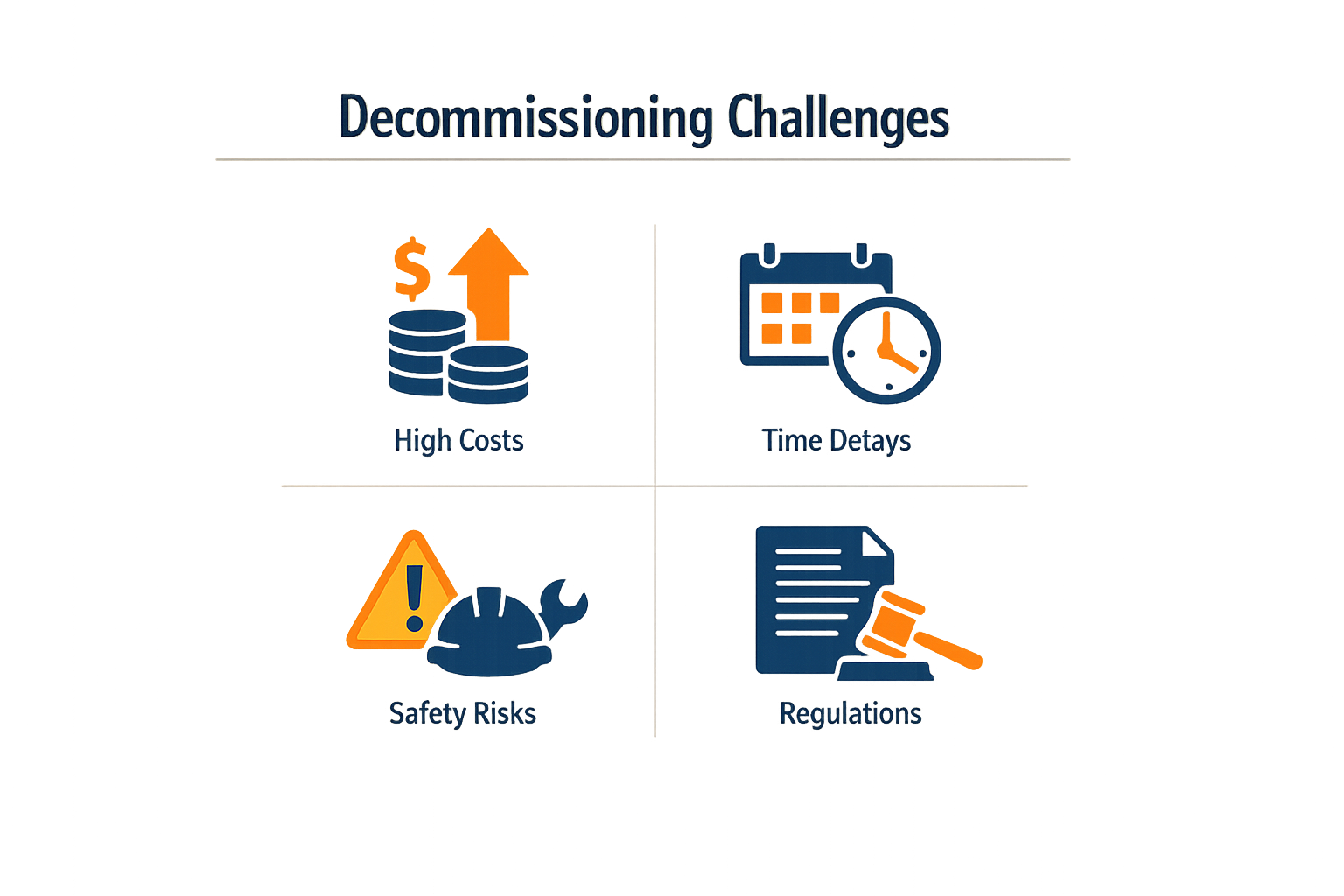
The term "business decommissioning services" carries different meanings depending on who's using it. A vendor might describe data center decommissioning as a turnkey process, while the operator receiving the proposal sees a checklist that stops short of the chain-of-custody documentation an auditor will demand. This gap between marketing language and operational reality is the industry's primary failure mode.
Modern enterprises recognize that data center teardowns involve intricate operational dependencies, major cybersecurity vulnerabilities, and strict environmental mandates. The complexity extends beyond physical removal. Large-scale data center decommissioning is a complex process that involves managing the retirement of IT assets while ensuring security, compliance, and operational continuity. Yet many RFPs we review treat decommissioning as a logistics problem rather than a compliance problem.
The Certificate-vs-Practice Gap
The certificate of data destruction is where ambiguity becomes measurable risk. In our editorial review of vendor profiles, the same pattern appears repeatedly: the certificate referenced in marketing material is structurally different from the certificate referenced in the vendor's published methodology. One document promises serialized asset tracking; the other delivers batch-level reporting with no mechanism to tie a specific drive to a specific destruction event.
This is not a documentation problem. It is a chain-of-custody problem. The question the auditor will ask is not "Did you destroy the data?" but "Can you prove which specific assets were destroyed, when, and by whom?" The vendor who cannot answer that question with serialized records is not providing decommissioning services in any audit-defensible sense.
What Survives Discovery
Decommissioning services must produce a documentary record that survives both regulatory audit and legal discovery. The underlying control is not the destruction method — it is the tracking mechanism that connects asset receipt to final disposition. When that mechanism is absent or incomplete, the service becomes indistinguishable from disposal.
The distinction matters materially. Disposal vendors handle logistics and environmental compliance. Decommissioning vendors handle those elements plus data security, chain-of-custody documentation, and downstream accountability. The trade-off is not price versus quality. It is documented control versus operational hope. For a deeper look at how certification standards address these controls, see our R2v3 Certification Guide: ITAD Standards Explained (2026).
Key Steps to Evaluate Decommissioning Services
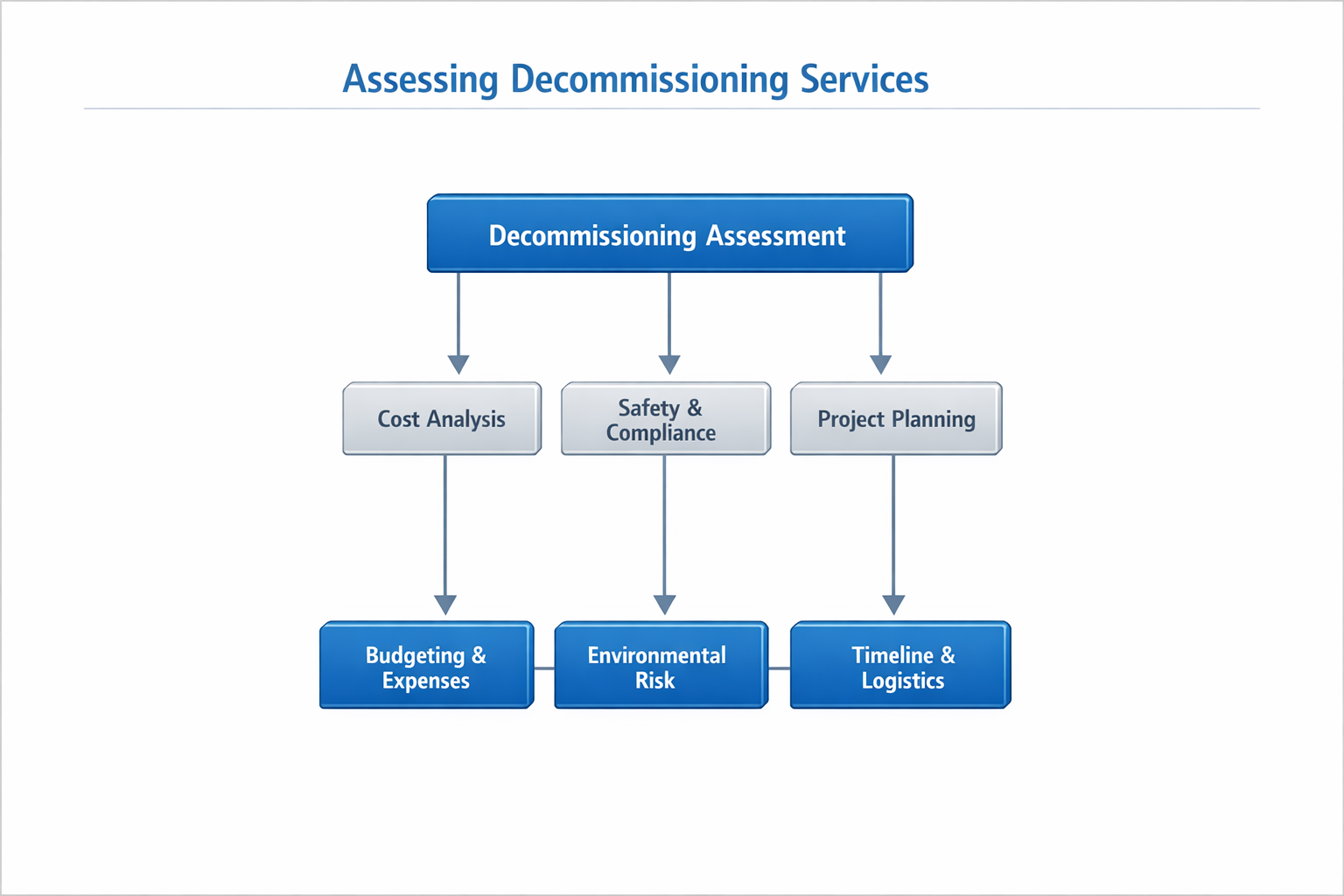
The evaluation process for business decommissioning services is not a checklist exercise. It is a structured review of what the operator can prove, what the contract language obligates them to do, and what survives an audit when the regulator asks for the documentary record. The vendor selection process most enterprise IT teams run focuses on price and turnaround time. The process that holds up in a post-incident review focuses on certification posture, chain-of-custody mechanics, and the gap between what the certificate says and what the underlying process actually delivers.
Verify Certification Posture and What It Covers
A certified ITAD provider should deliver data destruction to federal standards, serialized chain-of-custody tracking, compliant environmental recycling, and auditable documentation. The certifications themselves — R2v3, e-Stewards, NAID AAA, ISO 27001 — are not interchangeable. Each one covers a different scope, and the presence of one does not imply the presence of the others.
When choosing ITAD partners, look for certifications such as R2, e-Stewards, ISO 27001, and NAID AAA to ensure compliance and security. The operator's published methodology should state which certification applies to which part of the process. If the vendor holds R2v3 but not NAID AAA, the data destruction process may not meet the serialized tracking standard that financial-services auditors expect. If the vendor holds NAID AAA but not R2v3, the downstream environmental chain may not be auditable.
For a detailed comparison of R2v3 and e-Stewards certifications, see our R2v3 e-Stewards Comparison: Which ITAD Certification is Right for You? guide.
Confirm Serialized Chain-of-Custody Documentation
The chain-of-custody document is the operator's primary defense in a regulatory review. It must track every asset by serial number from the moment it leaves your facility to the moment it is destroyed or resold. Batch-level tracking is not adequate. The regulator will ask for the serialized record, and if the vendor cannot produce it, the liability falls back to you.
Step 1
Request a sample chain-of-custody report
Before signing a contract, ask the vendor for a redacted sample of the chain-of-custody report they provide to other clients. The report should show serialized asset tracking, timestamps for each custody transfer, and the final disposition method for each asset.
Step 2
Verify the report matches the contract language
The contract should specify serialized tracking, not batch tracking. If the contract says 'certificate of destruction' without defining what that certificate contains, the vendor may deliver a one-page summary that does not meet audit requirements.
Step 3
Confirm the vendor retains records for the required period
Financial-services regulators expect seven-year retention. Healthcare regulators expect six years from the date of creation or the date when last in effect, whichever is longer. The vendor's record-retention policy must match your industry's requirement.
Assess Data Destruction Methods and Federal Compliance
Data destruction to federal standards means NIST 800-88 for logical sanitization and physical destruction methods that meet the same purge or destroy classification. The vendor should state which method applies to which asset type. Overwrite methods work for traditional hard drives but do not work for solid-state drives with wear-leveling algorithms. Cryptographic erasure works for self-encrypting drives but only if the encryption was enabled and the key is destroyed in a documented process.
| Method | Asset Type | NIST 800-88 Classification | Audit Requirement |
|---|---|---|---|
| Overwrite (7-pass) | Traditional HDD | Purge | Serialized log per drive |
| Cryptographic erase | Self-encrypting drive | Purge | Key destruction certificate |
| Degaussing | Magnetic media | Purge | Equipment calibration log |
| Shredding | All media types | Destroy | Particle-size verification |
The vendor's published methodology should specify which destruction method applies to which asset type and how the method is verified. If the vendor says 'data destruction to NIST standards' without specifying the method, the contract language is not adequate.
Evaluate Environmental Compliance and Downstream Accountability
The vendor's environmental compliance posture determines whether the downstream processor is auditable. R2v3 and e-Stewards both require documented downstream accountability, but the mechanisms are different. R2v3 allows export to certain countries under a focus-material framework; e-Stewards prohibits export of functional electronics to developing countries. The choice between them is a policy question, but the presence of one or the other is a structural requirement.
The vendor should provide the name and certification status of every downstream processor. If the vendor says 'all downstream processors are certified' without naming them, the claim is not verifiable. In our editorial review of vendor profiles, undisclosed downstream subcontracting is the most common gap between the vendor's marketing posture and the verified record.
Tips and Tricks for Successful Decommissioning
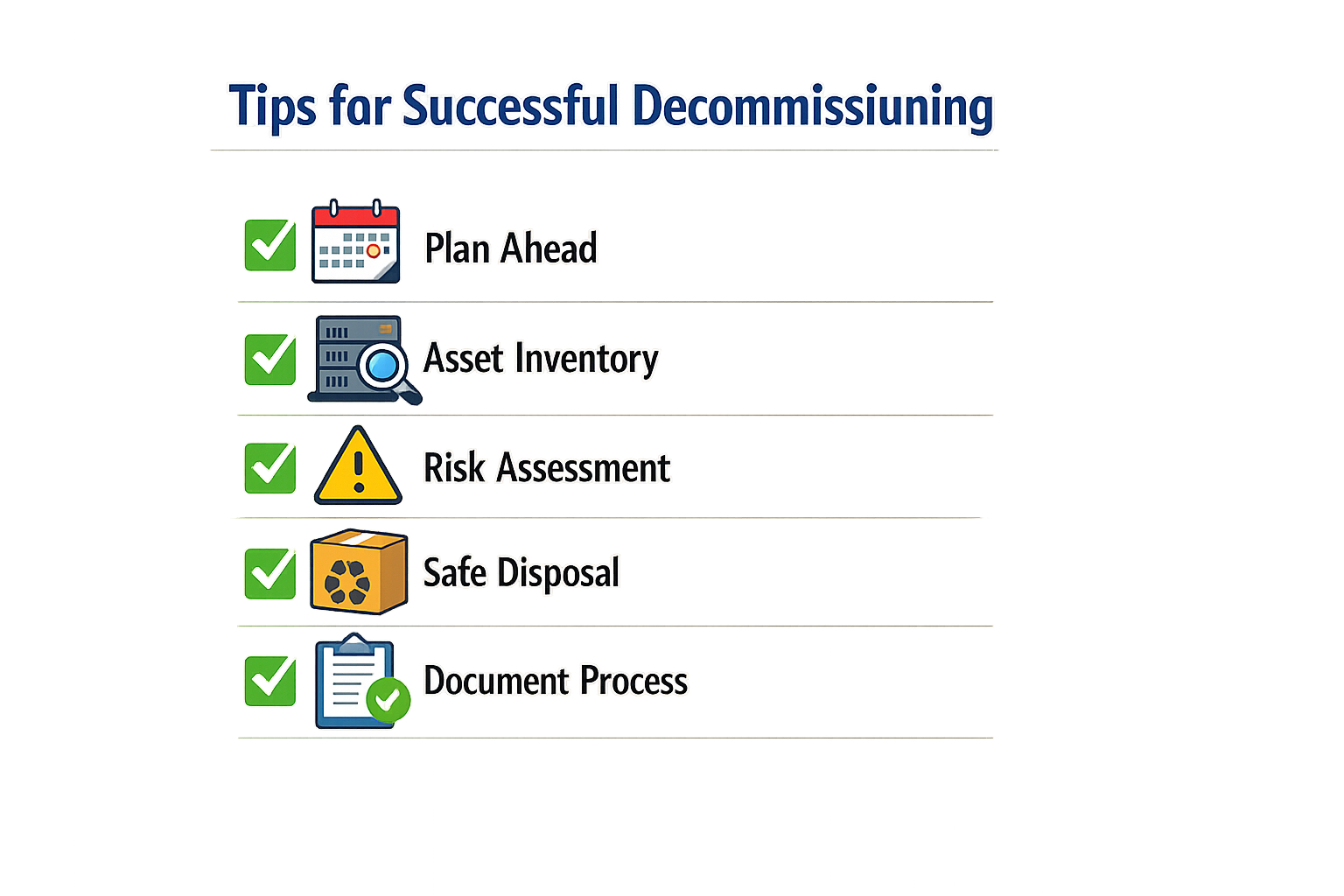
The mechanics of a successful decommissioning engagement are not mysterious. They are, however, specific. The difference between a smooth process and a regulatory exposure often comes down to three or four decisions made before the first asset leaves the building.
Build the ITAD Policy Before You Need It
Most organizations approach decommissioning reactively — a lease expires, a data center closes, a merger forces a consolidation. By that point, the vendor selection process is compressed, the asset inventory is incomplete, and the documentation posture is defensive rather than structured.
A strong ITAD policy defines the scope of covered assets, assigns ownership and responsibility across IT and procurement, outlines the regulatory requirements that apply to your sector, determines acceptable disposal methods, and sets the criteria vendors must meet before they bid. When the decommissioning event arrives, the policy becomes the operational checklist rather than something assembled under time pressure.
Inventory Before You Engage a Vendor
Vendors price what they can see. If your asset inventory is incomplete or organized by location rather than by data-risk profile, the bid you receive reflects that uncertainty. The operator's first question in any serious engagement is whether the client knows what they have — serialized, categorized by data sensitivity, and tagged with disposal requirements.
Catalog every asset by serial number, physical location, and data classification before the vendor sees the list. For environments with ePHI or cardholder data, track individual devices rather than batches. The certificate of data destruction you receive at the end of the engagement can only be as specific as the inventory you provided at the beginning.
Maximize Recovery Value Through Refurbishment
Not every asset in a decommissioning engagement is destined for shredding. Viable equipment — servers with remaining useful life, network gear that meets current standards, laptops that can be securely wiped and redeployed — represents recoverable value. Refurbishment and resale channels can offset decommissioning costs, sometimes significantly.
The trade-off is documentation. Equipment routed to resale must be sanitized to the same standard as equipment routed to destruction, and the chain-of-custody documentation must reflect the sanitization method, the verification process, and the downstream buyer. Operators who handle both destruction and refurbishment maintain separate processes for each; the certificate you receive should specify which path each asset took.
Engaging specialized professionals minimizes business interruption, protects your brand reputation, and directly supports the bottom line through component recovery and compliance adherence.
Verify the Vendor's Downstream Accountability
The decommissioning contract you sign is with the vendor who shows up on-site. The actual processing — shredding, smelting, component recovery — often happens at a downstream facility operated by a subcontractor you never meet. The regulatory exposure, however, remains with you.
Before you sign, ask whether the vendor processes in-house or subcontracts downstream. If they subcontract, ask for the name of the downstream processor, the certifications that processor holds, and whether your chain-of-custody documentation will include the downstream facility's records. Vendors who operate transparently provide this information in the RFP response. Vendors who resist the question are signaling a gap in their accountability posture.
Conclusion: The Future of Decommissioning Services
The global data center decommissioning market is projected to climb from $8.5 billion in 2023 to $15.2 billion by 2030 at an 8.7% CAGR. That growth is not a sign of industry maturity — it is a sign of compounding risk. More vendors, more certificates, more marketing language about "secure decommissioning," and in our editorial review of 35 vendor profiles, the same structural gap: the certificate referenced in marketing material is often not the certificate referenced in the vendor's published methodology.
The Morgan Stanley case is canonical because the failure was not in destruction methodology — it was in the chain-of-custody documentation that should have survived the auction and didn't. That is the failure mode that scales. As the market grows, the number of operators who understand the difference between a certificate of destruction and an audit-defensible chain-of-custody record is not growing at the same rate. The vendors who can deliver both are the minority, and they are not always the ones with the highest search-engine visibility.
What Holds Up in 2026
The informed buyer in 2026 is not asking "Do you offer business decommissioning services?" — the informed buyer is asking "What survives discovery?" The answer to that question is structural. It is in the contract language, the serialized tracking, the third-party verification, and the willingness to put the downstream processor's name on the certificate. It is in the vendor's posture when you ask to see the methodology that produces the certificate they handed you in the sales meeting.
If you are evaluating vendors now, the R2v3 Certification Guide provides the framework for what certification posture means in practice. If the vendor holds R2v3, ask what the scope statement says. If the vendor holds e-Stewards, ask whether the downstream processors are also certified. If the vendor holds neither, ask what third-party verification they do hold, and whether it covers data destruction or only environmental compliance.
The future of decommissioning services is not in the marketing language — it is in the documentary record. The vendors who understand that distinction are the ones whose certificates you can hand the auditor without flinching. In 2026, that is the standard.