
Recycling Servers: What Happens to Your Old Hardware
Discover what actually happens to your old hardware during recycling servers processes, from data destruction to environmental impact and material recovery.
What Happens When Recycling Servers: The Complete Process
Recycling servers is a documented process with specific technical controls, regulatory requirements, and measurable outcomes. The certificate of data destruction is the operator's primary documentary defense in a post-incident regulatory review. It is also, in our review of 35 vendor profiles, the document with the highest variance in what it actually means. When recycling servers, the question is not whether the hardware leaves your facility — it always does — but whether you can prove, in audit, what happened after it left.
In 2022, global e-waste generation reached 62 million metric tons, yet only 22.3% was formally recycled through certified programs. The remaining 77.7% entered disposal channels with no verified chain of custody, no documented data destruction, and no environmental accountability. For enterprise IT, this gap represents both a compliance exposure and a missed opportunity. The hardware being retired carries measurable recovery value that standard disposal programs consistently leave unrealized, creating an ESG governance gap that survives discovery.
This guide walks through what actually happens during the server recycling process, from the moment hardware leaves your data center to final material recovery. You will see the specific steps that certified operators follow, the failure modes that create regulatory exposure, and the documentary evidence that holds up in audit. We cover secure data destruction methods that meet NIST 800-88 standards, the physical disassembly and material separation processes, and the downstream processing pathways that determine whether value is recovered or lost.
The sections that follow provide a step-by-step breakdown of the recycling process, the prerequisites you need to evaluate vendor capabilities, and the troubleshooting guidance for common failure modes. By the end, you will know what questions to ask, what documentation to require, and what actually survives audit when regulators come asking.
Prerequisites for Understanding Server Recycling
Before you evaluate a recycling process or hand assets to a vendor, you need a working vocabulary for the mechanisms underneath. The industry uses specific terms—data center decommissioning, IT asset disposition, sanitization—and each has a precise meaning that determines what actually happens to your hardware and what documentary record you receive at the end.
What Server Decommissioning Actually Means
Server decommissioning is the operational process of retiring hardware from production while managing two primary risks: data exposure and environmental penalties. It is not the same as disposal. Decommissioning includes inventory, data destruction, physical handling, and downstream accountability—disposal is one possible outcome at the end of that chain. When a vendor says "we decommission servers," the question is what controls they apply at each step and what survives audit if something goes wrong. Understanding server decommissioning costs helps frame vendor proposals correctly.
ITAD as the Structured Framework
IT Asset Disposition (ITAD) is the structured process of retiring hardware through a certified program that applies documented controls for data security, environmental compliance, and material recovery. ITAD is not recycling—it is the framework that determines whether recycling happens, and if so, under what conditions. A sustainable data center decommissioning program applies ITAD controls at rack level, meaning every asset is tracked individually from removal through final disposition, with serialized chain-of-custody documentation.
The Circular Economy Model in Practice
A circular economy IT strategy prioritizes reuse and refurbishment over material recovery. In practice, this means functional servers are tested, sanitized, and resold; components with residual value are harvested for repair inventory; and only end-of-life materials proceed to recycling. The economic model is straightforward: reuse generates higher returns than scrap, so certified ITAD operators maximize reuse where data security and compliance allow it. The trade-off is documentation—every reuse decision requires a corresponding data-destruction certificate and downstream chain-of-custody record.
What You Need to Know Before Engaging a Vendor
You do not need to become an ITAD expert to evaluate a vendor, but you do need to understand three things: what certifications the vendor holds and what each certification actually requires; what data-destruction method they will use and whether it meets your regulatory standard; and what documentation they provide at the end and whether it survives audit. If you cannot answer those three questions from the vendor's proposal, the proposal is incomplete.
How Does Recycling Servers Work? A Step-by-Step Guide
The mechanics of recycling servers follow a structured path from decommissioning to final material recovery. Each phase addresses a distinct risk: data exposure, environmental liability, and asset-value leakage. The operator's posture matters most in the first two.
Step 1: Inventory and Asset Tagging
Step 1
Catalog every asset before vendor contact
Document each server by serial number, physical location, and data classification. If the unit touched regulated data — ePHI, payment card information, personally identifiable information — mark it explicitly. Vendors price what they can see; if your inventory is incomplete, your chain of custody starts incomplete too.
The inventory phase determines whether you can answer the auditor's first question: what left the building, when, and in whose custody. In our editorial review of 35 vendor profiles, the operators with audit-defensible processes all required serialized intake manifests that matched the customer's pre-shipment inventory line by line.
Step 2: Data Destruction
Step 2
Verify the destruction method matches your data classification
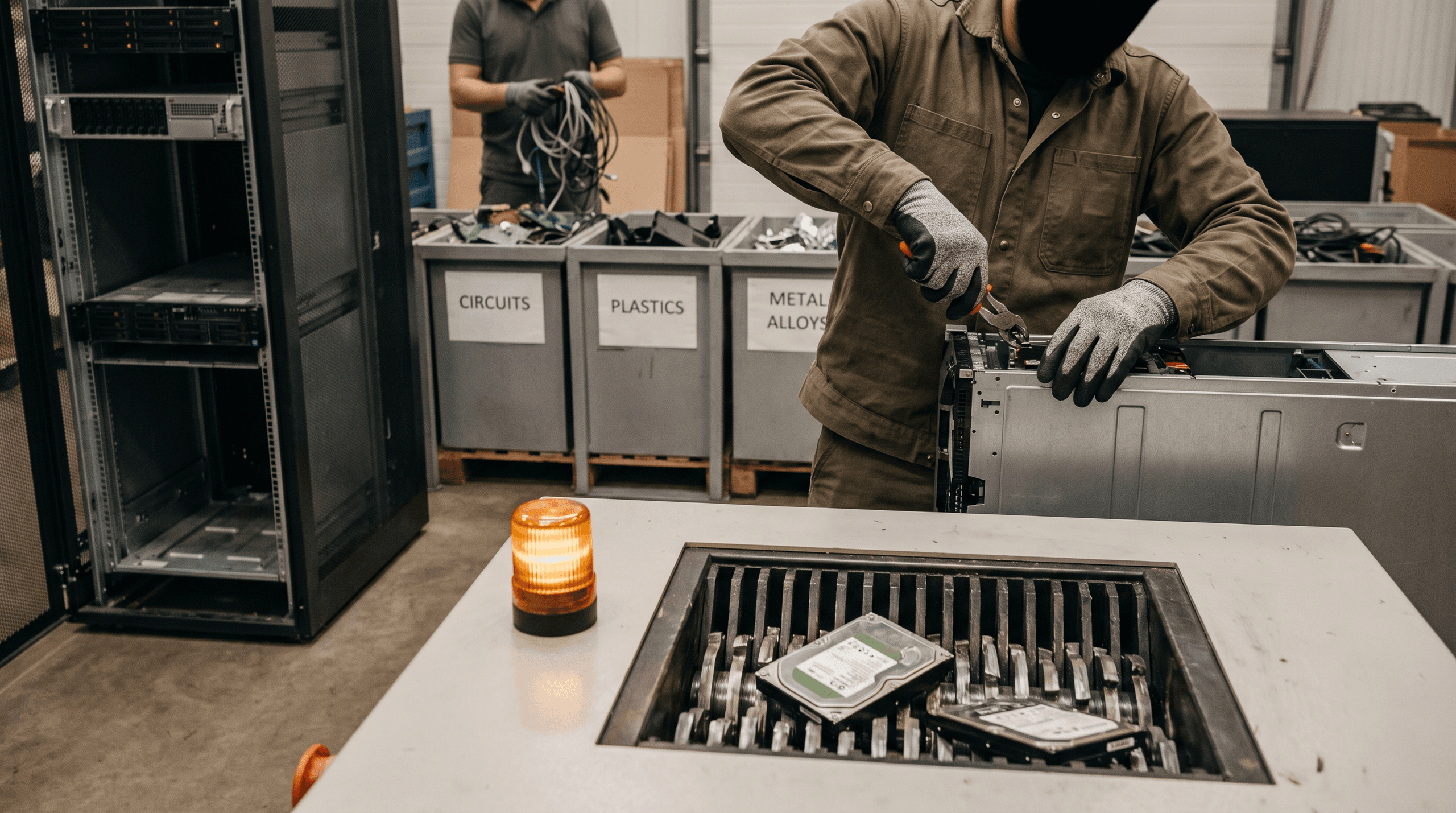
Physical destruction (shredding, crushing, degaussing) renders media unreadable but destroys residual value. Logical sanitization (NIST 800-88 Rev. 2 overwrite or cryptographic erasure) preserves hardware for resale but requires third-party verification that the process completed successfully. The trade-off is economic and documentary: shredding is irreversible and generates a simpler certificate; sanitization is reversible if the process fails mid-run.
A healthcare provider retiring a server that stored patient records must certify the absolute destruction of that data to satisfy HIPAA disclosure obligations. The certificate of data destruction is the operator's primary documentary defense in a post-incident regulatory review. It is also, in our review, the document with the highest variance in what it actually means. Some certificates confirm only that the asset entered the facility; others confirm serialized sanitization with method, timestamp, and technician signature.
For a deeper comparison of destruction methods and their audit posture, see Secure Data Destruction Services: 6 Methods and Their Uses.
Step 3: Hazard Triage and Demanufacturing
Step 3
Separate hazardous components before bulk processing
Servers contain batteries, capacitors, and mercury-bearing backlights that require specialized handling under EPA universal waste rules or equivalent EU directives. The triage phase isolates these materials before the chassis enters the demanufacturing line. Operators certified under R2v3 or e-Stewards maintain documented downstream contracts for each hazard class.
Demanufacturing is the manual disassembly phase: remove drives, pull memory modules, extract CPUs, separate steel chassis from aluminum heat sinks. The goal is to maximize material purity before industrial shredding. Mixed-material streams recover less value and generate more landfill residue.
Step 4: Material Recovery and Industrial Shredding
Step 4
Confirm the downstream processor's certification posture
After demanufacturing, the remaining material enters an industrial shredder that reduces chassis, circuit boards, and cabling to fist-sized fragments. Those fragments move to a material recovery facility where magnets pull ferrous metal, eddy-current separators pull aluminum and copper, and optical sorters isolate plastic by resin type. The final outputs — baled metal, plastic pellets, and a small residual waste stream — move to smelters, resin processors, and permitted landfills.
The documented chain of custody must extend to the final downstream processor. If your vendor's R2v3 certificate lists a downstream smelter, that smelter's name and location should appear in your vendor's public accountability documentation. In practice, many enterprise RFPs do not require this level of specificity, and the gap becomes visible only when a regulator asks for it.
The cheapest vendor is the one whose paper trail you trust enough to hand the auditor without flinching.
Step 5: Certificate of Recycling and Audit Trail
Step 5
Verify the certificate matches the scope of work
The final certificate should list every serialized asset, the destruction method applied, the date and facility location, and the downstream disposition (resale, material recovery, or permitted disposal). If the certificate omits serial numbers, it is a batch-level document and will not survive an asset-specific audit query.
In the Morgan Stanley case — the canonical ITAD failure reference with over $100M in cumulative regulatory and remediation costs — the operator's certificates did not match the actual disposition of the drives. The documentary record collapsed under examination, and the enforcement action followed.
What Problems Occur When Recycling Servers?
The server decommissioning process surfaces predictable failure modes. Most of them trace back to gaps in documentation, unclear vendor accountability, or misaligned assumptions about what the recycling contract actually covers. In our editorial review of operator practices, the same four issues appear repeatedly across enterprise IT environments: incomplete data destruction verification, undisclosed downstream subcontracting, certificate-vs-practice gaps, and chain-of-custody breakdowns when assets move between facilities.
These aren't edge cases. They're the failure modes that survive audit and show up in regulatory enforcement records. The troubleshooting approach below addresses each one with operator-grade remediation steps.
Issue 1: Incomplete or Unverifiable Data Destruction
Symptom: The vendor returns a certificate of data destruction, but the certificate lists batch totals rather than serialized asset records. When you ask for drive-level documentation, the vendor says "that's not standard."
Root cause: The destruction process happened, but the documentary record doesn't map individual drives to individual destruction events. In a post-incident review, regulators expect serialized chain-of-custody. Batch certificates don't hold up.
Remediation:
- Request serialized certificates before the engagement begins. If the vendor can't produce them, that's a selection-stage disqualifier.
- For drives already processed under batch certificates, request the underlying destruction logs. If those logs don't exist, the risk posture is unchanged — treat those drives as undestroyed for compliance purposes.
- Going forward, specify NIST 800-88 sanitization methods in the contract language and require serialized reporting as a contract deliverable.
Issue 2: Undisclosed Downstream Subcontracting
Symptom: You contracted with Vendor A. Six months later, during an internal audit, you discover that Vendor A sent a portion of your asset stream to Vendor B without prior disclosure. Vendor B's certifications are unknown, and there's no contract between you and Vendor B.
Root cause: The original contract didn't prohibit subcontracting, and the vendor interpreted silence as permission. The chain of custody now includes an undocumented handoff.
Remediation:
- Review the existing contract for subcontracting language. If it's silent, assume subcontracting is happening.
- Request a full list of downstream processors the vendor has used in the past 12 months. If the vendor refuses, that's a red flag.
- Amend the contract to require written approval for any downstream handoff, with 30-day advance notice and full certification disclosure for the downstream processor.
- For assets already processed through undisclosed subcontractors, request the subcontractor's certifications and destruction records. If those records don't exist, the risk posture is unmitigated.
Issue 3: Certificate-vs-Practice Gaps
Symptom: The vendor holds R2v3 certification, but when you visit the facility, you observe drives staged in unlocked bins, no video surveillance in the destruction area, and employees who can't describe the data destruction SOP when asked.
Root cause: Certification audits are point-in-time assessments. The certified posture and the operational posture can diverge. The certificate tells you what the vendor was doing on audit day; it doesn't guarantee what happens to your assets six months later.
Remediation:
- Schedule an unannounced facility visit before awarding the contract. If the vendor refuses unannounced visits, that's a selection-stage disqualifier.
- Request the most recent third-party audit report (not just the certificate). Review the findings and corrective actions.
- Include ongoing audit rights in the contract language, with at least one unannounced visit per year for multi-year engagements.
- If you've already awarded the contract and discovered a gap, document the gap in writing and request a corrective action plan with a 30-day timeline. If the vendor doesn't respond, invoke the termination clause.
The certificate is evidence of what the vendor showed the auditor. The operational posture is what your assets actually experience. Treat them as separate questions.
Issue 4: Chain-of-Custody Breakdowns During Multi-Site Transfers
Symptom: Your decommissioned servers left your data center in Dallas, were consolidated at the vendor's facility in Phoenix, then forwarded to a destruction subcontractor in Los Angeles. The chain-of-custody documentation shows the Dallas-to-Phoenix leg, but the Phoenix-to-LA handoff is missing.
Root cause: The vendor's internal transfer process doesn't generate custody records for intra-company moves. The gap appears when a third party enters the chain.
Remediation:
- Require serialized chain-of-custody documentation for every physical handoff, including intra-company transfers. If the vendor's system doesn't support that, the vendor's system is inadequate.
- Request a full asset manifest at each handoff point: departure, arrival, and final disposition. Compare serial numbers across all three manifests. Discrepancies indicate lost assets or documentation gaps.
- For assets already in process with missing custody records, request video evidence or gate logs from the vendor's facilities. If those records don't exist, the chain of custody is broken — treat the affected assets as unaccounted-for in your compliance documentation.
When to Escalate vs. Remediate
Not every issue is fixable in-contract. If the vendor can't produce serialized destruction records, can't name its downstream processors, or refuses facility audits, remediation isn't the right path. Escalation is.
Escalate immediately when:
- The vendor refuses to provide serialized asset-level documentation after a written request.
- Downstream subcontracting is discovered and the vendor won't disclose the subcontractor's certifications.
- A facility visit reveals material gaps between certified posture and operational practice, and the vendor doesn't commit to a corrective action plan within 30 days.
Remediate when:
- The vendor's documentation is incomplete but the vendor commits to fixing the gap and can demonstrate the fix within a defined timeline.
- The contract language was ambiguous and both parties agree to amend it going forward.
- The operational gap is minor (e.g., a single missing manifest page) and the vendor can reconstruct the record from backup logs.
The decision point is simple: if the vendor's response to a documented gap is defensiveness or deflection, you're looking at a structural problem, not a process problem. Structural problems don't remediate.
Conclusion: The Importance of Responsible Server Recycling
The documentary record you build during recycling servers determines what survives audit. Every section of this guide—inventory, data destruction method selection, vendor verification, chain-of-custody tracking—exists because regulators and auditors ask specific questions when something goes wrong. The operator who can answer those questions with serialized records and verified downstream processors has a defensible position. The operator who cannot does not.
In our review of 35 vendor profiles in the Compare ITAD directory, the variance in what "recycling" actually means is the industry's core failure mode. A certificate of recycling is not a certificate of data destruction. A certificate of data destruction that does not specify the method applied to each drive does not establish what the auditor needs to see. The cheapest vendor is the one whose paper trail you trust enough to hand the auditor without flinching.
The environmental case is equally operator-grade. Electronic waste accounts for roughly 2% of U.S. landfill volume but is responsible for approximately 70% of the toxic heavy metals found at those sites. When you select a vendor without R2v3 or e-Stewards certification, you are making a structural bet that their downstream processors handle those metals correctly. That bet is unverifiable without audit rights in the contract language.
The mechanism that prevents both regulatory exposure and environmental harm is the same: verified chain of custody from your loading dock to the final downstream processor. When you select an ITAD vendor, you are buying their documentary posture as much as their processing capability. The vendor's certification status, their willingness to provide serialized certificates, and their contract language on downstream accountability are the three variables that determine whether recycling servers protects you or exposes you.
In practice, responsible server recycling is a procurement decision that IT makes once and lives with for years. The RFP language you write, the vendor you select, and the records you retain determine what happens when the question gets asked. The question always gets asked.
Frequently Asked Questions About Recycling Servers
What certifications should a server recycling vendor hold?Look for R2v3 or e-Stewards certification. These define minimum controls for data destruction, downstream tracking, and environmental handling. Without certification, the term "ITAD" has no enforceable meaning.
How is data destroyed during server recycling?Physical destruction (shredding, crushing, degaussing) renders media unreadable but destroys residual value. Logical sanitization (NIST 800-88 overwrite or cryptographic erasure) preserves hardware for resale but requires third-party verification that the process completed successfully.
What happens to server components during recycling?Functional servers are tested, sanitized, and resold. Components with residual value are harvested for repair inventory. End-of-life materials proceed to demanufacturing: drives are removed, memory modules pulled, CPUs extracted, and chassis separated by material type before industrial shredding and material recovery.
What documentation should I receive after recycling servers?The final certificate should list every serialized asset, the destruction method applied, the date and facility location, and the downstream disposition. If the certificate omits serial numbers, it is a batch-level document and will not survive an asset-specific audit query.