
Data Destruction Companies: How to Evaluate Vendors Beyond
Learn how to evaluate data destruction companies thoroughly, focusing on key factors beyond marketing claims to ensure effective vendor selection.

Introduction
Data destruction service providers are essential for ensuring that sensitive information is handled securely and in compliance with regulations. The certificate of data destruction is the operator's primary documentary defense in a post-incident regulatory review. It is also, in our review of vendor profiles across the industry, the document with the highest variance in what it actually means. When enterprise IT teams evaluate data destruction service providers, the selection process typically begins with a vendor's website, a list of certifications, and a set of marketing claims about security and compliance. What that process often misses is the gap between what a vendor says and what their controls actually deliver when an auditor asks to see the chain of custody.
In the aftermath of regulatory enforcement actions, the question is never whether the vendor's marketing sounded credible. The question is whether the documentary record shows that customer data was sanitized according to a published standard, that the vendor verified successful sanitization, and that the organization conducted due diligence before handing over the assets. The FTC Disposal Rule requires due diligence that includes reviewing independent audits of a disposal company's operations and verifying compliance with recognized standards. That requirement exists because the failure mode is well-documented: vendors who claim compliance but cannot produce the audit trail when it matters.
This guide walks through the evaluation process that produces an audit-defensible vendor selection. It covers what to verify before signing a contract, how to assess whether a vendor's controls match their claims, and what documentation you need to satisfy regulatory expectations. The goal is not to find the vendor with the most impressive website. The goal is to find the vendor whose paper trail you trust enough to hand the auditor without flinching. For a deeper look at what makes a data destruction certificate defensible, see our guide on data destruction certificate components and auditor focus.
Prerequisites
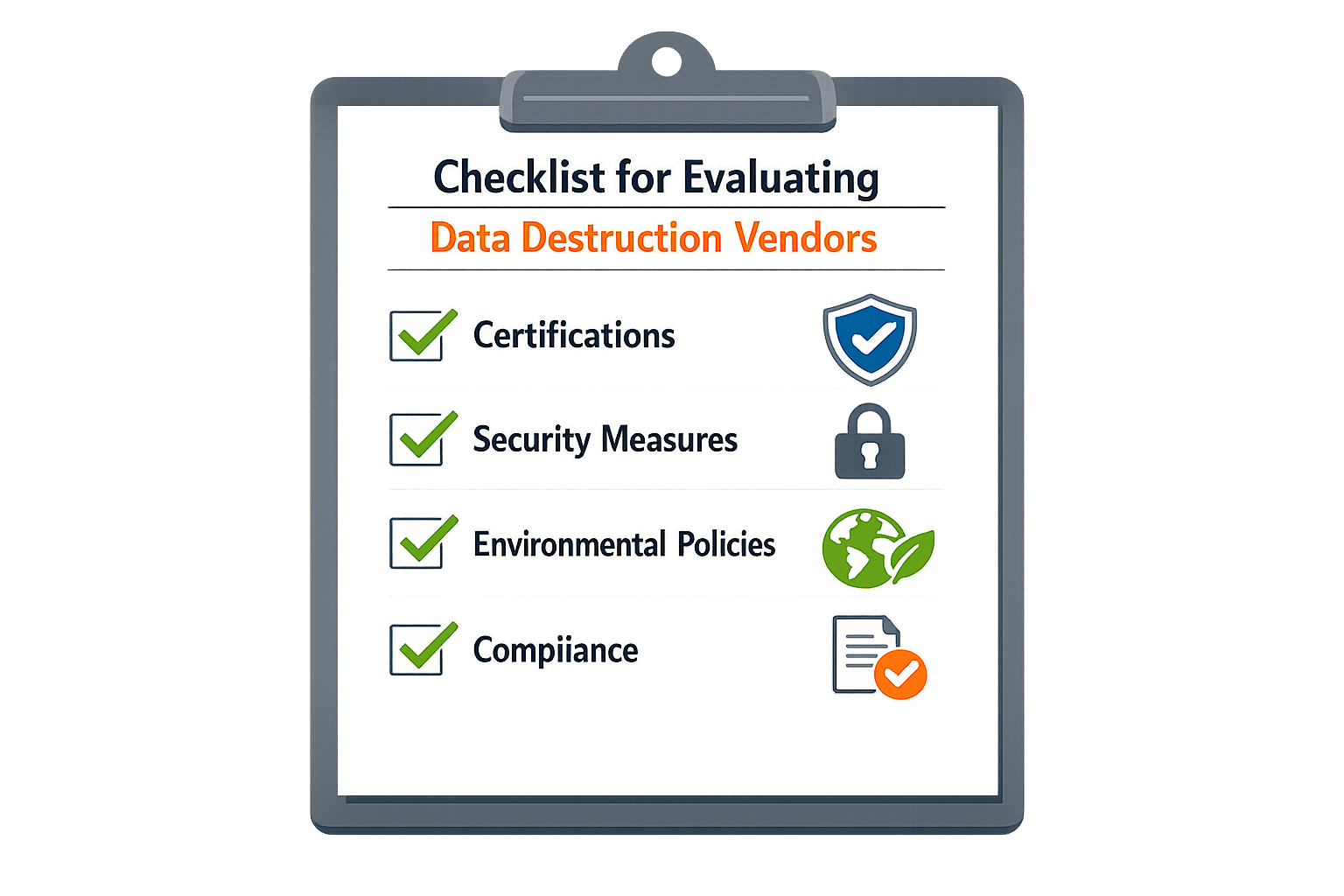
Before you contact a single data destruction service provider, you need to build the internal documentary foundation that makes evaluation possible. In our editorial review of vendor selection processes, the operators who run effective evaluations all start from the same place: a clearly defined internal position on what they're buying, what risk they're transferring, and what evidence they need to see.
The following prerequisites are not aspirational. They are the minimum inputs required to run a defensible vendor evaluation. If you skip them, you are not evaluating vendors — you are accepting marketing collateral as fact and hoping the downstream consequences stay out of the audit record.
Internal Asset and Data Classification
You must know what you are handing the vendor before you hand it to them. That means a documented inventory that identifies each asset by serial number, asset type, and data classification. The classification determines the destruction method, the chain-of-custody requirements, and the regulatory framework that applies.
If your inventory is incomplete, your RFP will be incomplete, your vendor's bid will be incomplete, and the certificate of destruction you receive will document an incomplete process. The failure mode is structural.
Defined Risk Transfer and Liability Posture
You need to know, in writing, what risk you are transferring to the vendor and what risk you retain. That decision drives contract language, insurance requirements, and the level of verification you need to see in the vendor's operational posture.
For most enterprise IT teams, the question is: does the vendor assume liability for a data breach that occurs after custody transfer? If the answer is yes, the vendor's insurance coverage, indemnification language, and financial stability become primary evaluation criteria. If the answer is no, you are retaining breach liability, and the vendor's documentary controls — chain of custody, serialized tracking, audit-defensible certificates — become the primary criteria.
There is no neutral position. The contract language either transfers the risk or it does not. Know which one you are buying before you start the evaluation.
Regulatory and Compliance Framework Identification
Identify every regulatory framework that applies to the data on the assets you are disposing of. The list might include HIPAA, PCI DSS, GDPR, CCPA, SEC recordkeeping rules, FINRA retention requirements, or state-level breach notification statutes. Each framework imposes specific requirements on data destruction methods, chain-of-custody documentation, and vendor accountability.
The FTC Disposal Rule, for example, requires due diligence when engaging a third-party disposal company, including reviewing independent audits of the disposal company's operations and compliance with the rule. That due diligence is not optional — it is a regulatory obligation, and it must be documented.
For a detailed breakdown of how IT asset disposal intersects with regulatory frameworks, see our guide on disposal of IT assets.
Reference and Certification Verification Process
Before you issue an RFP, establish the process you will use to verify vendor references and certifications. The FTC Disposal Rule explicitly requires obtaining information about the disposal company from several references or reliable sources. That means you need a documented process for contacting references, asking specific questions about performance and compliance, and recording the responses.
For certifications, you need to verify that the vendor holds current certification from a recognized body — R2v3, e-Stewards, NAID AAA, or equivalent — and that the certification applies to the specific services and locations you are evaluating. A vendor with R2v3 certification at one facility and no certification at another is not a certified vendor for work performed at the second facility. The certification must match the scope of work.
Chain-of-Custody Requirements and Documentation Standards
Define, in writing, what chain-of-custody documentation you require from the vendor. The e-Stewards standard provides a useful baseline: a clearly defined chain of custody should include stipulations on when and where the transfer of custody begins and ends, secure logistics for transport, and effective physical and electronic controls.
Your internal requirements should specify the data fields required in the chain-of-custody record (serial numbers, asset types, pickup location, destruction date, destruction method), the format of the certificate of destruction, and the retention period for all documentation. These requirements become part of the RFP and the contract. If they are not defined before the evaluation starts, they will not appear in the vendor's proposal, and you will not have the documentary record you need when the auditor asks for it.
Step-by-Step Guide to Evaluating Data Destruction Service Providers
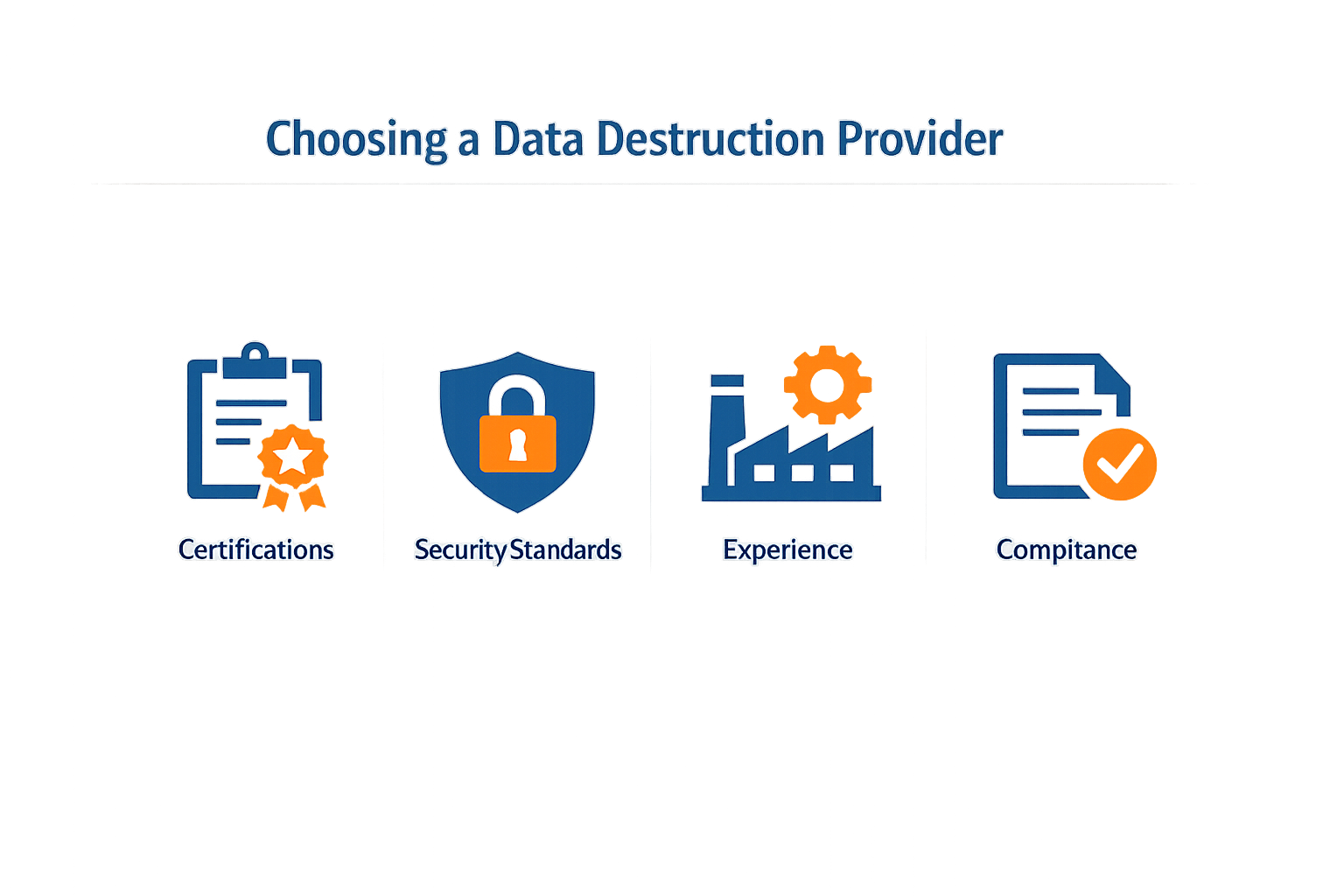
The vendor selection process most enterprise IT teams run is not adequate to the risk. A structured evaluation framework separates operators who can defend their position in audit from those who cannot.
Step 1: Verify Third-Party Certification Posture
Step 1
Verify third-party certification posture
Request current certification documentation for R2v3, e-Stewards, or NAID AAA. The certificate must show the facility address that will handle your assets, the scope of operations covered, and an expiration date within the next twelve months. Certificates older than the current audit cycle or covering a different facility location are not defensible.
Certification bodies maintain public registries. Cross-reference the vendor's claimed certification against the issuing body's directory. If the vendor appears on the registry but the scope excludes data sanitization services, the certification does not cover the work you are buying.
Step 2: Request Sample Chain-of-Custody Documentation
Step 2
Request sample chain-of-custody documentation
Ask for a redacted example of the chain-of-custody packet the vendor provides after processing. The packet should include: asset manifest with serial numbers, signed custody transfer records, sanitization method per device, verification results, and final disposition evidence. If the vendor cannot produce a sample packet, they cannot produce one for your engagement.
The documentary record must survive discovery. Chain-of-custody gaps — unsigned transfers, missing serial numbers, batch-level reporting instead of device-level tracking — are the failure modes that surface in regulatory enforcement. The data destruction certificate is the operator's primary documentary defense in a post-incident review.
Step 3: Confirm Sanitization Method Alignment to NIST SP 800-88 Rev. 2
Step 3
Confirm sanitization method alignment to current standards
Verify that the vendor's sanitization methods reference NIST SP 800-88 Rev. 2 (published 2025). Vendors citing Rev. 1 (withdrawn September 2024) are operating on outdated guidance. For logical sanitization, the vendor must verify successful overwrite for 100% of physical memory locations. For physical destruction, the vendor must document destruction to a particle size that prevents data recovery.
Standards-body requirements are explicit. E-Stewards mandates verification of prescribed overwrite instructions for all devices going to reuse, and particle-size documentation for devices going to destruction. R2v3 Core 7 requires either physical destruction or enhanced sanitization methods with device-level tracking. A vendor that cannot describe how their process maps to these requirements cannot defend the process in audit.
Step 4: Assess Downstream Processor Transparency
Step 4
Assess downstream processor transparency
Request disclosure of all downstream processors who will handle your assets after they leave the vendor's facility. The vendor must provide facility names, addresses, certification status, and the specific processing activities each downstream processor performs. Undisclosed subcontracting is the structural failure mode in the Morgan Stanley case and similar enforcement actions.
Chain-of-custody does not end when the asset leaves the primary vendor's dock. If a downstream processor shreds drives or processes circuit boards, that processor's controls become your controls for audit purposes. The vendor's refusal to disclose downstream relationships is a disqualifying signal.
Step 5: Evaluate Certificate Content Against Auditor Expectations
Step 5
Evaluate certificate content against auditor expectations
Review the vendor's standard certificate of data destruction template. The certificate must include: customer name, date of service, asset serial numbers, sanitization method per device, verification method, technician signature, and a statement of compliance with a named standard. Certificates that report only asset counts or batch-level summaries do not meet auditor expectations for device-level accountability.
The certificate of data destruction is the document with the highest variance in what it actually means — what the auditor needs is serialized proof, not a summary statement.
E-Stewards and R2v3 Appendix B both require device-level tracking and sanitization records. A certificate that does not tie a specific serial number to a specific sanitization result and a specific verification outcome is not audit-defensible. The question the auditor will ask is: can you prove this specific device was sanitized to this specific standard? If the certificate cannot answer that question, it fails.
Step 6: Confirm Insurance Coverage and Limits
Step 6
Confirm insurance coverage and limits
Request a certificate of insurance showing cyber liability, errors and omissions, and general liability coverage. The policy limits must be adequate to the value of the assets under management and the regulatory exposure in your jurisdiction. Policies with sub-limits for data breach or exclusions for downstream processor failures do not provide the coverage the certificate implies.
The vendor's insurance is your fallback when their process fails. In our review of vendor profiles, insurance adequacy is one of the most under-examined criteria in RFP processes. The certificate of insurance is a public document; if the vendor will not provide it during evaluation, they will not provide it when you need to file a claim.
Troubleshooting Common Issues in Vendor Evaluation
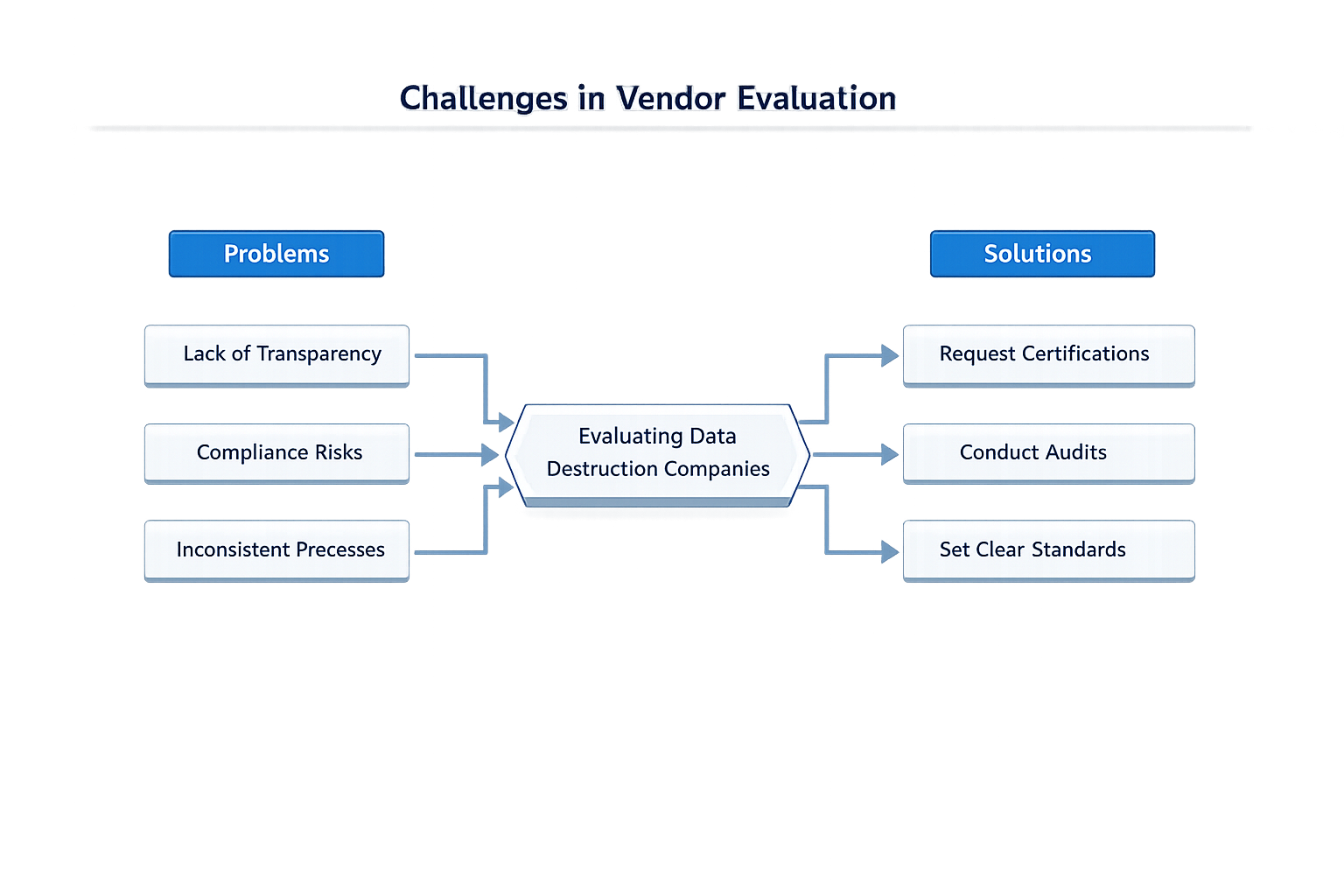
The vendor evaluation process surfaces predictable failure modes. These failures emerge not from bad faith but from structural gaps in how operators document, subcontract, and price their services. The following troubleshooting scenarios address the issues enterprise IT teams encounter most frequently when moving from RFP to contract.
Vendor Cannot Produce Sample Certificates of Destruction
When a vendor cannot provide sample CODs during the evaluation phase, the problem is not the sample — it is the underlying process. If the operator does not generate certificates as a standard output of every engagement, you are evaluating a vendor whose documentation posture will fail audit.
Resolution: Request certificates from three recent engagements, redacted for client confidentiality but showing full serialization, destruction method, date, facility location, and signatory. If the vendor cannot produce these within 48 hours, the certificates do not exist in usable form. Move to the next vendor.
Chain-of-Custody Documentation Is Incomplete or Generic
Many operators provide batch-level manifests rather than serialized chain-of-custody records. The manifest lists asset counts and types but does not track individual devices from pickup through destruction. This structure collapses under regulatory scrutiny.
Resolution: Require serialized tracking at the device level, with timestamps and custody transfers documented per asset. For ePHI or other regulated data, batch tracking is not adequate. The data destruction certificate must tie to a serialized chain that names every handler and every facility.
MSSB did not obtain CODs, or document the chain of custody for devices throughout the decommissioning process.
Vendor Discloses Downstream Subcontracting Late in the Process
Subcontracting is not inherently disqualifying, but late disclosure signals weak internal controls. If the vendor waits until contract negotiation to mention that physical destruction happens at a third-party facility, the question is not whether subcontracting is acceptable — it is whether the vendor has visibility into what the subcontractor actually does.
Resolution: Ask in the RFP whether any portion of the engagement will be subcontracted. Require the vendor to name the downstream processor, provide that processor's certifications, and specify how chain-of-custody transfers at the handoff point. If the vendor cannot answer these questions in writing, the subcontracting relationship is not audit-defensible.
Pricing Appears Significantly Lower Than Peer Bids
When one bid is 30–40% below the others, the vendor is either pricing at a loss to win the engagement or omitting costs that will surface later. The most common omissions: transportation for remote sites, per-device reporting, and COD generation.
Resolution: Itemize the scope in the RFP to include all documentation, transportation, and reporting requirements. Ask the low bidder to confirm in writing that the quoted price includes serialized CODs, chain-of-custody documentation, and on-site pickup for all listed locations. If the vendor revises the bid upward after clarification, the original bid was incomplete.
Vendor's Certification Is Expired or Under Suspension
Certification lapses happen, but they indicate either financial stress or operational inattention. A vendor operating under an expired R2v3 or e-Stewards certification is not technically certified, regardless of what the website claims.
Resolution: Verify certification status directly with the certifying body (R2, e-Stewards, NAID). Do not rely on certificates provided by the vendor. If the certification is expired, ask when renewal is expected and whether the vendor will accept a contract clause requiring valid certification at the time of service delivery. If the vendor resists the clause, the renewal is not imminent.
Vendor Cannot Explain the Difference Between Overwrite and Degaussing
When a vendor's sales team cannot articulate the technical distinctions between destruction methods, the problem is not sales training — it is that the vendor does not control the technical layer of the operation. The operator who cannot explain NIST 800-88 overwrite standards is not implementing them.
Resolution: Ask the vendor to describe, in writing, which destruction method applies to which device type and why. SSDs require different handling than HDDs; factory resets do not meet regulatory standards for mobile devices. If the response is generic or defers to "industry best practices" without naming a standard, the vendor does not have method-specific procedures.
Conclusion
The vendor selection process most enterprise IT teams run is not adequate to the risk. Marketing claims and sales presentations are designed to close deals, not to document the controls that survive audit. The operator's posture under contract — what they commit to in writing, what they verify with third parties, and what they hand you as documentary evidence — is the only position that matters when the auditor sits down across from you.
In our editorial review of vendor profiles, the gap between claimed capability and verified practice is consistent. Operators who hold NAID AAA Certification or equivalent third-party audit have submitted to unannounced reviews and continuous monitoring. Operators who do not hold such certification may perform identical work, but they have not subjected their controls to independent verification. The FTC Disposal Rule explicitly recognizes this distinction: due diligence includes reviewing an independent audit of the disposal company's operations.
The documentary record you receive — certificates of destruction, chain-of-custody logs, audit reports — is the only evidence that holds up in a regulatory review. The cheapest vendor is the one whose paper trail you trust enough to hand the auditor without flinching. Enterprise Data Destruction Standards for Corporate IT provides additional context on building audit-defensible procurement frameworks.
The operator's posture — what they commit to contractually, what they verify independently, and what they document at every handoff — is the only mechanism that protects you when the failure mode emerges. In practice, diligent vendor evaluation is not about finding the perfect operator. It is about identifying the operator whose controls you can defend in writing.
Frequently asked questions
What certifications should data destruction service providers hold?
Data destruction service providers should hold current certification from recognized bodies such as R2v3, e-Stewards, or NAID AAA. Verify that the certification applies to the specific facility and services you are evaluating, not just to the company name.
How do I verify a vendor's chain-of-custody documentation?
Request a redacted sample chain-of-custody packet from a recent engagement. The packet should include serialized asset tracking, signed custody transfers, sanitization method per device, verification results, and final disposition evidence. If the vendor cannot produce this immediately, their documentation posture is inadequate.
What is the difference between batch-level and device-level tracking?
Batch-level tracking reports aggregate counts ("50 laptops destroyed"), while device-level tracking ties each serial number to a specific sanitization result and verification outcome. Regulators expect device-level tracking for assets containing regulated data such as ePHI or cardholder information.
Why does downstream processor disclosure matter?
Chain-of-custody extends through every facility that handles your assets. If a downstream processor shreds drives or processes circuit boards, their controls become your controls for audit purposes. Undisclosed subcontracting is a structural failure mode in regulatory enforcement.
What should a certificate of data destruction include?
An audit-defensible certificate includes customer name, service date, asset serial numbers, sanitization method per device, verification method, technician signature, and a compliance statement referencing a named standard (NIST SP 800-88 Rev. 2, DoD 5220.22-M, or equivalent).