
Hard Drive Data Destruction: Data Destruction Methods: Software
Compare hard drive data destruction methods for secure data removal: software wiping, degaussing, and physical destruction. Learn which method ensures secure data
Introduction
Data destruction methods are the foundation of defensible IT asset disposition. In our editorial review of 35 vendor profiles, we noticed a recurring pattern: many vendors' certificate-of-data-destruction claims were inconsistent with their published methodologies. The certificate is the operator's primary documentary defense in a post-incident regulatory review, yet it is also the document with the highest variance in what it actually means. This variance matters because regulators and auditors expect that information cannot practicably be read or reconstructed after destruction — a standard that applies equally to software wipes, degaussing, and physical destruction.
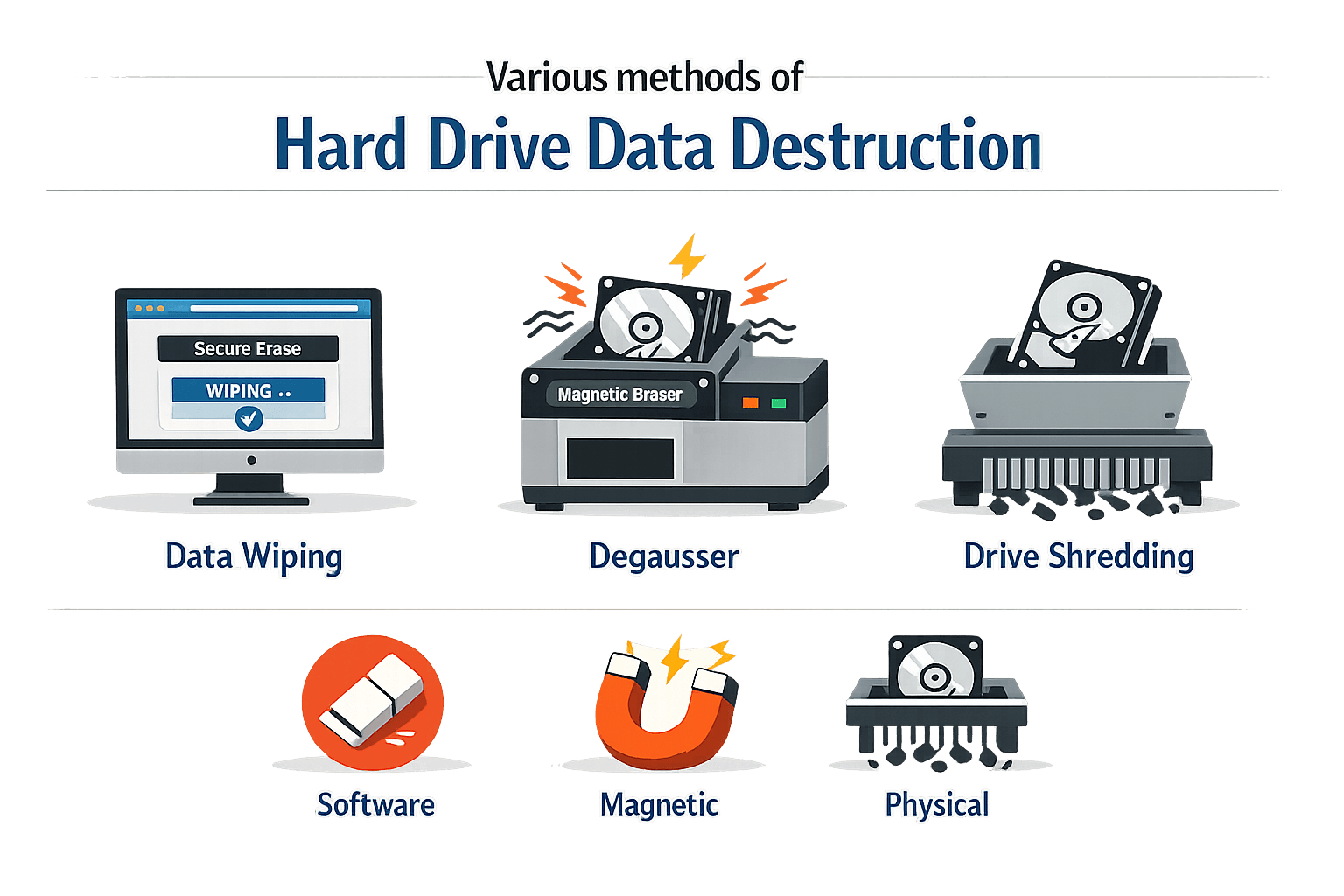
The choice of data destruction methods depends on device type, data sensitivity, regulatory requirements, and whether the equipment will be resold or scrapped. Software-based overwrite methods work well for devices headed to reuse, but fail on certain drive architectures. Degaussing renders magnetic media unreadable but destroys the drive's functionality. Physical destruction — shredding, crushing, or disintegration — provides the highest assurance for sensitive data but eliminates any residual value in the equipment.
What is Hard Drive Data Destruction?
Hard drive data destruction is the process of rendering stored information on magnetic, solid-state, or hybrid storage media permanently unrecoverable. The operative word is permanently. A factory reset, a quick format, or a file deletion does not meet the definition — those operations leave data structures intact and recoverable with readily available forensic tools.
In regulatory and audit contexts, data destruction means applying a sanitization method that makes target data recovery infeasible using state-of-the-art laboratory techniques. NIST SP 800-88 Rev. 2, the current federal media sanitization standard published in September 2025, defines three sanitization categories: clear, purge, and destroy. Clear methods apply logical techniques to sanitize data in all user-addressable storage locations, protecting against simple, non-invasive recovery attempts. Purge methods apply physical or logical techniques that make recovery infeasible even with advanced laboratory equipment. Destroy methods render the physical media itself unusable, typically through shredding, crushing, or incineration.
Why Hard Drive Data Destruction Matters
The significance of effective data destruction lies in what survives the process. In post-incident regulatory reviews, the certificate of data destruction is often the operator's primary documentary defense. The FTC Disposal Rule (16 CFR Part 682) requires organizations to implement policies that ensure electronic media containing consumer information "cannot practicably be read or reconstructed." That standard — cannot practicably be read — is the threshold the auditor will apply when reviewing your vendor's certificate.
The failure mode we see most often in vendor assessments is not inadequate destruction methodology but inadequate documentation of what was actually destroyed. A drive that was physically shredded but never serialized in the chain-of-custody record is, from an audit perspective, a drive that might still be circulating. The e-Stewards Standard V4.1 requires organizations to verify successful sanitization for 100% of devices, with verification tied to serialized asset records. The underlying control is traceability: the documentary record must connect the specific device that held the data to the specific destruction event that eliminated it.
For enterprise IT and procurement leads evaluating ITAD vendors, the question is not "Do you shred drives?" but "Can you produce a serialized destruction record that survives discovery?" The answer to that question determines whether your vendor selection holds up when the auditor asks to see it. For a deeper examination of what constitutes adequate documentation across the full ITAD process, see our IT Asset Disposition framework.
How Do Data Destruction Methods Work?
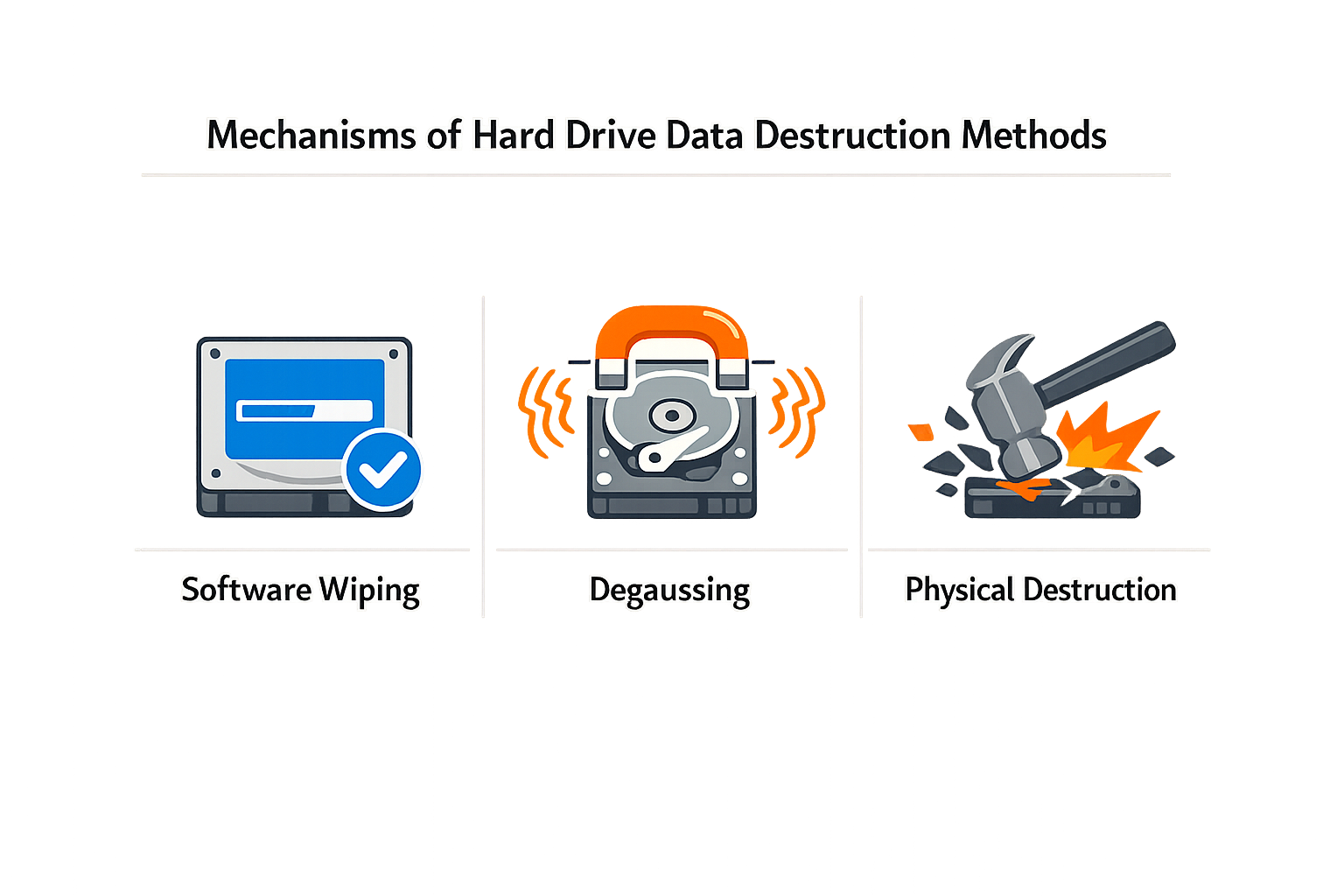
The mechanism underneath a data destruction method determines what survives a state-of-the-art laboratory attack. Three categories dominate the ITAD operator's toolkit: software-based overwrite, degaussing, and physical destruction. Each operates on a different principle, and each carries documented failure modes when applied to the wrong media type or executed without the underlying control.
Software Overwrite and NIST 800-88 Rev. 2
Software overwrite applies logical techniques to replace target data with a fixed or random pattern across all user-addressable storage locations. NIST SP 800-88 Rev. 2, published September 2024 and the current media sanitization standard, defines this as the clear sanitization method for information storage media. The standard notes that for magnetic hard drives, a single overwrite pass with a fixed pattern such as binary zeros typically hinders recovery of data even if state-of-the-art laboratory techniques are applied.
Historically, operators ran multiple overwrite passes — ranging from a single pass to as many as 39 — often using specific binary patterns. The published verification today is that a single pass is structurally adequate for conventional magnetic media. The trade-off: overwrite techniques are infeasible for flash memory-based storage devices such as SSDs. Flash architecture includes spare cells and wear leveling, and the controller may redirect write operations away from the target address. The result is that previous data in unmapped cells survives the overwrite.
For detailed guidance on software-based data destruction methods and their proper application, see our guide on data wiping services and understanding data erasure.
Degaussing: The Magnetic-Media Mechanism
Degaussing applies a powerful magnetic field to disrupt the magnetic domains that encode data on hard drives and tapes. It is a fundamental way to sanitize magnetic media and falls under the purge sanitization category in NIST SP 800-88 Rev. 2, which applies physical or logical techniques that make recovery of target data infeasible using state-of-the-art laboratory methods.
The underlying control is field strength. A degausser must exceed the coercivity of the target media — the magnetic force required to flip the domains. Modern high-coercivity drives require industrial-grade degaussers; consumer-grade units do not generate adequate field strength. The documented limitation: degaussing does not apply to flash memory-based devices like SSDs, which store data as electrical charge in transistor gates rather than magnetic orientation.
Degaussing also renders the drive permanently inoperable. The magnetic field erases not only user data but also the servo tracks and firmware zones the controller needs to address sectors. For operators who intend to resell drives, degaussing is not a viable path.
Physical Destruction: The Destroy Sanitization Method
Physical destruction renders target data recovery infeasible by destroying the media substrate itself. NIST SP 800-88 Rev. 2 defines this as the destroy sanitization method, appropriate for all hard copy and most information storage media except logical or virtual storage. Common techniques include disintegration, incineration, melting, pulverizing, and shredding. Each technique physically fragments the platters or chips to a particle size that prevents reassembly.
The question the auditor will ask: what particle size did the shredder produce, and does the certificate specify it? A shredder that reduces a 3.5-inch hard drive to 1-inch fragments may leave platters largely intact. Operators who handle classified or ePHI-bearing drives typically specify sub-centimeter particle sizes and document the shredder model and its certified output specification.
Physical destruction techniques render target data recovery infeasible using state-of-the-art laboratory techniques — but only when the particle size is small enough to prevent platter reassembly.
Physical destruction is media-agnostic. It works on magnetic hard drives, SSDs, hybrid drives, and removable media. The trade-off is total loss of asset value. A shredded drive generates scrap metal revenue; it does not generate a functional resale price. For operators balancing data risk against asset recovery, the choice between data destruction methods is the choice between what the documentary record can defend and what the downstream market will pay. For a deeper look at the standards and verification frameworks that govern these processes, see What is Data Destruction? Definition, Methods, Standards.
Real-World Examples of Hard Drive Data Destruction
The effectiveness of data destruction methods becomes clear when you examine how organizations apply them in practice. The underlying control is not the method itself but the documented verification that the method was executed correctly and completely. In our review of 35 vendor profiles, we have seen the gap between a vendor's stated methodology and the documentary record that survives audit.
Physical Destruction in High-Security Environments
Physical destruction techniques — disintegration, incineration, melting, pulverizing, and shredding — are the standard for classified and highly sensitive environments where reuse is not a priority. These data destruction methods render the media physically incapable of reconstruction. According to NIST SP 800-88 Rev. 2, the destroy sanitization method is appropriate for all hard copy and most information storage media, making target data recovery infeasible using state-of-the-art laboratory techniques.
The failure mode is not in the destruction itself but in the chain-of-custody documentation. When an organization cannot produce serialized records of which drives were destroyed, when, and by whom, the certificate of destruction becomes legally meaningless. The question the auditor will ask is not whether the shredder worked — it is whether you can prove this specific drive went through it.
Software Overwrite in Enterprise IT Refreshes
Historically, hard drives were erased using multiple overwrite passes, ranging from a single pass to as many as 39, often using specific binary patterns. Modern practice has moved toward single-pass overwrite for magnetic media, as NIST SP 800-88 Rev. 2 recognizes that state-of-the-art laboratory techniques cannot recover data after a properly executed single-pass overwrite on contemporary drives.
The operator's posture on software wipes depends on verification. E-Stewards Standard V4.1 requires organizations to verify successful sanitization of all customer data, including verification that prescribed overwrite instructions have been successfully executed for 100% of a device's physical memory locations for all data storage devices going for reuse. The published verification is what holds up in audit — not the vendor's assurance that they ran the software.
The Trade-Off Between Reuse and Destruction
In practice, the choice between data destruction methods is a trade-off between asset recovery value and documentary simplicity. Software wipes allow drives to be resold, but they require per-drive verification logs, serial tracking, and software attestation. Physical destruction eliminates reuse value but produces a simpler audit trail — the drive is gone, and the shredder log proves it.
For organizations subject to regulatory oversight, the NAID AAA Certification framework provides the audit-defensible structure that bridges both methods. The mechanism is not the destruction technique itself but the documented process control that proves the technique was applied to the correct asset at the correct time.
Benefits of Effective Hard Drive Data Destruction
The operator who treats data destruction as a checkbox exercise discovers the cost of that choice when the auditor arrives. Effective hard drive data destruction is not primarily about the act of rendering data unreadable — it is about the documentary record that survives the audit, the regulatory compliance posture that holds up under scrutiny, and the risk mitigation that protects the organization when something goes wrong downstream.
Regulatory Compliance and Audit Defense
The FTC Disposal Rule requires organizations to implement and monitor compliance with policies and procedures that ensure the destruction or erasure of electronic media containing consumer information so that the information cannot practicably be read or reconstructed. This is not a suggestion — it is a regulatory requirement with enforcement teeth. The mechanism that satisfies this requirement is not the destruction event itself, but the documented process that demonstrates ongoing monitoring and compliance.
In practice, this means the operator must be able to produce a chain-of-custody record, a certificate of destruction tied to serialized asset identifiers, and evidence that the data destruction methods employed meet the regulatory standard for the data sensitivity involved. The vendor who cannot produce this documentation in audit-defensible form is not compliant, regardless of how thoroughly the drives were destroyed.
Risk Mitigation Across the Disposal Lifecycle
The benefit of effective data destruction is the elimination of downstream exposure. When a drive leaves the operator's custody, the question is not whether it was destroyed — the question is whether the operator can prove it was destroyed, and whether that proof will hold up when a regulator or opposing counsel examines it.
Certification programs like NAID AAA Certification provide third-party verification of destruction qualifications through a rigorous audit program that includes both scheduled and unannounced reviews. Organizations that achieve this certification demonstrate to auditors, customers, and regulators that their data destruction process is not ad hoc — it is systematically verified and continuously monitored.
Certification helps organizations meet key regulatory requirements and ensure the protection of sensitive information through verified destruction processes.
The trade-off is cost and operational discipline. Achieving and maintaining certification requires investment in process documentation, staff training, and the willingness to submit to unannounced audits. For operators handling consumer information, protected health information, or financial data, this investment is not optional — it is the price of audit-defensible compliance.
Operational Confidence and Vendor Accountability
Effective data destruction creates operational confidence. The IT lead who can hand an auditor a complete chain-of-custody record, a serialized certificate of destruction, and third-party verification of the vendor's process is not hoping the documentation holds up — they know it will. This confidence extends to vendor accountability: when the destruction process is documented and verified, the operator has recourse if something goes wrong downstream.
The vendor who cannot produce this level of documentation is not necessarily cheaper in the long run. The cheapest vendor is the one whose paper trail you trust enough to hand the auditor without flinching. The vendor whose certificate is vague, whose chain-of-custody is incomplete, or whose certification status is unclear may cost less per drive — but the cost of that choice becomes visible only when the regulatory review begins.
Frequently asked questions
What are the three main data destruction methods?
The three main data destruction methods are software overwrite (logical erasure using fixed or random patterns), degaussing (magnetic field disruption for magnetic media), and physical destruction (shredding, crushing, or disintegration). Each method serves different use cases based on device type, data sensitivity, and whether equipment will be resold or scrapped.
Which data destruction methods work for SSDs?
Software overwrite and degaussing do not work reliably on SSDs due to flash architecture, wear leveling, and spare cells. Physical destruction is the only data destruction method that guarantees complete data elimination on solid-state drives. The controller's wear-leveling algorithm redirects writes, leaving prior data in unmapped cells accessible to forensic recovery.
How do I verify that data destruction methods were properly applied?
Verification requires serialized chain-of-custody records, certificates of destruction tied to specific asset identifiers, and evidence that the chosen method meets regulatory standards. E-Stewards Standard V4.1 requires 100% verification of successful sanitization for devices going to reuse. Third-party certification like NAID AAA provides audit-defensible proof of process compliance.
What is the difference between NIST clear, purge, and destroy sanitization?
NIST SP 800-88 Rev. 2 defines clear as logical techniques protecting against simple recovery attempts, purge as physical or logical techniques making recovery infeasible with advanced laboratory equipment, and destroy as rendering physical media unusable. These categories map to software overwrite, degaussing, and physical destruction respectively.
Do data destruction methods meet FTC Disposal Rule requirements?
Data destruction methods meet FTC Disposal Rule requirements only when they ensure information "cannot practicably be read or reconstructed" and the organization implements documented policies to monitor compliance. The method alone is insufficient — the documentary record connecting the asset to the destruction event is what survives regulatory review.
Conclusion
The choice among data destruction methods is not a technical preference — it is a documented position that either survives regulatory review or does not. Software wiping under NIST 800-88 Rev. 2 guidelines works for devices where the erasure can be verified and the drive remains functional post-process. Degaussing renders magnetic media unreadable but also permanently inoperable, making it suitable only when device reuse is not a requirement. Physical destruction — shredding, crushing, or disintegration — is the only method that guarantees data cannot be reconstructed, and it is the method regulators expect for high-sensitivity environments where the documentary burden of proving a successful wipe exceeds the residual value of the asset.
In our editorial review of 35 vendor profiles, the variance in what a certificate of data destruction actually means is the single largest gap between vendor posture and operator expectation. The Morgan Stanley case remains the canonical reference: the failure was not in the destruction methodology but in the chain-of-custody documentation that should have survived the auction and did not. The operator's question is not which method is most secure in theory — it is which method produces the documentary record that holds up when the auditor asks to see it.
For enterprise IT and procurement leads building an IT asset disposition framework, the decision tree is straightforward: if the device holds data subject to regulatory retention or breach-notification timelines, and the residual asset value does not justify the cost of verified erasure and the audit trail it requires, physical destruction is the defensible position. If the device can be wiped to a published standard and the operator has the tooling and process discipline to produce serialized certificates tied to individual assets, software erasure is audit-grade. Degaussing occupies the middle ground — effective for magnetic media, but with no reuse value and a narrower applicability as SSD adoption continues.
The method is not the end of the process. The certificate, the chain of custody, and the contract language that defines downstream accountability are what the auditor will ask to see. Choose the method that produces the record you can hand over without flinching.