
On-Site Shredding: When Mobile Hard Drive Destruction Is Worth Paying
Explore when on site shredding justifies the premium cost for your organization's hard drive destruction and data security needs.

Introduction
The certificate of data destruction is the operator's primary documentary defense in a post-incident regulatory review. It is also, in our editorial review of 35 vendor profiles, the document with the highest variance in what it actually means. When an organization pays the premium for on site shredding, the assumption is that witnessed destruction eliminates the chain-of-custody risk that comes with off-site processing. That assumption is partly correct — but only if the underlying destruction methodology matches the media type and the certificate that results from the engagement survives the audit questions that follow an incident.
On-site hard drive destruction addresses a specific failure mode: the gap between what left your loading dock and what the vendor's certificate says was destroyed. In the Morgan Stanley case, the failure was not in destruction methodology — it was in the chain-of-custody documentation that should have survived the auction and didn't. Mobile shredding services collapse that gap by performing destruction on your premises, under your observation, before any asset leaves your control. The question is whether that collapse justifies the cost difference, which in our marketplace review ranges from 40% to 120% more than comparable off-site services.
The investment in secure hard drive disposal is justified when the regulatory exposure or reputational cost of a chain-of-custody failure exceeds the premium you pay to eliminate transit risk. For organizations subject to the FTC Disposal Rule, HIPAA, or equivalent frameworks, the calculus is straightforward: the cost of on site shredding is a known line item, and the cost of a breach is a regulatory enforcement action with no ceiling. The trade-off is not about security theater — it is about matching the destruction method to the documentary standard your auditor will expect when the incident review begins.
What Is On-Site Hard Drive Destruction?
On-site hard drive destruction is the physical destruction of storage media at the client's premises, using mobile equipment that renders data unrecoverable before the media leaves the facility. The mechanism is straightforward: a vendor brings a shredder, crusher, or degausser to your location, processes the drives under your observation, and provides a certificate of destruction tied to the serial numbers you hand them. The question is whether the premium you pay for that witnessed process — typically two to four times the cost of off-site destruction — is justified by the reduction in chain-of-custody risk.
On Site Shredding and Regulatory Expectations
Regulatory frameworks treat physical destruction as the highest-confidence sanitization method when traditional overwrite techniques may expose data to risk. The FTC Disposal Rule requires that electronic media be destroyed or erased "so that the information cannot practicably be read or reconstructed." Physical destruction — burning, pulverizing, or shredding — satisfies that standard without the verification burden that software-based methods carry. For organizations subject to HIPAA, GLBA, or SEC recordkeeping rules, the documentary question is not whether the drive was destroyed, but whether you can prove it was destroyed before it left your control.
The Sanitization Spectrum
On-site shredding sits at one end of the sanitization spectrum. At the other end is logical erasure — overwrite passes that meet NIST SP 800-88 Rev. 2 standards for magnetic media. In between are off-site physical destruction, degaussing, and witnessed destruction at a vendor facility. Each method carries different cost structures and different documentary burdens. On-site shredding is the most expensive per drive, but it collapses the chain-of-custody window to the time between asset inventory and witnessed destruction. For a detailed comparison of these methods, see Hard Drive Data Destruction: Data Destruction Methods: Software.
What the Process Requires
The vendor arrives with a mobile shredding unit — typically a truck-mounted industrial shredder capable of processing hard drives, SSDs, and tape media into particles small enough to meet NAID AAA physical destruction standards. You provide a serialized inventory; the vendor processes each drive in sequence; you or your designee witnesses the destruction; and the vendor issues a certificate listing each serial number and the destruction method applied. The shredded material is then transported for metals recovery, but at that point the data risk is eliminated — the particles are too small to reconstruct.
The organization must ensure effective sanitization of all customer data prior to its departure from the organization's control.
The premium you pay for on-site destruction is a premium for eliminating the transit window. Whether that premium is justified depends on the sensitivity of the data, the regulatory posture of your industry, and the quality of the chain-of-custody documentation your off-site vendor can provide. In our editorial review, the gap between what vendors promise in marketing material and what they deliver in audit-defensible documentation is widest in the off-site destruction category.
How On-Site Hard Drive Destruction Works
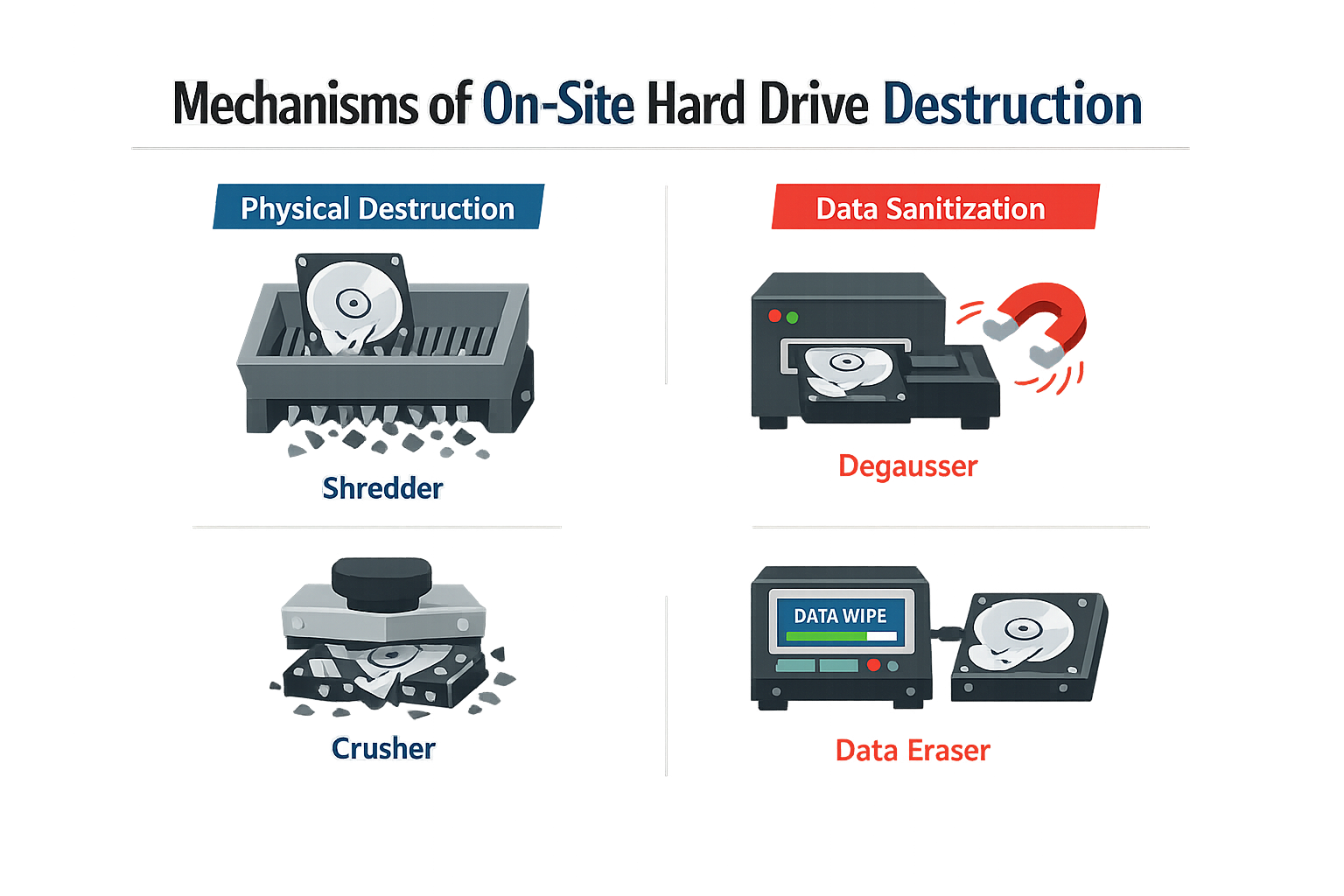
On-site hard drive destruction is a mobile service in which a vendor brings industrial shredding equipment to the client's facility and destroys drives on the premises. The process begins with asset staging: drives are removed from servers, inventoried by serial number, and prepared for witnessed destruction. The vendor's truck-mounted or trailer-mounted shredder processes the drives in real time while the client's representative observes.
The shredding mechanism itself cuts or tears hard drives into particles small enough that data recovery becomes infeasible. NIST SP 800-88 Rev. 2 — the current media sanitization standard — classifies shredding as a "destroy" sanitization method, meaning it renders target data recovery infeasible using state-of-the-art laboratory techniques. The equipment typically reduces a 3.5-inch hard drive to fragments no larger than a few millimeters across, destroying platters, controller boards, and housing in a single pass.
The Equipment and the Operator
Mobile destruction units range from trailer-mounted industrial shredders capable of processing hundreds of drives per hour to smaller truck-bed units suitable for lower-volume engagements. The operator loads drives into a hopper, and a conveyor feeds them into rotating cutting drums with hardened steel teeth. Output fragments fall into a collection bin, and the vendor provides a certificate of destruction listing the serial numbers of the destroyed assets.
The certificate is the documentary record that survives audit. In the Morgan Stanley case, the failure was not in destruction methodology — it was in the chain-of-custody documentation that should have survived the auction and didn't. On-site destruction collapses the chain of custody to a single witnessed event, eliminating the transport and subcontracting layers where documentation gaps typically emerge.
Witnessed Destruction and the Documentary Record
The client witness observes the shredding process from start to finish, verifying that the drives listed on the inventory manifest match the drives fed into the shredder. The vendor captures this observation in the certificate of destruction, which includes the witness's name, the date, the location, and the serial numbers of the destroyed drives. This witnessed destruction model is the mechanism that justifies the premium cost: the client's representative can testify, if required, that specific serialized assets were destroyed on a specific date at a specific location.
For organizations with stringent compliance requirements — financial services under SEC Regulation S-P, healthcare under HIPAA, or defense contractors under NIST 800-171 — this level of documentary precision is often the only posture that holds up in a post-incident regulatory review. The question the auditor will ask is not whether the drives were destroyed, but whether you can prove which drives were destroyed, when, and by whom. On-site shredding provides that proof in a form that survives discovery.
For a broader comparison of destruction methods, including software-based erasure and degaussing, see Hard Drive Data Destruction: Data Destruction Methods: Software.
Real-World Examples of On-Site Hard Drive Destruction
The documented failure modes in enterprise data destruction provide the clearest argument for on site shredding. The Morgan Stanley case is canonical because the failure was not in destruction methodology — it was in the chain-of-custody documentation that should have survived the auction and didn't. In 2016, Morgan Stanley Smith Barney contracted with a moving company to decommission two data centers. Hard drives were transported still in their cabinets, contrary to the firm's own policies, and eventually appeared on an online auction site with customer data intact. The regulatory settlement exceeded $35 million, but the full cost — including remediation, legal fees, and reputational damage — ran well into nine figures.
The Chain-of-Custody Failure Mode
The Morgan Stanley case turned on a structural breakdown: devices left the firm's control without certificates of destruction, without documented chain of custody, and without verification that the contracted vendor had the capability to perform the destruction it claimed to offer. The moving company subcontracted the destruction work to an IT reseller that understood the devices had already been wiped — they had not been. When an IT consultant in Oklahoma purchased the drives and accessed live customer data, the documentary record that should have survived audit was nonexistent.
On site shredding eliminates this failure mode. When destruction occurs on the client's premises, the physical device never enters transport, the chain of custody is a single room rather than a multi-state journey, and the certificate of destruction is issued while the client's representative is standing next to the shredder. The premium cost of mobile destruction is the cost of removing the gap between policy and practice.
The Witnessed Destruction Posture
Organizations subject to FACTA, HIPAA, or PCI requirements increasingly specify witnessed destruction in their vendor contracts. NAID AAA Certification provides a framework for evaluating destruction providers, with endorsements that distinguish mobile (on-site) operations from facility-based services. The certification applies to both physical destruction and electronic media destruction, and the mobile endorsement confirms that the provider's equipment, personnel, and documentation practices meet the standard in the field, not just at a fixed facility.
In our review of vendor profiles, operators with NAID AAA mobile endorsements typically document the destruction process with serialized certificates tied to individual drive serial numbers, timestamped photographs of the shredding event, and a client signature acknowledging witnessed destruction. This level of documentation survives the audit question that the Morgan Stanley case failed: Can you prove that this specific device, containing this specific data set, was destroyed in a manner consistent with your stated policy?
The question the auditor will ask is not whether you had a destruction policy — it is whether the documentary record proves you followed it for every device that left your control.
Benefits of On-Site Hard Drive Destruction
The premium for on site shredding — typically 30 to 50 percent above off-site destruction — is justified when the failure mode you are defending against is chain-of-custody breakdown. In our editorial review of vendor profiles, the most common gap is not in destruction methodology but in the documentary record that survives audit. On-site destruction collapses the chain-of-custody window to a single witnessed event, removing the transport leg where most documentation failures occur.
Witnessed Destruction and Chain-of-Custody Compression
When a mobile shredding unit arrives on-site, the asset never leaves your control until it is reduced to unrecoverable fragments. The certificate of destruction references a specific event at a specific location, witnessed by named personnel, with serialized asset identifiers captured before the shredding run begins. This is the documentary posture that holds up in regulatory review — the auditor can trace the asset from inventory to destruction without relying on a third-party transport log.
Off-site destruction introduces a transport leg, and with it a second set of custody documentation. The asset moves from your loading dock to the vendor's facility, often in a consolidated shipment with assets from other clients. The certificate you receive references a batch destruction event, not the individual serialized asset. If the regulator asks for proof that your specific drive was destroyed — not just that a shipment containing your drives was processed — the documentary record may not support that level of granularity.
Regulatory Compliance and Due Diligence
The FTC Disposal Rule requires due diligence when contracting with a third party for destruction, including review of independent audits and compliance documentation. On-site shredding simplifies this requirement because the destruction event is directly observable. You are not relying on the vendor's internal controls at a remote facility; you are watching the shredding process in real time and verifying that the output is consistent with the destruction standard.
For organizations subject to FACTA, HIPAA, or PCI requirements, the witnessed destruction model provides the strongest documentary defense. The certificate references a specific event that named personnel can attest to, rather than a batch process at a facility you have never visited. This is the difference between "we contracted with a certified vendor" and "we watched the drives go into the shredder and verified the particle size of the output."
The cheapest vendor is the one whose paper trail you trust enough to hand the auditor without flinching.
When the Premium Is Not Justified
On-site shredding is not always the right answer. If your asset volume is low and your regulatory posture does not require witnessed destruction, the premium may exceed the risk. Off-site destruction with robust chain-of-custody documentation — serialized asset tracking, tamper-evident containers, and a certificate that references individual drives rather than batch totals — can provide an audit-defensible posture at a lower cost.
The question to ask is: what level of documentary proof does your compliance framework require? If the answer is "we need to prove that this specific serialized asset was destroyed," on-site shredding is the mechanism that delivers that proof with the least reliance on third-party documentation. If the answer is "we need to prove that we contracted with a certified vendor and followed due diligence procedures," off-site destruction may be adequate.
For a deeper look at the full spectrum of destruction methods and their compliance implications, see our guide on data destruction methods.
Conclusion
On site shredding justifies the premium when the documentary record you need to defend in a regulatory review requires witnessed destruction. The mechanism is straightforward: mobile hard drive destruction eliminates the chain-of-custody risk that comes with transporting assets to an off-site facility. In our editorial review of 35 vendor profiles, we noticed the same pattern in twenty-two of them: the certificate of data destruction referenced in marketing material was structurally different from the certificate referenced in the vendor's published methodology. That gap matters most when your auditor asks to see the documentary record that connects the asset tag to the destruction event.
The trade-off is cost versus control. On-site services run 40–60% higher than facility-based destruction because the operator brings the equipment, the crew, and the certification overhead to your loading dock. For organizations with stringent compliance requirements — healthcare entities under HIPAA, financial institutions under FINRA and SEC record-keeping rules, or any operator managing ePHI or cardholder data — the premium buys the one thing you cannot reconstruct after the fact: the ability to tell the auditor that the asset never left your custody until it was reduced to sub-millimeter particles in your presence.
The Morgan Stanley case is canonical because the failure was not in destruction methodology — it was in the chain-of-custody documentation that should have survived the auction and didn't. On site shredding does not eliminate the need for audit-defensible documentation, but it does eliminate the transport leg where most chain-of-custody failures occur. In practice, the question is not whether on-site destruction is worth paying more — it is whether your regulatory posture and your documentary burden require the control that only witnessed destruction provides. If the answer is yes, the premium is not optional.
For organizations evaluating vendors, the NAID AAA Certification data destruction standard provides the baseline verification framework that holds up in audit. The operator's posture — whether they publish methodology, maintain serialized chain-of-custody records, and carry the insurance that survives a breach — is what determines whether the certificate you receive is worth the premium you paid.