
Data Wiping Services: Understanding Data Erasure and Differences
Learn what data wiping services accomplish, how data erasure differs from deletion, and when it's sufficient for data protection.

Introduction
The certificate of data destruction is the operator's primary documentary defense in a post-incident regulatory review. It is also, in our review of 35 vendor profiles, the document with the highest variance in what it actually means. Data wiping services — the commercial layer that sits between enterprise IT asset retirement and verified data erasure — operate under multiple technical standards, competing certification regimes, and a regulatory landscape that treats "erasure" and "deletion" as materially different acts.
Data erasure is the process of destroying or erasing electronic media containing consumer information so that the information cannot practicably be read or reconstructed. This is not the same as file deletion, which removes pointers to data but leaves the underlying content intact and recoverable with forensic tools. The distinction matters in regulatory enforcement: the FTC Disposal Rule requires that organizations implement policies to ensure "the destruction or erasure of electronic media containing consumer information so that the information cannot practicably be read or reconstructed."
In practice, the gap between what enterprise IT teams believe they purchased and what the vendor actually performed has been the failure mode in every major ITAD incident we track. The Morgan Stanley case — which resulted in cumulative costs exceeding $100 million — began with unverified data erasure claims and ended with regulators discovering customer data on auctioned drives. The documentary record did not survive discovery.
For organizations evaluating data destruction certificate requirements, the question is not whether the vendor says they erased the data. The question is what evidence the vendor can produce, under oath, that the erasure was performed to a named standard, verified at the device level, and documented in a chain of custody that connects the asset tag to the certificate serial number. That documentary standard is what this article addresses.
The upstream process — how equipment enters the ITAD vendor's facility, how it is inventoried, how data-bearing devices are identified and segregated — determines whether the downstream data wiping services can produce an audit-defensible record. Organizations that treat vendor selection as a procurement exercise rather than a risk-transfer evaluation are discovering, in regulatory review, that the cheapest bid did not include the documentary controls the auditor expected to see.
The Problem Statement
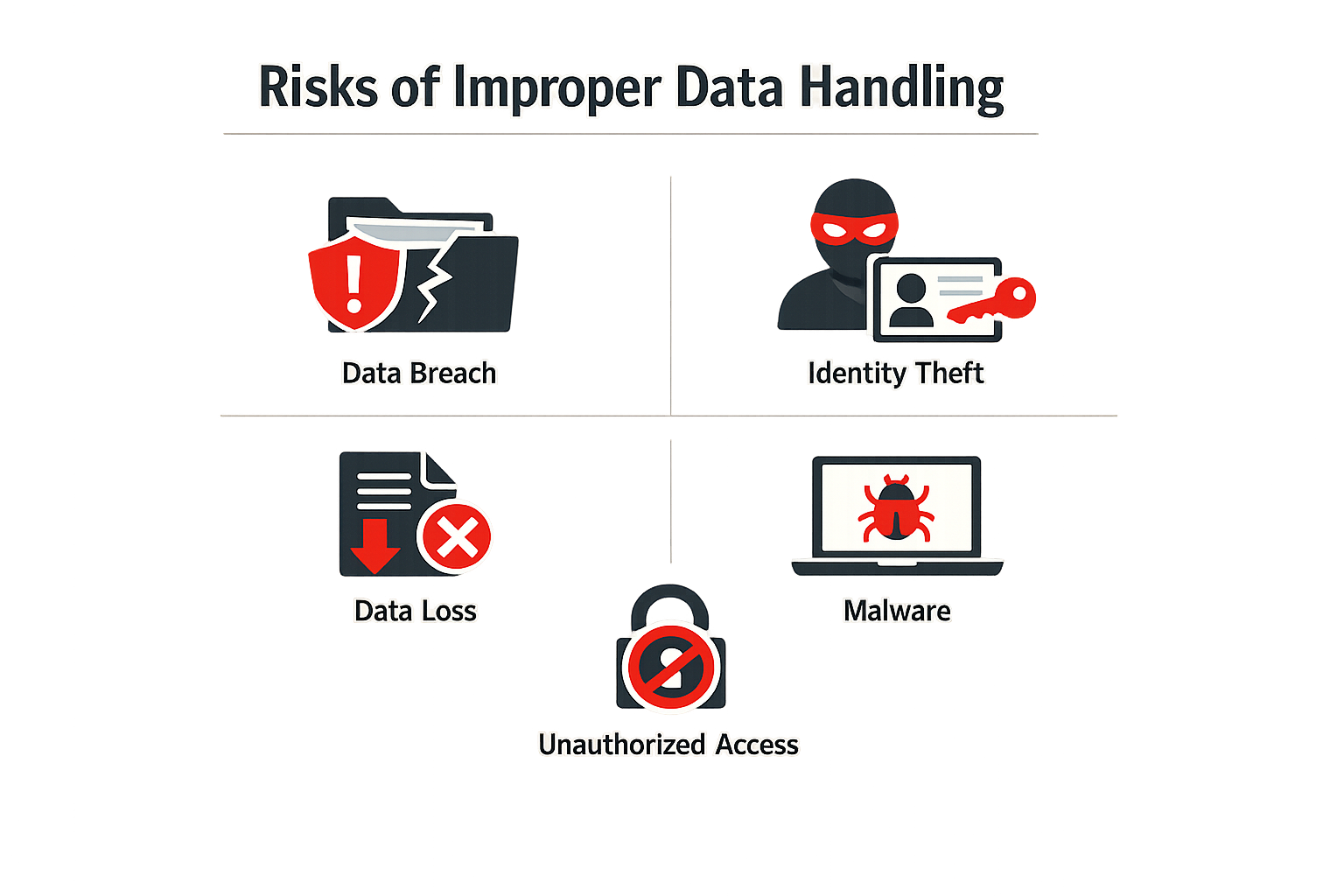
The operator who assumes deletion equals data destruction is the operator whose documentary record collapses in audit. File deletion removes pointers, not data — the underlying bits remain on the media, recoverable with standard forensic tools, until they are overwritten by new writes or deliberately sanitized. Most enterprise IT teams operate under this misconception until the first regulatory review or downstream breach forces them to confront what their certificates of data destruction actually mean.
The Gap Between Deletion and Sanitization
NIST SP 800-88 Rev. 2, the current federal media sanitization standard published September 2024, defines three sanitization methods: Clear, Purge, and Destroy. Clear applies logical techniques to sanitize data in all user-addressable storage locations; Purge applies physical or logical techniques that make target data recovery infeasible using state-of-the-art laboratory techniques; Destroy renders target data recovery infeasible using any known technique. Standard file deletion qualifies as none of these — it is a file-system operation, not a sanitization method.
The documentary record matters because the auditor will ask what method was used, what verification was performed, and what the certificate attests to. If the answer is "we deleted the files," the operator has no defensible position. If the answer is "we applied a NIST-compliant overwrite using certified software and retained serialized verification records," the operator has an audit-defensible posture.
The Failure Mode in Multi-Tenant Environments
The problem compounds in environments where a single drive contains data from multiple customers or regulatory domains. A datacenter operator who retires a drive after one customer discontinues service cannot simply delete that customer's partition and redeploy the drive — the residual data remains, and the next tenant inherits the risk. The only operator-grade solution is full-media sanitization before redeployment or a documented decision to physically destroy the media and absorb the asset-value loss.
Organizations maintain storage devices with differing levels of confidentiality, and it is critical to understand what types of data may be stored on a device in order to apply the appropriate sanitization method. A drive that once held ePHI or PII retains that classification until it is sanitized to a standard that matches the regulatory framework governing that data type. The certificate of data destruction is the operator's proof that the classification was cleared — or it is the document that exposes the operator's failure to clear it.
A media sanitization program can help ensure the consistent and appropriate disposal of storage assets and avoid data breaches due to mishandling.
In our editorial review of vendor profiles and downstream processor relationships, the most common failure mode is the gap between the certificate language and the underlying process. The vendor issues a certificate that says "data destroyed," but the process applied was logical deletion or a single-pass overwrite on flash media — neither of which meets the Purge standard for high-confidentiality data. The operator who accepts the certificate without verifying the process inherits the risk, and the auditor will hold the operator accountable, not the vendor.
For a detailed breakdown of what an audit-defensible certificate must contain, see Data Destruction Certificate: Key Elements and Auditor Expectations.
Solution Steps for Effective Data Erasure
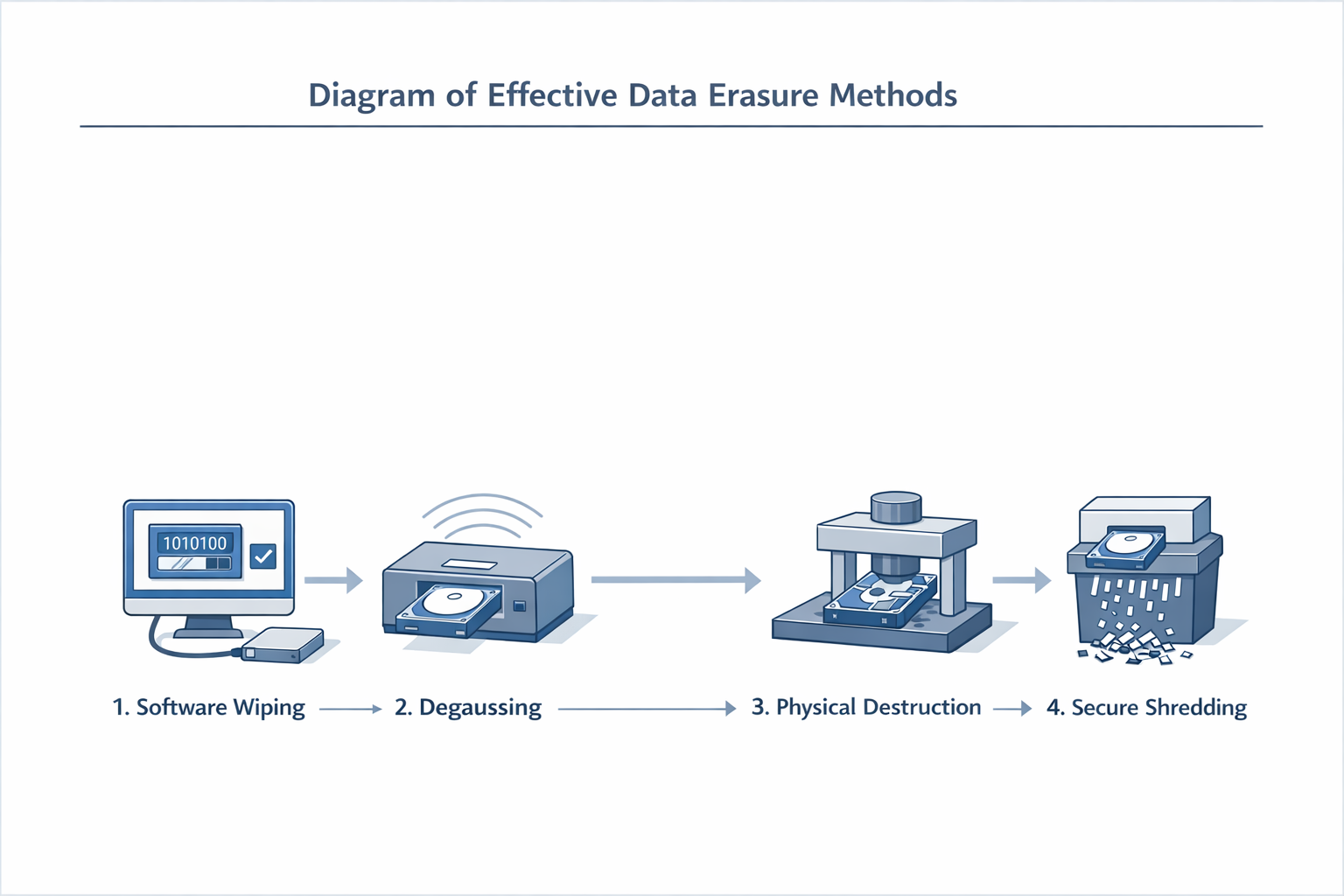
The documented process matters more than the vendor's assurances. NIST SP 800-88 Rev. 2, published in September 2025, supersedes all prior guidance and defines three sanitization methods: Clear, Purge, and Destroy. Each method corresponds to a different level of threat model and asset residual value. The operator's task is to select the correct method for the data sensitivity and document the execution in a way that survives audit.
Step 1: Classify the Data Before Selecting the Method
Step 1
Classify the data before selecting the method
Identify what data the asset held and assign a confidentiality category. NIST SP 800-88 Rev. 2 requires organizations to understand the types of data stored on each device before applying sanitization. A drive that held customer PII requires a different method than a drive that held publicly available marketing collateral. The classification drives the sanitization decision — not the asset type, not the vendor's default process.
The failure mode here is assuming all assets are the same. They are not. A single drive in a datacenter may contain data from multiple customers with different retention obligations. Classify each asset individually, by serial number, before any vendor sees the inventory.
Step 2: Select Clear, Purge, or Destroy Based on Threat Model
Step 2
Select Clear, Purge, or Destroy based on threat model
The Clear method applies logical techniques to sanitize data in all user-addressable storage locations, protecting against simple non-invasive data recovery. The Purge method applies physical or logical techniques that render target data recovery infeasible using state-of-the-art laboratory techniques. The Destroy method renders target data recovery infeasible using any known technique and is appropriate for all hard copy and most information storage media.
Clear is sufficient when the asset will remain in a controlled environment and the threat is opportunistic. Purge is the standard for assets leaving organizational control where residual value justifies reuse. Destroy is mandatory when regulatory obligation or data sensitivity outweighs asset value. The Morgan Stanley case turned on this distinction — the operator chose Clear when the regulator expected Destroy.
Step 3: Execute the Method and Verify Completion
Step 3
Execute the method and verify completion
For logical sanitization (Clear and Purge), the operator must verify that the process completed successfully on every addressable sector. NIST SP 800-88 Rev. 2 requires secondary verification on at least 20% of sanitized media, selected at random, using a different verification tool from a separate developer. For physical destruction (Destroy), the operator must document the destruction method — disintegration, incineration, melting, pulverizing, or shredding — and retain evidence that the media was rendered unreadable.
The verification step is where most operators cut corners. A certificate that says "data wiped" without a verification log is not audit-defensible. The auditor will ask for the tool name, the verification percentage, and the random-selection methodology. If those records do not exist, the sanitization did not happen in a way that holds up in discovery.
Step 4: Document the Chain of Custody and Retain the Record
Step 4
Document the chain of custody and retain the record
R2v3 Appendix B requires specific device tracking and sanitization records for facilities providing data sanitization services. The documentary record must include the asset serial number, the data classification, the sanitization method, the tool used, the verification result, the operator who performed the work, and the date. The record must be retained for the period required by the applicable regulatory framework — typically seven years for financial services, six years for HIPAA-covered entities.
The chain-of-custody document is the operator's primary defense in a post-incident review. It is also the document with the highest variance in what it actually means. A vendor that provides a batch certificate with no serial-level detail has not provided a chain of custody. A vendor that subcontracts the work without disclosing the downstream processor has broken the chain. The question the auditor will ask is: can you prove, with documentary evidence, that this specific asset was sanitized to the specified standard by a known party on a known date?
A media sanitization program can help ensure the consistent and appropriate disposal of storage assets and avoid data breaches due to mishandling.
For a detailed breakdown of what auditors expect in the certificate itself, see Data Destruction Certificate: Key Elements and Auditor Expectations.
Tips and Tricks for Ensuring Data Erasure

The documented failure modes in data wiping services trace back to a handful of recurring control gaps. Organizations that treat erasure as a checkbox event rather than a verifiable process discover the problem during regulatory review, when the certificate of data destruction is the only documentary defense available. The following practices address the mechanisms where the process typically breaks.
Implement First-Touch Controls Before Any Processing
Equipment entering an ITAD workflow must be locked down immediately upon receipt, before any handling, sorting, or transport to a processing area. The first-touch policy establishes physical and logical controls at the intake point — assets are logged by serial number, photographed, and moved into a secured holding area with access logging. This prevents the scenario where a device is powered on, network-connected, or otherwise exposed before sanitization is complete.
In practice, the operator's posture on first-touch determines whether the chain of custody holds up in audit. The equipment that arrives at the loading dock is the equipment the auditor will ask about; if the intake log shows a gap between receipt and secure storage, the entire downstream process is suspect.
Verify Sanitization on a Statistically Significant Sample
The e-Stewards Standard requires 100% verification that prescribed overwrite instructions executed successfully for devices going to reuse. For organizations managing large volumes, secondary verification adds a second layer: select at least 20% of sanitized media at random and re-verify using a different tool from a separate developer. This catches the failure mode where a single software tool reports success but the underlying media retains recoverable data.
The verification step is not the same as the erasure step. The erasure process writes to the media; the verification process reads from the media and confirms that the expected pattern is present. If the verification tool and the erasure tool share the same codebase or developer, a bug in the erasure logic may also be present in the verification logic. Using a second tool from a different vendor breaks that dependency.
Match Sanitization Method to Media Type and Data Classification
Different types of media require different sanitization methods. Magnetic hard drives respond to overwrite techniques; solid-state drives require cryptographic erasure or physical destruction due to wear-leveling and over-provisioning. Network equipment such as routers and switches may retain configuration data in non-volatile memory that survives a factory reset. The organization must identify the media type before selecting the sanitization method, and the RFP language must specify that the vendor will handle each media type according to the appropriate standard.
The published verification from a Verified or Verified RI vendor in the Compare ITAD directory includes the data destruction methods and certifications the operator holds. If the vendor's posture does not include the media types in your inventory, the contract language will not close the gap.
| Media Type | Appropriate Method | Verification Requirement |
|---|---|---|
| Magnetic HDD | Overwrite (single pass) | 100% verification of write completion |
| SSD / Flash | Cryptographic erasure or physical destruction | Verification of key destruction or shred particle size |
| Network Equipment | Firmware-level wipe or physical destruction | Manual inspection or destruction certificate |
Document the Full Chain of Custody for Audit Defense
The certificate of data destruction is the starting point, not the endpoint. The audit-defensible record includes the intake manifest (serial numbers, asset tags, data classification), the sanitization report (method, date, operator signature), the verification report (tool used, sample size, results), and the final disposition record (reuse, recycling, or destruction). If the asset left the organization's control at any point before sanitization, the record must show who had custody, under what contract terms, and what controls were in place.
In the operator's defense, the documentary record is the only evidence that survives discovery. If the record shows a gap, the regulator will assume the worst case. If the record shows continuous custody and verified sanitization, the operator's posture is defensible even if a downstream processor later mishandles the equipment.
Conclusion
Data erasure is not a theoretical control. It is the documented step that stands between an operator and the regulatory review that follows a breach disclosure. The enterprise IT teams that treat it as a checkbox item—selecting the cheapest vendor, accepting a generic certificate, skipping the chain-of-custody reconciliation—are the ones who discover, in discovery, that their documentation does not match the risk they accepted.
The mechanism is straightforward. Data wiping services that conform to a published standard and produce serialized, audit-defensible records create a documentary trail that survives scrutiny. Services that do not conform produce certificates that collapse under the first question an auditor or regulator will ask: how do you know this specific drive was actually overwritten? The difference between those two postures is not academic. It is the difference between a defensible position and a gap that costs millions to remediate after the fact.
The Operator's Posture
In our editorial review of vendor profiles and the underlying verification records, the operators who maintain audit-defensible data erasure processes share a common set of practices. They track assets by serial number from intake to final disposition. They verify 100% of logical media sanitization, not a sample. They maintain certificates that tie the erasure method, the timestamp, the operator ID, and the specific asset serial into a single record. They do not subcontract the erasure step to an undisclosed downstream processor without extending the chain-of-custody documentation to cover that handoff.
These are not expensive practices. They are structural practices. The cost difference between an operator who maintains them and one who does not is often negligible in the per-asset pricing. The difference in the documentary record is not negligible. It is the difference between a certificate you can hand an auditor without flinching and a certificate that invites the follow-up questions you cannot answer.
For organizations managing IT asset disposition at scale, the data destruction certificate is the primary documentary artifact that ties the vendor's work to your compliance obligation. Understanding what that certificate must contain—and verifying the vendor's posture before the engagement begins—is the upstream control that determines whether your data protection strategy is defensible or merely documented.