
Iron Mountain Data Destruction: Shredding Cost and Services Guide
Compare Iron Mountain data destruction services and shredding costs. Understand pricing factors, service options, and how Iron Mountain stacks up in the ITAD industry.

Introduction
Iron Mountain shredding cost is the operator's first question, but the certificate of data destruction is the primary documentary defense in a post-incident regulatory review. It is also, in our review of vendor profiles across the ITAD industry, the document with the highest variance in what it actually means. When enterprise IT teams evaluate Iron Mountain data destruction or any data destruction vendor, the question is not just what you pay—it is what you can hand an auditor without flinching.
Iron Mountain operates at scale in secure data destruction, records management, and IT asset disposition. For organizations decommissioning data centers, retiring storage arrays, or managing end-of-life media, Iron Mountain's name recognition and footprint make it a frequent RFP participant. But the industry has seen high-profile failures where vendor reputation did not prevent catastrophic breakdowns in chain of custody. In 2016, Morgan Stanley Smith Barney decommissioned two data centers and contracted with a moving company that subcontracted devices to processors who resold equipment without proper data sanitization. The SEC enforcement action that followed cost the firm over $100 million in cumulative penalties and remediation. The devices were supposed to be destroyed; instead, they appeared on online auction sites with customer data intact.
Understanding Iron Mountain's data destruction services—and how they compare to other verified operators—requires looking past marketing language to the underlying controls: what gets documented, what survives discovery, and whether the contract language matches the actual process. This guide examines Iron Mountain's service model, the factors that drive data destruction certificate requirements, and how to evaluate any vendor against the standards that hold up in audit. The goal is not to declare one vendor superior, but to equip procurement and IT leads with the questions that matter when the regulatory review begins.
What is Iron Mountain Data Destruction?
Iron Mountain operates as a processor in the ITAD landscape — an entity that disassembles, dismantles, or shreds electronic products to recover materials for reuse while following established processing standards. In the regulatory definition under Washington RCW 70A.500.020, a processor transforms unwanted electronic products into usable materials, salvages parts for resale, and ensures that recovered materials meet reuse or recycling standards rather than ending up in landfills or incinerators.
The company offers both mobile (on-site) and facility-based data destruction operations. Mobile services bring shredding equipment directly to the customer's location, allowing IT teams to witness physical destruction in real time. Facility-based operations process assets at Iron Mountain's secured sites, typically with higher throughput capacity and more diverse destruction methods. Both service models operate under third-party certification frameworks — most commonly NAID AAA Certification, which applies to physical destruction of paper and electronic media alike.
Certification and Compliance Posture
Iron Mountain holds NAID AAA Certification, a third-party credential that audits destruction processes, chain-of-custody controls, and employee background screening. The certification includes endorsements for specific service types — mobile operations, facility-based processing, and media categories such as hard drives and solid-state devices. NAID AAA does not prescribe a single destruction method; instead, it verifies that the operator's chosen method renders data unrecoverable and that the operator maintains documented controls over the entire destruction workflow.
The certification framework addresses the question the auditor will ask: can you prove this asset was destroyed, when, by whom, and under what process controls? For enterprise IT teams managing data destruction certificate requirements, the NAID AAA credential provides a baseline for vendor evaluation — though the certificate itself remains the documentary record that survives discovery.
Service Scope and Operational Model
Iron Mountain's data destruction services sit within a broader portfolio that includes records management, secure storage, and logistics. The operational model integrates destruction with upstream collection and downstream material recovery — assets move from customer sites through Iron Mountain's logistics network to destruction facilities, then into commodity recovery channels. The company does not typically disclose the full downstream chain in public documentation, which means enterprise buyers evaluating Iron Mountain against ITAD services standards should request downstream processor disclosures during the RFP process.
In practice, Iron Mountain functions as both a destruction provider and a logistics aggregator. The distinction matters for chain-of-custody purposes: if Iron Mountain subcontracts destruction or downstream processing to third parties, the contract language must specify who holds liability at each handoff and what documentary evidence the customer receives for each stage.
How Iron Mountain Shredding Cost is Determined
Iron Mountain shredding cost is a function of volume, media type, service model, and the documentary controls the engagement requires. Pricing structures vary across operators in the ITAD industry, but the underlying variables are consistent: the physical cost of destruction, the administrative cost of serialized tracking, and the liability transfer the vendor assumes when they sign the certificate of destruction.
Volume and Media Type
The base unit of Iron Mountain shredding cost is typically weight or device count. Hard drives, backup tapes, and solid-state media each carry different destruction complexity — platters require industrial shredding to meet NIST SP 800-88 Rev. 2 particle-size thresholds, while tape media can be processed through different equipment. Higher volumes generate economies of scale; a single pallet of devices costs materially less per unit than a box of ten drives.
For organizations managing enterprise data destruction standards, the cost structure also reflects the destruction method. Shredding is the most common method for hard drives and tapes, but degaussing (magnetic erasure) and physical crushing are alternatives that may carry different pricing. The contract language must specify which method the engagement requires and whether the certificate of destruction will document the method used.
Service Model: Mobile vs. Facility-Based
Iron Mountain offers both mobile (on-site) and facility-based destruction. Mobile services bring the shredding equipment to the customer's location, allowing IT teams to witness destruction in real time. This model typically costs more per device because the operator incurs transportation, equipment deployment, and on-site labor costs. The trade-off is chain-of-custody visibility — the customer sees the devices enter the shredder and can verify destruction before the truck leaves.
Facility-based destruction processes assets at Iron Mountain's secured sites. The operator picks up devices, transports them to the destruction facility, and issues a certificate of destruction after processing. This model supports higher volumes and more diverse media types, but it introduces a custody handoff that must be documented. For organizations evaluating disposal of IT assets, the facility-based model is typically the lower-cost option when volumes exceed a few hundred devices.
Chain-of-Custody and Serialized Tracking
The administrative cost embedded in Iron Mountain shredding cost reflects the serialized tracking infrastructure that supports audit-defensible certificates. Operators who maintain device-level manifests, barcode scanning at each handoff, and certificates that tie to specific serial numbers incur higher overhead than operators who issue batch-level certificates. The difference matters materially when the auditor asks to trace a specific asset from your inventory list through to final disposition.
In our editorial review of vendor profiles, the certificate of data destruction is the document with the highest variance in what it actually means. Iron Mountain's compliance with e-Stewards and R2v3 standards requires serialized tracking for data-bearing devices, which means their pricing reflects the cost of maintaining that documentary infrastructure. Operators who bid significantly below Iron Mountain's rates are often using a different control structure — one that may involve batch-level tracking or certificates issued by a processor the enterprise buyer never vetted.
Geographic Coverage and Logistics
Iron Mountain operates facilities across North America and internationally, which affects pricing when your decommissioning project spans multiple regions. A single-location operator may offer lower per-device costs in their home market, but when your project requires coordinated pickups in twelve cities, the operator's ability to replicate controls across locations becomes the critical variable. Iron Mountain's scale supports consistent processes, but that infrastructure carries fixed costs that appear in the pricing.
Contractual Liability and Indemnification
Iron Mountain shredding cost includes the liability transfer the vendor assumes when they sign the certificate of destruction. Contracts typically include indemnification clauses that transfer financial responsibility for data breaches resulting from improper destruction. This is not a substitute for verification — the Morgan Stanley case demonstrates that even large vendors can fail to execute as contracted — but it creates a financial backstop when the operator's controls are properly documented and audited.
For enterprise procurement teams, the operator's insurance coverage and financial depth provide a different risk profile than smaller operators without comparable reserves. The pricing reflects that risk transfer, and the trade-off is whether the documentary record the vendor produces is audit-defensible without requiring the vendor's cooperation after the engagement closes.
How Iron Mountain Data Destruction Works
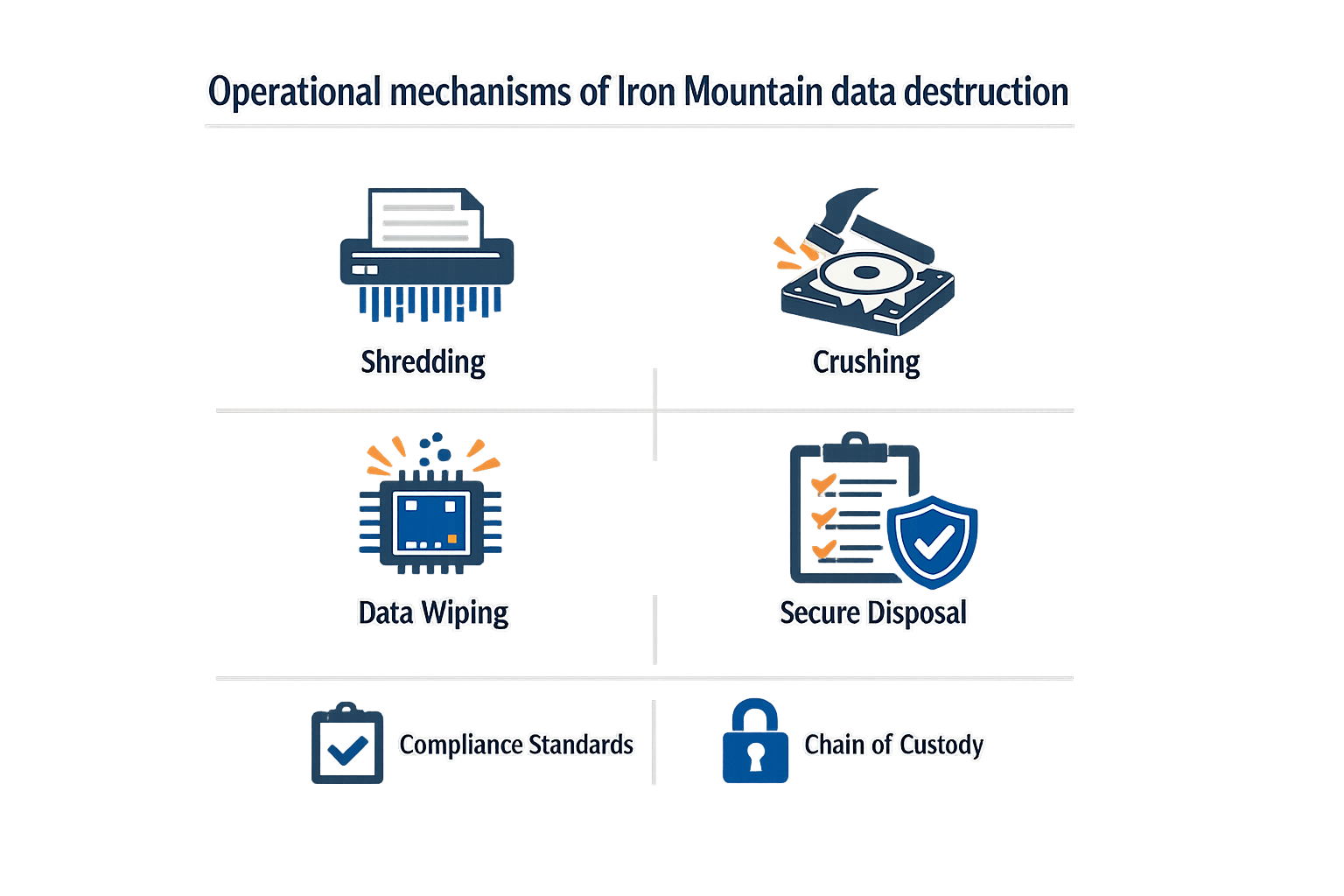
Iron Mountain's data destruction services operate through a structured process designed to render data recovery infeasible. The operator's methodology typically follows NIST SP 800-88 Rev. 2 guidelines, which define three sanitization methods: clear, purge, and destroy. Physical destruction — shredding, crushing, or disintegration — falls under the destroy category, where media is reduced to particles small enough that state-of-the-art laboratory techniques cannot reconstruct the original data.
The operational sequence begins with asset collection and chain-of-custody documentation. Iron Mountain's standard process involves serialized tracking from pickup through final disposition. For hard drives, backup tapes, and other information storage media, the operator maintains an inventory database that logs each device's movement through the destruction workflow. This tracking mechanism is the primary documentary defense in a post-incident regulatory review — the question the auditor will ask is whether the chain of custody survived the full retention period without gaps.
Physical Destruction Methods
Iron Mountain employs industrial shredders that cut or tear media into particles meeting specific size thresholds. For hard drives, the shred process typically reduces platters and housings to fragments smaller than one square inch. Backup tapes undergo similar treatment, with the magnetic media separated from casings and shredded to prevent reassembly. The destroy sanitization method is appropriate for all hard copy and most information storage media, as defined in NIST SP 800-88 Rev. 2.
For organizations managing enterprise data destruction standards, the critical question is not whether the vendor owns a shredder — it is whether the documented process from asset handoff to certificate issuance holds up under audit scrutiny. The Morgan Stanley case demonstrated that even with certificates of destruction in hand, gaps in chain-of-custody documentation and undisclosed subcontracting can create material regulatory exposure.
Certificates of Destruction and Documentary Evidence
Iron Mountain issues certificates of destruction (CODs) upon completion of the shred process. These certificates typically include the date of destruction, a description of the media types processed, and the total weight or count of items destroyed. In our review of vendor documentation standards, the certificate's evidentiary value depends on three factors: whether it ties to serialized asset tracking, whether it identifies the specific facility that performed the destruction, and whether it discloses any downstream subcontractors in the chain.
The certificate is the operator's primary documentary defense, but it is also the document with the highest variance in what it actually means. Some vendors issue batch-level certificates that aggregate hundreds of devices under a single date and weight figure, with no serialized correlation to the original inventory. Others provide device-level certificates with serial numbers, destruction method, and facility location. The difference matters materially when regulators request proof that a specific device containing protected data was destroyed according to policy.
The cheapest vendor is the one whose paper trail you trust enough to hand the auditor without flinching.
Compliance and Verification Mechanisms
Iron Mountain's data destruction services typically operate under R2v3 or e-Stewards certification, which establishes baseline controls for downstream accountability and environmental compliance. These certifications require annual third-party audits of the operator's documented processes, including chain-of-custody procedures and subcontractor management. The published verification provides a floor — it confirms the operator has documented processes that survived an audit at a point in time — but it does not guarantee that every engagement executes those processes without deviation.
The underlying control is whether the operator's contract language obligates them to maintain serialized tracking, disclose all downstream processors, and provide audit-defensible certificates. In practice, many enterprise RFPs do not specify these requirements with sufficient precision, and the resulting contract leaves gaps that only become visible after an incident. The failure mode is predictable: the vendor's standard process may meet certification requirements, but the specific engagement operates under looser terms because the buyer did not specify otherwise.
Real World Examples of Iron Mountain Data Destruction
The most instructive real-world example of data destruction failure in the financial-services sector does not involve Iron Mountain directly — it involves the documented absence of their controls. In 2016, Morgan Stanley Smith Barney decommissioned two primary data centers in Poughkeepsie, NY and Columbus, OH. The firm contracted with a moving company to handle approximately 4,900 devices, including 53 RAID arrays containing unencrypted customer PII and consumer report information. The moving company subcontracted the work to downstream processors without verifying their data-destruction capabilities or obtaining certificates of destruction.
The outcome: in October 2017, nearly a year after the project's completion, an IT consultant in Oklahoma contacted Morgan Stanley to inform them he had purchased hard drives from an online auction site — drives that still contained the firm's customer data. The SEC's subsequent enforcement action documented that Morgan Stanley had failed to obtain certificates of destruction, failed to document chain of custody, and failed to verify that subcontractors performed the destruction work specified in the contract. The cumulative cost of the failure exceeded $100 million in regulatory fines, remediation, and reputational damage.
What the Morgan Stanley Case Reveals About Vendor Selection
The documented failure mode was structural, not technical. Morgan Stanley's policies required certificates of destruction and documented chain of custody. The firm's contract with the moving company specified data-destruction standards. What failed was the verification layer — the mechanism that confirms the contracted service was actually performed by a qualified processor.
In the Morgan Stanley case, the moving company delivered devices to IT Corp A for a brief period, then redirected them to IT Corp B for auction. IT Corp B had data-destruction capability but was never asked to perform it — the moving company assumed the devices had already been wiped. Morgan Stanley's internal investigation revealed that approximately 8,000 backup tapes were also delivered to IT Corp B, and the firm had to email the processor in January 2018 asking whether they could "confirm the disposition of 3k lbs of tapes." The processor could not.
The Operator's Posture in Documented Engagements
Iron Mountain's verified position in the Compare ITAD directory reflects R2v3 and NAID AAA certifications, which require documented chain of custody and serialized tracking for data-bearing devices. In engagements where Iron Mountain performs the destruction work in-house at a certified facility, the documentary record typically includes:
- Serialized asset manifests with pick-up timestamps and facility-receipt confirmation
- Certificates of destruction issued by the facility that physically performed the shredding or degaussing
- Chain-of-custody documentation linking the manifest to the certificate
The trade-off: Iron Mountain shredding cost reflects the expense of maintaining that documentary infrastructure. Operators who bid significantly below Iron Mountain's rates are often using a different control structure — one that may involve downstream subcontracting, batch-level (rather than serialized) tracking, or certificates issued by a processor the enterprise buyer never vetted. For more on what survives audit in certificate documentation, see Data Destruction Certificate: Key Elements and Auditor Expectations.
The question the auditor will ask is not whether you received a certificate — it is whether the certificate documents a verifiable chain of custody from your loading dock to a certified destruction facility.
When the Verified Processor Is Not the Contracted Processor
A recurring failure mode in ITAD engagements is the gap between the contracted vendor and the downstream processor who performs the physical destruction. In the Morgan Stanley case, the firm contracted with a moving company, which subcontracted to IT Corp A, which redirected devices to IT Corp B. None of the processors in the chain were selected by Morgan Stanley's procurement team, and none were subject to the firm's vendor-assessment process.
Iron Mountain's operational model avoids this failure mode in standard engagements by performing destruction in-house. When downstream processing is required — for example, when a regional facility lacks the equipment to handle a specific media type — Iron Mountain's R2v3 certification requires documented approval of the downstream processor and serialized tracking through the transfer. The underlying control is auditable: the chain-of-custody record must show which processor took physical possession of which serialized asset, and the certificate of destruction must be issued by that processor.
The mechanism that prevents the Morgan Stanley failure mode is not the brand name on the contract — it is the verified documentary record that links the contracted service to the performed service. Operators who maintain that record can defend it in a post-incident regulatory review. Operators who do not maintain it cannot.
Benefits of Using Iron Mountain Data Destruction
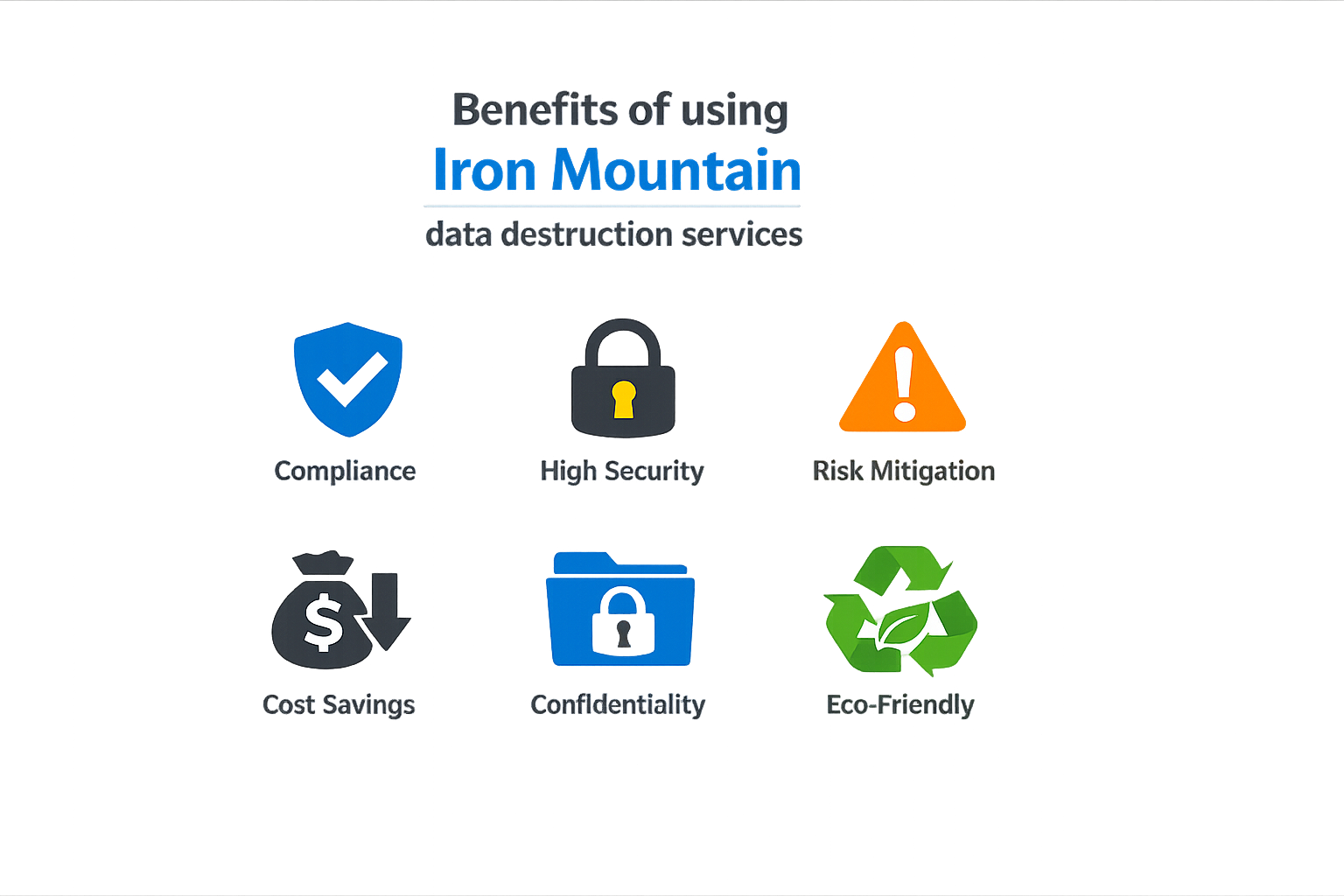
The operator's posture when selecting a data destruction vendor centers on what survives audit. Iron Mountain's documented scale and established compliance frameworks offer enterprise IT teams a known quantity in a market where verification gaps remain common. The benefits are structural — not marketing claims, but the underlying controls that hold up when the auditor asks to see the chain of custody.
Compliance Infrastructure and Regulatory Alignment
Iron Mountain maintains certifications across the major regulatory frameworks that govern data destruction: NAID AAA, e-Stewards, and R2v3. These are not voluntary badges — they represent third-party audits of the operator's documented processes. For organizations subject to SEC Regulation S-P, FINRA, or the FTC Disposal Rule, engaging a certified vendor creates a defensible position when regulators review your disposal practices.
The FTC Disposal Rule requires that organizations implement policies for "burning, pulverizing, or shredding of papers containing consumer information so that the information cannot practicably be read or reconstructed." Iron Mountain's documented processes align to this standard, and their certificates of data destruction provide the documentary record that compliance officers need during regulatory reviews.
Chain-of-Custody Documentation
In our editorial review of vendor profiles, the certificate of data destruction is the document with the highest variance in what it actually means. Iron Mountain's scale allows them to maintain serialized tracking systems that document each asset from pickup through final disposition. This is materially different from batch-level certificates that describe a truckload rather than individual devices.
The e-Stewards standard requires that organizations "verify successful sanitization of all Customer Data" and maintain documentation that confirms "prescribed overwrite instructions have been successfully executed for 100% of a device's physical memory locations." Iron Mountain's compliance with this standard means their certificates should include device-level verification, not aggregate claims.
The cheapest vendor is the one whose paper trail you trust enough to hand the auditor without flinching.
Operational Scale and Geographic Coverage
Iron Mountain operates facilities across North America and internationally, which matters when your decommissioning project spans multiple regions or requires coordinated logistics. For enterprise IT teams managing data center closures or fleet refreshes, a vendor with established infrastructure reduces the operational overhead of managing multiple regional contractors.
This scale also supports consistent processes. A single-location operator may execute flawlessly, but when your project requires simultaneous pickups in twelve cities, the operator's ability to replicate controls across locations becomes the critical variable. Iron Mountain's documented processes and centralized oversight structure are designed for this use case.
Risk Transfer and Indemnification
Iron Mountain's contracts typically include indemnification clauses that transfer liability for data breaches resulting from improper destruction. This is not a substitute for verification — the Morgan Stanley case demonstrates that even large vendors can fail to execute as contracted — but it creates a financial backstop when the operator's controls are properly documented and audited.
For enterprise procurement teams evaluating data destruction certificate components and auditor focus, Iron Mountain's position as a publicly traded company with established insurance coverage provides a different risk profile than smaller operators without comparable financial depth.
Audit-Defensible Reporting
Iron Mountain's reporting infrastructure supports the documentation requirements that enterprise compliance teams face during SOC 2, ISO 27001, or regulatory audits. Their certificates include the specific data destruction methods used (shredding, degaussing, overwrite), the date and location of destruction, and the serial numbers of destroyed devices.
This level of detail is what the auditor will ask for. Generic certificates that state "devices were destroyed in accordance with industry standards" do not hold up when the auditor wants to trace a specific asset from your inventory list through to final disposition. Iron Mountain's systems are built to provide that serialized record.
Integration with Broader ITAD Services
Iron Mountain offers data destruction as part of a broader ITAD service portfolio that includes asset remarketing, logistics, and reporting. For organizations that want to consolidate vendors rather than managing separate contracts for destruction, resale, and transportation, this integration reduces coordination overhead.
The trade-off is flexibility. A specialized data destruction operator may offer more granular control over specific destruction methods or faster turnaround on certificates. Iron Mountain's integrated model prioritizes standardized processes over customization, which works for some operators and constrains others.
Conclusion
Data destruction is not an administrative checkbox — it is the primary documentary defense an enterprise IT team presents when a regulator or auditor asks what happened to the customer records that lived on decommissioned equipment. The operator who can produce serialized certificates of destruction, chain-of-custody records, and a verified downstream processor stands in a materially different position than the operator who cannot. Iron Mountain shredding cost reflects scale, brand recognition, and a global footprint, but the question the auditor will ask is not about the vendor's size — it is about the documentary record that survives the engagement.
In our editorial review of ITAD vendor postures, the operator's ability to verify downstream accountability is the single most predictive factor of audit-defensible outcomes. Iron Mountain's shredding services produce certificates of destruction; the underlying question is whether those certificates document destruction that meets the technical standard the engagement requires, whether the chain of custody is unbroken from pickup to final disposition, and whether the contract language obligates the vendor to the same standard the enterprise IT team is obligated to meet. These are operator-grade questions, and they do not resolve themselves by selecting a name-brand vendor.
The Morgan Stanley case remains the canonical reference for what happens when the documentary record fails. The SEC enforcement action documented devices that left the data center under one contractor's control, passed through subcontractors without serialized tracking, and surfaced months later in an online auction with unencrypted customer data intact. The cumulative cost exceeded $100 million, and the regulatory finding centered on the failure to follow internal policies, obtain certificates of destruction, and maintain chain of custody. The vendor selection process most enterprise IT teams run is not adequate to that risk.
If your organization is evaluating Iron Mountain or any other ITAD vendor, the RFP language must specify the destruction method, the certificate format, the chain-of-custody documentation, and the downstream processor's verified certification posture. The contract must obligate the vendor to the same regulatory standard the enterprise is obligated to meet, and the post-engagement audit trail must be audit-defensible without requiring the vendor's cooperation. For a structured comparison of ITAD vendors and the verification standards underneath them, see our guide to ITAD services categories and vendor selection.
The cheapest vendor is the one whose paper trail you trust enough to hand the auditor without flinching. That is the trade-off, and it is not negotiable.
Frequently asked questions
What factors determine Iron Mountain shredding cost?
Iron Mountain shredding cost depends on volume, media type (hard drives, tapes, solid-state devices), service model (mobile on-site vs. facility-based), chain-of-custody requirements, and geographic coverage. Higher volumes and facility-based processing typically reduce per-device costs, while mobile services and serialized tracking increase pricing.
How does Iron Mountain shredding cost compare to other ITAD vendors?
Iron Mountain's pricing reflects the cost of maintaining NAID AAA and R2v3-certified processes, serialized tracking infrastructure, and global logistics networks. Operators who bid significantly below Iron Mountain's rates often use batch-level tracking, subcontract destruction to unvetted processors, or issue generic certificates that may not survive audit scrutiny.
Does Iron Mountain shredding cost include certificates of destruction?
Yes, Iron Mountain's standard pricing includes certificates of destruction issued upon completion of the shred process. The certificate's evidentiary value depends on whether it includes serialized asset tracking, identifies the specific destruction facility, and discloses any downstream subcontractors in the chain of custody.
What is the difference between mobile and facility-based Iron Mountain shredding cost?
Mobile (on-site) shredding costs more per device because Iron Mountain deploys equipment and personnel to your location, but it provides real-time chain-of-custody visibility. Facility-based destruction processes assets at Iron Mountain's secured sites, supports higher volumes, and typically costs less per device but introduces a custody handoff that must be documented.
How can I verify that Iron Mountain shredding cost is audit-defensible?
Request sample certificates of destruction, verify current NAID AAA and R2v3 certification status, confirm that the contract specifies serialized tracking and device-level certificates, and ensure the RFP language obligates Iron Mountain to disclose all downstream processors. The documentary record must link your inventory list to the certificate without gaps.