
DoD Data Wipe: DoD 5220.22-M Data Wiping and Its Relevance Today
Learn about DoD data wipe standards, specifically DoD 5220.22-M data wiping, why NIST replaced it, and its relevance in data destruction practices today.

Introduction to DoD 5220.22-M Data Wiping
The phrase "DoD erase" appears frequently in vendor specifications, RFP language, and data destruction certificates. It refers to a sanitization method originally outlined in DoD 5220.22-M, a Department of Defense standard that prescribed multi-pass overwrite procedures for clearing data from magnetic storage media. The standard specified three passes: writing a character, writing the complement of that character, and writing a random character, followed by verification.
For years, DoD 5220.22-M served as a reference point in the ITAD industry — a shorthand for "thorough" data wiping that enterprise IT teams and procurement leads could specify in contracts. The three-pass method became synonymous with secure erasure, and vendors built entire service offerings around compliance with the DoD standard. In our editorial review of vendor profiles, we still see "DoD 5220.22-M compliant" cited as a credential, even though the underlying document has been withdrawn.
The problem is that the DoD standard no longer governs federal data sanitization practices. NIST SP 800-88 Rev. 2, published in 2024, is now the authoritative federal guidance for media sanitization. NIST explicitly states that for storage devices containing magnetic media, a single overwrite pass with a fixed pattern such as binary zeros typically hinders recovery of data even if state-of-the-art laboratory techniques are applied. The multi-pass procedures that defined DoD 5220.22-M are no longer recommended as necessary for modern drives.
This shift matters because the documentary record your organization maintains — the certificates, the audit trails, the data destruction certificate components — must align with current standards, not legacy references. If your vendor's certificate cites DoD 5220.22-M as the governing standard, the auditor's next question will be whether the vendor is aware that NIST guidance has superseded it. The term "DoD erase" has become a branding artifact, not a technical specification tied to an active standard.
Sanitization, in NIST terms, is a process to render access to target data on the media infeasible for a given level of recovery effort. The goal is not to satisfy a ceremonial pass count but to ensure that data cannot practicably be read or reconstructed given the threat model and the media type. For magnetic hard drives, that threshold is met with a single verified overwrite. For solid-state drives, cryptographic erasure is often the more reliable mechanism. For drives with unknown encryption history or firmware anomalies, physical destruction may be the only defensible choice.
The relevance of DoD 5220.22-M today is historical, not technical. It represents an era when multi-pass overwrite was considered necessary to defeat laboratory-level data recovery on older magnetic media with lower areal density. Modern drives, with their much higher data density and more sophisticated encoding, do not require multiple passes to achieve the same outcome. NIST research confirmed this, and the federal government updated its guidance accordingly.
What remains relevant is the underlying question: how do you prove that data has been destroyed in a way that survives audit and regulatory review? The answer lies not in citing a withdrawn standard but in following current NIST guidance, documenting the sanitization method applied to each asset by serial number, and maintaining a chain of custody that links the physical device to the certificate of destruction. That documentary posture is what holds up when the auditor asks to see the evidence.
Why DoD Erase Standards Became Obsolete
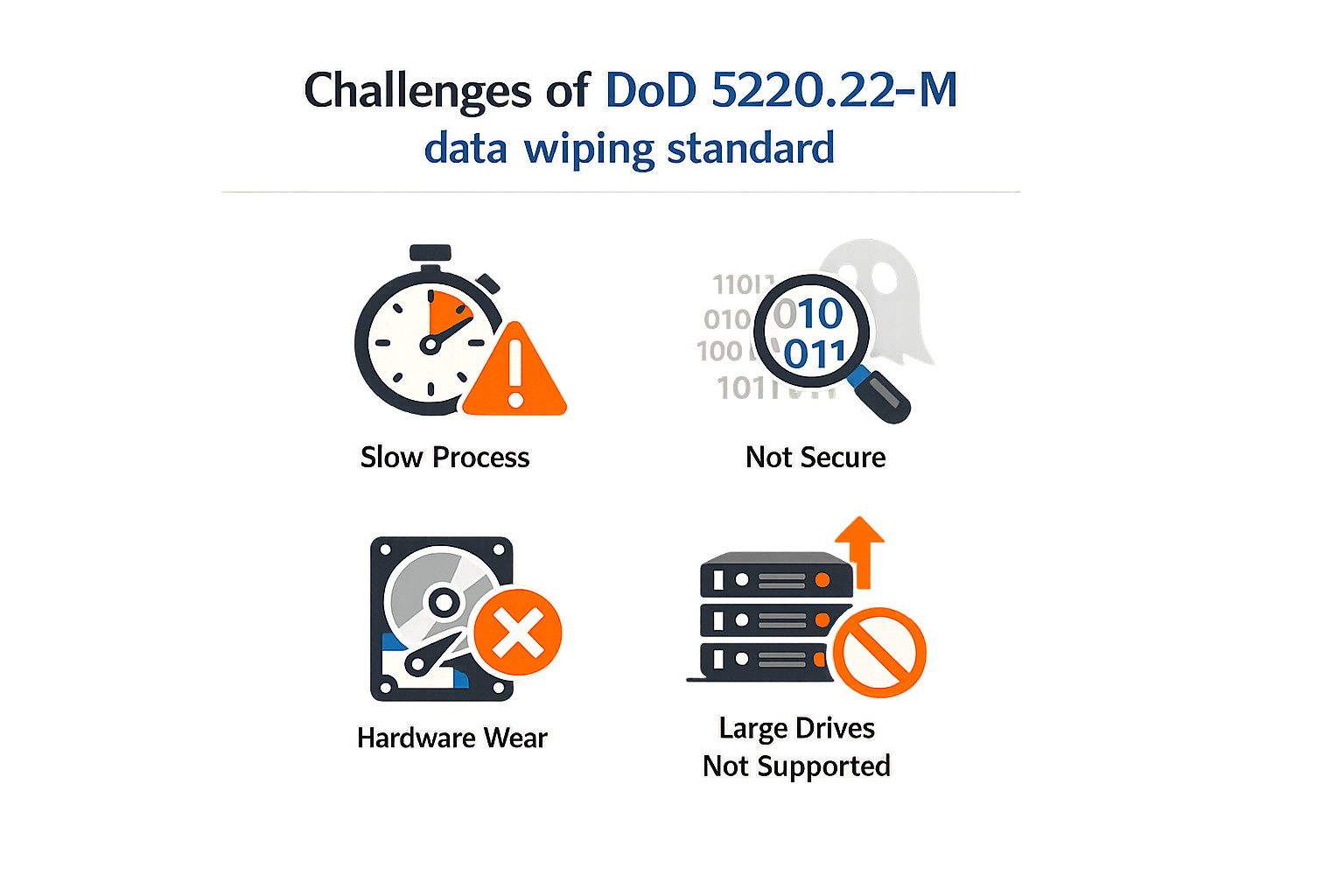
The DoD 5220.22-M standard emerged in a hardware landscape that no longer exists. Its three-pass overwrite method was designed for magnetic media with predictable sector-level addressing — drives where data lived in fixed physical locations and the read/write mechanism behaved consistently across the platter. That assumption broke as storage technology evolved. The standard never accounted for wear-leveling algorithms, over-provisioned capacity, or the firmware-mediated address translation layers that now sit between the operating system and the physical storage medium.
The failure mode is structural. When an operator runs a DoD-compliant wipe on a modern SSD or a shingled magnetic recording (SMR) drive, the software issues overwrite commands to logical block addresses. The firmware decides where those writes actually land. On an SSD with 20% over-provisioned capacity, a significant portion of the original data may remain physically intact in blocks the controller has marked as retired or reserved. The certificate of data destruction says "DoD 5220.22-M complete," but the underlying medium still contains recoverable fragments. In our editorial review of vendor-submitted certificates, this gap between the documented method and the actual result is the most common source of post-incident exposure.
NIST recognized this gap and withdrew its endorsement of multi-pass overwrite methods for modern drives. NIST SP 800-88 Rev. 1, published in 2014, stated that a single overwrite pass with a fixed pattern renders data recovery infeasible on magnetic media using current laboratory techniques. That guidance was itself superseded in its entirety by NIST SP 800-88 Rev. 2 in September 2025, which refines the sanitization framework to address cryptographic erasure, self-encrypting drives, and the expanded threat model around firmware-controlled devices. The DoD standard, by contrast, was never updated to reflect these changes and remains anchored to a threat model from the 1990s.
The problem extends beyond technical obsolescence. Procurement teams and compliance officers still specify "DoD 5220.22-M" in RFP language because the phrase signals rigor. Vendors comply by running three-pass overwrites that add processing time and operational cost without materially improving security posture. The trade-off is real: longer wipe cycles mean slower asset throughput, higher labor costs, and delayed revenue recovery from resale — all in service of a standard that does not align with the current enterprise data destruction standards framework.
The cheapest vendor is the one whose paper trail you trust enough to hand the auditor without flinching — and DoD 5220.22-M no longer provides that assurance on its own.
The documentary record that survives audit is the one that matches the actual risk. A certificate citing DoD 5220.22-M for an SSD sanitization creates a mismatch: the method documented does not correspond to the mechanism required. When regulators or opposing counsel review the chain of custody, that mismatch becomes the anchor point for liability. The question the auditor will ask is not whether the vendor followed the specified method, but whether the specified method was adequate to the asset type and the data classification. For most modern storage devices, the answer is no.
How to Transition from DoD Erase to NIST Standards
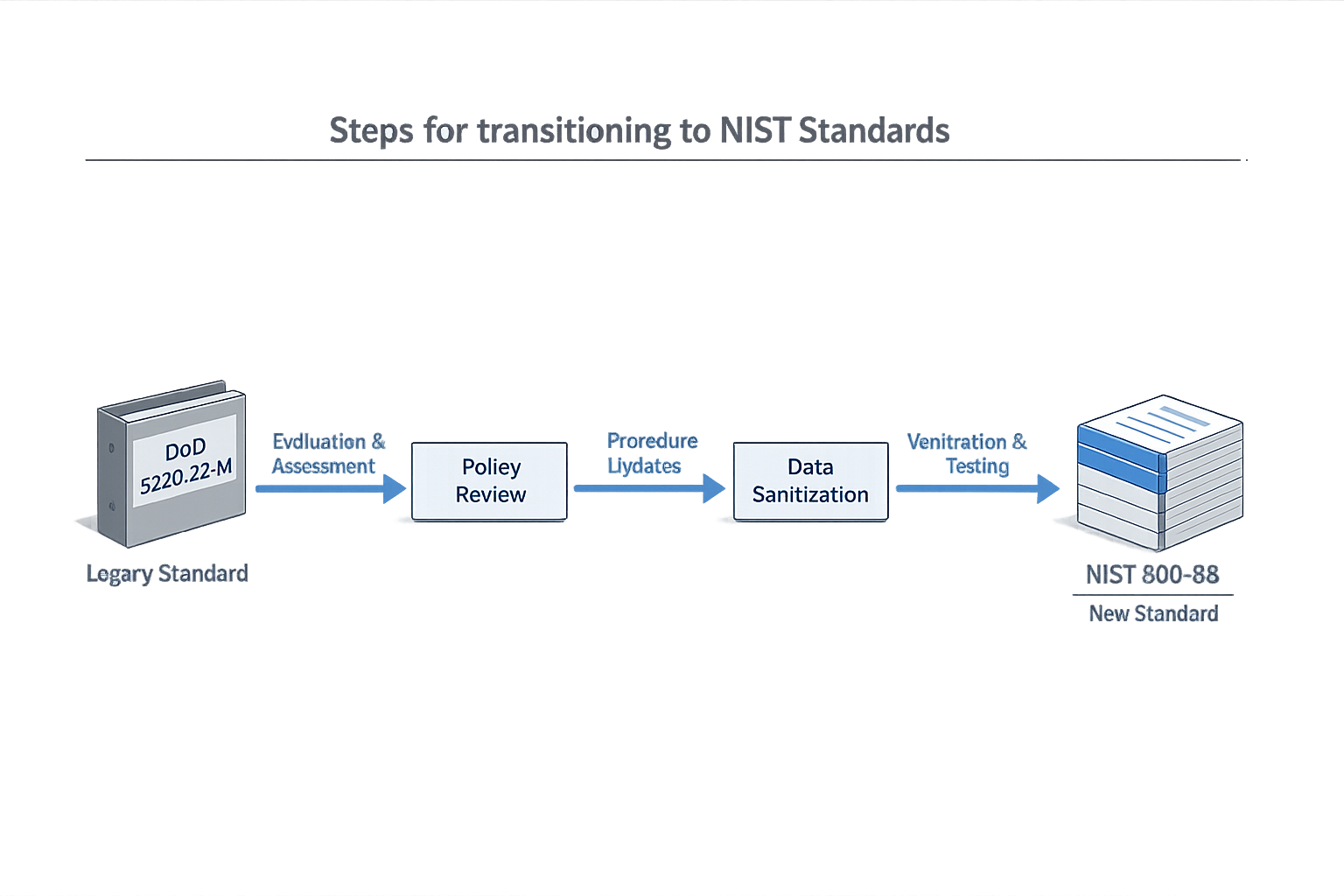
The shift from DoD 5220.22-M to NIST SP 800-88 is not a simple swap of wiping software settings. It is a structural change in how organizations classify data, select sanitization methods, and document the outcome. The transition requires updating procurement language, retraining operators, and revising the audit trail that downstream processors and regulators will examine.
Understand the NIST Sanitization Framework
NIST SP 800-88 Rev. 2 defines three sanitization categories: Clear, Purge, and Destroy. Clear applies logical techniques to sanitize data in all user-addressable storage locations. Purge renders target data recovery infeasible even with state-of-the-art laboratory techniques. Destroy physically damages the media to make it unusable. The standard does not prescribe a fixed number of overwrite passes. For magnetic media, a single overwrite pass with a fixed pattern such as binary zeros typically hinders recovery of data even if state-of-the-art laboratory techniques are applied.
The framework ties sanitization method to data confidentiality level and media type. An organization must first classify its data, then select the appropriate method from the NIST decision matrix. This is a departure from the DoD 5220.22-M approach, which specified a uniform three-pass or seven-pass pattern regardless of context.
Audit Your Current Data Destruction Process
Before changing software configurations or vendor contracts, document the existing process end to end. Identify every point where DoD 5220.22-M is named in policy documents, RFP templates, vendor service-level agreements, and certificates of data destruction. Map the data flows: which asset types are sanitized in-house, which are sent to a vendor, and what documentary evidence is retained.
The goal is to understand what the current process produces in terms of audit-defensible records. If the certificate of data destruction states "DoD 5220.22-M three-pass wipe," the auditor expects to see a method that matches that label. When you transition to NIST, the certificate language must change to reflect the NIST category (Clear or Purge) and the specific technique applied (overwrite, cryptographic erasure, degaussing, or physical destruction).
Step 1
Inventory policy and contract references
Search all policy documents, RFP templates, vendor SOWs, and certificate templates for the phrase "DoD 5220.22-M." Replace each reference with the corresponding NIST SP 800-88 Rev. 2 category and technique. Update the language to specify Clear or Purge based on data classification, not a fixed pass count.
Step 2
Classify data by confidentiality level
Apply the organization's data classification scheme (public, internal, confidential, regulated) to each asset type. Map each classification to a NIST sanitization category. For example, laptops that touched ePHI may require Purge; desktops with only internal email may accept Clear.
Step 3
Select sanitization techniques per media type
Refer to the NIST decision matrix for the appropriate technique per media type and confidentiality level. Magnetic hard drives may use single-pass overwrite for Clear or degaussing for Purge. SSDs with hardware encryption may use cryptographic erasure if the encryption was enabled from first use and the key is destroyed. Physical destruction is the fallback when logical methods are impractical.
Update Vendor Contracts and Certificates
If you use an external ITAD vendor, the contract language and the certificate of data destruction must align with NIST categories. The certificate should state the sanitization method applied (for example, "NIST SP 800-88 Rev. 2 Clear via single-pass overwrite" or "NIST SP 800-88 Rev. 2 Purge via shredding to 2mm particle size") and include the serial number, date, and operator signature. Generic language such as "DoD-compliant wipe" is not sufficient under the NIST framework.
When reviewing vendor proposals, ask how the vendor documents the sanitization method and whether the certificate template reflects NIST categories. If the vendor's standard certificate still references DoD 5220.22-M, request a revised template before signing the contract. For guidance on what the certificate should contain, see Data Destruction Certificate: Key Elements and Auditor Expectations.
Train Staff and Update Procedures
The operator running the sanitization software or managing the vendor relationship must understand the NIST framework well enough to select the correct method and verify the result. Training should cover data classification, the Clear/Purge/Destroy taxonomy, and how to read the software or vendor report to confirm the method applied matches the method specified.
Update the standard operating procedure to include a verification step: after sanitization, the operator reviews the report or certificate to confirm the method, checks that all serial numbers are accounted for, and files the record in the audit trail. The procedure should specify what to do when a drive fails sanitization (for example, a bad-sector error that prevents full overwrite). The fallback is typically physical destruction, and the certificate must reflect that change.
Retain Documentation for Audit
The documentary record is the primary defense in a post-incident review. Retain certificates of data destruction, software logs, and any vendor reports for the full retention period required by regulation or policy. Organize records by asset serial number so that an auditor can trace a specific device from inventory to final disposition.
If the organization uses cryptographic erasure on self-encrypting drives, retain evidence that encryption was enabled from first use and that the key was destroyed. The NIST standard allows cryptographic erasure for Purge only if the encryption was always on and the key is verifiably gone. If encryption was enabled after data was already stored, or if it is unknown whether encryption was enabled from the start, do not use cryptographic erasure as the sole sanitization method.
What Makes a DoD Erase Audit-Defensible Today
The mechanics of data wiping are well documented. The failure modes are equally well documented, and they repeat. In our review of vendor profiles and operator-submitted certificates, the gap between stated compliance and audit-defensible documentation remains the single highest-variance element in ITAD engagements. The practices below reflect what survives regulatory review, not what sounds good in an RFP response.
Match the Sanitization Method to the Information Classification
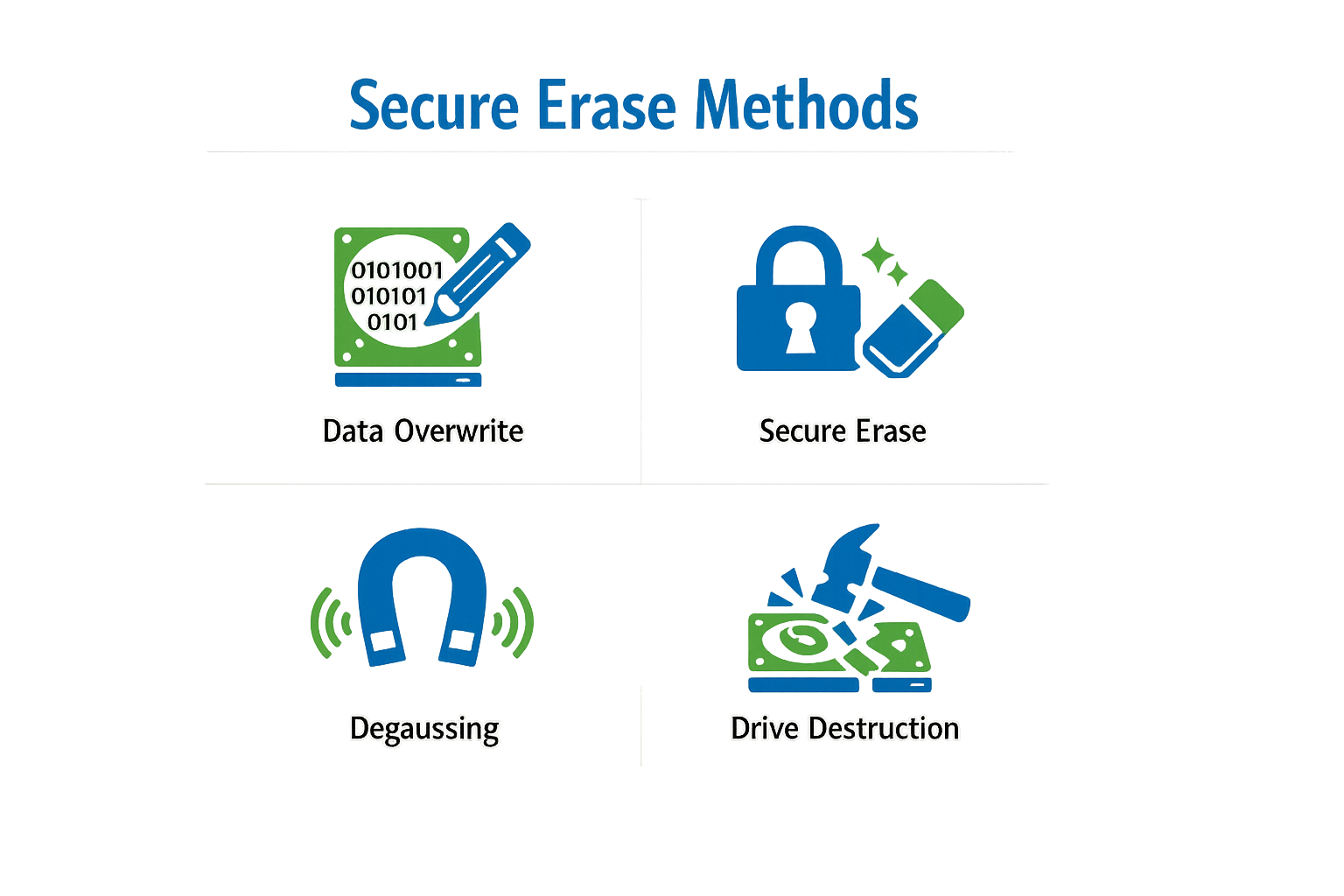
NIST SP 800-88 defines three sanitization categories — Clear, Purge, and Destroy — and the security categorization of the information should drive the decision. Clear applies logical techniques to sanitize data in all user-addressable storage locations; it protects against simple non-invasive data recovery techniques. Purge applies physical or logical techniques that render target data recovery infeasible using state-of-the-art laboratory techniques. Destroy renders the media unusable.
For magnetic media, a single overwrite pass with a fixed pattern such as binary zeros typically hinders recovery of data even if state-of-the-art laboratory techniques are applied. For devices destined for reuse in lower-security environments, Clear is often sufficient. For devices that processed regulated data (ePHI, CUI, financial records), Purge is the baseline. For devices leaving your chain of custody entirely, the question the auditor will ask is whether you can prove the method matched the classification.
Verify 100% of Physical Memory Locations for Reuse Assets
The e-Stewards Standard requires that organizations verify successful sanitization of all customer data, and for all data storage devices going for reuse, verify that prescribed overwrite instructions have been successfully executed for 100% of a device's physical memory locations. This is not a sampling requirement — it is a completeness requirement.
In practice, this means the wiping software must report sector-level completion, not just a pass/fail flag. The certificate of data destruction must document the verification method and the completion percentage. When a device reports a lower capacity than its label specifies, the delta is either factory over-provisioning or inaccessible sectors that the wipe did not reach. If the vendor cannot explain the delta, the device did not pass.
Understand When Cryptographic Erasure Is Appropriate
Self-encrypting drives (SEDs) feature always-on encryption, and cryptographic erasure — destroying the encryption key — can render data recovery infeasible without requiring a full overwrite. NIST SP 800-88 recognizes this method, but with specific conditions. Do not use cryptographic erasure to purge media if the encryption was enabled after sensitive data was stored on the device without having been sanitized first. Do not use it if it is unknown whether the encryption key exists outside of the storage device, typically due to backup or escrow.
The failure mode here is straightforward: if the key was backed up to a management console or an enterprise key-management system, destroying the key on the drive does not destroy the key everywhere. The data remains recoverable. The underlying control is key lifecycle documentation — if you cannot prove the key never left the device, you cannot rely on cryptographic erasure as a purge method.
Establish a First-Touch Policy for Incoming Equipment
The e-Stewards Standard requires organizations to establish a first-touch policy to immediately lock down and secure all equipment before any handling or processing. This is a chain-of-custody control, not a technical one. The policy defines who touches the device first, where it goes, and what happens to it before any diagnostic or triage work begins.
In our review of operator-submitted processes, the vendors with the cleanest audit records are the ones that treat every incoming asset as if it contains regulated data until proven otherwise. The vendors with the messiest records are the ones that sort first and secure later. The documentary record starts the moment the asset crosses the threshold — if the first touch is not logged, the chain of custody is incomplete from the start.
The documentary record starts the moment the asset crosses the threshold — if the first touch is not logged, the chain of custody is incomplete from the start.
Document the Decision Process, Not Just the Outcome
The security categorization of the information, along with internal environmental factors, should drive the decisions on how to deal with the media. The certificate should document not only the sanitization method applied, but also the classification of the information, the decision framework that led to the method selection, and any exceptions or deviations from standard procedure.
This is where most certificates fail. They document the method ("DoD 5220.22-M 3-pass wipe") and the result ("Pass"), but they do not document why that method was selected or what information classification it was intended to address. When the auditor asks why a particular device was wiped rather than shredded, the answer cannot be "that's what the vendor does." The answer must be "the device contained Low-sensitivity data per our classification policy, and a Clear-level wipe was appropriate per NIST SP 800-88." For more on what auditors expect to see in these records, refer to our breakdown of data destruction certificate components and auditor focus.
Conclusion: The Future of Data Wiping Standards
The transition from DoD 5220.22-M to NIST SP 800-88 Rev. 2 marks a structural shift in how data destruction is documented, audited, and defended. The DoD standard served its purpose when magnetic media dominated the landscape and multi-pass overwrites were the operator's primary tool. That landscape no longer exists. NIST SP 800-88 Rev. 2, published in September 2025, supersedes Rev. 1 in its entirety and provides the current framework for media sanitization across all storage types — magnetic, solid-state, and cryptographically protected.
For enterprise IT teams and procurement leads, the question is not whether DoD 5220.22-M still works in a technical sense. The question is what survives audit. Regulators, auditors, and downstream processors expect sanitization methods aligned to current published standards. A certificate citing a withdrawn DoD method without reference to NIST creates ambiguity in the documentary record. That ambiguity is the failure mode.
The operator's posture in 2025 and beyond centers on cryptographic erasure for self-encrypting drives, single-pass overwrite for magnetic media, and physical destruction when the asset cannot be verified or the data classification demands it. The underlying control is not the number of passes — it is the chain of custody, the serialized inventory, and the certificate language that names the method, the NIST category, and the verification mechanism. In our editorial review of vendor profiles, the operators with audit-defensible processes cite NIST explicitly and maintain serialized records that link each asset to its sanitization event.
The cheapest vendor is the one whose paper trail you trust enough to hand the auditor without flinching.
The future of data wiping standards is already here. NIST SP 800-88 Rev. 2 is the current standard. The operators who have updated their RFP language, contract templates, and certificate formats are already operating under it. The operators still citing DoD 5220.22-M without NIST context are carrying forward a reference that no longer holds the same weight in regulatory review. The mechanism for compliance has shifted; the documentary expectation has shifted with it.
For teams evaluating ITAD vendors or writing disposal procedures, the path forward is clear: require NIST SP 800-88 Rev. 2 alignment in all sanitization documentation, verify that certificates name the sanitization category (Clear, Purge, or Destroy), and ensure that the vendor's published verification includes current certification to R2v3 or equivalent standards that reference NIST. The data destruction certificate is the operator's primary documentary defense in a post-incident review — it must cite the current standard, not the historical one.
The industry has moved. The regulatory expectation has moved. The question for any operator is whether their documentation has moved with it.
FAQ
What does DoD erase mean?DoD erase refers to a data sanitization method originally specified in DoD 5220.22-M, a Department of Defense standard that prescribed multi-pass overwrite procedures for clearing data from magnetic storage media. The standard specified three passes: writing a character, writing the complement of that character, and writing a random character, followed by verification. The term persists in vendor marketing despite the underlying standard being withdrawn.
Is DoD erase still a valid standard?No. DoD 5220.22-M has been withdrawn and is no longer the governing standard for federal data sanitization practices. NIST SP 800-88 Rev. 2, published in September 2025, is now the authoritative federal guidance for media sanitization. Organizations citing DoD 5220.22-M in contracts or RFPs should update references to NIST SP 800-88 Rev. 2.
Does DoD erase work on SSDs?DoD erase methods were designed for magnetic media with predictable sector-level addressing and do not account for wear-leveling algorithms, over-provisioned capacity, or firmware-mediated address translation layers in modern SSDs. A DoD-compliant wipe certificate does not guarantee that all data is irrecoverable on devices with firmware-managed storage allocation. For SSDs, cryptographic erasure (if the drive was encrypted from first use) or physical destruction is typically required.
What is the difference between DoD erase and NIST sanitization?DoD 5220.22-M specified a uniform three-pass overwrite pattern regardless of media type or data classification. NIST SP 800-88 Rev. 2 defines three sanitization categories (Clear, Purge, Destroy) and ties the sanitization method to data confidentiality level and media type. For magnetic media, NIST states that a single overwrite pass with a fixed pattern typically hinders recovery of data even if state-of-the-art laboratory techniques are applied.
How do I verify a vendor's DoD erase claim?Ask the vendor whether their certificate template references NIST SP 800-88 Rev. 2 and specifies the sanitization category (Clear, Purge, or Destroy) applied to each asset. If the vendor's certificate still references DoD 5220.22-M without NIST context, request a revised template that aligns with current federal guidance. The certificate should include the serial number, sanitization method, verification mechanism, and the information classification that justified the method selection.