
Enterprise Data Center Shutdown: Asset Recovery and Disposal Planning
Complete guide to enterprise data center shutdown planning, covering asset recovery, disposal strategies, and decommissioning best practices for enterprises.
Introduction
The enterprise data center shutdown is an operator's moment of maximum documentary exposure. Every hard drive, every RAID array, every backup tape that leaves the building creates a chain-of-custody obligation that extends years into the future. In our editorial review of 35 vendor profiles and three years of regulatory enforcement records, the pattern is consistent: the failure mode is not technical, it is procedural. The vendor you select performs one process, documents a different process, and the gap emerges only when the regulator asks for the serialized record.
The 2016 Morgan Stanley Smith Barney data center decommissioning illustrates the mechanism precisely. Moving Company was retained to decommission two primary data centers, handling approximately 4,900 devices including 53 RAID arrays containing roughly 1,000 hard drives and 8,000 backup tapes. The contract specified one process — devices delivered to a certified processor, inventoried in a tracking database, wiped or destroyed with certificates of destruction issued for each serialized device. The actual process diverged early: the subcontractor relationship changed, the tracking database was abandoned, certificates of destruction stopped being issued, and hard drives were transported still mounted in their cabinets, contrary to the operator's own policies. No one at MSSB monitored the database or maintained direct contact with the processor to verify the documented process matched the actual process.
That gap — between what the contract promised and what the vendor delivered — is the risk you are managing in a data center decommissioning engagement. It is not an edge case. It is the central planning problem.
This guide walks through the planning structure that reduces that gap: how to inventory before bidding, how to evaluate vendor posture beyond the marketing deck, how to structure the contract so the documented process and the actual process remain aligned, and how to verify that alignment while the engagement is still active. The goal is not perfection — the goal is an audit-defensible record that matches what actually happened to the assets under your control.
Problem Statement
The enterprise data center shutdown introduces a set of concurrent risks that do not resolve themselves through standard IT project management. Asset inventories become incomplete the moment the first rack leaves the floor. Chain-of-custody documentation gaps emerge when multiple contractors handle different phases of the decommission. And the regulatory exposure compounds when the organization cannot produce serialized destruction records for every data-bearing device that left the facility.
In our editorial review of documented ITAD failures, the shutdown scenario is where the operator's posture matters most — and where the documentary record most often fails to survive audit.
The Inventory Problem
Data centers contain more data-bearing devices than most IT teams realize. Routers retain configuration files. Out-of-band management controllers store access logs. Backup appliances hold encryption keys. When the decommission timeline compresses — and it always compresses — these secondary storage devices disappear into the asset stream without individual tracking. The e-Stewards Standard requires "clear identification of all equipment and components that require data security services, either by using a manufacturer-designated serial number or assigning a unique number for each device." In practice, the operator who runs batch processing for non-serialized devices is the operator whose certificate the auditor will challenge.
The Chain-of-Custody Failure Mode
The standard enterprise shutdown involves at least three handoffs: internal IT to the decommissioning contractor, contractor to the ITAD processor, ITAD processor to the downstream destruction or refurbishment facility. Each handoff is a point where custody documentation can degrade. The e-Stewards Standard stipulates that chain of custody must "provide secure logistics, including the transport of data-bearing devices to the Organization's facility(s), between the Organization's facilities, and/or to the End Provider(s), and maintain effective physical and electronic controls throughout the transport and transfer processes." The question the auditor will ask is not whether your primary vendor maintained custody — it is whether you can produce the signed transfer record for every downstream handoff, including subcontractors you did not select.
For a detailed breakdown of what drives cost in these engagements, see our analysis at Data Center Decommissioning Cost: A Realistic Breakdown.
The Sanitization Verification Gap
The certificate of data destruction is the operator's primary documentary defense in a post-incident regulatory review. It is also, in our review of vendor profiles, the document with the highest variance in what it actually means. The e-Stewards Standard requires that organizations "verify successful sanitization of all Customer Data, whether clearing, purging, or destroying data storage devices" and "retain verification records of successful sanitization for each serialized device." Failed sanitization must also be logged. The gap emerges when the vendor's certificate does not specify the sanitization method per device type, does not list failed devices, and does not tie the destruction event to a serialized inventory.
The cheapest vendor is the one whose paper trail you trust enough to hand the auditor without flinching.
The Compliance Timeline Trap
Regulatory disclosure timelines do not pause while you reconstruct what happened to an asset. HIPAA breach notification rules trigger the moment you cannot account for a device that may have contained ePHI. The e-Stewards Standard requires that data sanitization occur "prior to its departure from the Organization's Control" — which means the destruction event must complete before the device leaves your contracted processor's facility, not at some later point in the downstream chain. The operator who signs off on a shutdown plan without confirming that timeline is the operator who will explain the gap to counsel when the regulator's letter arrives.
Solution Steps for Effective Shutdown Planning
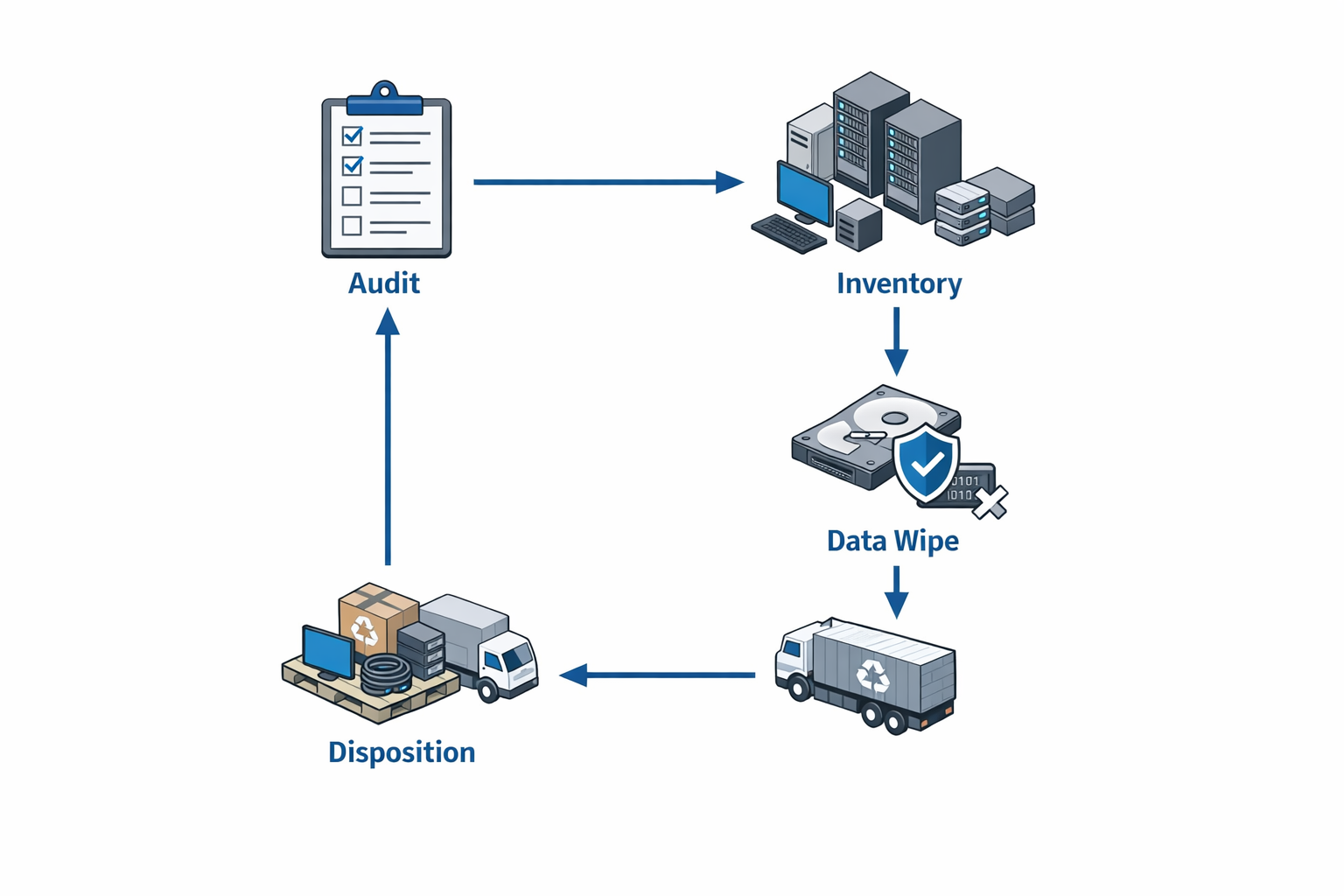
An effective enterprise data center shutdown requires a documented sequence that addresses asset recovery, data security, and chain-of-custody from the moment equipment leaves the rack until sanitization is verified. The following steps outline the operator-grade approach that survives audit.
Step 1: Inventory Before Vendor Contact
Step 1
Catalog every device by serial and data-bearing status
Before any vendor sees the asset list, catalog every device by manufacturer serial number, location, and data-bearing classification. Non-serialized devices (small drives, USB keys, standalone media) require secure accumulation containers with tracking labels. The inventory drives the RFP scope; if your list is incomplete, your bids will be incomplete too.
The e-Stewards Standard requires organizations to "establish a clearly defined chain of custody for devices containing or possibly containing Customer Data" that begins at the point of transfer. That transfer starts with your inventory — what you cannot count, you cannot track, and what you cannot track, you cannot defend in a post-incident review.
Step 2: Define the Data Security Requirement
Step 2
Specify sanitization method and verification standard
For every data-bearing device, specify the sanitization method in writing: logical overwrite to NIST 800-88 standards for devices destined for reuse, or physical destruction for devices going to materials recovery. Require serialized certificates of destruction or data sanitization for 100% of devices, not batch-level reporting.
The R2v3 standard states that "data sanitization may be performed by the facility or outsourced to a verified downstream vendor" — but the upstream operator retains responsibility. If the vendor subcontracts sanitization, the contract must name the downstream processor and require proof of their certification posture before any device leaves your control.
Step 3: Establish Physical Security Controls
Devices in transit are devices at risk. The contract must specify:
- Locked transport from the data center to the vendor's certified facility, with GPS tracking and tamper-evident seals on containers
- Segregated storage at the vendor facility, where data-bearing devices are isolated from loading docks and areas accessible to unauthorized personnel
- Background-verified personnel handling customer data, as required by the e-Stewards Standard's worker-control provisions
In the 2016 data center decommissioning case, devices were transported with hard drives still mounted in their cabinets, contrary to the operator's own policies. The vendor later sold the cabinets to a third party with drives in place — a structural failure in physical security that no certificate could remediate after the fact.
Step 4: Require Real-Time Tracking Access
Step 4
Demand direct access to the vendor's tracking system
The contract should grant you read access to the vendor's inventory database, updated in real time as devices move through intake, sanitization, and final disposition. Batch reporting at project close is not adequate — you need to see the current status of serialized devices while the engagement is live.
In the Morgan Stanley matter, the upstream operator had access to IT Corp A's tracking database but never monitored it. When the subcontractor relationship ended early in the project, the database went dark — and no one at the upstream operator noticed until the regulatory review began. Real-time access is worthless if no one is assigned to check it.
Step 5: Verify Downstream Processor Credentials
If the vendor will subcontract any portion of the sanitization or disposition work, require:
- Named downstream processors in the contract, with current R2v3, e-Stewards, or NAID AAA certification
- Proof of certification before any device is transferred to the downstream processor
- Contractual flow-down of data security and chain-of-custody requirements to the subcontractor
The e-Stewards Standard requires that organizations "retain responsibility for preventing unauthorized access to or release of any Customer Data, regardless of whether data-bearing devices are going for Direct Reuse, Materials Recovery, or Final Disposal." That responsibility does not transfer when you hire a vendor — it remains with you through the entire downstream chain.
For a detailed breakdown of what to negotiate in vendor contracts, see Data Center Decommissioning Services: What's Included, What's Extra.
Step 6: Conduct Pre-Close Verification
Step 6
Audit certificates before final payment
Before closing the engagement, verify that you have received serialized certificates of destruction or data sanitization for 100% of data-bearing devices. Cross-check certificate serial numbers against your intake inventory. Any missing serials require written explanation and remediation before final payment.
The certificate of data destruction is the operator's primary documentary defense in a post-incident regulatory review — and the document with the highest variance in what it actually means.
The R2v3 standard requires facilities to "maintain specific device tracking and sanitization records" as part of the data sanitization process. If the vendor cannot produce a serialized record for a device that was in your inventory, that device is unaccounted for — and in a regulatory review, unaccounted-for devices are treated as breached devices until proven otherwise.
Tips and Tricks for Asset Recovery and Disposal

The documentary record you build during asset recovery is the only thing standing between you and a regulatory enforcement action. The Morgan Stanley case demonstrated that gap: devices left the data center, tracking databases went dark mid-engagement, and no one at the enterprise verified that the contracted destruction actually occurred. The result was a $100M+ cumulative cost and a permanent reference point in SEC enforcement.
Verify Downstream Processor Credentials Before Pickup
The contract says one thing. The truck that arrives may be operated by a different entity entirely. In the 2016 Morgan Stanley data center decommissioning, the primary contractor ceased working with the subcontractor early in the engagement, but no one at the enterprise noticed until the enforcement review. The inventory tracking database went offline, certificates of destruction stopped arriving, and devices continued leaving the facility.
Before any asset leaves your control, verify the downstream processor's R2v3 certification status and confirm that your contract explicitly permits the handoff. R2v3 Core 7 requires that data-containing devices remain secured from the moment they enter the facility's control, and that data sanitization—whether physical destruction or logical wiping—follows documented processes. If the vendor outsources sanitization, the downstream processor must meet the same R2v3 Downstream Vendor Qualifications.
Track Devices Individually, Not in Batches
Enterprise IT teams often inventory decommissioned hardware in bulk: "47 servers, 12 storage arrays, 200 drives." That aggregation breaks chain of custody. When an auditor or regulator asks what happened to a specific RAID array containing unencrypted customer data, the answer "it was part of a batch we sent to the vendor" does not survive discovery.
In the Morgan Stanley case, Moving Company handled approximately 4,900 devices, including 53 RAID arrays containing roughly 1,000 hard drives. The enterprise transported hard drive shelves with drives still in place, contrary to its own policies. One downstream processor sold the shelves to another purchaser with the drives still present. Serial-level tracking would have surfaced that failure before the devices left the building.
For facilities performing logical data sanitization under R2v3 Appendix B, the standard requires specific device tracking and sanitization records for every unit processed. If your vendor cannot provide serialized documentation, the vendor cannot meet the standard.
Facilities that perform logical data sanitization must maintain specific device tracking and sanitization records—batch-level documentation does not meet the requirement.
Maintain Direct Access to the Tracking Database
The Morgan Stanley engagement included a provision for direct database access: the subcontractor inventoried devices throughout collection, wiping, and resale, and the enterprise had independent access to monitor the process. No one at the enterprise used it. When the subcontractor ceased operations, the enterprise had no visibility into what happened to the devices still in transit.
If your contract includes database access, assign someone to check it weekly during the decommissioning window. If certificates of destruction stop appearing, if device counts stop updating, or if the last recorded activity is more than 10 days old, halt the engagement and require the vendor to produce the documentary record before any additional assets leave your facility.
For a deeper evaluation framework on vendor selection and the questions that survive audit, see How to Evaluate Data Center Decommissioning Companies.
Confirm Physical Destruction for High-Risk Assets
Logical sanitization—NIST 800-88 overwrite or cryptographic erasure—works when applied correctly to supported drive types. It fails when applied to shingled magnetic recording (SMR) drives without vendor-specific tooling, when applied to SSDs with wear-leveling that remaps sectors, and when applied to network devices where a factory reset leaves configuration data in non-volatile memory.
For assets that contained unencrypted regulated data, require physical destruction and a certificate that identifies the destruction method, the facility location, and the date of destruction. R2v3 permits physical destruction as one of two acceptable sanitization paths; the certificate is the evidence that the path was followed.
Audit the Resale Process If You Permit Remarketing
The Morgan Stanley contract permitted the subcontractor to resell wiped devices and remit a portion of the proceeds to the primary contractor, which would then remit proceeds to the enterprise. The enterprise never requested the resale amounts, never monitored the online auction listings, and never verified that the devices listed for sale had been wiped according to the contract terms.
If your engagement includes a resale or value-recovery component, require serialized proof of sanitization before any device is listed. If the vendor cannot produce a sanitization record for a specific serial number, the device does not get sold—it gets destroyed, and you receive a certificate.
Conclusion
The documentary record is what survives the regulatory review. In enterprise data center shutdowns, the difference between a controlled decommissioning and a compliance failure is not what the operator intended — it is what the operator can prove, with serialized chain-of-custody documentation, certificates of destruction that match the asset manifest, and a contract structure that holds downstream processors accountable for the work they claim to perform.
The Morgan Stanley case demonstrated the cost of planning that looked adequate on paper but collapsed under audit. The operator had engaged vendors, signed contracts, and believed the work was being done. What the operator did not have was real-time visibility into the destruction process, serialized tracking that matched devices to certificates, or contractual mechanisms that prevented subcontractors from reselling devices that should have been destroyed. The regulatory settlement exceeded $100 million, and the reputational cost compounded for years.
In our editorial review of enterprise shutdown engagements, the operators who emerged from decommissioning with audit-defensible records shared three structural practices. First, they inventoried every asset by serial number before any vendor touched the equipment — fuzzy inventories produce fuzzy bids and unverifiable destruction records. Second, they required serialized certificates of destruction that matched the original manifest, not batch-level summaries that obscured individual device disposition. Third, they structured contracts with clear downstream accountability, including the right to audit subcontractors and financial penalties for undisclosed resale of devices marked for destruction.
The planning phase determines the documentary outcome. Data center decommissioning services that include serialized tracking, real-time inventory visibility, and contractual audit rights cost more than baseline logistics — but the cost difference is a rounding error compared to the regulatory exposure of an inadequate record. The operator's task is not to find the lowest bid; it is to structure an engagement that produces a record the operator can defend in discovery.
For enterprise IT and procurement teams facing a shutdown timeline, the question is not whether to invest in proper asset recovery and disposal planning — it is whether the organization can afford the alternative. The regulatory framework does not grade on effort; it grades on the documentary record. In practice, that means the shutdown plan must produce serialized chain-of-custody documentation, destruction certificates that match the asset manifest, and contract language that survives audit. Anything less is a compliance risk dressed up as a logistics project.