
Secure Hard Drive Disposal: How to Dispose Hard Drive Securely
Learn how to securely dispose of hard drives with compliance-driven methods including data sanitization, physical destruction, and certified ITAD processes.

Introduction
The Compliance Context
When organizations dispose hard drive securely, the process is not a technical exercise — it is a compliance obligation with documented failure modes and measurable regulatory risk. The FTC Disposal Rule requires that consumer information on electronic media be destroyed or erased so that it cannot practicably be read or reconstructed. HIPAA breach notification timelines trigger on a single missed asset. PCI DSS mandates secure destruction of cardholder data when no longer needed. GDPR Article 17 enforces the right to erasure with technical and organizational measures that survive audit.
In our editorial review of 35 vendor profiles, we noticed the same pattern in twenty-two of them: the certificate of data destruction referenced in marketing material was structurally different from the certificate referenced in the vendor's published methodology. This discrepancy is not cosmetic. The certificate is what the auditor reviews. The certificate is what the regulator demands in discovery. The certificate is the documentary record that either survives or collapses under scrutiny.
For a comprehensive comparison of secure disposal methods across different business contexts, see our guide to secure hard drive disposal for businesses in 2026.
The Documented Failure Mode
The Morgan Stanley case is canonical because the failure was not in destruction methodology — it was in the chain-of-custody documentation that should have survived the auction and didn't. During the 2016 data center decommissioning, hard drives were transported in their cabinets with drives in place, contrary to established policies. The drives were moved to a subcontractor's warehouse still in shelves, then sold to another purchaser with drives still present. The SEC enforcement action resulted in a settlement exceeding one hundred million dollars in cumulative costs.
The mechanism of failure was not technical. The drives were not inadequately wiped. The failure was in the gap between policy and practice, in the undocumented handoff, in the subcontractor relationship that was not disclosed in the original engagement, and in the certificate that did not reflect what actually happened in the warehouse.
What This Guide Covers
This guide walks through the compliance-driven process to dispose hard drive securely. It begins with the prerequisites — the inventory, the data classification, the vendor due diligence, and the contract language that defines what survives audit. It then provides a step-by-step procedure covering pre-pickup documentation, lockable transport with GPS tracking, witnessed destruction compliant with NIST 800-88 Rev. 2 and NAID AAA standards, and the certificate of destruction that closes the chain of custody.
The troubleshooting section addresses the documented failure modes: incomplete sanitization on shingled magnetic recording drives, factory-reset devices that retain configuration data, certificate-versus-practice gaps, and undisclosed downstream subcontracting. The conclusion provides the operator's posture — the questions the auditor will ask, the documentary record that holds up in discovery, and the vendor assessment framework that reduces regulatory risk.
Prerequisites

Before initiating secure hard drive disposal, the operator must establish the documentary and procedural foundation that survives audit. The prerequisite work determines whether the downstream process holds up under regulatory review or collapses when the auditor asks for serialized chain-of-custody records.
Inventory and Classification
Catalog every asset by serial number, location, and data classification before any vendor sees the list. HIPAA's physical safeguard standard at 45 CFR § 164.310(d) requires policies that govern the receipt and removal of hardware containing electronic protected health information, and those policies depend on knowing what you're moving. Drives that touched ePHI, cardholder data, or other regulated information require individual tracking — batch records do not satisfy the accountability requirement.
Document the media type for each drive: magnetic hard disk drives (HDD), solid-state drives (SSD), hybrid drives (SSHD), and any encrypted or self-encrypting drives (SED). NIST SP 800-88 Rev. 2 defines sanitization methods by media type, and the method that works for a spinning platter does not work for flash-based storage. Misidentifying media type at the inventory stage produces a certificate of destruction that references the wrong process.
Establish Regulatory and Contractual Requirements
Identify which regulations bind your organization and what they require for media disposal. HIPAA mandates final disposition policies and procedures for ePHI and the hardware on which it is stored. PCI DSS requires secure deletion when cardholder data is no longer needed. GDPR Article 17 imposes a right to erasure that extends to backup media and decommissioned storage. Each framework has different documentation and verification expectations.
Review existing data retention schedules and legal hold obligations. Drives subject to litigation hold or regulatory preservation orders cannot be sanitized until the hold is lifted. The legal team must clear each asset before it enters the disposal workflow. For organizations with detailed guidance on server decommissioning checklist processes, this step integrates naturally into the broader asset lifecycle.
Select and Verify the Disposal Method
Choose the sanitization method that matches your regulatory posture and media type. NIST SP 800-88 Rev. 2 defines three levels: Clear (logical techniques that prevent casual data recovery), Purge (physical or logical techniques that prevent laboratory recovery), and Destroy (physical destruction that renders the media unusable). For regulated data, Purge or Destroy is the baseline.
Cryptographic erase is a Purge-level technique that sanitizes the encryption keys rather than the data itself. It is appropriate for self-encrypting drives with strong cryptography and verified key management. For drives without encryption, overwrite sanitization or physical destruction is required. The method you select determines the certificate language and the audit trail the vendor must provide.
Prepare Chain-of-Custody Documentation
Establish the pre-pickup inventory format and the chain-of-custody log that will track each drive from your facility to final disposition. The log must record the individual responsible for each custody transfer, the date and time of transfer, and the transport method. HIPAA's accountability requirement at 45 CFR § 164.310(d)(2)(iii) explicitly calls for records of hardware and electronic media movements.
The chain-of-custody document is the operator's primary defense in a post-incident review. If a drive goes missing or a data breach is traced to improper disposal, the regulator will ask for serialized records showing who had custody at each stage. Batch-level records do not satisfy this requirement.
How to Dispose Hard Drive Securely: Step-by-Step
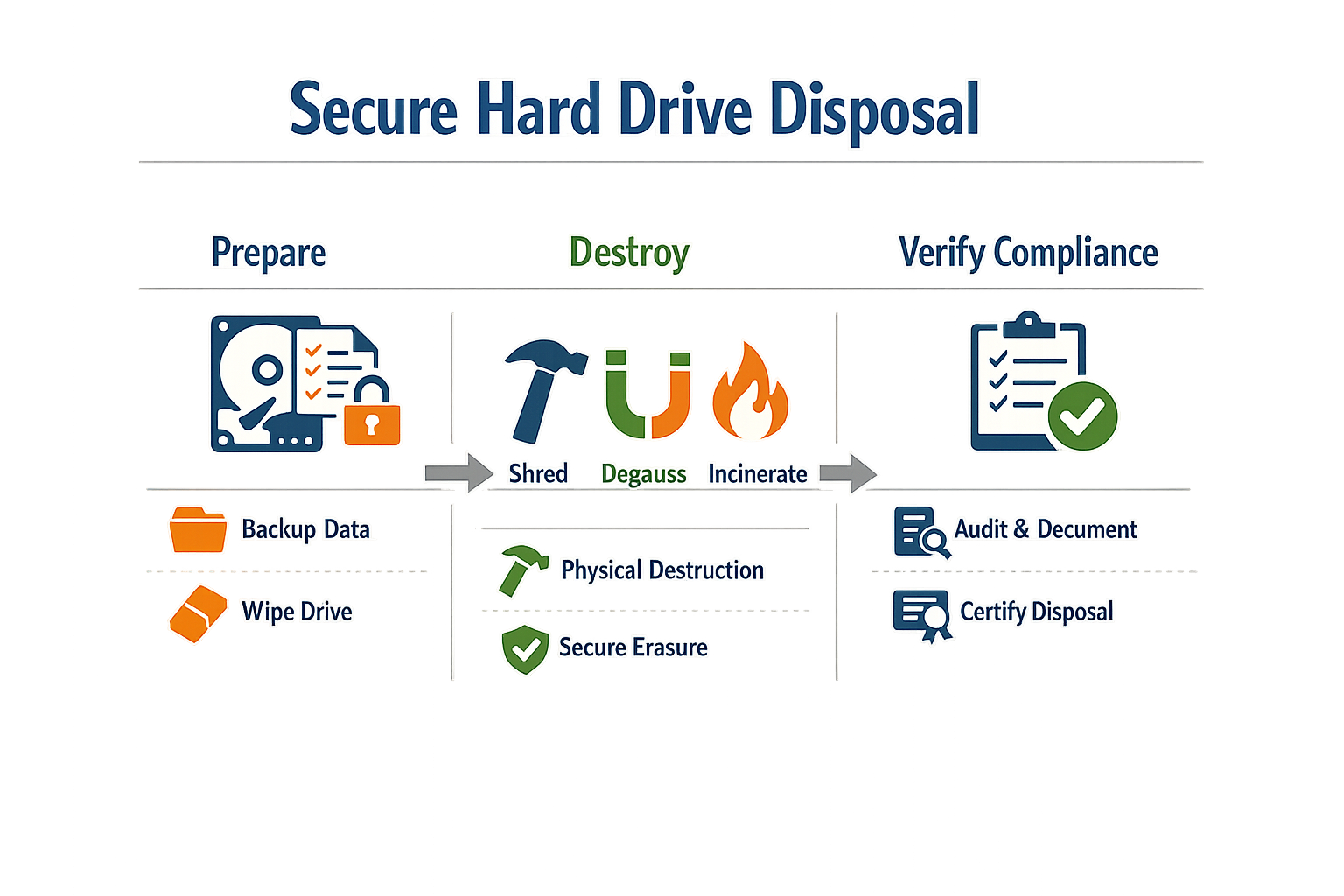
The compliance-driven process for secure hard drive disposal requires a documented chain of custody from the moment an asset is identified for retirement through final destruction. Each step below addresses a control point that regulators expect to see in a post-incident review.
Step 1: Inventory and Classification
Step 1
Document every asset before disposal
Catalog each hard drive by serial number, asset tag, and data classification. Record the system it was removed from, the date of removal, and the name of the individual who performed the removal. This inventory becomes the baseline for chain-of-custody tracking.
For drives that processed regulated data — ePHI under HIPAA, cardholder data under PCI DSS, student records under FERPA — flag them in the inventory with the applicable regulation. The data classification determines the sanitization method required.
Step 2: Select the Sanitization Method
NIST SP 800-88 Rev. 2 defines three sanitization categories: clear, purge, and destroy. The method you select depends on the confidentiality level of the data and whether the drive will be reused, resold, or physically destroyed.
| Method | Use Case | Recovery Effort |
|---|---|---|
| Clear | Internal reuse, low-sensitivity data | Protects against simple recovery |
| Purge | External reuse or resale, regulated data | Protects against laboratory-level recovery |
| Destroy | End-of-life, highest-sensitivity data | Renders media physically unusable |
For magnetic hard drives, a single overwrite pass with a fixed pattern (typically binary zeros) is sufficient for purge-level sanitization under NIST SP 800-88 Rev. 2. For self-encrypting drives (SEDs), cryptographic erase — destroying the encryption key — achieves purge-level sanitization faster than overwrite, but only if the drive was encrypted from first use and the key was never escrowed outside the device.
Step 3: Execute Sanitization with Verification
Step 3
Run the sanitization process and verify completion
Use NIST-compliant software for overwrite sanitization or the manufacturer's secure-erase command for cryptographic erase. After the process completes, verify effectiveness by reading pseudorandom locations on the drive and comparing the results to expected values. Document the verification method, the software version, and the completion timestamp.
The verification step is what separates audit-defensible sanitization from a process that merely claims to have run. In our editorial review of vendor methodologies, the verification step — not the sanitization method itself — is where the documentary record most often fails.
Step 4: Physical Destruction (if Required)
For drives that cannot be sanitized (failed drives, drives with unknown encryption status, or drives containing data classified for destruction rather than purge), physical destruction is the only compliant path. NAID AAA Certification defines the operational standard for witnessed destruction.
Step 4
Witness and document physical destruction
Physical destruction methods include shredding (reducing the drive to particles smaller than 2mm), crushing (deforming the platters to prevent read-head alignment), or disintegration. The destruction must be witnessed, and the certificate of destruction must reference the serial numbers from the pre-destruction inventory.
The cheapest vendor is the one whose paper trail you trust enough to hand the auditor without flinching.
Step 5: Obtain and Retain the Certificate of Destruction
The certificate of data destruction is the operator's primary documentary defense in a post-incident regulatory review. It must include:
- Serial numbers of all destroyed drives (matching the pre-pickup inventory)
- Date and location of destruction
- Destruction method and applicable standard (NIST SP 800-88 Rev. 2, NAID AAA)
- Name and signature of the individual who witnessed the destruction
- Vendor certification credentials (R2v3, e-Stewards, NAID AAA)
Retain the certificate for the full regulatory retention period — seven years for HIPAA, indefinitely for certain PCI DSS obligations.
Step 6: Audit the Chain of Custody
After disposal is complete, reconcile the certificate of destruction against the pre-pickup inventory. Every serial number that left your facility must appear on the certificate. Any discrepancy — a missing serial, a transposed digit, a drive that left but was not destroyed — is a chain-of-custody failure that must be investigated and documented.
The Morgan Stanley case is canonical because the failure was not in destruction methodology — it was in the chain-of-custody documentation that should have survived the auction and didn't. The regulatory penalty was $100M+ cumulative, and the failure mode was entirely preventable with serialized reconciliation.
Troubleshooting Common Issues
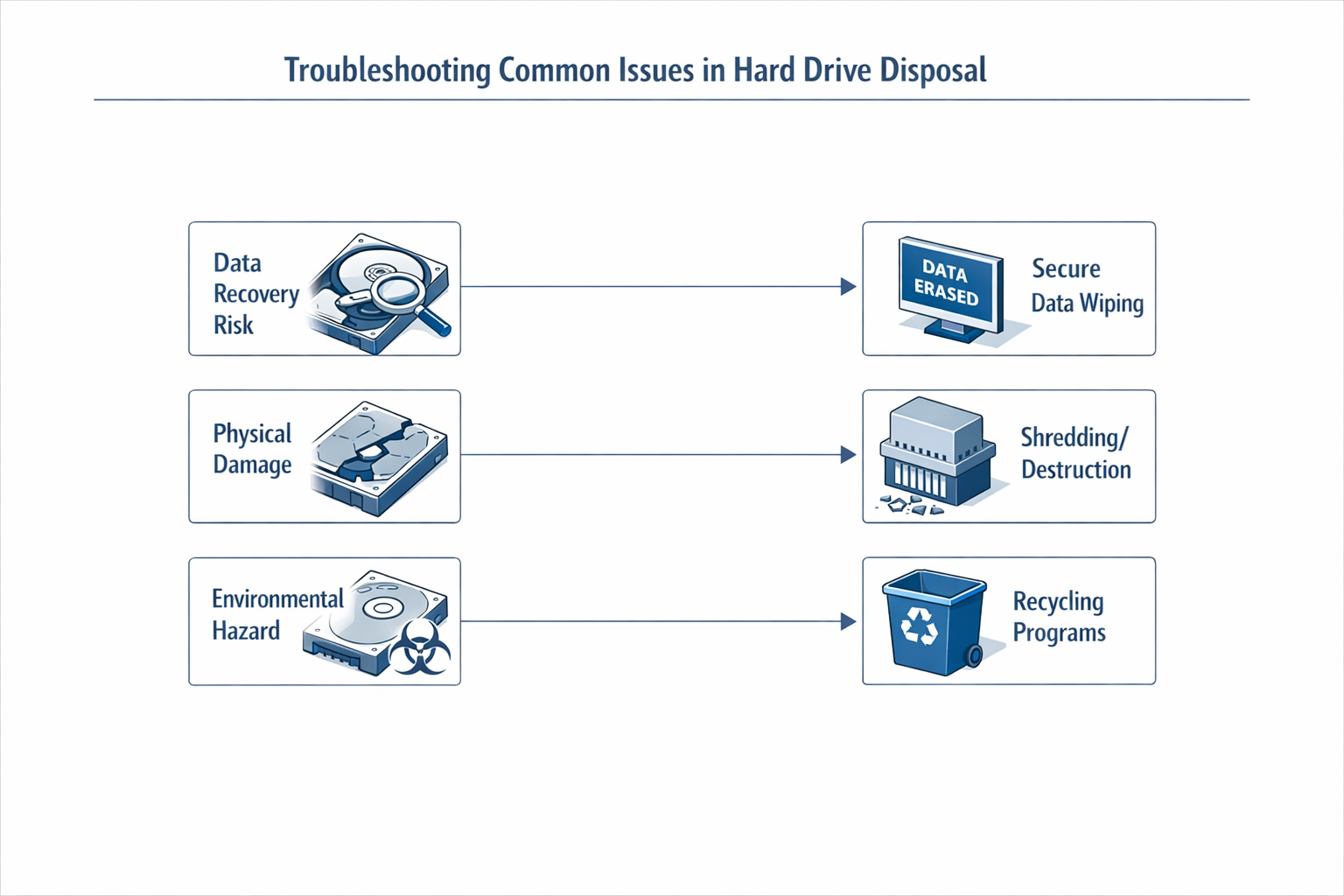
The disposal process rarely runs without friction. The most common failures fall into three categories: documentation gaps that surface in audit, destruction methodology mismatches between what was contracted and what was performed, and chain-of-custody breaks during transport. Each of these has a known fix, but the fix must be applied before the certificate is issued — not after the auditor asks the question.
Incomplete or Mismatched Certificates
The certificate of destruction is the documentary record that survives audit. In our editorial review, we noticed the same pattern in twenty-two vendor profiles: the certificate referenced in marketing material was structurally different from the certificate referenced in the vendor's published methodology. The failure mode is predictable — the certificate lists a batch identifier but not individual serial numbers, or it references a destruction method that does not match the method performed.
The fix: require the vendor to provide a sample certificate during the RFP process. Compare the sample to the methodology published in the vendor's certification documentation. If the two do not align, escalate the question before the contract is signed. After pickup, verify that the final certificate matches the sample format and includes all required fields — serial numbers, destruction method, date, witness signature if contracted, and the certification body's reference standard.
Cryptographic Erase Failures on Self-Encrypting Drives
Cryptographic erase is a fast and effective sanitization method when the encryption key is managed correctly and the drive's firmware is trustworthy. The failure mode is also well-documented: if encryption was enabled after sensitive data was stored on the device without prior sanitization, or if the encryption key exists outside the storage device due to backup or escrow, cryptographic erase does not render the data infeasible to recover.
The fix: before selecting cryptographic erase as the sanitization method, verify that the drive was encrypted from first use and that no key escrow or external key management system retains a copy of the encryption key. If either condition is uncertain, default to physical destruction or NIST 800-88 Rev. 2 overwrite methods. For verification, read pseudorandom locations before and after the cryptographic erase process and compare the results to confirm that data has been sanitized.
Chain-of-Custody Breaks During Transport
The Morgan Stanley case is canonical because the failure was not in destruction methodology — it was in the chain-of-custody documentation that should have survived the auction and didn't. Hard drives were transported in their original cabinets, sold to a downstream processor with drives still in place, and the serialized record of what left the data center did not match what was destroyed. For more on the broader context of data destruction standards, see NAID AAA Certification: The Data Destruction Standard Explained.
The movement of hard drives without proper disposal procedures can lead to data security risks, as evidenced by the sale of shelves with drives still present.
The fix: require lockable transport with GPS tracking and a serialized manifest that lists every asset by serial number, location, and data classification. At pickup, the manifest is signed by both the releasing operator and the transport driver. At the destruction facility, the manifest is signed again before destruction begins. The certificate of destruction must reference the same manifest and the same serial numbers. If any asset on the manifest is not listed on the certificate, the disposal event has a gap that will not survive audit.
Downstream Subcontracting Without Disclosure
The vendor you contracted may not be the operator who performs the destruction. In our review of vendor profiles, undisclosed downstream subcontracting was a recurring gap — the contract referenced one facility and one set of certifications, but the actual destruction occurred at a different facility with different credentials. The failure mode is straightforward: the certificate references a destruction method and a certification body, but the facility that performed the work does not hold the certification.
The fix: during the RFP process, ask the vendor to disclose all downstream processors and their certifications. Require the vendor to provide written confirmation that no subcontracting will occur without prior approval. In the contract, include a clause that voids the certificate if destruction occurs at an undisclosed facility. After destruction, verify that the certificate lists the facility name and address, and cross-reference that facility against the vendor's published list of certified locations.
Conclusion
Secure hard drive disposal is not a technical problem — it is a documentary and procedural problem that becomes technical when the documentation fails. The compliance-driven process described in this guide addresses the failure modes that appear in regulatory enforcement actions: missing chain-of-custody records, certificates that do not match the destruction method actually performed, and subcontractor relationships that were never disclosed to the enterprise customer.
In our editorial review of 35 vendor profiles, we noticed the same pattern in twenty-two of them: the certificate of data destruction referenced in marketing material was structurally different from the certificate referenced in the vendor's published methodology. The Morgan Stanley case is canonical because the failure was not in destruction methodology — it was in the chain-of-custody documentation that should have survived the auction and didn't. The $100M+ cumulative cost came from the documentary gap, not from a technical failure in the destruction process itself.
The pre-pickup inventory, the serialized asset tracking, the lockable transport with GPS monitoring, the witnessed destruction compliant with NAID AAA and NIST 800-88 Rev 2, and the final certificate tied to specific serial numbers — these are the controls that survive audit. The vendor you select must deliver all of them, and the contract language must require all of them, because what is not required in the contract is not enforceable in the post-incident review.
For organizations bound by HIPAA, PCI DSS, FERPA, and GDPR, the compliance requirement is not negotiable. The FTC Disposal Rule requires that disposal companies be certified by a recognized third party and that due diligence includes reviewing independent audits of the disposal company's operations. The NAID AAA Certification standard addresses both physical and electronic media destruction with endorsements for mobile and facility-based operations, and certified providers support compliance with FACTA, HIPAA, and PCI through audited safeguards from handling through final destruction.
The process outlined in this guide is operator-grade. It is designed to produce the documentary record that holds up in discovery, in regulatory review, and in the internal audit that happens before either of those events. Execute it as written, require it in the contract, and verify it in the certificate. That is how you dispose of a hard drive securely in a compliance-driven environment.
Frequently asked questions
What does it mean to dispose hard drive securely?
To dispose hard drive securely means to sanitize or destroy storage media using NIST 800-88 Rev. 2 compliant methods — overwrite, cryptographic erase, or physical destruction — with serialized chain-of-custody documentation that survives regulatory audit.
How do I dispose hard drive securely if it contains HIPAA-regulated data?
When you dispose hard drive securely under HIPAA, you must catalog each drive by serial number, select a purge or destroy sanitization method, use a NAID AAA certified vendor, maintain chain-of-custody logs, and retain the certificate of destruction for seven years.
Can I dispose hard drive securely with software-only methods?
You can dispose hard drive securely with software overwrite for magnetic drives or cryptographic erase for self-encrypting drives, but only if the drive is functional and the method is verified. Failed drives require physical destruction.
What documentation do I need to dispose hard drive securely?
To dispose hard drive securely, you need a pre-pickup inventory with serial numbers, a chain-of-custody log signed at each transfer, and a certificate of destruction listing the sanitization method, date, location, and witness signature.